Swim workouts that actually do something
Most people who swim for fitness do the same thing every session: get in, swim lengths until bored, get out. It works for about six weeks and then stops. What follows is how a session is structured, why each part is there, and three complete workouts you can take to the pool tomorrow.
The anatomy of a session
Every well-built swim session has the same four parts, and skipping any of them changes what the session does:
- Warm-up. Not a formality. Swimming is the only endurance sport where you are horizontal and your face is in the water, and both take a few hundred metres to settle. A cold main set is a slower main set.
- Activation or drill. Short, fast, or technical. Wakes up the stroke rate before a hard set, or isolates one fault before an easy one.
- Main set. The reason the session exists. It should have a single purpose you could state in one sentence.
- Swim-down. Two hundred metres of easy swimming. It costs five minutes and is the difference between arriving at the next session fresh or flat.
Pick the intensity before you pick the distance
“Swim hard” is not an instruction. The zones below come from your Critical Swim Speed, which you get from two time trials — and once you have it, every set has a number attached instead of a feeling.
| Zone | % of CSS | What it is for | Typical set |
|---|---|---|---|
| Recovery | 70 % | Flushing between hard sets and on easy days. Should feel almost lazy. | 200–400 m continuous, or the swim-down after a threshold set |
| Endurance 1 | 80 % | Aerobic base. The pace you can hold while still thinking about technique. | 8 × 200 m on a generous send-off |
| Endurance 2 | 88 % | Aerobic capacity. Steady work, breathing hard but controlled. | 5 × 400 m with 30 s rest |
| Threshold | 95 % | The zone that actually moves CSS. Sustainable but uncomfortable. | 10 × 100 m at CSS + 2 s, 15 s rest |
| VO₂max | 105 % | Maximum aerobic power. Short, hard, expensive — use sparingly. | 8 × 50 m at CSS − 3 s, 30 s rest |
The common failure is spending every session somewhere between Endurance 2 and Threshold: too hard to build a base, too easy to move the threshold. Going genuinely easy on easy days is what makes the hard days work.
Three complete sessions
Technique session — ≈ 1,600 m
Any level. This is the one most adult swimmers skip and most need.
| Part | Set |
|---|---|
| Warm-up | 300 easy, alternating 50 freestyle / 50 backstroke |
| Drill | 6 × 50 as 25 drill / 25 swim, 15 s rest — pick one fault, not four |
| Main | 8 × 50 counting strokes, holding the same count, 20 s rest |
| Main | 4 × 100 easy with one thing to think about per 100 |
| Swim-down | 200 easy |
Threshold session — ≈ 2,200 m
Once you have a CSS pace. This is the session that moves it.
| Part | Set |
|---|---|
| Warm-up | 400 mixed, building the last 100 |
| Activation | 8 × 25 fast, 20 s rest |
| Main | 10 × 100 at CSS pace, 15 s rest — the last one should be the same speed as the first |
| Recovery | 200 easy |
| Main | 4 × 50 at CSS − 3 s, 30 s rest |
| Swim-down | 200 easy |
Aerobic session — ≈ 2,400 m
Building the base. Boring on purpose — the effort stays honest and steady.
| Part | Set |
|---|---|
| Warm-up | 400 easy |
| Main | 3 × 400 at Endurance 2 pace, 30 s rest |
| Main | 4 × 100 descending 1–4, 20 s rest |
| Swim-down | 200 easy backstroke |
Choosing the send-off
The interval — the send-off — is what turns a list of repeats into a set. Work backwards from the rest you want, not forwards from a round number:
- Take your target pace for the repeat. The pace calculator converts a target time into per-repeat splits.
- Add the rest the set is supposed to give: 10–15 s for threshold, 30 s+ for speed.
- Round up to the nearest five seconds so you can read the pace clock.
If you are finishing with 40 seconds of rest on a threshold set, the send-off is wrong and the set is no longer a threshold set. If you are touching and going, the same.
A week that works
For three sessions a week: one technique, one threshold, one aerobic. For four, add a second aerobic session rather than a second hard one — the most common mistake among motivated adult swimmers is two or three hard sessions a week and no easy ones, which produces a plateau and a sore shoulder at roughly the same time.
Retest CSS every six to eight weeks and rewrite the paces. Training to a threshold you passed two months ago is the quietest way to stop improving. And when the numbers stop moving despite the training being right, the limit is usually the stroke — that is what the technique section is for, and the SWOLF check will tell you which it is.
Guides in this section
Calories burned swimming: 170 to 540 in half an hour
Thirty minutes of freestyle costs 174 to 539 kcal depending on weight and pace. The published MET values, the arithmetic, and the 20% overestimate inside every calculator.
Lane etiquette: how to share a crowded lane without being the problem
Which way to circle in the US, Britain and Australia, picking a lane by seconds per length, the 5-second gap, passing and resting — and where the published rules disagree.
Swim paddles and fins: what they train and when they cost you
Paddles lower your training load at steady speed and a four-week block changed nothing; fins raise energy cost. What the measurements say and how to use both.
Wetsuit for open water swimming: when you actually need one
The water temperatures at which World Aquatics, U.S. Masters Swimming and USA Triathlon require or ban wetsuits, what a suit does to your body, and how to measure it.
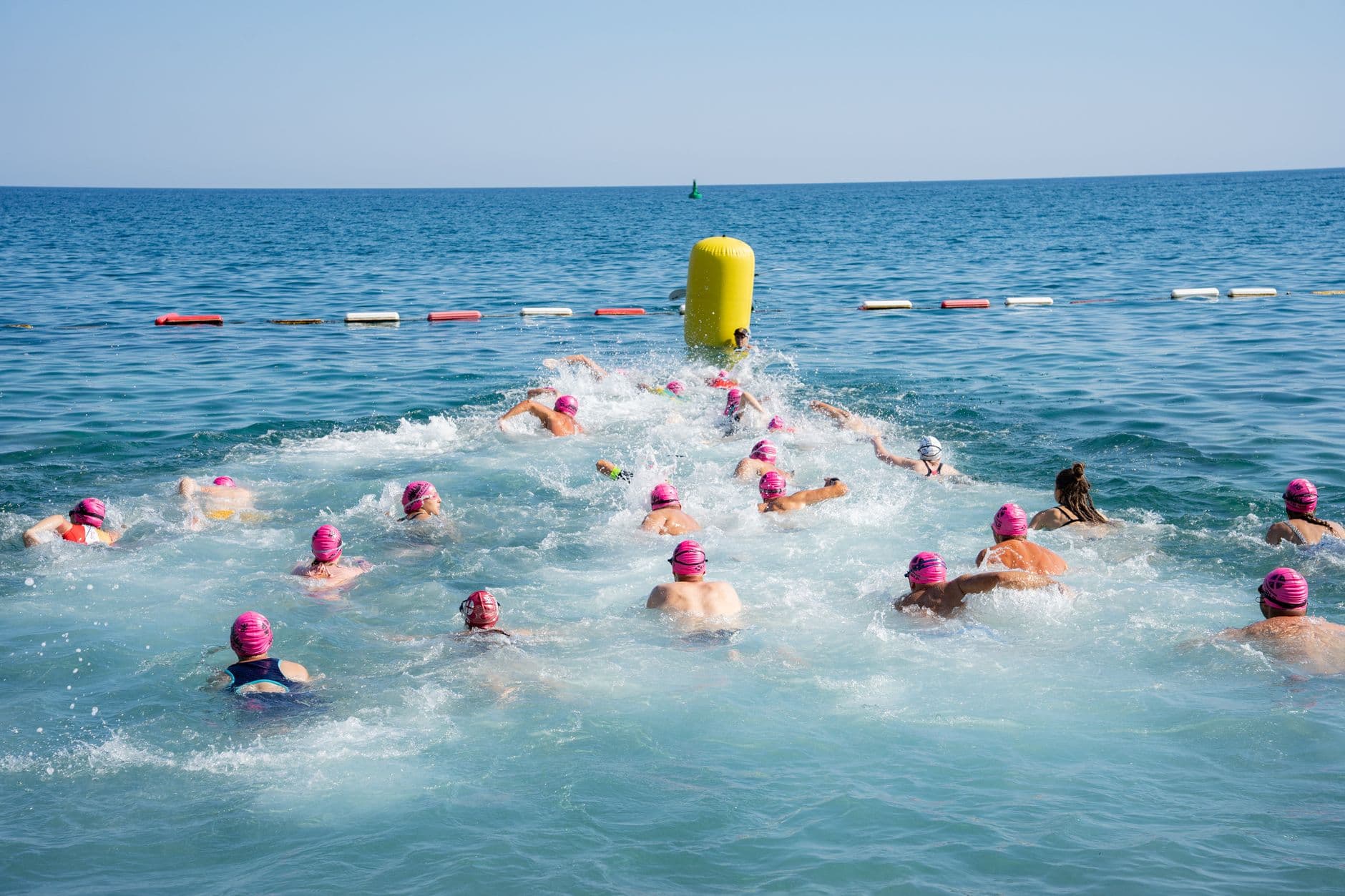
Your first open water swim: what nobody warns you about
The cold-water gasp, the fact that you cannot judge your own condition once acclimatised, and why a strong pool swimmer can be in trouble in twenty minutes.
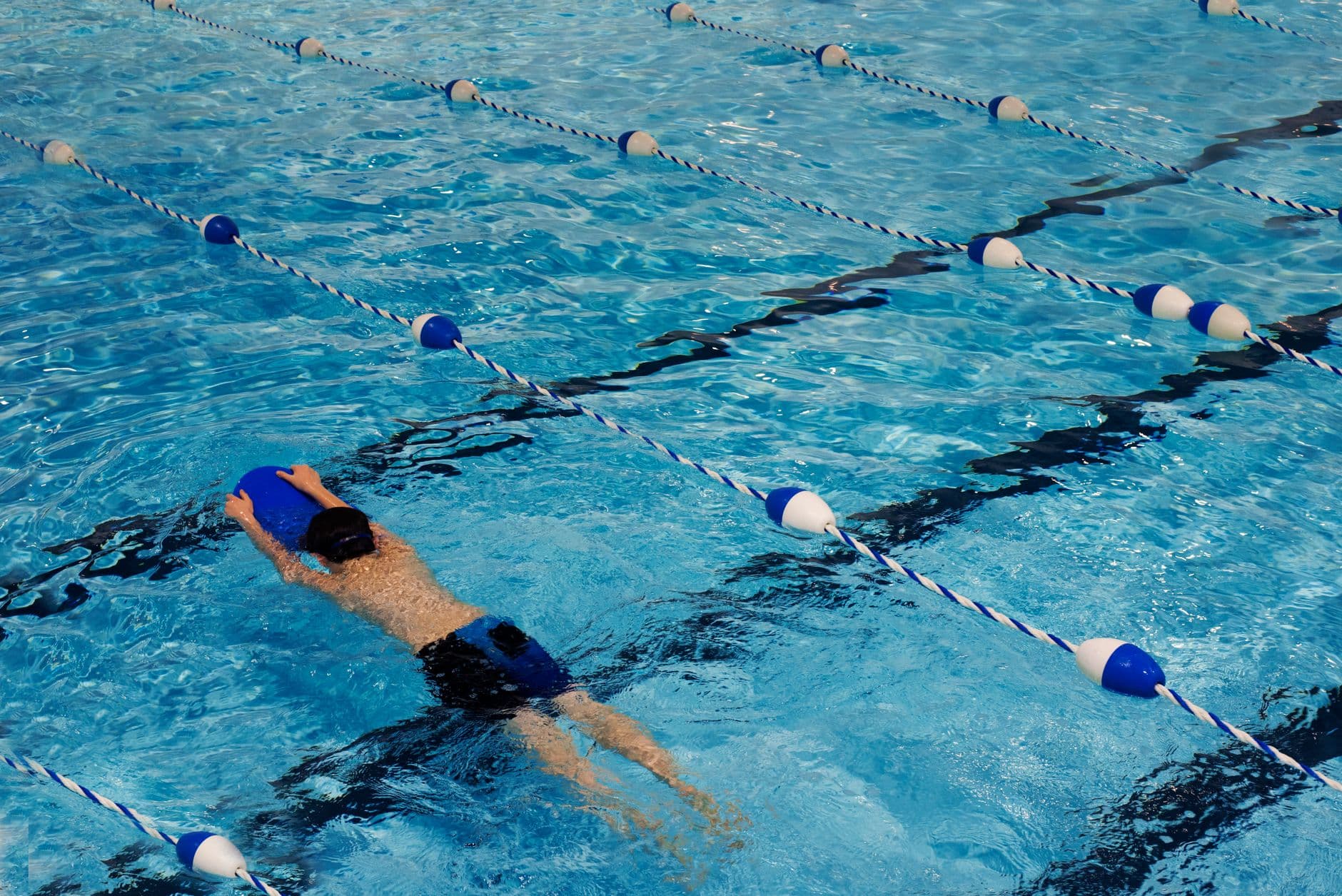
Is kickboard work worth it? What the kick set is really training
The legs contribute roughly 30% of front crawl propulsion but a much larger share of the oxygen cost. That is the honest case for and against kick sets.
Should you swim every day? What frequency actually does
Swimming is a skill sport with no impact, which changes the usual answer. Frequency helps the skill; the limit is your shoulders, not your legs.
500-yard swim: how long it takes, and how to do it without stopping
A 500-yard swim is 20 lengths of a 25-yard pool: 10:00 at 2:00 per 100, 12:30 at 2:30. The published time standards, and the fix for stopping short.
The swim warm-up: what it is for and how short it can be
Most adult swimmers either skip it or swim a slow 400 out of habit. Neither does what a warm-up is supposed to do, and both cost you the first ten minutes of the session.
CSS pace: the one number that makes your sets make sense
Critical swim speed turns two time trials into a training pace, so you stop guessing how hard a set should feel and start swimming to a number.
Triathlon swim training: what changes with no wall to push off
A pool 1,500 has 59 push-offs and a triathlon 1,500 has none. What that removes, what open water adds, and the World Triathlon rules that decide your race.
How many laps is a good swim workout? 40 to 80 lengths
Roughly 40 to 80 lengths of a 25-yard pool, or 20 to 45 minutes of actual swimming. The arithmetic by pace, the 30-lap case, and why a lap is not a length.
How to build swim endurance when you can barely finish a length
Gassing out after two lengths is usually an efficiency problem, not a lung problem. How to tell which you have, plus an eight-week fix built on your own paces.
Swim workouts for beginners: four sessions, not just laps
Four complete beginner swim sessions, 900 to 1,300 m, with the rest written in. Each block says what it measures and exactly when to make it harder.
Frequently asked questions
How far should a beginner swim in one session?
Between 800 and 1,200 m including warm-up and drills is plenty for the first month, and it should be broken into short repeats rather than swum continuously. Volume is the easiest thing to add later and the easiest thing to get injured by early — shoulders adapt far more slowly than lungs do.
How do I know what interval to use?
Work backwards from the rest, not the send-off. Decide how much rest the set is supposed to give — 10 to 15 seconds for a threshold set, 30 or more for a speed set — then add it to your target pace for the repeat and round up to the nearest five seconds. A set where you touch and go is a different set from the one you wrote.
How many times a week should I swim to improve?
Twice a week maintains, three times improves, four or more improves quickly if the sessions are not all the same. The single biggest predictor of progress in adult swimmers is frequency rather than session length: three sessions of 45 minutes beats two of 90 by a wide margin, because swimming is a skill and skills decay between sessions.
Should I use paddles and fins?
Fins, yes — they let you hold a good body position long enough to learn what it feels like, which is exactly what a beginner needs. Paddles, later and carefully: they multiply the load on a shoulder that is usually the first thing to complain in adult swimmers, and they will happily reinforce a bad catch at higher force.
Sources
- Wakayoshi K. et al. (1992) — critical velocity as an index of swimming performance — European Journal of Applied Physiology
- Workout library and coaching articles — U.S. Masters Swimming
SwimFast is an independent publication. We are not a swim school, a coaching service or a governing body, and nothing here is medical advice. Training paces and test protocols are cited from the published research or federation documents linked on each page. Never swim alone, never attempt breath-hold work without supervision, and check with a doctor before starting a new training programme.