Triathlon swim training: what changes with no wall to push off
A pool 1,500 has 59 push-offs and a triathlon 1,500 has none. What that removes, what open water adds, and the World Triathlon rules that decide your race.
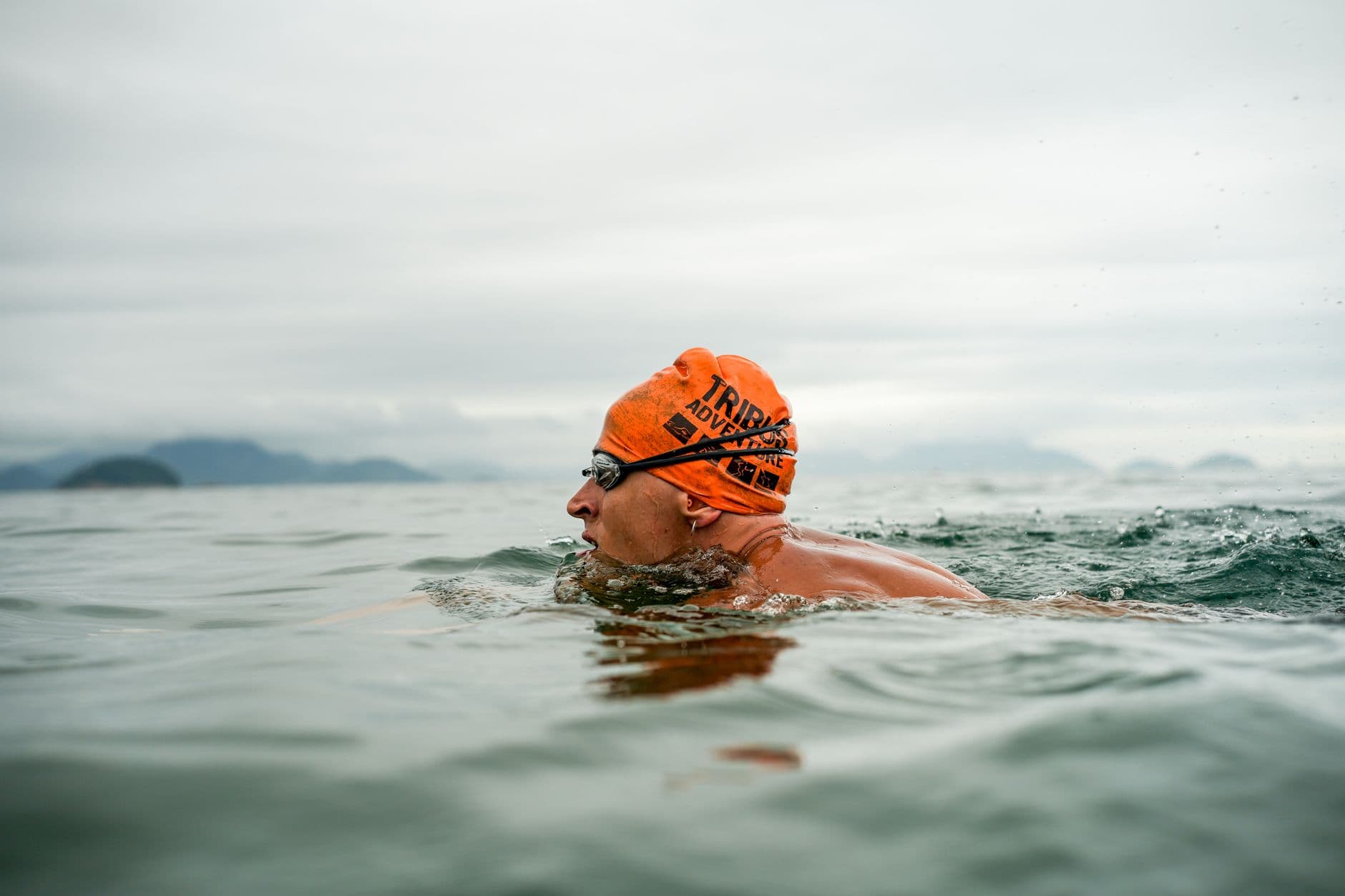
A 1,500 m triathlon swim and a 1,500 m pool swim share a number and almost nothing else. Swum in a 25 m pool, that distance contains 59 push-offs. Swum in a 50 m pool it contains 29. Swum around a set of orange buoys in a lake, it contains none at all — and everything that follows comes from that one missing input.
Most triathlon swim advice is written as if the problem were fitness. Usually it is not. The problem is that a pool swimmer has built a stroke around a rhythm of work and free speed, and open water quietly removes the free speed while adding three jobs nobody trains: navigating, sitting in someone else's water, and swimming in a suit that changes where the body floats.
Count the walls you are about to lose
Start with the arithmetic. A wall gives you two things: a push-off that is faster than any stroke you own, and a moment of rest inside a continuous effort. In a 25 m pool a 1,500 hands you both of those 59 times.
The scale of the free speed is not small. The men's 1500 m freestyle world record — 14:26.79, set by Johannes Liebmann at the 2026 European Championships — averages 1.73 m/s, and a competent push-off leaves the wall faster than that. Every push-off is speed you did not generate with your arms.
You can watch the same effect in reverse on our course time converter: the reason one swimmer posts a quicker time in a 25 m pool than in a 50 m pool is walls, and the converter shows the turn count beside the conversion. Open water is the far end of that scale, the course with zero turns.
If your turns are currently the strongest part of your race, read that as a warning rather than a compliment. Our guide to the flip turn exists because turns are worth a great deal in a pool. In a triathlon they are worth nothing at all.
The session changes shape before the training does
The practical consequence is that a triathlete's pool session should stop looking like a swimmer's. A set of 15 × 100 with 20 seconds rest is fifteen restarts and fifty-nine push-offs. The race has none of either.
Not every session becomes a long slog, but the long unbroken swim becomes the specific session of the block: 800, 1,000 or 1,500 m straight, held at a pace chosen in advance rather than one you drifted into. Everything in our guide to building swimming endurance applies, with one change of emphasis — here the continuous swim is not the warm-down, it is the point.
A useful halfway house is the broken-but-not-really set: 3 × 500 with 15 seconds rest, or 5 × 300 with 10. Short enough rest that the effort stays continuous, long enough to hold the pace honestly. For total session volume, how many laps make a good swim workout covers the general case.
How long is the swim in a triathlon
Under World Triathlon rules a sprint triathlon swim is 750 m and a standard, or Olympic, triathlon swim is 1,500 m. Super-sprint races use 250 to 500 m, middle distance runs 1,900 to 2,999 m, and long distance 3,000 to 4,000 m — the band that contains the familiar 3,800 m. Relay legs are 250 to 300 m per athlete.
To turn any of those distances into a time, the triathlon swim calculator projects the split from a pool pace and itemises every correction.
| Format | Swim | Bike | Run |
|---|---|---|---|
| Relay leg, per athlete | 250–300 m | 5–8 km | 1.5–2 km |
| Super-sprint | 250–500 m | 6.5–13 km | 1.7–3.5 km |
| Sprint | 750 m | 20 km | 5 km |
| Standard (Olympic) | 1,500 m | 40 km | 10 km |
| Middle | 1,900–2,999 m | 80–90 km | 20–21.9 km |
| Long | 3,000–4,000 m | 91–200 km | 22–42.2 km |
Distances from Appendix A of the World Triathlon Competition Rules, edition dated 13 December 2025. Independent race series set their own distances, inside or outside these bands; check your own race's athlete guide.
Notice how wide those bands are. "Middle distance" covers 1,900 to 2,999 m, a range of 58%. Train for your race's number, not for its category.
Sighting: what lifting your head actually costs
Sighting is the job with no pool equivalent. Every few strokes you lift your eyes to find the next buoy, and every lift drops the hips.
The honest state of the evidence is that nobody has measured the cost of race sighting directly, but head position has been measured. Cortesi and Gatta towed ten experienced swimmers underwater at 1.5, 1.7 and 1.9 m/s in three head positions. With the arms extended overhead, moving the head from up to down or neutral cut passive drag by 10.4 to 10.9%. With arms alongside the body the difference was 4 to 5.2%.
That study measured passive towing rather than swimming, so treat the figure as an indication of scale, not as a sighting cost you can bank. What it establishes is that head position is not a detail: if lifting the head raises drag by something like a tenth for the duration of the lift, a swimmer sighting every four strokes across 1,500 m pays that tax several hundred times.
The same mechanism explains a problem that is not unique to open water. Our guide on why legs sink is largely a guide about head position; open water just forces the fault on you at regular intervals.
How to pay less for sighting
Three things reduce the bill, and none of them is "sight less often" — swimming forty extra metres because you drifted off line costs far more than the sighting would have.
- Lift only the eyes. Waterline at the goggles or just below, forehead still wet. A full head-and-chin lift is what drops the hips.
- Attach the sight to a breath. Eyes forward, then roll straight into the normal breathing rotation to the side. One head movement doing two jobs.
- Sight in pairs. Two quick looks on consecutive strokes beat one long look, because a wave will hide the buoy on roughly half of your attempts.
Breathing to either side matters more here than in a pool: wind, sun and the field decide which side is available on the day, and a swimmer with only one will spend the race breathing into chop. That is the practical argument for bilateral breathing.
Drafting is the largest legal gain in the sport
Drafting on the bike is banned in most age-group racing. Drafting in the swim is not, and it is the biggest free saving available to you.
Chatard and Wilson had eleven swimmers perform four-minute flume swims at 95% of their best 1500 m pace, alone and then directly behind a lead swimmer at four separation distances. Oxygen uptake, heart rate, blood lactate, perceived exertion and stroke rate all fell in every drafting position, while stroke length rose.
| Position | Passive drag | Metabolic responses |
|---|---|---|
| Directly behind, 0 cm off the leader's toes | −21% | Reduced by 11–38% |
| Directly behind, 50 cm | −20% | Reduced by 11–38% |
| Directly behind, 100–150 cm | Smaller, not statistically different | Reduced by 8–31% |
| Beside, about 100 cm to the side, 50 cm behind the hands | −6% | Not measured |
| Beside, about 100 cm to the side, 100 cm behind the hands | −7% | Not measured |
Chatard J-C and Wilson B (2003), Medicine & Science in Sports & Exercise 35(7):1176–1181. Lead swimmers were instructed not to kick, so the turbulence of a real race differs from the test condition.
Two things there are worth memorising. First, 0 cm was no better than 50 cm, so there is no reason to touch anybody's feet; half a metre back is easier to hold and less likely to start an argument. Second, even at 150 cm the authors report roughly a 10% reduction in metabolic cost. You do not have to be glued on to benefit.
Drafting beside someone, head at about their hip, returns roughly a third of the benefit — often the only position on offer in a crowded field.
The finding runs the other way in training, too. If you always swim second or third in a busy lane, you are getting an easier session than the person on the front at the same pace on the clock. Chatard and Wilson estimate the effect only disappears somewhere beyond 2.5 m of separation. Lead the lane sometimes, or leave a bigger gap.
A wetsuit buys body position, not fitness
The wetsuit is routinely misread as a fitness boost.
Toussaint and colleagues measured active drag directly in twelve swimmers using a system of instrumented underwater push-off pads, with and without a triathlon wetsuit. At 1.25 m/s, a typical triathlon swimming speed, drag fell by 14%, from 48.7 N to 41.8 N. At 1.50 m/s the reduction was 12%. The authors attribute most of it to increased buoyancy producing less frontal resistance.
What follows from a buoyancy effect is specific: the swimmers who gain most from a wetsuit are the ones whose legs sink most without one. If your body position is already flat, expect less than the headline number. And a suit that fits badly across the shoulders will cost you more in stroke restriction than it returns in drag — worth weighing if you have any history of the problems covered in our guide to swimmer's shoulder.
World Triathlon caps wetsuit thickness at 5 mm anywhere on the suit. It may cover any part of the body except the face, hands and feet, and where wetsuits are mandatory it must cover at least the torso.
When you are allowed to wear one
Wetsuit legality is decided by water temperature, and the thresholds differ by age category and by swim length. Water temperature is measured one hour before the start, at the middle of the course and at two other points, at a depth of 60 cm.
| Category | Swim length | Wetsuit forbidden | Wetsuit mandatory |
|---|---|---|---|
| Elite, U23, junior, youth | Up to 1,500 m | 20 °C and above | 15.9 °C and below |
| Elite, U23, junior, youth | 1,501 m and longer | 22 °C and above | 15.9 °C and below |
| Age group, youngest to 55–59 | Up to 1,500 m | 22 °C and above | 15.9 °C and below |
| Age group, youngest to 55–59 | 1,501 m and longer | 24.6 °C and above | 15.9 °C and below |
| Age group, 60–64 and older | All distances | 24.6 °C and above | 15.9 °C and below |
World Triathlon Competition Rules, section 4.2, edition dated 13 December 2025. Independent race organisers publish their own thresholds; these are not universal.
The gap between the elite and age-group rows is the part people miss. In 21 °C water over 1,500 m, an age-group athlete swims in a wetsuit and an elite athlete does not. Do not plan your race around what the professionals were wearing.
The swim can be shortened, or cancelled
Temperature does not only decide clothing. Under the same rules the swim distance is reduced in cold or hot water, and the swim is cancelled outright below 11.0 °C or above 33.0 °C. A 1,500 m swim can be cut to 750 m; a 3,800 m swim can be cut to 1,500 m. The decision is announced one hour before the start.
That matters for pacing: a race you trained 3,800 m for can become a 1,500 m race on the morning, and that changes the pacing plan completely. Have a plan for the shortened version before you need one.
The cut-off almost nobody trains for
World Triathlon sets a maximum time in the water for each swim length. Miss it and the race ends there. The calculator checks a projection against these limits for you. The limits are generous at the short end and much tighter at the long end than most athletes assume — below they are, converted into the pace per 100 m they actually demand.
| Swim length | Age-group limit | Pace that limit demands | Elite limit |
|---|---|---|---|
| Up to 300 m | 20 min | 6:40 per 100 m at 300 m | 10 min |
| 301–750 m | 30 min | 4:00 per 100 m at 750 m | 20 min |
| 751–1,000 m | 50 min | 5:00 per 100 m at 1,000 m | 25 min |
| 1,001–1,500 m | 1 h 10 min | 4:40 per 100 m at 1,500 m | 30 min |
| 1,501–3,000 m | 1 h 40 min | 5:16 at 1,900 m; 3:20 at 2,999 m | 1 h 15 min |
| 3,001–4,000 m | 2 h 20 min | 3:41 per 100 m at 3,800 m | 1 h 45 min |
Limits from section 4.3 of the World Triathlon Competition Rules, 13 December 2025; the 301–750 m age-group limit drops to 20 minutes when the water is 31 °C or above. The pace column is our own arithmetic from those limits. Individual races publish their own cut-offs, which are often different.
Read the last two rows again. Because the limits are set per band rather than per metre, a swimmer at the top of a band faces a far harder standard than one at the bottom: 2,999 m in 1 h 40 min demands 3:20 per 100 m, while 1,900 m inside the same band asks only 5:16. A 3,800 m swim demands 3:41 per 100 m, which is a real target rather than a formality.
Put your own numbers into the pace calculator and find out where you sit before race week rather than during it. If you have never timed a continuous long swim, how long it takes to swim 1 km gives a realistic frame, and if holding one is itself the obstacle, start at 500.
Choose your paces from a test, not a feeling
Once the walls are gone, pacing is the whole skill. The tool for it is Critical Swim Speed: swim a 400 and a 200 at full effort with a proper rest between them, and the difference between the two gives the speed you can sustain aerobically. The method comes from Wakayoshi and colleagues in 1992, simplified for pool use by Ginn.
Our CSS calculator turns those two times into a pace and five training zones. For an open-water race the number that matters is the endurance pace, held for the full race distance, with the understanding that a wetsuit usually makes you slightly quicker and sighting slightly slower. Retest every six to eight weeks. A CSS that has not moved is telling you something about your training rather than about your talent.
Measure the thing the wall used to tell you
In a pool, the clock on every wall is a feedback loop. Take it away and it becomes easy to swim the middle 800 m of a race half asleep.
The substitute is stroke count. SWOLF — seconds plus strokes for a length — catches efficiency decay that pace alone hides, because a swimmer whose stroke is falling apart usually holds the pace for a while by turning the arms over faster. Our SWOLF calculator puts a number on it. In practice: take SWOLF at the start of a long continuous swim and again at the end. A stable score means you paced it, a rising one means the first third was too quick.
The same check works outside, counting strokes between two fixed buoys. The absolute number does not matter; the drift across the swim does.
Training for open water when you only have a pool
Most of the specific work can be done in a lane.
- Long continuous swims. The single most transferable session: no rest, no clock at the wall, a pace chosen in advance.
- Sighting drills. Every fifth or seventh stroke, eyes forward to a fixed point at the end of the lane. Do it inside a normal set, not as a novelty — the sighting guide has the drill progression.
- No push-off swimming. Come into the wall, stop, turn around, start from still. Unpleasant, and the closest a pool comes to reproducing the absence of a wall.
- Lane drafting. Sit 50 cm off the feet in front for a set, then lead the same set. The difference in perceived effort is the lesson.
- Swim in the wetsuit at least twice before race day, if your pool allows it. Shoulder restriction and neck chafing are discovered, never predicted.
None of it replaces having been outside once: your first open water swim covers what to arrange and how to pick a venue.
More session structure for each of these lives in our workouts section, and the stroke work that underpins them in technique.
Any stroke is legal, and so is stopping
Yes, you can swim breaststroke in a triathlon. World Triathlon rules let athletes use any stroke to propel themselves through the water, and also allow treading water and floating. There is no rule requiring front crawl at any point in the swim.
You may also stand on the bottom, and rest by holding an inanimate object such as a buoy or a stationary boat. What you may not do is pull or push on it to make progress. Athletes may push off the ground at the beginning and end of every swim lap.
This matters more than it sounds. A swimmer who knows breaststroke and a hand on a buoy are both legal is far less likely to panic in the first 200 m, and panic is the real risk of an open-water start. Front crawl is faster. It is not compulsory.
In an emergency the procedure is to raise one arm overhead and call for assistance. Once official assistance has been given, the athlete must retire from the race. Use it anyway.
Safety, and where this guide stops
Open water is not a pool with weeds in it. Two things deserve to be taken seriously.
Cold water. Sudden immersion in cold water triggers a cold shock response and, further in, cold-induced physical incapacitation. Both are described in the drowning physiology literature as precursors of collapse. Enter cold water gradually, get your face wet before you start swimming, and accept that the first two minutes will feel wrong even when nothing is wrong.
Never hold your breath in cold water, and never swim open water alone. Breath-holding during cold-water immersion can set the cold shock response and the diving response against each other. Shattock and Tipton describe this "autonomic conflict" as a plausible cause of arrhythmias and of some deaths previously attributed to drowning. No triathlon session requires breath-holding. Swim with a partner, in a supervised venue, with a tow float.
If you have a heart or respiratory condition, or you get chest pain, dizziness or breathlessness that does not settle, talk to a doctor before starting open-water training. If shoulder pain persists after swimming, see a physiotherapist. Neither question can be answered by an article.
All of the above is about a race. None of it is worth an incident in a lake in March. Build open-water exposure slowly, in supervised water, in company — and do the rest of the work where the clock and the lifeguard both live, which is still the pool. Standards for that side of it live in our times section.
Frequently asked questions
How long is the swim in a sprint triathlon?
A sprint triathlon swim is 750 m under World Triathlon rules, followed by a 20 km bike and a 5 km run. A standard or Olympic triathlon uses 1,500 m, super-sprint races use 250 to 500 m, and long distance runs from 3,000 to 4,000 m. Independent race series may vary.
Can you swim breaststroke in a triathlon?
Yes. World Triathlon rules let athletes use any stroke to propel themselves through the water, and also allow treading water and floating. You may stand on the bottom or rest by holding a buoy or a stationary boat, provided you do not pull or push on it to make progress.
How do you train for a triathlon swim without open water?
Swap broken sets for long continuous swims, add sighting every fifth to seventh stroke inside normal sets, and start some repeats from a dead stop instead of a push-off. Draft off the swimmer in front for one set and lead the next. Those four changes reproduce most of what open water demands.
Does a wetsuit make you faster in a triathlon swim?
Usually yes, mainly by lifting the hips rather than by adding fitness. Measured directly, a triathlon wetsuit cut active drag by 14% at 1.25 m/s and 12% at 1.50 m/s, most of it from increased buoyancy. Swimmers whose legs sink gain the most; an already flat body position gains less.
How close should you draft behind another swimmer?
About 50 cm behind their toes. In flume testing, 0 cm and 50 cm both cut passive drag by roughly 20%, so there is nothing to gain from touching feet. Even 150 cm back still gave around a 10% reduction in metabolic cost, and swimming beside someone returns about a third of the benefit.
Sources
- World Triathlon Competition Rules (edition of 13 December 2025) - sections 4.1 to 4.4 and Appendix A — World Triathlon
- Chatard J-C, Wilson B (2003). Drafting Distance in Swimming — Medicine & Science in Sports & Exercise 35(7):1176-1181
- Toussaint HM et al. (1989). Effect of a triathlon wet suit on drag during swimming — Medicine & Science in Sports & Exercise 21(3):325-328
- Cortesi M, Gatta G (2015). Effect of the Swimmer's Head Position on Passive Drag — Journal of Human Kinetics 49:37-45
- Wakayoshi K et al. (1992). Determination and validity of critical velocity as an index of swimming performance — European Journal of Applied Physiology
- Bierens JJ, Lunetta P, Tipton M, Warner DS (2016). Physiology of Drowning: A Review — Physiology (Bethesda) 31(2):147-166
- Shattock MJ, Tipton MJ (2012). Autonomic conflict: a different way to die during cold water immersion? — The Journal of Physiology 590(14):3219-3230
- Paris 2026: Liebmann crushes the men's 1500m world record on day six — European Aquatics
Read next
Lane etiquette: how to share a crowded lane without being the problem
Which way to circle in the US, Britain and Australia, picking a lane by seconds per length, the 5-second gap, passing and resting — and where the published rules disagree.
Swim paddles and fins: what they train and when they cost you
Paddles lower your training load at steady speed and a four-week block changed nothing; fins raise energy cost. What the measurements say and how to use both.
Wetsuit for open water swimming: when you actually need one
The water temperatures at which World Aquatics, U.S. Masters Swimming and USA Triathlon require or ban wetsuits, what a suit does to your body, and how to measure it.
SwimFast is an independent publication. We are not a swim school, a coaching service or a governing body, and nothing here is medical advice. Training paces and test protocols are cited from the published research or federation documents linked on each page. Never swim alone, never attempt breath-hold work without supervision, and check with a doctor before starting a new training programme.