Can you wear contact lenses swimming? What the eye bodies actually say
The FDA, the CDC and UK and Australian eye bodies all say take your lenses out before you swim — and the reason is not chlorine. Here is what they are worried about.
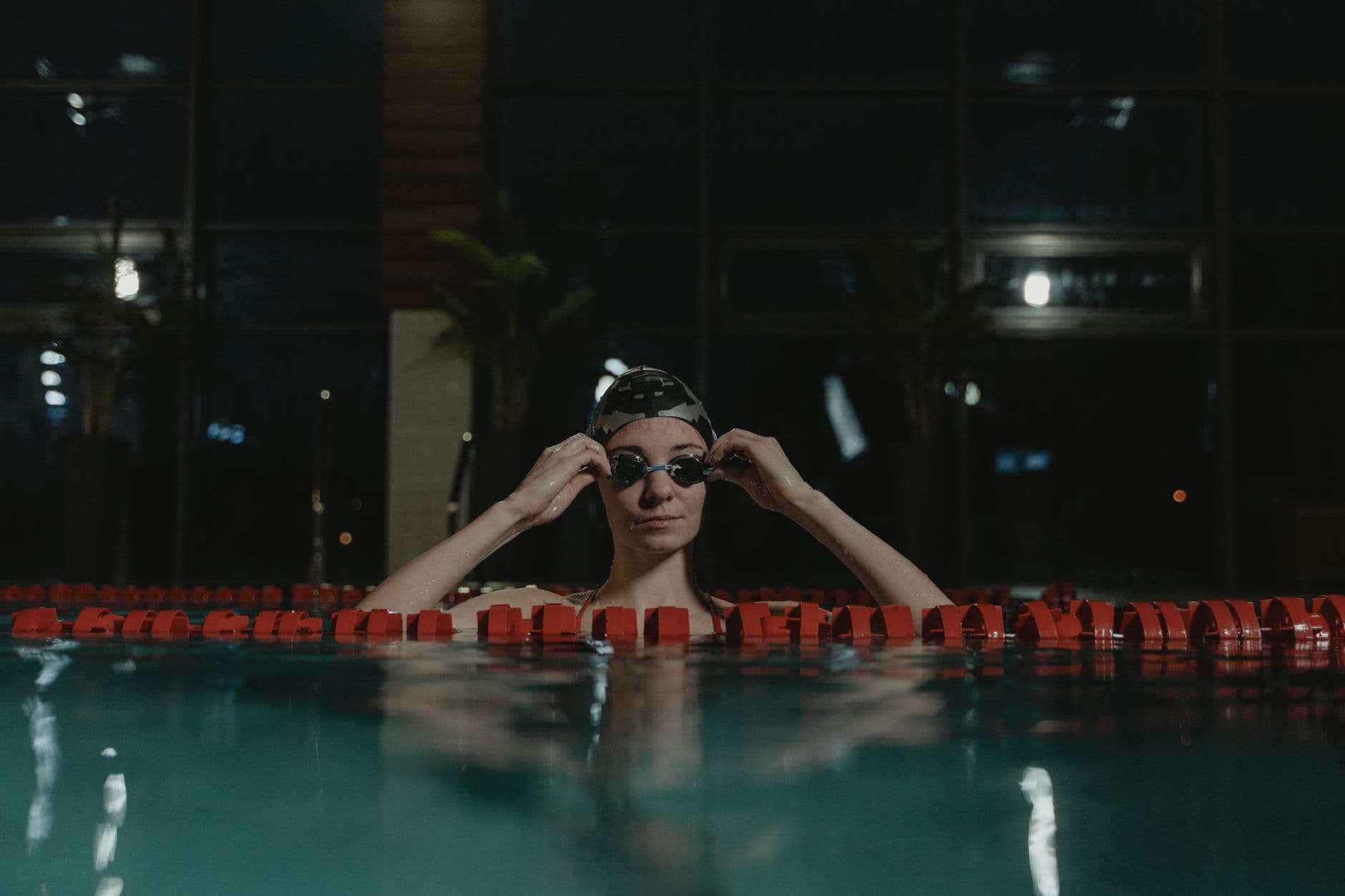
If you wear contact lenses and you swim, you have probably already worked out that nobody at the pool is going to stop you. You put them in, you pull your goggles on, and you can see the lane rope and the clock. It works. That is exactly why this question gets asked so often, and why the answer from the organisations that regulate contact lenses is so much blunter than you would expect.
Here is what they say, what they are actually worried about, and what to do instead — including the bit that almost no page on this topic bothers to mention, which is that even the official guidance is not unanimous.
The short answer, and why it is not about chlorine
No, you should not swim in contact lenses. The US Food and Drug Administration lists it under "Do Not" on its everyday contact lens care page, and on its risks page it says plainly: "Remove your contact lenses before swimming. There is a risk of eye infection from bacteria in swimming pool water, hot tubs, lakes and the ocean." The same page goes further than swimming — "Do not expose your contact lenses to any water: tap, bottled, distilled, lake or ocean water."
The US Centers for Disease Control and Prevention puts it under a heading that leaves no room to negotiate, "Keep contact lenses away from all water", followed by "Remove before swimming or showering to prevent germ exposure." Optometry Australia's patient handout has it in the "Don't" column. The UK's College of Optometrists builds its prevention advice around keeping water, and especially tap water, off lenses and lens cases.
Notice what none of them say. None of them mention chlorine, or sting, or your eyes going red. That is a different problem with a different cause, and if red stinging eyes are what brought you here, the chemistry behind it is in our guide to chlorine, your skin and your hair — the irritant is mostly chloramines, not chlorine itself. The reason the eye bodies care about swimming in lenses is an organism.
What Acanthamoeba is, and why the cyst is the whole problem
Acanthamoeba is a single-celled amoeba that lives in water. Not exotic water — Moorfields Eye Hospital, the specialist NHS eye hospital in London, lists where it is normally found: "bodies of water (lakes, oceans and rivers) as well as domestic tap water, swimming pools, hot tubs, soil and air". You meet it constantly and it does nothing to you. It becomes a problem in exactly one situation: when it gets onto your cornea and stays there.
The infection it causes is called Acanthamoeba keratitis. It is an infection of the cornea, the clear window at the front of the eye, and the College of Optometrists describes it as "a rare sight-threatening infection". The FDA's own description of it is four words long and worth reading twice: "resistant to treatment and cure".
The detail that explains everything else is that Acanthamoeba has two forms. There is the active trophozoite, which feeds and reproduces and, in the College's words, "is easier to kill". And there is the cyst, a dormant armoured form that is, again quoting the College, "much harder to destroy". The amoeba switches to the cyst when the environment turns hostile. A hostile environment is, for example, a chlorinated swimming pool.
How rare is it, really?
Rare enough that you have probably never met anyone who has had it, and serious enough that the people who treat it will not let the word "rare" do the talking. Two sets of UK figures exist, with different denominators, and it is worth keeping them apart because they get mangled online.
The College of Optometrists gives a population figure: "UK annual incidence is only 2.35 cases per million", with contact lens wearers "accounting for approximately 90% of cases". Moorfields gives a wearer figure, which is the one that matters to you: studies suggest Acanthamoeba keratitis "affects around 2 in 100,000 contact lens wearers per year in the UK". Moorfields also puts that in proportion — it is "around 20 times less than the number of daily wear soft contact lens wearers with bacterial infections". In other words, amoebae are the headline, but bacteria are the common case.
Two more things from Moorfields. UK incidence is higher than in much of the world because of how UK domestic water is stored and supplied, so a British wearer and an American wearer are not running identical risks. And since 2011, Moorfields and other centres in the UK and USA have reported a threefold increase in cases, "although it still remains rare".
What does not exist is a US rate. The CDC's current contact lens pages say there have been "multiple outbreaks" of Acanthamoeba and fungal keratitis in the US since 2006, alongside the 45 million Americans who wear lenses, but they do not publish an incidence figure. If you see a confident US number quoted anywhere, ask where it came from.
The part that makes the "rare" figure worth respecting
A one-in-fifty-thousand annual risk is the kind of number most people happily ignore. The reason to take this one seriously is not how often it happens but what happens when it does.
Moorfields reports that "a degree of permanent vision loss occurs in around a quarter of cases", and that around 25% of the Acanthamoeba keratitis cases it sees result in a corneal transplant. Treatment means intensive eye drops given day and night, often with a hospital admission. The pain can be severe — Moorfields points out that the cornea has the highest density of pain receptors in the body.
This is a page about reducing a risk, not about diagnosing anything. If you have a painful red eye, blurred vision or new sensitivity to light — particularly after swimming in lenses — that is not something to read about. Take the lenses out, keep them, and get seen today. The section below on warning signs explains why the hurry.
A chlorinated pool: lower risk, not a clean room
A properly run pool is the least hospitable of the places you might swim, and it is still not a reason to leave your lenses in. The problem is specific: chlorine at pool concentrations is not reliable against Acanthamoeba in its cyst form.
A laboratory comparison of chlorine, monochloramine and chlorine dioxide against three genera of free-living amoebae found that, of the organisms tested, "only the Acanthamoeba cysts were highly more resistant to treatment than trophozoites" — the cyst is the one that survives the disinfectant that kills the active form. A separate survey of indoor recreational water centres states the practical version outright: the amoeba "is resistant to the common chlorine concentration that used for disinfecting the swimming pool water".
That survey also gives the only measured ranking of swimming environments we could find, and it is not the ranking people expect. Across ten indoor centres in one city, Acanthamoeba turned up in six of them, and the hot tubs were worse than the pools.
One study in one city is not a global statistic, and we are not going to pretend it is. What it does establish is that the amoeba is found in chlorinated recreational water, that biofilm on surfaces is part of the story, and that the warm tub you get into after your swim is the worst place in the building to be wearing lenses.
Lakes, rivers and reservoirs
Fresh water is the scenario the warnings were written for, and it is the one where nothing is working in your favour. There is no disinfection at all, there is sediment and biofilm, and Moorfields lists lakes and rivers first among the places Acanthamoeba normally lives.
It is also, awkwardly, where lenses are most tempting. In a pool you can follow a lane line blurred; in a lake you are navigating, and sighting badly costs you real distance. That is a genuine reason to want to see, and it is exactly why the alternative further down this page matters more here than anywhere. If you are planning a first session in a lake, our guide to your first open water swim covers the rest of the kit list.
Salt water
The sea is not a free pass, and the honest answer here is more interesting than a ranking. Moorfields lists oceans alongside lakes and rivers among the waters where Acanthamoeba is found. The FDA names "the ocean" explicitly in both its "do not expose lenses to any water" list and its swimming warning. The CDC does not distinguish between pools, fresh water and sea water at all: its instruction is "all water", full stop.
So whatever intuition you have about salt being sterilising, none of the bodies that write this guidance share it. They have chosen not to rank the three environments, and the sensible reading of that is not that they have overlooked it — it is that the recommendation does not change between them, so the ranking would not help you.
Do goggles make it safe?
Goggles help, and they do not make it safe. The mechanism is simple: well-fitted goggles keep most water off your eye most of the time, and "most" is not "all". Goggles leak. They leak when you push off a wall, when a flip turn goes slightly wrong, when someone's arm catches you, and when the seal breaks for half a second at the surface. Anyone who has had to stop mid-length to empty one knows the volume involved is more than enough to carry an amoeba.
The published review of this question is careful in a way worth noticing. A 2019 review in Cornea from the School of Optometry and Vision Science at UNSW Sydney concluded that guidelines "should unequivocally advocate for the avoidance of any water exposure", and its list of what to avoid ends with "swimming with CLs without wearing goggles". Read that literally and the authors are treating goggles as meaningful mitigation rather than as nothing — which is also why you will find eye care professionals who, for an individual patient, will say goggles plus daily disposables is an acceptable compromise.
What goggles cannot do is turn a documented risk into no risk. And if your reason for wanting lenses is that you cannot see properly through fogged-up goggles anyway, fix that problem first — why goggles fog and what actually stops it is a cheaper intervention than anything on this page.
Why even the official advice disagrees with itself
This is the part that explains why you have read five pages on this question and come away unsure, and it is not your fault.
The same 2019 Cornea review set out to compare the guidance given by lens manufacturers, public health bodies and professional associations, and found that "discrepancies exist" between them. It also noted something you can verify yourself in about thirty seconds: the "widespread use of water imagery within CL marketing and packaging materials". Lens boxes have been sold with pictures of water on them while the regulator says keep lenses away from all water. The review's conclusion is that these factors "may give rise to confusion among wearers and may contribute toward risk-taking behaviors".
You can see the discrepancy in the primary documents. The FDA and the CDC give flat prohibitions. Optometry Australia's patient brochure, by contrast, lists under "Don't": "Swim in your lenses, unless we advise otherwise" — an explicit carve-out for clinical judgement about a particular patient. Neither is wrong. A regulator writing for 45 million people writes a rule; an optometrist writing a handout for a patient they have examined leaves room to be the one who decides. Which means the genuinely correct answer to "can I swim in my contacts" is that the default is no, and the only person who can give you a different answer is the one who fitted them.
Can you put your contacts back in after swimming?
If you swam without them, yes — clean dry hands, fresh solution, normal routine, and give your eyes a moment if they are irritated from the water itself. There is no waiting period in any of the guidance we checked.
If you swam in them, the honest answer is that none of the bodies above publishes a post-swim protocol — no "disinfect twice", no stated number of hours. What they do publish is the rule that makes the protocol unnecessary: the FDA's instruction is never to reuse solution or to top off a case, and the College's prevention advice is to keep water off lenses and cases entirely. Applied to a lens that has been in a pool, the only move that fits all of that is to bin it, which is an argument for daily disposables being the lens you keep in your swim bag rather than your monthlies.
And if your eyes are sore afterwards, do not reach for lenses again to find out whether it passes. Take them out, wear glasses, and read the next section.
The warning signs, and why speed matters
The FDA lists the symptoms that mean lenses come out immediately and stay out: discomfort, excess tearing or other discharge, unusual sensitivity to light, itching, burning or gritty feelings, unusual redness, blurred vision, swelling, and pain. Its instruction is to remove the lenses, not put them back in, and contact an eye care professional straight away.
For a possible Acanthamoeba infection specifically, the urgency is not a suggestion. The College of Optometrists guideline "highlights the need for contact lens wear to cease immediately and for emergency referral to hospital eye service or A&E", and says an optometrist who suspects it should refer the patient as a same-day emergency. The early picture, per both the College and Moorfields, is discomfort, redness and light sensitivity, with intense pain arriving later — so waiting for severe pain before acting is waiting too long.
Keep the lens. This is the one piece of practical advice on this page you will not find on a swimming blog, and two separate bodies give it. The FDA: "don't throw away your lenses. Store them in your case and take them to your eye care professional" — they may be used to work out what caused it. The College of Optometrists amended its guideline in April 2026 to advise patients to retain their lenses and lens case after removal, because both can be used in culture studies that decide the diagnosis and the treatment. Binning the evidence on the way to the appointment costs you days.
Separately, if what hurts is your ear rather than your eye, that is a different and much more common swimmer's complaint — see swimmer's ear.
Prescription goggles, the answer nobody leads with
The whole question dissolves if you can see without lenses, and swimming is one of the few sports where that is easy, because the optics are already sitting on your face. Prescription swim goggles exist in two forms. Ready-made ones come in fixed dioptre steps, usually the same correction in both eyes, and cost very little more than ordinary goggles. Made-to-order ones take a proper prescription, including different corrections per eye, and cost considerably more but still less than most people assume.
Two things to get right before you buy. First, a swim goggle prescription is not simply your glasses prescription — the lens sits closer to the eye and there is water involved, so ask the person who wrote your prescription which dioptre to order rather than guessing from your spectacle numbers. Second, stock goggles handle short-sightedness well and astigmatism badly; if you have significant astigmatism, ready-made ones will leave you disappointed and you want the custom route.
For a lot of lap swimmers there is also a third option worth naming, which is nothing at all. In a 25-metre pool with lane ropes and a black line on the bottom, most people need far less visual acuity than they think. If you are still at the stage of being uneasy in the water, that calculation is different and being able to see matters more — our guides to learning to swim as an adult and the rest of the technique section assume you can see the wall.
What this looks like in a real swim bag
Translated into a routine, the guidance costs you about two minutes. Lenses out before you get changed, into a case with fresh solution, case in the bag — never in a locker where it might get wet. Glasses on to walk to the pool, then goggles. Prescription goggles if you need to see, which for open water is most people. Lenses back in afterwards, with hands washed and properly dried, because the College lists handling lenses with wet hands as a risk factor in its own right. Case replaced at least every three months, which both the FDA and the CDC specify.
If you are a triathlete, the pinch point is transition, where the temptation is to swim in lenses so that you can see on the bike. The answer there is prescription goggles plus your usual glasses or a lens put in dry at transition — not an open-water swim in the lenses you then wear for four hours. Our triathlon swim training guide covers the swim itself, and if you are trying to work out how long you will actually be in the water, the triathlon swim calculator gives you the exposure time to plan around.
The bottom line
The default answer is no, and the reason is not the one most people assume. It is not that chlorine will damage your lenses or sting your eyes; it is that water of every kind carries an amoeba whose armoured form survives pool-strength chlorine, and that the infection it occasionally causes is rare but bad enough that around a quarter of cases leave permanent vision loss behind.
Goggles reduce the exposure without eliminating it. Daily disposables you bin afterwards are better than monthlies you keep. A pair of prescription goggles removes the question entirely and is the cheapest fix available. And since the official guidance genuinely is not unanimous on the edge cases, the one conversation worth having is with the optometrist who fitted your lenses — they are the only person entitled to tell you that your situation is the exception.
Frequently asked questions
Can you wear contacts swimming with goggles on?
It lowers the risk rather than removing it, because goggles leak. The 2019 Cornea review of water exposure treats goggles as real mitigation — its list of things to avoid ends with swimming in lenses without goggles — but the FDA and CDC positions have no goggle exception at all. If you swim in lenses behind goggles, use daily disposables and bin them afterwards.
What actually happens if you swim with contacts in?
Almost always nothing. The risk is cumulative exposure to waterborne organisms, chiefly Acanthamoeba, and the resulting corneal infection is rare: UK figures suggest around 2 cases per 100,000 lens wearers a year. Bacterial infections are roughly twenty times more common. The reason the warnings are so firm is severity, not frequency.
Can you wear contacts in the ocean, or is salt water safer?
None of the bodies we checked treat the sea as safer. The FDA names ocean water explicitly in both its swimming warning and its list of waters that must never touch a lens, Moorfields lists oceans among the places Acanthamoeba lives, and the CDC simply says keep lenses away from all water. The advice does not change by water type.
Can you wear contacts after swimming?
Yes, if you swam without them: wash and dry your hands, use fresh solution, and carry on as normal. There is no stated waiting period. If you swam in them, the guidance on never reusing solution and keeping water off lenses points to discarding that pair rather than storing it, which is why daily disposables suit swimmers better than monthlies.
When should I see someone about my eye after swimming in lenses?
Same day if there is pain, unusual redness, new sensitivity to light, blurred vision or discharge. Take the lenses out and keep them: the FDA says to store them in the case and bring them, and the College of Optometrists advises retaining lenses and case because they can be cultured. Early Acanthamoeba keratitis warrants emergency referral.
Sources
- Contact Lens Risks — U.S. Food and Drug Administration
- Contact Lenses: Everyday Eye Care — U.S. Food and Drug Administration
- Preventing Contact Lens-Related Eye Infections — Centers for Disease Control and Prevention
- About Contact Lenses — Centers for Disease Control and Prevention
- Acanthamoeba keratitis — Moorfields Eye Hospital NHS Foundation Trust
- Clinical Management Guideline: Microbial keratitis (acanthamoeba sp.), version 15, April 2026 — The College of Optometrists (UK)
- Arshad M. et al. (2019) — Water Exposure and the Risk of Contact Lens-Related Disease — Cornea 38(6):791-797
- Dupuy M. et al. (2014) — Sensitivity of free-living amoeba trophozoites and cysts to water disinfectants — Int J Hyg Environ Health 217(2-3):335-339
- Poor BM. et al. (2018) — Contamination of swimming pools and hot tubs biofilms with Acanthamoeba — Acta Parasitologica 63(1):147-153
- Contact lenses — patient information brochure — Optometry Australia
Read next
Why do swimmers wear two caps? To pin the goggle straps down
The second cap covers the goggle straps and stops the first one wrinkling. Two caps is explicitly legal, and two is the written maximum — here is the rule.
What age should a child start swim lessons?
The official answer is the first birthday for lessons, but babies can be in water long before that. Here is where each health body draws the line, and why it matters.
Why swimmers get disqualified: the calls officials make
A disqualification is a procedure, not an opinion. Who is allowed to call one, what goes on the slip, what the code means, and how it can be challenged.
SwimFast is an independent publication. We are not a swim school, a coaching service or a governing body, and nothing here is medical advice. Training paces and test protocols are cited from the published research or federation documents linked on each page. Never swim alone, never attempt breath-hold work without supervision, and check with a doctor before starting a new training programme.