Masters swimming age groups: the 5-year bands and where you'd place
Masters age groups run in five-year bands from 25–29 (World Aquatics) or 18–24 (USMS), age usually counted on 31 December, and a 0.6%-a-year decline behind them.
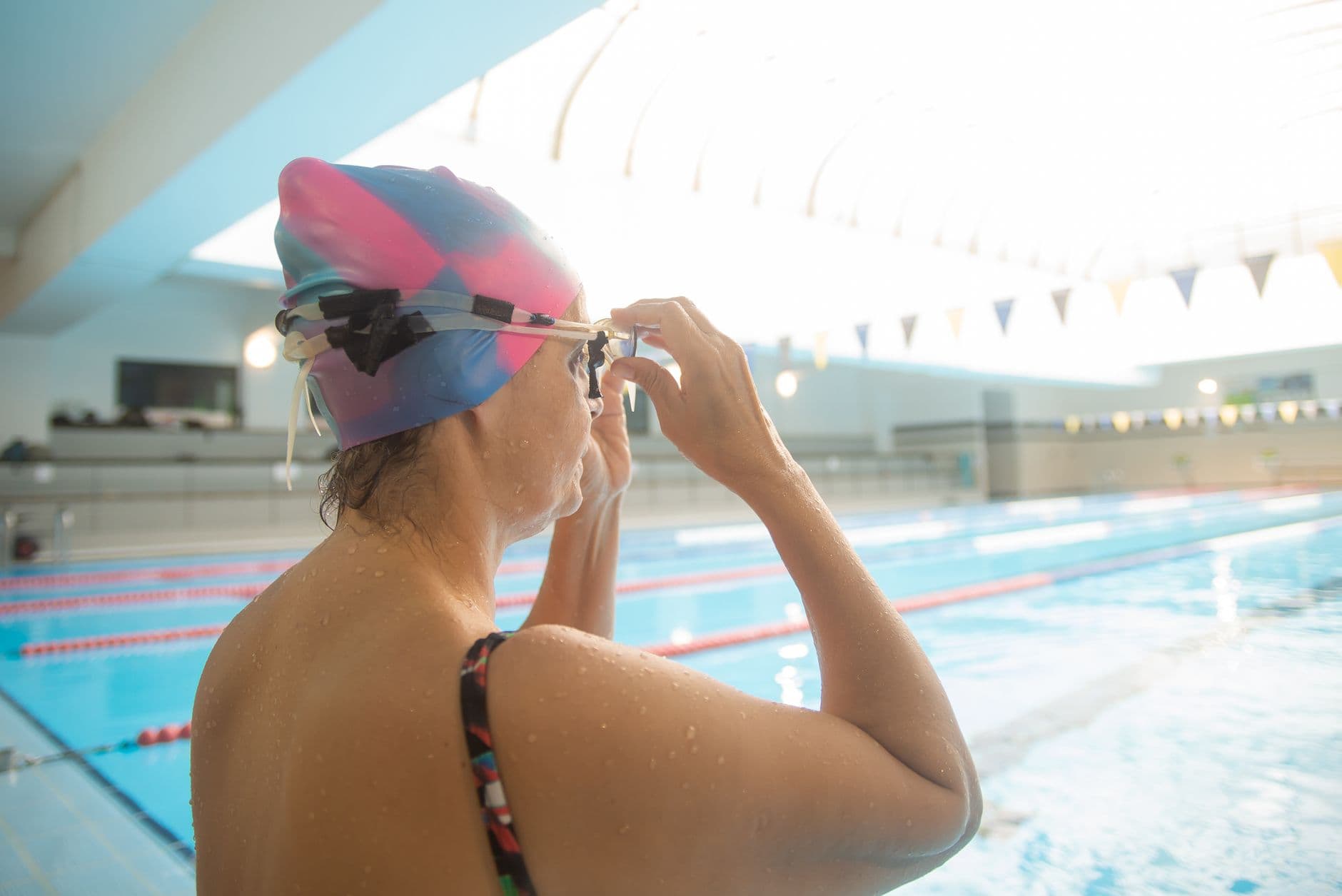
Adults who start swimming seriously in their thirties or forties eventually run into the same wall: they are getting fitter, and their times are not obviously getting faster. Masters swimming is the structure that makes sense of that, and it is built on a specific number.
The 0.6% that explains everything
A longitudinal study published in the Open Access Journal of Sports Medicine followed 19 male and 26 female national and international champion masters swimmers, aged 25 to 96, who had competed for an average of 23 years.
Its central finding: performance decline among these swimmers is roughly linear at about 0.6% per year up to age 70–75, after which it accelerates in a quadratic fashion.
Sit with that for a second, because it reframes a lot.
Zero point six per cent a year means that a swimmer who does nothing wrong — trains consistently, stays healthy, keeps their technique — should expect to be about 6% slower a decade later. Over a 100 m freestyle at 1:40, that is roughly six seconds.
Which means a 48-year-old who swims the same time they did at 38 has, in a meaningful sense, improved. The clock says nothing changed. The curve says they gained six seconds on themselves.
Two honest caveats. This is a study of champions — people at the top of the distribution, training seriously for decades. And a linear average conceals individual variation, illness and interruption. Do not treat 0.6% as a personal forecast.
How the bands work
Masters competition sorts swimmers into five-year age bands, upward with no ceiling, and results are ranked within the band. Where the first band starts depends on who runs the meet:
| Governing body | Individual age groups | Your age is counted on |
|---|---|---|
| World Aquatics (World Masters Championships) | 25–29, 30–34, 35–39 … in five-year steps; 25 is the minimum age | 31 December of the year of competition |
| U.S. Masters Swimming, short course meters and long course | 18–24, then 25–29, 30–34 … 100–104 and higher as needed | 31 December of the year of competition |
| U.S. Masters Swimming, short course yards | Same bands | The last day of the meet |
So an American 20-year-old can swim a USMS meet in the 18–24 group but is too young for the World Masters Championships, and the same swimmer can sit in different bands at a yards meet in spring and a meters meet in the same year. Relays use wider bands again: in USMS yards relays the groups go up in ten-year steps (18+, 25+, 35+ and so on) and are set by the youngest swimmer on the team.
The logic follows directly from the decline curve. If everyone raced everyone, the results would largely be an age ranking, and the sport would be uninteresting for anyone over 35. Banding compares swimmers at similar points on the same curve.
The date rule in the table is the part swimmers trip over. Under a 31 December rule you swim the whole year in the band of the age you will reach by New Year's Eve, so someone turning 40 in November is already a 40–44 swimmer in January. Under the USMS yards rule, the band changes at the first meet after the birthday. Either way, reaching an age ending in 0 or 5 drops you to the youngest end of a new band — the one place in life where getting older improves your ranking.
There is no upper limit, which is not a technicality. Competitive bands exist well past 90, and the longitudinal study above includes swimmers up to 96.
What masters does not have is a graded ladder. Swimmers of 18 and under in the United States are measured against USA Swimming's B to AAAA motivational standards, published for every event and for five age groups from 10 and under upward, and the time standards table has them. Adults get bands and meet results instead, so the comparison that means anything is the people in your own five-year band, not a national cut.
Where you would actually place
The honest answer is that we cannot tell you, and neither can any article that offers a table of "good times by age" without saying where the numbers came from.
What we can do is point at the real source. Published ranking lists and record lists by age group are the ground truth, they are maintained by the governing bodies, and they are free to look at. If you want to know where a 1:38 100 free places for a 47-year-old, the ranking list for that band answers it exactly and no estimate will.
Two things to check before you compare yourself to one:
Course. A short course time and a long course time are different swims, and one study of over 26,000 swims put the average gap at 4.3%. That is covered in short course vs long course.
Units. American lists are usually in yards. A 100-yard time is not a 100 m time, and the time converter exists for exactly this.
For a general sense of the ranges before you go near a ranking list, average 100 m times and what counts as a good mile are the starting points on this site.
Comparing your own events. A ranking list places you among people your age; it will not tell you whether your 100 freestyle or your 200 backstroke is the better swim. World Aquatics points will, because every event is scored against the same yardstick, and the points calculator does the arithmetic. Two things matter for a masters swimmer. The base times are the open world records, not age-group ones, so the number will look small — that is the scale working as designed, not a verdict on you. And a score is only comparable with another from the same table, because the bases are replaced every season.
Why the curve is flatter than in most sports
Swimmers hold their performance for longer than runners of the same age, and there is a structural reason worth knowing.
Swimming has no impact. There is no ground reaction force, no eccentric loading of the legs, nothing that accumulates joint damage over decades. The tissue that wears out first in most endurance sports is not being loaded that way here.
It is also a skill sport to an unusual degree. A large share of swimming speed comes from managing drag, and drag management is technique. Technique is knowledge, and knowledge does not decline at 0.6% a year.
That combination is why masters swimming has meaningful competition into the nineties while other sports thin out much earlier, and why the entry point for an adult beginner is genuinely open rather than nominally open.
It also sets the priority for anyone reading this in their forties or later: the return on improving your stroke is larger, and lasts longer, than the return on training harder.
What masters actually is, day to day
The competition structure gets the attention, and it is the smaller half of the thing.
For most members a masters club is a coached training session at a fixed time with people of a similar standard in the lane. Someone else writes the set. Someone watches your stroke from the deck. You turn up because the session exists, which solves the largest problem in adult fitness.
Standards within a club vary enormously, and clubs are used to that — lanes are organised by pace, and the swimmer doing 45 minutes of steady freestyle sits alongside the one doing a threshold set.
The barrier most adults imagine — that you need to be fast, or to have swum as a child — is not real. The barrier that is real is being able to swim continuously for a while, and that is a solvable problem covered in how to build swim endurance.
How to find a club and what to expect on day one
The practical barrier is rarely fitness. It is not knowing what happens when you walk in.
Clubs are usually attached to a pool and run fixed sessions — often early morning or evening, two to five times a week, and you attend the ones you can. Nearly all will let you try a session before joining.
On arrival you will be asked roughly how fast you swim, and put in a lane accordingly. If you do not know, say so: "I can swim continuously for about twenty minutes" is a more useful answer than a time, and everybody has given it at some point.
The set will be written on a board in shorthand. 8 × 100 @ 2:00 means eight hundreds leaving every two minutes. If that is too fast an interval for you, the coach will give you a different one. Nobody expects a new swimmer to hold the lane's send-off.
The two things worth knowing before you go: the direction you circle in is set by the pool, not by the country, so follow the lane board or watch one length before you push off; and the safe default is to let faster swimmers past at the wall rather than mid-length. U.S. Masters Swimming says counter-clockwise, while some British clubs alternate direction lane by lane, which is why lane etiquette is worth five minutes before your first session. Everything else you will pick up in a week.
Training when the curve is against you
If the decline is roughly 0.6% a year, the interesting question is what you can influence.
Technique is the part that does not decline. Efficiency is a skill, and skills hold up far better with age than power does. An adult who improves their stroke can go faster in their fifties than they did in their forties, because the technique gain outruns the physiological loss. The stroke work is in technique.
Consistency beats intensity. The study followed people who competed for an average of 23 years. Whatever their sessions looked like, they kept turning up.
Injury is the real risk to the curve. A linear decline assumes uninterrupted training. Six months out with a shoulder is worth more than several years of ageing, which is why swimmer's shoulder is worth reading before you need it.
Expect the acceleration late. The quadratic phase past 70–75 is real and is not a failure of training. Knowing it is coming makes it easier to reset expectations rather than conclude you are doing something wrong.
The rest of the standards are in times, and the sets in workouts.
This is general information rather than advice for your health or your training. If you are returning to exercise after a long gap or with a medical history, start with a doctor rather than with a ranking list. Spotted an error? Tell us and we will correct it and date the change.
Frequently asked questions
How are masters age groups organised?
In five-year bands with no upper limit. World Aquatics starts at 25–29, with 25 as the minimum age; U.S. Masters Swimming adds an 18–24 group below that. Results are ranked within each band, so you are compared with swimmers at a similar point on the age curve rather than against the whole field.
How fast do swimmers actually slow down with age?
A longitudinal study of 19 male and 26 female national and international champion masters swimmers, followed over an average of 23 years, found the decline in performance is roughly linear at about 0.6% per year up to age 70–75, after which it accelerates in a quadratic fashion. That is for champions, which is worth remembering when applying it to yourself.
Do I have to be fast to join masters swimming?
No. Masters clubs are training organisations first and competition organisations second, and most members never enter a meet. The coached sessions, the lane structure and the company are the point for the majority; the age groups exist for the minority who want to race.
Why do I move up a band mid-season?
Usually because of the date rule. World Aquatics, and USMS for short course meters and long course, count your age on 31 December of the competition year, so you move up in January. USMS short course yards counts your age on the last day of the meet, so there you move up at your birthday. Reaching an age ending in 0 or 5 puts you at the bottom of a new band.
Are the records comparable across bands?
They are separate lists, and comparing across them is comparing different physiological realities. What is comparable is the shape: each band's record times sit roughly on the same declining curve, which is exactly what the longitudinal research describes.
Sources
- Rubin RT, Rahe RH (2010/2013). Declines in swimming performance with age: a longitudinal study of Masters swimming champions. Open Access J Sports Med
- Nikolaidis PT et al. Freestyle masters swimming: nationality, sex, and performance trends in World Aquatics competitions. PLoS One
- U.S. Masters Swimming — National championships
- World Aquatics — Competition Regulations
- U.S. Masters Swimming Rule Book 2026, Part 1 (articles 102.2 and 102.3) — U.S. Masters Swimming
- About Doha 2024: everything you need to know about the World Aquatics Masters Championships — World Aquatics
Read next
Short course vs long course: why your two times differ
A 25 m pool has twice the walls of a 50 m pool, and walls are free speed. One study of 26,000 swims put the average gap at 4.3%.
How to swim your 100 freestyle faster: where the seconds actually are
In a short course 100 there are four walls and three turns. For most adult swimmers there is more time in those than in the stroke they have been polishing.

SWOLF: what the number means and when to ignore it
Add the seconds and the strokes for a length and you get a single efficiency score. It is genuinely useful, and it lies about sprinting for a reason worth understanding.
SwimFast is an independent publication. We are not a swim school, a coaching service or a governing body, and nothing here is medical advice. Training paces and test protocols are cited from the published research or federation documents linked on each page. Never swim alone, never attempt breath-hold work without supervision, and check with a doctor before starting a new training programme.