Why do swimmers shave, and how much does it really do?
Shaving down is one of the few swimming habits with real experiments behind it. Here is what those experiments measured, what they could not measure, and how to do it safely.
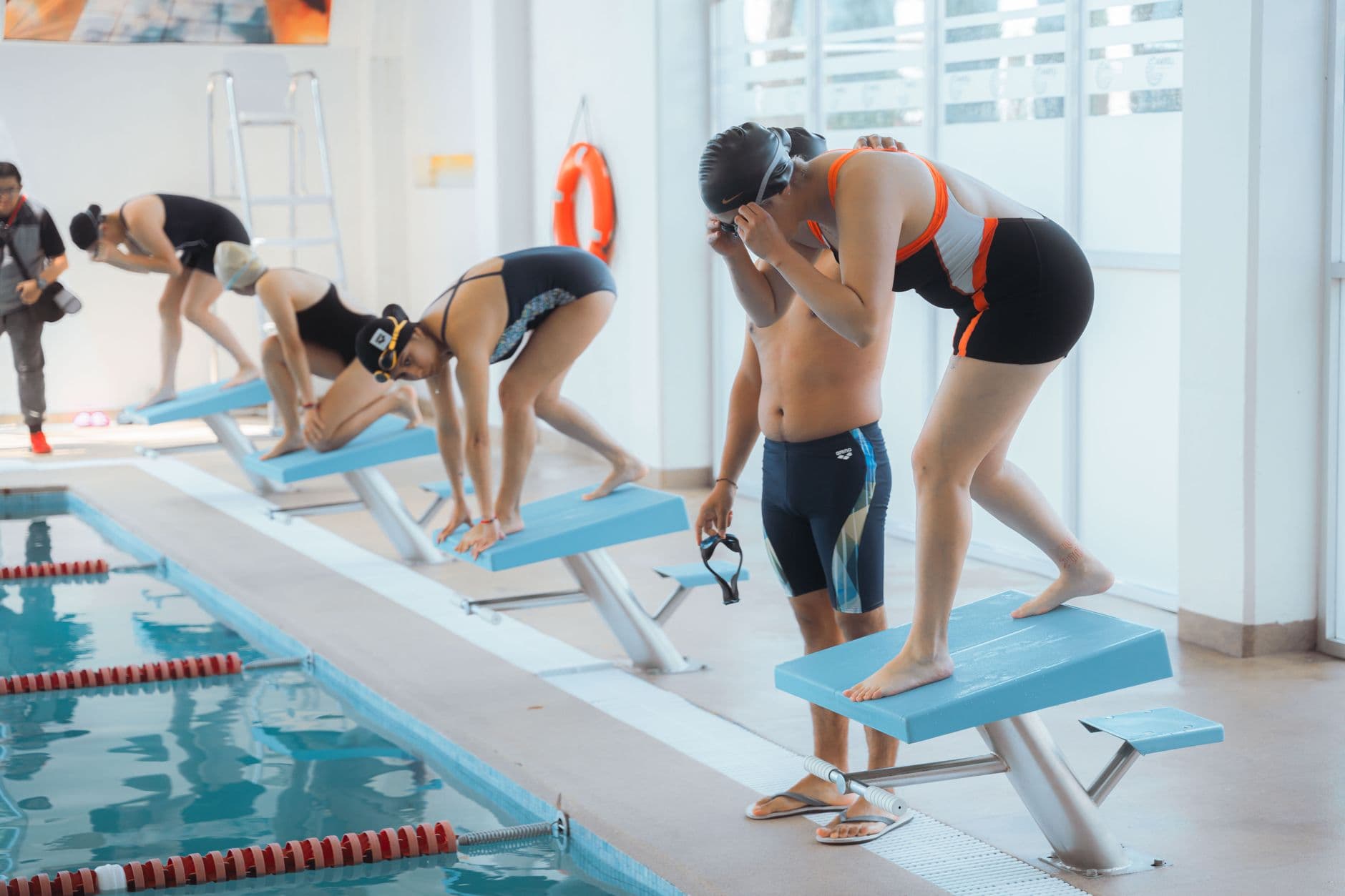
Swimmers shave to reduce drag, and unlike most pool-deck lore this one has experiments behind it. In the two published studies, shaving the arms, legs and exposed torso cut blood lactate at a fixed swimming speed by 23 to 28%, raised distance per stroke, and lowered oxygen cost. Swimmers also report a sharper feel for the water.
That is the short answer. The longer one is more interesting, because the size of the measured effect does not match the size of the drag component shaving can physically touch - and the researchers who ran the studies said so themselves. What follows is what was measured, what was not, and how to shave down without ending up with an infected leg the week of your meet.
What "shaving down" actually means
In competitive swimming, shaving down means removing hair from the arms, the legs and whatever part of the torso the suit leaves exposed. Many swimmers include the armpits; some shave their heads as well. The practice dates to the late 1950s, and by the late 1980s the authors of the first study on it noted that only a very small share of American and world records over the previous twenty years had been set by an unshaved swimmer.
A "shave meet" is the championship meet a swimmer saves it for: most of the season is swum hairy on purpose, so that the one meet that matters gets whatever advantage the shave carries. Whether saving it is the right call is a separate question, and the evidence on that is thinner than the evidence on whether shaving does anything at all.
The two experiments everyone is quoting
Almost every claim you will read about shaving traces back to two papers from the same research line.
The first, published in the Journal of Swimming Research in 1988, took six subjects - four men and two women, aged 20 to 34, none of them in swim training at the time - and had them swim four progressively faster 200-yard freestyles with 15 minutes of rest between each, with a fingertip blood sample two minutes after every swim. The next day they shaved arms, legs and exposed torso and repeated the whole protocol. Because nobody can reproduce their own times exactly, the researchers fitted lactate against velocity for each swimmer and compared the two days at matched speeds.
At 1.08 m/s, blood lactate fell by an average of 28%. At 1.30 m/s - the fastest speed any of them had reached unshaved - it fell from 10.56 to 7.99 mmol/L, an average drop of 23%.
The second paper, in Medicine & Science in Sports & Exercise in 1989, is the better-designed one. Nine male collegiate swimmers were tested eight days before and one day after shaving, with four teammates who did not shave as a control group. The test was a 365.8 m breaststroke swim at about 90% effort:
- Distance per stroke rose from 2.07 to 2.31 m per stroke - about 12% further on each stroke.
- Oxygen uptake fell from 3.60 to 3.27 L/min, roughly 9% less.
- Blood lactate fell from 8.48 to 6.74 mmol/L.
- Heart rate dropped from 174 to 168 beats/min, which did not reach statistical significance.
- The control group showed no change in lactate, stroke length or heart rate.
A separate arm of the same study had nine swimmers shave and nine not, then measured how fast their speed decayed during a prone glide after a maximal underwater push-off. The shaved group decelerated significantly more slowly. That glide result is the most direct piece of drag evidence in the whole literature, because a glide has no stroke mechanics to confuse the picture.
What that looks like in seconds
The 1988 paper did the arithmetic that swimmers actually want. Using each subject's unshaved maximum lactate as the reference, the shaved 200-yard time that would produce the same internal cost came out at 2:15.0, against 2:21.6 unshaved. The time they actually swam all-out after shaving was 2:15.5.
So: about six and a half seconds over 200 yards, for swimmers going roughly 2:20. Be careful what you do with that number. These were six people who were not in training, swimming a 200 at a pace a club age-grouper would find easy. A 1:50 college swimmer is operating at a different speed, with a different drag profile and a different stroke, and nobody has measured them. If you want to see what a given number of seconds does to your pace per 100, put both times through the pace calculator rather than assuming the percentage carries across distances.
The 1988 authors noted that the drop was close to the lactate shift they had been seeing across a full collegiate season of training. That is a striking comparison, and it is also a comparison between six untrained volunteers and an unpublished in-house observation. Treat the six seconds as an order of magnitude, not a promise.
The tethered swim that showed nothing
Buried in the 1989 study is the detail that makes the whole thing credible. Alongside the free swim, the same swimmers did a tethered breaststroke swim against retarding forces of 6.27, 7.75 and 9.26 kg - swimming hard but staying in one place. In the tethered condition there were no before-and-after differences in oxygen uptake, heart rate or lactate, in either group.
That is exactly what you would expect if the mechanism is hydrodynamic. Drag rises with the square of velocity, a relationship first measured for towed swimmers in 1933. Take the velocity away and there is no drag left to save, so a shaved swimmer tethered to the wall gains nothing. If the gains had come purely from feeling fresh and confident, the tethered swim should have improved too. It did not.
Skin friction is the smallest part of your drag
Here is the part that most articles on this topic skip. A swimmer's resistance has three parts: pressure drag, from pushing a body-shaped hole through the water; wave drag, from making waves at the surface; and skin friction, from water shearing along the skin. Shaving can only act on the third one.
A 2015 study of sixty young swimmers partitioned total passive drag and found friction drag accounted for 14.1% of it, with pressure drag making up the other 85.9%. The spread was wide - plus or minus 9.3 percentage points - but the ranking is not in doubt. An analysis of underwater swimming reached the same conclusion: skin friction is real and significant, but it is the second contributor, not the first, and over most of a swimmer's body the flow is turbulent rather than laminar.
The practical reading: shaving works on roughly a seventh of your resistance, while your body position works on the other six-sevenths. A swimmer whose hips ride low is leaving far more on the table than a swimmer with hairy legs, which is why fixing a sinking lower body is worth more than any razor.
So why did the measured effect come out so large?
This is the open question, and the people who ran the experiments were the first to raise it. The 1988 paper states plainly that its data do not allow certainty that shaving reduces drag enough to account for the lactate drop observed, and offers the alternative: that shaving improves a swimmer's ability to sense and eliminate wasted, non-propulsive movement.
That idea was not new. In 1968 the coach James Counsilman argued there was no valid evidence that shaving reduced skin resistance enough to matter, and speculated that any real benefit came from increased sensitivity to the feel and pressure of the water, and therefore better coordination.
Both mechanisms fit the 1989 breaststroke data. Distance per stroke rose by 12%, which is a technique variable as much as a drag variable - and it is the variable this site keeps coming back to in stroke rate versus stroke length. The glide result, where there is no technique to improve, points at genuine drag reduction. The most defensible position is that both are happening and nobody has cleanly separated them. Where the evidence runs out, say so.
Smoother is not automatically faster
It is tempting to extend "less hair, less friction" into "the slipperier the better". Hydrodynamics does not cooperate.
A 2004 study towed seven male swimmers in five suits at speeds up to 2.2 m/s and decomposed the drag. The transition from laminar to turbulent flow happened very close to the swimmer's leading edge - the head - and the flow was transitional over most of the body. The authors' conclusion was counterintuitive: increasing skin friction on the upper body can reduce pressure and wave drag, by tripping the boundary layer and keeping the flow attached from shoulder to knee. The shoulder-to-knee suit, not the briefs, had the least total drag at race speed.
A swim cap study makes the same point from the other direction. Ten swimmers were towed at 1.5, 1.7 and 1.9 m/s in a smooth silicone cap, a dimpled one and a wrinkled one. With the arms above the head, no difference. With the arms alongside the body, the wrinkled cap produced 4.4% more speed-specific drag than the dimpled one - and smooth and dimpled did not differ. Wrinkles cost you; smoothness by itself bought nothing.
None of this argues against shaving. It argues against the reasoning people use to justify it, and against believing any "X% less drag" number without asking who measured it and how.
Shaving is not a taper, and it is not a suit
These three get bundled together as "meet prep" and they behave differently.
A taper is a planned reduction in training load over one to three weeks, and it is the one with a large evidence base behind it - see the separate guide on how to taper for a swim meet for the numbers. A race suit is a regulated piece of equipment whose benefit is routinely overstated: when researchers measured active drag directly in thirteen swimmers wearing a first-generation Fastskin, they found a 2% reduction that was not statistically significant, against the manufacturer's claim of 7.5%. Shaving is free, unregulated, and backed by two small studies that found an effect larger than the suit study found.
If you shave for the first time in the same week you start your first real taper and wear a new suit, you will have no idea which of the three did anything. Change one thing at a time if you want to learn anything from it.
When swimmers actually shave
There is no study on timing. What exists is practice, and it is worth labelling as practice.
Both experiments tested swimmers the day after shaving - the 1989 study tested one day post-shave, the 1988 study the following morning. So "the night before, or the evening before the first session" is the only timing anyone has actually measured, which is convenient, because it is also what most swimmers do.
A U.S. Masters Swimming column from 1993 describes the "typical taper and shave of three days during the meet cycle" and argues for a longer one: its author shaved at a regional meet, stayed shaved for the two weeks until nationals so that race-speed practice felt like racing, shaved again at nationals, and still dropped time. That is one masters swimmer's experience in a coaching column, not evidence, and it is useful mainly because it shows the "save the shave" convention has never been tested either.
The 1988 authors took the opposite view and wrote that since the effect is not purely psychological, there is no reason to expect repeated shaving to diminish it, so shaving more often during a season can be justified - while acknowledging the trade-off against whatever psychological lift comes from saving it.
What gets shaved, and what about your head
In both studies the protocol was arms, legs and exposed torso. That is the practical answer to most of the variants people search for: the surfaces moving through water that the suit does not cover.
Armpits are usually included, since they sit in the flow during recovery. Backs and shoulders get shaved by swimmers who have hair there, often with help - and that is where a razor meets skin nobody can see, which is the main route to the problems further down this page.
Heads are different. World Aquatics requires a cap to be an independent item, not attached to the suit or goggles and not made of hard material, so a shaved head competes against a silicone cap rather than against nothing. No study has compared the two. Since the cap study found a penalty for wrinkles and none for smoothness, pulling your cap on properly is the part supported by data.
As for the pubic area: suits cover men from the navel to the knee and women from the shoulders down, so anything under the suit is not in the flow. That is grooming, not performance.
What the rulebook regulates, and what it ignores
The World Aquatics Competition Regulations in force from February 2026 are detailed about what you can wear and silent about your hair.
Suits must be non-transparent, must be on the World Aquatics List of Approved Swimwear at the time of the competition, and are capped at 0.8 mm total material thickness. Women's suits must not cover the neck or extend past the shoulders or below the knee; men's must not extend above the navel or below the knee. Caps have their own article. Hair does not appear anywhere.
That asymmetry is the quiet argument for shaving: the engineered route to less drag is capped by rule and costs money, while the route through your own skin is free. It is also the argument for the things no rule touches at all - your streamline off every wall, your turns, your underwater kick. Those act on the 86% of drag a razor cannot reach.
How to shave down without wrecking your skin
The NHS guidance on ingrown hairs is the most specific public-health advice available on how to shave a large area, and it maps directly onto shaving down:
- Wet the skin with warm water first and use shaving gel.
- Shave in the direction the hair grows, not against it.
- Use as few strokes of the razor as possible, and rinse the blade after every stroke.
- Do not shave too close - leaving at least 1 mm of stubble reduces ingrown hairs, and 1 mm of stubble is not what is costing you your race.
- Never use a blunt razor. A dragging blade is how legs get cut.
- Hold a cool, wet cloth against the skin afterwards to reduce irritation.
- Do not scratch, pick or squeeze bumps afterwards; that is how irritation turns into infection.
Two additions for swimmers. First, do not go straight from the razor into the pool. Freshly shaved skin carries thousands of microabrasions, and chlorinated water on top of them stings and dries - the mechanism behind the problems in chlorine, skin and hair. Leave a few hours, and moisturise after you swim.
Second, never share a razor and never lend yours. That is the single most effective item on this list.
The skin problems that make shaving a bad trade
Shaving breaks the skin barrier, and a pool deck is a place where broken skin meets other people's skin.
In a documented outbreak on a 100-player college football team, ten players developed MRSA cellulitis or abscesses and two were hospitalised. On analysis, body shaving carried a relative risk of 6.1 - a six-fold higher rate of infection among players who shaved - alongside turf burns at 7.2. Three of the four infections at a covered site were in an area the player had shaved, and frequent sharing of a whirlpool whose water was not properly disinfected carried a relative risk of 12.2. The investigators' recommendation was explicit: minimise skin breaks among athletes, including education about the risks of cosmetic body shaving.
Swimming is not football, and a chlorinated pool is not a whirlpool topped up with dilute iodine. But shared benches, shared equipment and shaved legs are common to both: do not shave over broken skin, do not shave an area already inflamed, and do not get in the water with an open cut.
Then there is pseudofolliculitis barbae, the inflammatory reaction that happens when a cut hair tip grows back into the skin. It produces papules, pustules and lasting dark marks, it occurs more frequently in men of African and Asian descent, and people carrying a particular variant in a hair-follicle keratin gene have around a six-fold higher chance of developing it. Keloid scarring can follow. The reliable treatment is stopping shaving. For a swimmer who gets it badly, six seconds in a 200 is not a sensible trade against months of scarring, and a clipper that leaves stubble, or simply not shaving, is the better answer.
When to stop and see a doctor
Most shaving irritation settles on its own. According to NHS guidance, see a GP or doctor if an ingrown hair or the area around it becomes very painful, hot or swollen, or if you develop a high temperature or feel hot, cold, shivery or generally unwell. Those are the signs of an infection that needs treating rather than waiting out, and a spreading skin infection is a reason to miss a meet, not to swim through.
Nothing in this guide is medical advice. If you have a skin condition, take a medication that affects your skin, or have had a bad reaction to shaving before, ask a pharmacist or your doctor before shaving a large area for the first time.
How to tell whether it worked for you
With one swimmer and one shave you cannot run an experiment, but you can make the comparison less useless than "I felt fast".
Measure distance per stroke before and after, in the same pool, over the same distance, at the same effort. That is the variable the 1989 study moved most clearly, and it is cheap to count. Pair it with your time over the same length and you have SWOLF, which the SWOLF calculator will work out for you; a lower score at the same speed means you are covering more water per stroke.
Do it on a repeatable set rather than a time trial. If you know your threshold pace - CSS pace is the simplest way to get one - swim the same set at the same prescribed pace before and after and compare how it felt and what your stroke count did, instead of chasing a best time on a day when you are also tapered.
And keep the comparison honest about the pool: a 25-metre course is worth several seconds over 200 compared with a 50-metre one. If the two swims were in different pools, convert with the time converter and read short course versus long course before you credit the razor.
Frequently asked questions
Does shaving actually make you swim faster?
In the two published experiments, yes. Shaving the arms, legs and exposed torso cut blood lactate at a fixed speed by 23-28%, cut oxygen cost by about 9%, and increased distance per stroke by about 12%. Both studies were small - six and nine shaved swimmers - so treat the size of the effect as an estimate, not a fixed number.
Why do swimmers shave their legs and arms rather than just wear a suit?
Because the rules cap the suit and not the skin. World Aquatics limits racing suits to 0.8 mm of material, to an approved list, and to waist-to-knee coverage for men and shoulder-to-knee for women. Hair is not mentioned anywhere in the regulations, so shaving is the one drag reduction that is free and unlimited.
When should you shave before a swim meet?
The only timing anyone has tested is the day before: both experiments measured swimmers one day after shaving. The widespread practice is to shave the evening before the first session of a championship meet and to save it for that meet. Nobody has compared shaving the night before against shaving a week out.
Do swimmers shave their heads too?
Some do, but a shaved head is competing against a silicone cap rather than against bare skin, and no study has compared the two. What has been measured is cap surface: a wrinkled cap produced 4.4% more drag than a dimpled one with the arms alongside the body, while a smooth cap offered no advantage over a dimpled one.
Does shaving work for female swimmers as well?
The mechanism does not depend on sex, and the 1988 study included two women among its six subjects. The practical difference is that many female swimmers are already shaved year-round, so race day feels no different. A common workaround is to train in two suits and race in one, which changes the feel without changing anything about hair.
Is shaving down risky?
It breaks the skin barrier, which matters more than most swimmers think. In one college outbreak, body shaving carried a six-fold higher risk of MRSA skin infection. Shaving also triggers ingrown hairs and pseudofolliculitis barbae, which is more frequent in people of African and Asian descent. Never share a razor, never shave over broken skin, and see a doctor if an area becomes hot, swollen or very painful.
Sources
- Sharp RL, Hackney AC, Cain SM, Ness RJ (1988). The Effect of Shaving Body Hair on the Physiological Cost of Freestyle Swimming - lactate reduced 28% at 1.08 m/s and 23% at 1.30 m/s in six swimmers — Journal of Swimming Research
- Sharp RL, Costill DL (1989). Influence of body hair removal on physiological responses during breaststroke swimming - distance per stroke 2.07 to 2.31 m, VO2 3.60 to 3.27 L/min, and reduced glide velocity decay — Medicine & Science in Sports & Exercise
- Barbosa TM, Morais JE, Forte P, Neiva H, Garrido ND, Marinho DA (2015). A Comparison of Experimental and Analytical Procedures to Measure Passive Drag in Human Swimming - friction drag 14.12 +/- 9.33% of total passive drag — PLoS One
- Polidori G, Taiar R, Fohanno S, Mai TH, Lodini A (2006). Skin-friction drag analysis from the forced convection modeling in simplified underwater swimming — Journal of Biomechanics
- Mollendorf JC, Termin AC, Oppenheim E, Pendergast DR (2004). Effect of swim suit design on passive drag - boundary-layer transition near the head and the shoulder-to-knee suit ranking lowest for drag at 2.2 m/s — Medicine & Science in Sports & Exercise
- Toussaint HM, Truijens M, Elzinga MJ, van de Ven A, de Best H, Snabel B, de Groot G (2002). Effect of a Fast-skin 'body' suit on drag during front crawl swimming - 2% reduction, not significant, against a claimed 7.5% — Sports Biomechanics
- Gatta G, Cortesi M, Zamparo P (2015). Effect of Swim Cap Surface Roughness on Passive Drag - wrinkled cap 4.4% more speed-specific drag than a dimpled cap with arms alongside the body — Journal of Strength and Conditioning Research
- Begier EM et al. (2004). A high-morbidity outbreak of methicillin-resistant Staphylococcus aureus among players on a college football team, facilitated by cosmetic body shaving and turf burns - relative risk 6.1 for body shaving — Clinical Infectious Diseases
- Ogunbiyi A (2019). Pseudofolliculitis barbae; current treatment options - shaving as the precipitating factor, the K6hf keratin variant and its six-fold risk, and cessation of shaving as the reliable treatment — Clinical, Cosmetic and Investigational Dermatology
- Ingrown hairs - prevention, self-care and when to see a GP (page last reviewed 1 September 2026) — NHS
- World Aquatics Competition Regulations, Part One - articles 6.3 and 6.5 (approved swimwear), 6.8 (swimsuit coverage and the 0.8 mm thickness limit) and 6.10 (swim caps), in force from February 2026 — World Aquatics
- World Aquatics - Rules and Competition Regulations index (current and archived versions) — World Aquatics
- McCauley W. (1 February 1993). Breaststroker Taper and Shave - a masters coach's account of the typical three-day taper and shave and of staying shaved between meets — U.S. Masters Swimming
Read next
Why do swimmers wear two caps? To pin the goggle straps down
The second cap covers the goggle straps and stops the first one wrinkling. Two caps is explicitly legal, and two is the written maximum — here is the rule.

What age should a child start swim lessons?
The official answer is the first birthday for lessons, but babies can be in water long before that. Here is where each health body draws the line, and why it matters.
Why swimmers get disqualified: the calls officials make
A disqualification is a procedure, not an opinion. Who is allowed to call one, what goes on the slip, what the code means, and how it can be challenged.
SwimFast is an independent publication. We are not a swim school, a coaching service or a governing body, and nothing here is medical advice. Training paces and test protocols are cited from the published research or federation documents linked on each page. Never swim alone, never attempt breath-hold work without supervision, and check with a doctor before starting a new training programme.