Underwater dolphin kick: how far off the wall is it worth going?
World-class 100 freestyle finalists use about nine metres of the fifteen allowed. Here is what decides your own number, how to measure it, and where the rules stop you.
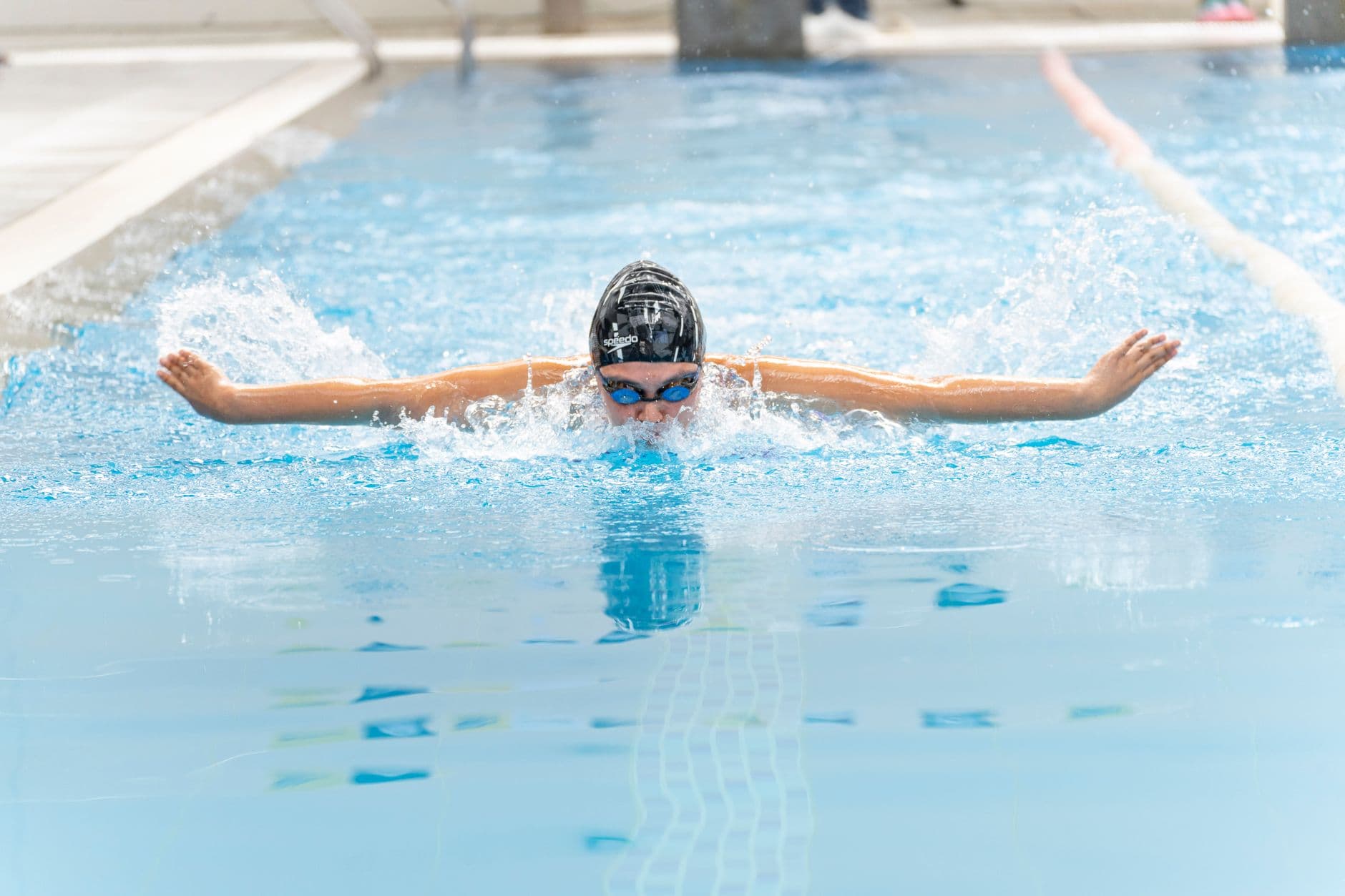
There is a line of tiles 15 metres from each wall of a racing pool, and plenty of swimmers treat it as a target. It is not a target. It is a ceiling — the point by which three of the four strokes require your head to have broken the surface — and the fastest swimmers in the world stop well short of it. In the clearest measurement available, finalists at a World Short Course Championships covered about 37.5 metres of a 100 metre freestyle underwater in total. Spread across one start and three turns, that is roughly nine metres a wall out of a legal sixty.
Which leaves the question that actually matters, and it is not “how long can I hold it”. It is this: at what distance does kicking under the surface stop being faster than swimming on top of it? That distance is yours, not the world record holder’s, and you can measure it in about twenty minutes with a watch.
How far is it worth kicking off the wall?
For most swimmers, somewhere between five and ten metres — not fifteen. The speed you borrow from the wall is spent by roughly six metres, and beyond that you are travelling at whatever your kick alone produces. World-class 100 freestyle finalists hold about nine metres a wall, and they own the fastest underwater kicks anybody has measured.
The nine-metre figure comes from a study of 79 swimmers racing the short-course 100 freestyle, split into three performance groups. It is the most useful table in this whole subject, because the groups differ in exactly the way the argument predicts.
| Group | Total distance underwater (100 m) | Mean underwater speed | Non-swimming share of the race |
|---|---|---|---|
| World Championship finalists | 37.50 ± 4.92 m | 2.54 ± 0.05 m/s | 39.11 ± 4.73 % |
| National swimmers under 50 s | 31.90 ± 4.88 m | 2.46 ± 0.09 m/s | 34.21 ± 4.55 % |
| National swimmers over 50 s | 31.94 ± 4.93 m | 2.38 ± 0.11 m/s | 33.94 ± 5.00 % |
Read the two right-hand columns together. The world group did not simply stay under longer; they stayed under longer and moved faster while they were there. The two national groups covered almost identical distances and separated on speed alone. That is the whole principle in one table: distance underwater only pays if the speed holds up. Going further at a speed that has already collapsed is just a slower way to reach the 10 metre mark.
Do you swim faster underwater or above water?
For the first few metres off a wall, always underwater — you are coasting on push-off speed, which is well above any swimming speed you can generate. After that it depends entirely on you. A world-class kick beats world-class swimming. A mediocre kick loses to your own ordinary freestyle, and the crossover usually arrives sooner than it feels like it does.
The two sets of numbers are worth seeing side by side, with one caveat stated up front: they are not measured the same way. The elite figure is a mean across a whole underwater section, push-off included, so it is flattered by the wall. The youth figures are steady-state kicking over about seven metres, with the wall already behind them.
Those orange bars are the honest part of this page. A trained sixteen-year-old with a respectable 540-point profile kicks at around 1.3 m/s once the wall is gone. That is slower than world-record surface distance pace, and it is slower than the same swimmer’s own sprint freestyle. Which means that for a very large share of swimmers, metre eleven underwater is slower than metre eleven on the surface — and the only reason it feels fast is that metres one to five were.
The push-off advantage is gone by six metres
This is the finding that settles the argument, and it is unusually clean. Thirteen swimmers performed 15 metre maximal underwater kicks from four deliberately different push-off speeds. The first kick cycle differed significantly between conditions, as you would expect. The middle and final cycles did not differ at all.
Statistical mapping put the point where the differences became negligible at about six metres from the wall. The same study found that swimmers reached their maximum achievable kicking velocity at roughly five metres even when the push-off was poor. In other words the wall hands you an advantage, the advantage is large, and it is completely spent within two body lengths and change. From six metres on, nobody is coasting; everybody is simply kicking at their own speed.
That is why “go to fifteen” is bad instruction and “go until the kick is slower than your swimming” is good instruction. The first is a rule about the pool. The second is a rule about you.
Test your own break-even in one session
Two timed efforts, both from a push off the wall rather than a dive, so the only variable is what you do after you leave. Warm up properly first — a structured warm-up matters more than usual here, because this is a sprint test and cold ankles kick badly.
- 15 metres, underwater kick, maximum effort. Push off streamlined, kick to the 15 metre mark without surfacing, and have someone time you from push to the mark. One normal breath before you go — see the breathing section below, which is not optional reading.
- Rest fully. Three to four minutes. This is not a conditioning set.
- 15 metres, surface swimming, maximum effort. Same push, break out immediately, swim your fastest stroke to the same mark.
- Repeat each once more and keep the faster of the two times.
Divide 15 by each time to get metres per second. If the pool is marked in yards, 15 yards is 13.72 metres; divide by that instead, or push both times through the course converter first so you are comparing like with like. The pace calculator will turn either result into a per-100 pace if that is the number you think in.
Reading your two numbers
Both trials include the same push-off, so the gap between them is a fair read on what your kick does once the free speed runs out. Three outcomes, three different instructions.
| What you measured | What it means | What to do off the wall |
|---|---|---|
| Kick clearly faster than swim | Your kick is a genuine weapon and the wall is where you gain time | Hold 8–12 m, and work on holding speed rather than on going further |
| Within about half a second of each other | Break-even sits somewhere in the middle of the 15 m | Hold 5–7 m, surface before the kick decays, train the kick separately |
| Swim clearly faster than kick | Every metre past the glide is costing you time | Streamline, two or three kicks, break out early — and go fix the kick on its own |
One warning about the third row: “break out early” does not mean abandon the streamline. The glide is free speed for everybody, however poor the kick. What you cut short is the kicking, not the push-off. And if low hips are what decelerates you, that is a different problem with a different fix — sinking legs covers it.
Why the kick fades at the end of a long underwater
It is not your imagination and it is not only fitness. Fifty-four national-level swimmers were filmed doing 25 metre maximal underwater efforts, and their first kick was compared with their last. Velocity dropped markedly, with an effect size large enough to call it the dominant feature of the effort rather than noise.
How it dropped split by sex: the men lost kicking amplitude, the women lost kicking frequency. The more interesting result is the cause. Joint ranges of motion barely changed — only the hip moved differently. What changed was body configuration as the swimmers approached the surface: more trunk inclination and greater vertical body amplitude. The kick was not falling apart. The swimmer was angling up and starting to porpoise, and the drag penalty for that is what ate the speed.
The practical instruction is narrow and useful: on the last two or three kicks of any underwater, consciously flatten. Keep the vertical travel of your hips small and keep your line long. Most of the late-underwater speed loss that swimmers blame on their legs is actually paid at the shoulders and hips.
What extra underwater distance actually costs
Here the evidence is narrower than the confident advice floating around the sport, so it is worth being exact about what was found. Twelve national-team youth swimmers swam 2 × 75 m at 200 m race pace under three conditions: their own natural underwater sections, those sections plus two extra kicks, and maximum distance underwater.
Overall performance held up, and neither heart rate nor blood lactate differed between conditions. What did change, significantly, was rated perceived exertion: the forced conditions felt considerably harder. The authors’ reading is the sensible one — trained swimmers can absorb controlled increases in underwater distance at the cost of some added discomfort.
Two things that does not license. Extended underwaters are not metabolically free for an untrained swimmer — twelve national-team teenagers at 200 pace is a narrow window. And it says nothing about breath-hold work done on purpose, which is covered below. For the broader picture of what swimming costs you energetically, what swimming actually burns handles it properly.
Why dolphin and not flutter
Every coach says the dolphin kick is faster underwater than a flutter kick, and for once the mechanism has been measured rather than assumed. Eight swimmers performed both in a flume at matched effort, with three-dimensional motion capture, surface electromyography on the left leg and simulated fluid forces.
The flutter kick came out smaller on every count: less kick amplitude, less joint range of motion, lower muscle activity, lower peak hip and knee torques. Crucially, the estimated propulsion was lower for the flutter kick on both the downbeat and the upbeat. The dolphin kick is faster because it is a bigger movement driven harder through a longer range, generating force in two directions instead of mostly one.
That also explains why the upward half is where most swimmers have room to improve. A flutter kick is essentially a one-way propeller; a dolphin kick is not, and treating it like one throws away half the stroke. Worth noting too that kickboard sets put you in exactly the body position this skill does not use.
How the kick is actually trained
It responds to training, and the timescale is reassuring. Seventeen age-group swimmers followed a seven-week protocol; afterwards their time to 10 metres, their mean, peak and minimum intra-cycle velocities and their gliding performance had all improved significantly. The improvement came mostly from a better upbeat, together with a likely reduction in drag. The authors note honestly that growth over seven weeks contributed too, which is the kind of caveat worth repeating rather than hiding.
What that implies for a session, kept deliberately short because the research supports the direction and not a specific set:
- Short and fast, fully rested. Repeats of 10 to 15 metres with long recovery. Speed is the quality being trained; a tired kick trains the wrong thing.
- Train the upbeat on purpose. Vertical kicking in deep water with the head out, hands on the chest or above the surface, teaches the backward leg drive that the research identifies as the discriminator. Head out means no breath-holding, which is the point.
- Kick on your side and on your back as well as face down. The dorsal version matters for backstroke, and the side position exposes a kick that only works against the floor.
- Ankles, with a caveat. In the 41-swimmer study maximum ankle extension correlated with kicking velocity in both sexes, but the faster group had the smaller ankle range — correlations in trained swimmers, not a prescription to stretch your way to speed.
- Fins sparingly. They change the surface area you kick with: useful for feel, misleading for pacing. Paddles and fins covers when each earns its place.
Put the rest intervals on a clock rather than guessing them — the interval calculator will give you a send-off that keeps the repeats genuinely fast, and the workout generator will build the rest of the session around them. One more honest note: a systematic review of this literature pooled 412 competitive swimmers across 23 studies and concluded that the evidence on what determines underwater kicking performance is still inconsistent, partly because researchers do not define the parameters the same way. Treat anybody who gives you precise targets for kick amplitude with suspicion.
The on-back version, and what backstroke changes
Backstrokers get more out of this skill than anybody, because the underwater phase is a larger share of their race, and the kick on the back has been studied separately. Forty-one national-level swimmers were filmed doing 25 metre backstroke efforts from a push start; faster and slower groups separated on the kinematics of the dorsal kick, and kick order mattered within the effort.
Two practical differences from the face-down version. You cannot see the wall or the line, so distance control has to be counted rather than watched — which means counting kicks, not metres, and knowing what your count buys you. And the backstroke finish now has its own rule allowing full submersion once part of the head passes the 5 metre mark, so the kick has a second home at the other end of the length. If holding a line without visual reference is the harder problem for you, swimming backstroke straight deals with it directly.
One sex comparison cuts against a common assumption: girls and boys differed in the level of their kinematic indicators, but underwater kicking velocity depended on the same variables in both groups. The authors concluded that technical training for this skill need not be split by sex.
Where the rules stop you, stroke by stroke
Three strokes have a 15 metre limit and one does not, and the exception catches out swimmers who have been racing for years.
| Stroke | Limit on the underwater phase | Rule |
|---|---|---|
| Freestyle | Head must break the surface by 15 m after the start and each turn | Article 5.3 |
| Backstroke | Head must break the surface by 15 m after the start and each turn | Article 6.3 |
| Butterfly | Head must break the surface by 15 m after the start and each turn | Article 8.6 |
| Breaststroke | No distance limit — the limit is a stroke count | Article 7.1 |
Those article numbers are from the World Aquatics Competition Regulations in force from February 2026, linked in the sources below; check the current version before a meet, because domestic rule books sometimes word the same requirement more strictly. Breaststroke is the odd one out: it allows one arm stroke and a single butterfly kick before the head must surface, and since a pullout does not reach 15 metres anyway, no distance rule was ever needed. The breaststroke pullout guide works through that sequence and its disqualifications in full, and butterfly two-kick timing covers the one stroke that gives you more than one kick.
One more context note. A short-course race has twice the walls of a long-course race over the same distance, so the same kick is worth twice as much — which is part of why the same swimmer is faster in a 25 m pool. Short course versus long course quantifies that gap, and the flip turn guide covers the half of the wall that happens before any of this.
Breathing, and the one rule with no exceptions
Never hyperventilate before going underwater, and never build sets around holding your breath longer. The American Red Cross, USA Swimming and the YMCA of the USA issued a joint statement in November 2022: hyperventilation before underwater swimming and extended breath-holding in water are dangerous and potentially deadly. The correct name for the result is hypoxic blackout. It arrives without warning and without struggle, and it has killed strong, fit swimmers. Their instructors are taught to limit swimmers to a single inhalation before submerging — apply the same limit to yourself.
Everything on this page is compatible with that rule, because none of it requires a long breath hold. A 15 metre underwater at speed takes most swimmers six to eight seconds. The test above is two such efforts with minutes of rest between them. Training repeats are 10 to 15 metres fast, not 25 metres grim. The moment the goal becomes distance-per-breath rather than speed, you have left the subject of this page and entered one that injures people.
The practical version: one normal breath in, never a series of deep ones; exhale steadily rather than clamping down; never do underwater work alone or in a pool without a lifeguard; and stop the set — the set, not the repeat — at the first sign of light-headedness, tingling or tunnel vision. If you have ever greyed out, blacked out or come close in the water, that belongs in front of a doctor before your next session, not in a training log. For the surface breathing pattern that makes all of this less necessary in the first place, breathing in freestyle is the place to start.
When it still does not work
| What happens | Usual cause | What to change |
|---|---|---|
| You go nowhere and run out of air fast | Kicking from the knees, so the legs scull rather than undulate | Initiate at the hips and let the knee bend happen as a consequence. Kick vertically with the head out to feel the difference. |
| Speed falls off a cliff at about five metres | Normal — that is the push-off running out | Nothing to fix. Compare that steady speed with your surface speed and decide the distance from there. |
| You drift up toward the surface | Head and chest lifting; the body is angling up before the breakout | Eyes down, hands pressed together and held long. Flatten deliberately on the last two kicks. |
| You surface slower than you went under | Breakout timing, not the kick | Take the first arm stroke while still carrying speed, rather than gliding to a halt and starting from nothing. |
| Dizziness, headache or tingling after sets | Breath-holding, hyperventilation or both | Stop. One breath only, shorter repeats, longer rest. Recurring symptoms go to a doctor. |
And if the test said your swimming beats your kicking by a distance, that is useful information rather than bad news: the cheapest time available to you is on the surface, not under it. A faster 100 freestyle and stroke rate against stroke length are where that time is, and the rest of the technique guides and the calculators are there when you want to measure the next thing.
Frequently asked questions
How many dolphin kicks should you do off the wall?
Count them rather than guessing, but set the number from distance, not habit. Most swimmers are best served surfacing between five and ten metres out, which is commonly three to six kicks depending on how much each one travels. The right count is the one that gets you to your own break-even distance, not the one that reaches fifteen metres.
Is the dolphin kick faster than freestyle?
Underwater, for the first few metres off a wall, yes — you are carrying push-off speed that no stroke can match. Past about six metres it depends on you. World-class kicks beat world-class swimming, but steady kicking in trained teenagers has been measured at around 1.3 metres per second, which is slower than their own sprint freestyle.
How far can you swim underwater in a race?
In freestyle, backstroke and butterfly, your head must break the surface by the 15 metre mark after the start and after every turn. Breaststroke has no distance limit at all: it allows one arm stroke and a single butterfly kick before the head must surface, so the limit is a stroke count instead of a line on the floor.
Why does my dolphin kick go nowhere?
Usually because it starts at the knees instead of the hips, so the legs scull back and forth without moving water backwards. The second common cause is a weak upbeat — measured research found the upward half of the kick is where improvement mostly comes from. Vertical kicking with your head above the surface exposes both faults quickly.
Should I practise holding my breath to kick further underwater?
No. Hyperventilating before underwater swimming and extended breath-holding in water are dangerous and potentially deadly, and the resulting hypoxic blackout gives no warning before it happens. Take one normal breath before submerging, never a series of deep ones, never train underwater alone, and keep repeats short and fast rather than long and desperate.
Sources
- World Aquatics Competition Regulations, Part Two: Swimming Rules — articles 5.3 (freestyle), 6.3 (backstroke) and 8.6 (butterfly), the 15 metre limits, and 7.1 (breaststroke), in force from February 2026 — World Aquatics
- Joint Statement from the American Red Cross, USA Swimming and the YMCA of the USA on Hypoxic Blackout, November 2022 — American Red Cross
- Pla R, Poszalczyk G, Souaissia C, Joulia F, Guimard A (2021). Underwater and Surface Swimming Parameters Reflect Performance Level in Elite Swimmers — Frontiers in Physiology 12:712652
- Yamakawa KK, Nishiwaki R, Takeda T (2025). Effects of different initial speeds on subsequent glide and underwater undulatory swimming — Sports Biomechanics
- Veiga S, Qiu X, Trinidad A, Suz P, Bazuelo B, Navarro E (2025). Kinematic changes in the undulatory kicking during underwater swimming — Sports Biomechanics
- Veiga S, Pla R, Qiu X, Boudet D, Guimard A (2022). Effects of Extended Underwater Sections on the Physiological and Biomechanical Parameters of Competitive Swimmers — Frontiers in Physiology 13:815766
- Yamakawa KK, Homoto K, Nakashima M, Shimojo H, Nakazono Y et al. (2026). Differences in kinematics, kinetics, and muscle activity between underwater dolphin kicking and flutter kicking — Sports Biomechanics
- Ruiz-Navarro JJ, Cano-Adamuz M, Andersen JT, Cuenca-Fernández F et al. (2024). Understanding the effects of training on underwater undulatory swimming performance and kinematics — Sports Biomechanics
- Wądrzyk Ł, Staszkiewicz R, Kryst Ł, Żegleń M (2019). Gender effect on underwater undulatory swimming technique of young competitive swimmers — Acta of Bioengineering and Biomechanics 21(4)
- Veiga S, Lorenzo J, Trinidad A, Pla R, Fallas-Campos A, de la Rubia A (2022). Kinematic Analysis of the Underwater Undulatory Swimming Cycle: A Systematic and Synthetic Review — Int J Environ Res Public Health 19(19):12196
- Veiga S et al. (2024). Effect of the Skill, Gender, and Kick Order on the Kinematic Characteristics of Underwater Undulatory Swimming in the Dorsal Position — Journal of Human Kinetics
- Gonjo T, Olstad BH (2020). Start and Turn Performances of Competitive Swimmers in Sprint Butterfly Swimming — Journal of Sports Science and Medicine 19(4)
- Paris 2026: Liebmann crushes the men's 1500 m world record on day six (14:26.79) — European Aquatics
- U.S. Masters Swimming — Underwater kick guide — U.S. Masters Swimming
Read next
How to float on your back when your legs keep sinking
Floating is decided by lung volume and balance, not effort. The arithmetic behind a full breath, why your legs rotate down, and how to build a one-minute float.
The breaststroke pullout: the legal sequence, in order
One arm stroke, one dolphin kick, one breaststroke kick — and a rule that ends the pullout with a stroke, not a 15 metre mark. The sequence, and what gets called.
How to tread water without getting tired
Treading water has a measured energy cost, and the technique everyone recommends is the one that tires beginners fastest. What the research actually found.
SwimFast is an independent publication. We are not a swim school, a coaching service or a governing body, and nothing here is medical advice. Training paces and test protocols are cited from the published research or federation documents linked on each page. Never swim alone, never attempt breath-hold work without supervision, and check with a doctor before starting a new training programme.