How to swim your 100 freestyle faster: where the seconds actually are
In a short course 100 there are four walls and three turns. For most adult swimmers there is more time in those than in the stroke they have been polishing.
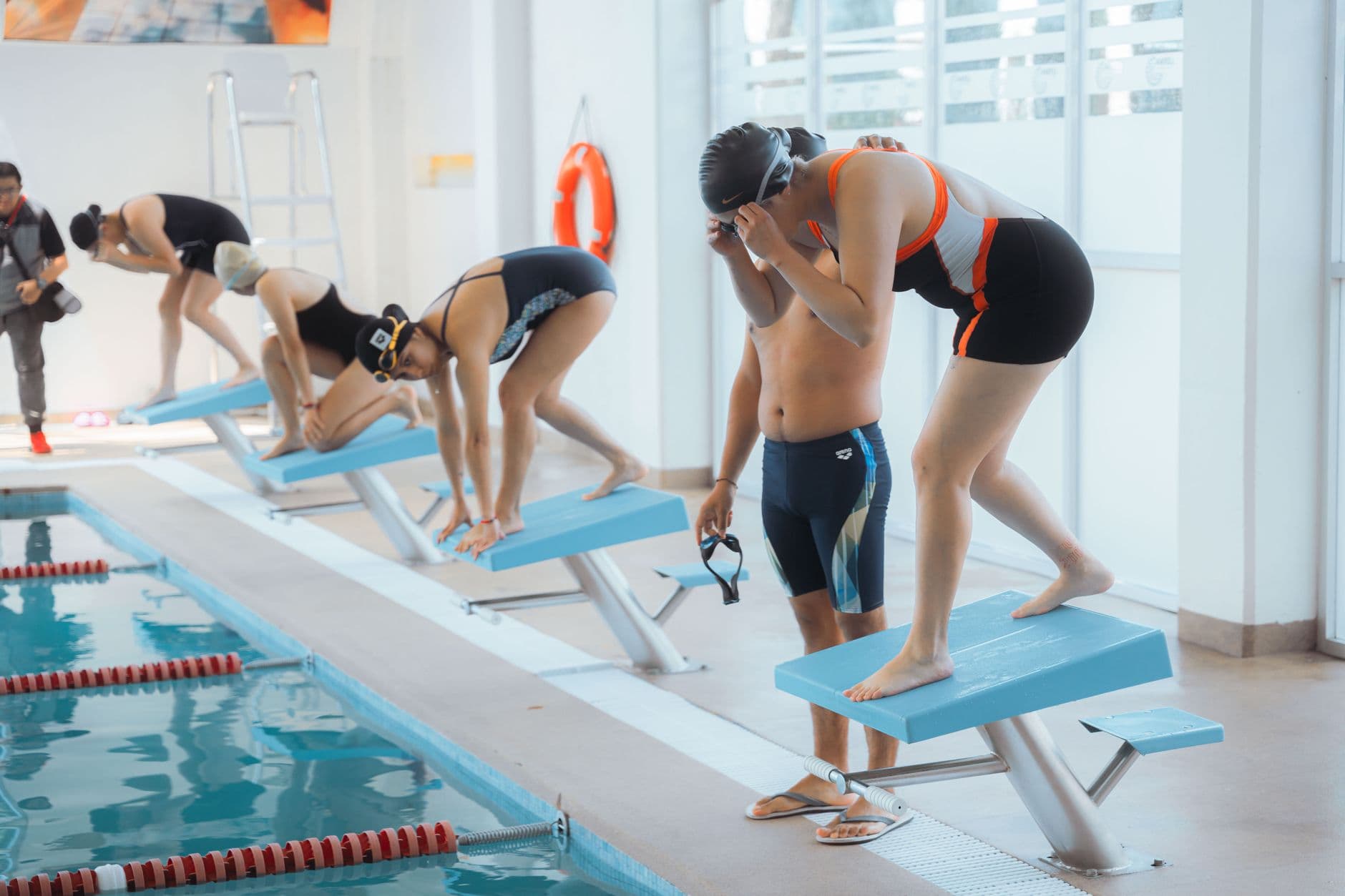
The 100 free is the distance most people want a number for, and the one where the most time is hiding in places that are not the stroke.
If you are trying to take seconds off, it helps to know where the seconds live.
What a 100 is actually made of
In a 25 m pool, a 100 freestyle contains:
One start, from a block or a push, followed by an underwater phase.
Three turns, each followed by another underwater phase.
Four lengths of actual surface swimming, each shortened by however far you travelled underwater.
The competition rules allow the head to remain submerged for up to 15 m after the start and after each turn. In a 25 m pool that is more than half the length, four separate times.
A swimmer who covers 8 m underwater off each wall has swum roughly 32 m of a 100 m race without taking a stroke. A swimmer who surfaces at 2 m has swum 92 m. Both did the same race, and one of them had 60 m less swimming to do.
That is the single most useful fact in this article, and it explains why adults who spend months on their catch sometimes find no time at all.
Turns first
Three turns, and most adult swimmers lose time on all of them.
The common faults are not exotic: arriving with too little speed, taking too long in the rotation, pushing off shallow, pushing off with a loose streamline, and surfacing immediately.
The way to find out is to measure. Have someone with a stopwatch time you from 5 m before the wall to 5 m after it — a 10 m segment centred on the turn. Do it for each of your three turns. Then compare with the time it takes you to swim any other 10 m of the race.
If the turn segment is slower than open-water swimming, the turn is costing you. If it is faster, it is doing its job.
The mechanics are in how to do a flip turn. For most adults reading this, that article and this measurement are worth more than any change to the arm stroke.
The same logic is what makes short course times faster than long course ones — one large study put the average gap at 4.3%, which is entirely a wall effect, as discussed in short course vs long course.
Pacing: the mistake almost everybody makes
The first 25 of a 100 feels wonderful. You are fresh, you have the speed of the start, and there is no sensation of effort. So you go far too fast.
The cost arrives in the third length, and it arrives as a stroke that has fallen apart rather than as tiredness. Rate rises, length collapses, and the last 25 is swum badly and slowly.
The fix is unglamorous: hold something back on the first length. A well-swum 100 is usually slightly positive split — the second 50 a shade slower than the first — because the start is free speed that cannot be repeated. What it should not be is a five-second collapse.
To find out what yours looks like, get your 50 splits. If the difference is large, that is your fastest available improvement and it costs nothing but discipline.
It helps to know those splits before the swim rather than after it. Put the 100 you are chasing into the pace calculator and it gives you the 25 and the 50 you have to hold for it, which is a number you can take to the wall instead of a vague intention to start easier.
A practical exercise: swim 4 × 100 where you deliberately start the first 50 slower than feels right, and record both splits. Most people discover that a slower first 50 produces a faster overall time, which is annoying and useful.
The reason it works is worth understanding rather than just accepting. Going out too hard does not simply borrow energy from later; it changes your stroke for the rest of the race. Once the rate has risen and the length has collapsed, you cannot get them back mid-swim, so the last 50 is swum by a less efficient swimmer than the one who started.
Then the stroke, and specifically the rate
With turns and pacing sorted, the stroke does matter, and over 100 m the lever is usually rate rather than length.
Speed is stroke rate multiplied by stroke length, an identity unpacked in stroke rate or stroke length. Over a distance swim, holding length as rate rises is the goal. Over 100 m, there is not enough distance for a long, economical stroke to pay back and not enough time for the fatigue cost of a high rate to fully arrive.
Which does not mean thrash. It means that a 100 is swum at a higher tempo than your 1,500 pace, and if your tempo is identical in both, one of them is wrong. Most adult swimmers have one tempo, learned during long steady swims, and take it into every distance they attempt.
The way to test it is to hold a deliberately higher rate over 50s and see what happens to your stroke count and your time. If the count holds and the time drops, the rate was worth adding.
The underwater phase is a skill, not a bonus
Given how much of a short course 100 can be spent underwater, it deserves treating as its own discipline rather than as the bit between the wall and the swimming.
Three things determine how much you get from it.
The streamline. Hands stacked, arms squeezed against the ears, head neutral, body long and still. Any gap between the arms, any lifted head, and the drag rises sharply at exactly the speed where drag matters most — right off the wall, when you are travelling faster than at any other point in the race.
The depth. Too shallow and you fight the turbulence at the surface. Too deep and you spend time and energy coming back up. Somewhere around half a metre to a metre below the surface is the usual working range, and it is worth experimenting rather than assuming.
The transition. The move from underwater kicking to the first stroke is where a lot of the gain is thrown away. Surfacing and then starting to stroke wastes the speed you just built; the first stroke should begin as you break the surface, carrying the momentum into the swim.
None of this requires a dolphin kick like a sprinter's. A modest, tight underwater phase done consistently on four walls beats a spectacular one done on the first and abandoned when tired.
Breathing, and the myth to drop
Somewhere, every adult swimmer is told that breathing slows you down and that the fast ones breathe less.
Over 25 m that is true. Over 100 m it is a good way to swim a bad third length.
Restricting breathing in a 100 leaves you oxygen-starved exactly when the race is decided, and the time lost to a disintegrating stroke dwarfs anything gained from a marginally better head position. Breathe. If you are unsure of the pattern, how to breathe while swimming freestyle covers it, and bilateral breathing covers when to use which.
Where breath control genuinely matters is the underwater phase, and that is a different skill from breath restriction while stroking.
A session that trains the actual race
Most adult sessions train continuous swimming, which is not what a 100 is. Two sets that are.
Broken 100s. 4 × 100 as 4 × 25 with 10 seconds rest, at the pace you want to hold for a real 100. This lets you feel race pace without the fatigue, and it exposes whether the target pace is realistic.
Turn repeats. 8 × 25 starting 10 m out from the wall, turning, and finishing 10 m past it. Full effort. This trains the segment you measured earlier, in isolation, with enough rest to do it properly.
Both start with a proper warm-up, which for anything fast is not optional — the builds at the end of it are what let you swim the first repeat at the pace you intended.
To know what pace to aim at, CSS pace gives you the anchor, and average 100 m times gives you the context. If you would rather aim at a published target than at an average, the age group time standards list USA Swimming’s B to AAAA cuts for the 100 freestyle in all three courses, for each of the five age groups up to 18. The rest of the standards are in times.
One more way to read the result. World Aquatics points score a swim against the world record for that event, which turns times from different pools into a single comparable number: on the men's table a 1:12.0 short course scores 241 points and a 1:15.0 long course scores 236, so those are the same swim, near enough. It is the least self-deceiving way to check whether a season of work actually moved you, and it survives a change of pool.
This is general training information rather than coaching for your race. If you have access to someone who can watch you turn from the deck, that is worth more than any article. Spotted an error? Tell us and we will correct it and date the change.
Frequently asked questions
Should I split a 100 evenly?
Not exactly evenly. A well-paced 100 is usually slightly positive split — the second 50 a little slower than the first — because the start gives the first length free speed that cannot be repeated. What you are trying to avoid is a large collapse, which is a pacing error rather than a limit of your fitness.
How much time is in the turns?
More than most adults expect. A short course 100 has three turns, and a swimmer who loses a second on each is giving away three seconds before their stroke is considered. The best way to find out is to have someone time you from the 5 m mark into the wall and out to the 5 m mark on the other side.
Is the underwater really faster than swimming?
For most swimmers with a competent streamline and dolphin kick, yes, which is why the rules cap it at 15 m after the start and each turn. It is also why short course times are faster than long course times: one study of over 26,000 swims found an average difference of 4.3%.
Should I breathe in a 100?
Yes. The idea that not breathing makes you faster survives because it is true over 25 m and false over 100. Restricting breathing in a 100 produces a swimmer who is oxygen-starved in the third length, and the time lost there is far larger than anything gained from a slightly better body position.
What should I train to improve it?
In rough order of return for an adult swimmer: turns and push-offs, pacing, then stroke rate. Aerobic base matters too, but a 100 is short enough that the technical and tactical pieces usually offer more improvement per hour invested than fitness does.
Sources
Read next
Masters swimming age groups: the 5-year bands and where you'd place
Masters age groups run in five-year bands from 25–29 (World Aquatics) or 18–24 (USMS), age usually counted on 31 December, and a 0.6%-a-year decline behind them.
Short course vs long course: why your two times differ
A 25 m pool has twice the walls of a 50 m pool, and walls are free speed. One study of 26,000 swims put the average gap at 4.3%.
SWOLF: what the number means and when to ignore it
Add the seconds and the strokes for a length and you get a single efficiency score. It is genuinely useful, and it lies about sprinting for a reason worth understanding.
SwimFast is an independent publication. We are not a swim school, a coaching service or a governing body, and nothing here is medical advice. Training paces and test protocols are cited from the published research or federation documents linked on each page. Never swim alone, never attempt breath-hold work without supervision, and check with a doctor before starting a new training programme.