What age should a child start swim lessons?
The official answer is the first birthday for lessons, but babies can be in water long before that. Here is where each health body draws the line, and why it matters.
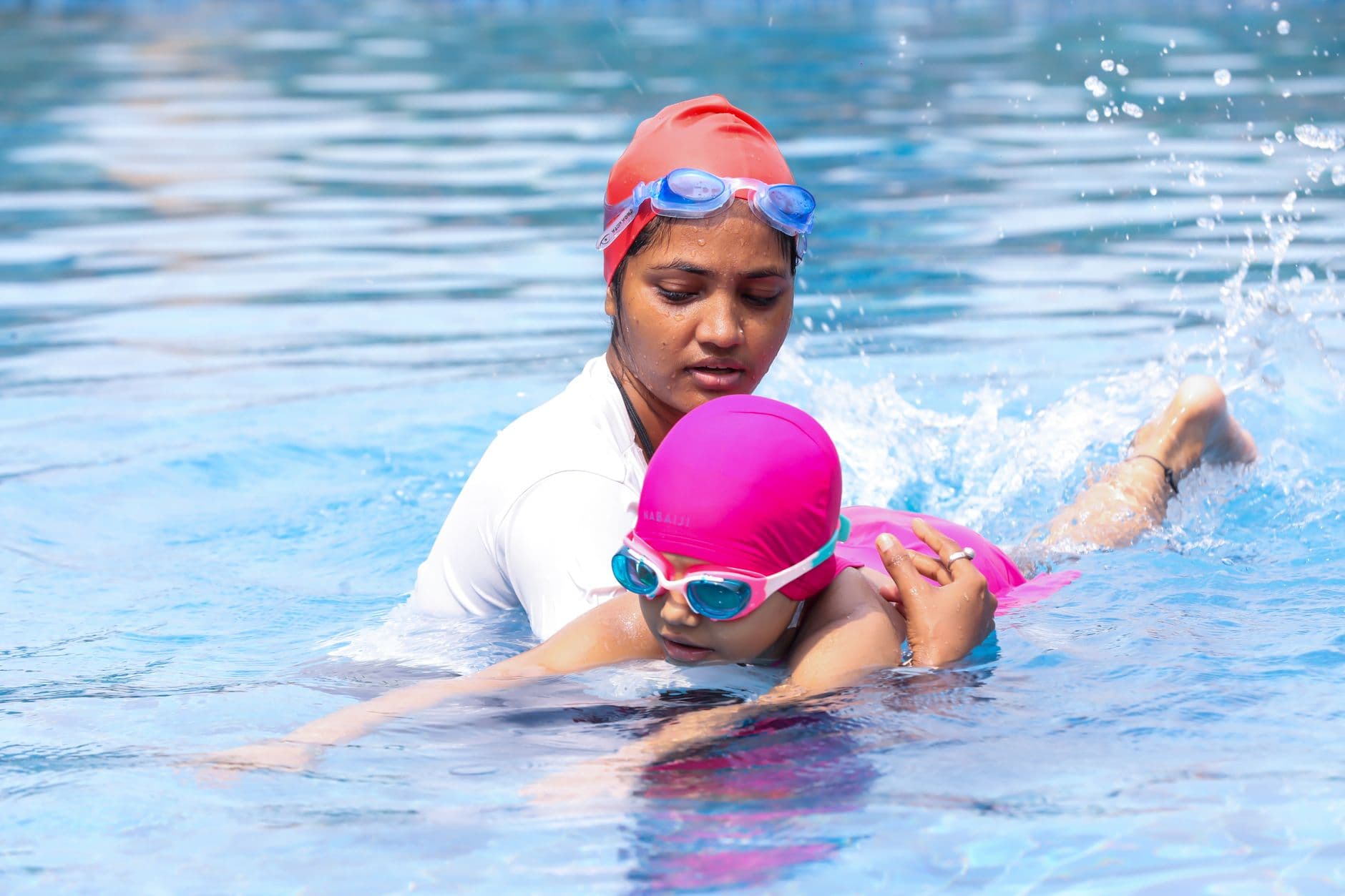
Search this question and you get a number back within half a second: one. Age one, first birthday, done. It is not wrong, but it is an answer to a question most parents are not actually asking, and the gap between the two is where the bad advice lives.
There are two questions tangled together here. When can my baby be in the water? And when do swimming lessons start counting as a defence against drowning? Those have different answers, from different bodies, for different reasons. This page separates them, says who published each threshold, and links every figure to the organisation that published it.
The short answer, and the two questions hiding inside it
If you want the one-line version: formal lessons from the first birthday, water from much earlier, and neither one replaces a fence or your eyes.
The reason the internet collapses this into a single number is that the number is genuinely the recommendation — for lessons. Australia's government health service, healthdirect, lists among its home drowning-prevention steps: “Teach children over 1 year of age to swim.” That is as unambiguous as public health guidance gets.
But a parent with a four-month-old who asks this question is usually not asking about a structured learn-to-swim programme. They are asking whether it is safe to get in the pool at all. And there the answer is yes, much earlier, from a completely different set of sources.
Where the official thresholds actually sit
Laid side by side, the guidance from the main English-speaking health and swimming bodies is more coherent than it looks. It only seems contradictory because each one is answering a slightly different question.
- Formal lessons, Australia. healthdirect: teach children over 1 year of age to swim.
- Formal lessons, United States. The American Academy of Pediatrics publishes the governing document, its Prevention of Drowning policy statement of July 2026. On its own public pages the AAP words the measure as “swim lessons once children are ready” and, in its own magazine, “swim lessons as soon as a child is developmentally ready” — a readiness test, not a date.
- Being in water, United Kingdom. The NHS: “You can take your baby swimming from a very young age – there's no need to wait until they've been vaccinated.”
- Structured baby programmes, United Kingdom. Swim England's Pre-School Framework covers “babies and toddlers between 0-5 years-old” and states that “Infants can start swimming from birth” — with the condition, repeated on its framework page, that this is “subject to Health Visitor advice being followed”.
- When swimming is usually learned. Australia's Raising Children Network: “many children can learn to swim by the time they're 4-5 years old”.
So: water from birth with a health visitor's nod, lessons as drowning prevention from one, and actual swimming somewhere around four or five for most children. Three different numbers, three different claims, none of them in conflict.
Why the first birthday is the line
The threshold is not bureaucratic. It tracks two things that change at roughly the same time.
The first is risk. CDC data is blunt about it: “More children ages 1–4 die from drowning than any other cause of death.” For ages 5–14 drowning drops to second among unintentional injury deaths, behind road crashes. healthdirect explains the mechanism without euphemism: “1-year-old toddlers are at the highest risk of drowning. This is because they are more mobile and curious, without understanding the dangers of water.” The danger arrives with walking.
The second is capability. Raising Children Network points out what anyone who has held a baby in a pool already knows: “Babies and toddlers are top heavy, which puts them at higher risk of drowning. If they fall into shallow water, they can't always lift themselves out.” Under a year, a baby cannot reliably roll, orient, reach a wall or hold a position. Those are the raw materials of every survival skill a lesson teaches. Without them there is nothing to teach yet.
Which is why the under-one answer is not “too young to be in water”. It is too young for a lesson to be doing the job you are buying it for.
Water from birth is not the same as lessons
This is the distinction the search results almost never make, and it is the one that changes what a parent does on Saturday morning.
Taking a baby into a pool is a developmental and social activity with real value, and both the NHS and Swim England support it from very early. Note the NHS line specifically addresses the most common worry — vaccinations — and dismisses it. Swim England's awards start at birth. The one condition both attach is to run it past your health visitor first, which is not boilerplate: it exists because a particular baby may have a reason to wait.
What those programmes are not is a drowning countermeasure for an infant. Nobody serious claims otherwise. If you are enrolling a six-month-old, enrol them for the water confidence, the handling practice and the half hour in warm water — all legitimate — and keep your expectations of safety benefit at zero until much later.
The readiness signals that beat the birthday
The AAP's own phrasing — lessons “as soon as a child is developmentally ready” — puts the decision on the child in front of you rather than the calendar. In practice, the signals worth watching are the ones a teacher can build on:
- Can they follow a one-step instruction? “Hold the wall.” “Blow bubbles.” A lesson is instruction; without this it is supervised play, which is fine but should not cost forty pounds a session.
- Do they tolerate water on the face? Not enjoy — tolerate. A child who panics at a splash will spend the lesson being calmed rather than taught. Start at the bath.
- Can they be separated from you for ten minutes without distress? This decides whether you are buying a parent-and-child class or a class where you watch from the side.
- Do they have the trunk strength to hold a horizontal position when supported? This is the physical prerequisite for everything else, and it arrives on its own schedule.
A child of three who has none of these will get less from a term of lessons than a child of eighteen months who has all four. If your child is older and the blocker is fear rather than development, that is a different problem with a known route through it — the sequence in our guide to getting over a fear of water was written for adults but the steps are the same ones, in the same order, at any age.
What the evidence for lessons actually shows
You will see “88% reduction in drowning risk” attached to swim lessons everywhere, including on the learn-to-swim page of Water Safety USA itself. The CDC puts the same claim more carefully: “Formal swimming lessons can reduce the risk of drowning.”
The 88% comes from a single case-control study of 88 drowning deaths published in 2009, and among 1- to 4-year-olds its confidence interval runs from 0.01 to 0.97 — consistent with a reduction anywhere between 3% and 99%. We take that study apart properly, including what it found about informal parent-led teaching, in how to teach a child to swim. The short version: it is the best evidence there is, it points towards lessons helping in exactly the 1–4 age band, and it is nowhere near precise enough to carry the weight the marketing puts on it.
The AAP's framing is the one to hold on to. Its policy statement opens by saying that “multiple layers of prevention are necessary, because no single method is effective in preventing drowning”. Lessons are one layer. They are not the layer.
What a lesson looks like at one, at three, at five
Knowing roughly what you are paying for at each stage stops you from reading normal progress as failure.
Around one. Parent in the water, almost always. The content is breath cueing, back floating with support, holding the wall, getting in and out safely. Nobody is swimming. The output you should expect is a child who is not frightened and who associates the pool with you being calm.
Two to three. Still usually parent-assisted, with short unsupported moments. Face in the water, blowing out rather than holding in, a few seconds of independent float, turning towards the wall. If your child can float on their back unaided by the end of this stage you are ahead; it is the single most useful thing they will learn, and the mechanics of why legs sink during a back float are worth understanding before you try to help at home.
Four to five. This is where swimming appears, which matches the Raising Children Network's “many children can learn to swim by the time they're 4-5 years old”. Expect unsupported distance to start accumulating in metres rather than seconds, plus treading or sculling to stay in place — the same skill covered in treading water without getting tired.
Six and up. Strokes get names and corrections. Swim England notes that children typically complete its full Stage 7 pathway “between the ages of 7 and 11 years old”. Benchmarks here are often written as 25 yards in the US and 25 metres in the UK and Australia, which are not the same distance; our course and distance converter handles the arithmetic if you ever need to compare the two.
The sentence that undoes the rest
Water Safety USA is the consortium of the AAP, the CDC, the American Red Cross, the Coast Guard and others. Its guidance for choosing a programme contains the sentence that every page on this topic should be built around: a good programme teaches skills “while acknowledging that no child, or person, is ever water-safe or drown-proofed”.
The CDC says the same thing operationally: “Children who have had swimming lessons still need close and constant supervision when in or around water.” Raising Children Network: watch closely “even when your child can swim”.
Be especially sceptical of any programme that implies a baby or toddler can be made safe, or that a child who can float is out of danger. Water Safety USA describes the circumstances of young children who drowned in pools: most “were last seen in the home, had been out of sight less than five minutes, and were in the care of one or both parents at the time”. Competence did not fail. Attention did.
Dunking, submersion and “self-rescue” courses
Infant programmes that submerge babies, sometimes repeatedly, are widely marketed and the question comes up constantly. There is a clear published position from a national governing body on this.
Swim England states it in two sentences on its Pre-School Framework: “Forced infant submersion is not recommended by Swim England”, and “Swim England believe submersion should be voluntary as and when the child is ready.” That is a straightforward test you can apply from the poolside in the first five minutes of a trial lesson. If babies are going under because an adult decided it was time, rather than because they went willingly, you are watching something a governing body has specifically declined to endorse.
On programmes that promise a baby will roll onto their back and float until rescued: treat the claim as unproven rather than false, and never let it change your supervision. The evidence base for lesson effectiveness sits in the 1–4 band, not below it, and “drown-proofed” is a term the bodies that publish the guidance explicitly reject.
How to tell a good programme from a bad one
Water Safety USA publishes a checklist for exactly this, and three items on it are things you can verify before handing over any money.
- Ratios. “Best practice for young or beginner level swimmers, without a caregiver in the water with them, is an instructor-to-student ratio of 1:4 or fewer”, and no more than one instructor to six students. Count heads in the lane.
- A lifeguard who is not the teacher. The checklist asks for “certified lifeguard(s) assigned to patron surveillance during swim lessons in addition to the swim instructor(s)”. An instructor watching four toddlers is not also surveilling the pool.
- You can watch. “Best practice involves the parent/caregiver always being able to watch the lesson.” A programme that moves parents out of sight has removed your only means of checking any of the above.
Add the obvious ones: nationally recognised teaching qualifications, classes grouped by ability rather than only by age, and water warm enough that a small child is not shivering through the useful half of the session. The five-skill finish line is a better measure of a programme than the number of badges it hands out.
The barriers doing the real work while your child learns
Between the first birthday and competent swimming there are years in which your child is mobile, curious and unable to save themselves. The layers that cover that gap are physical, not educational.
The AAP's technical report lists the proven strategies as four-sided isolation pool fencing with self-closing and self-latching gates, close and constant supervision, swimming competency, life jacket use when boating, and early rescue and resuscitation. The CDC specifies the fence: “at least four feet in height and fully encloses the pool”. In most Australian states and territories, Raising Children Network notes, pool fencing meeting Australian Standard 1926 is a legal requirement for any private pool or spa 30 cm deep or more, inflatables included.
On supervision, healthdirect gives the standard worth writing on the fridge: “Supervision means keeping constant visual contact with your child. You should keep them within arm's reach at all times.” And the line that catches most households out: “Supervise even if your child is using an inflatable flotation device (such as a ‘floatie’).” Armbands are a toy, not a barrier.
One more number for scale. Raising Children Network: “For every child who dies from drowning in Australia, approximately 7 other children are hospitalised from near-drowning incidents”, some with severe brain damage. The AAP's technical report counts 981 US children under 20 who died from drowning in 2023. These are not rare events happening to careless families.
If something happens in the water
If a child is pulled from the water after any submersion incident, healthdirect's instruction is unconditional: anyone involved in a drowning incident “should see a healthcare professional for a medical assessment, even if the incident was minor or they seem to have recovered”. A child who has been resuscitated needs close monitoring, because deterioration can follow minutes or hours later.
Call emergency services and start CPR if a child is unresponsive or not breathing. For what the warning signs in the hours afterwards actually are — and what the internet gets wrong about them — see is dry drowning real. Nothing on this page is medical advice, and anything concerning about your own child's breathing, development or readiness for lessons is a conversation for your paediatrician, GP or health visitor.
If you are the adult in the water and your own swimming is the weak link, that is worth fixing first and is entirely doable — the route is in learning to swim as an adult, and the rest of our technique guides pick up from there.
Frequently asked questions
What age should a child start swim lessons?
For formal lessons, the first birthday. Australia's healthdirect says to teach children over 1 year of age to swim, and the American Academy of Pediatrics words its own guidance as lessons once a child is developmentally ready. Babies can be taken into water much earlier than that, but no body recommends infant lessons as drowning prevention.
Can a baby under one go swimming?
Yes. The NHS says you can take your baby swimming from a very young age, with no need to wait for vaccinations, and Swim England's framework starts from birth subject to health visitor advice. Treat it as water confidence and time together, not as safety training: at that age a lesson cannot give a baby skills they are not yet developmentally able to use.
Do swim lessons stop a child from drowning?
They reduce risk but do not remove it. Water Safety USA, whose members include the AAP and the CDC, states that no child or person is ever water-safe or drown-proofed, and the CDC says children who have had lessons still need close and constant supervision. Four-sided fencing, constant supervision and life jackets are the layers that do the heavy lifting.
Is it safe for a baby to be dunked underwater in a lesson?
Swim England states that forced infant submersion is not recommended, and that submersion should be voluntary as and when the child is ready. That is a usable test at a trial lesson: if babies are going under because an adult decided it was time rather than because they chose to, you are watching something a national governing body has declined to endorse.
At what age can most children actually swim?
Australia's Raising Children Network says many children can learn to swim by the time they are four to five years old. Swim England reports that children typically complete its full seven-stage learn-to-swim pathway between the ages of seven and eleven. Progress before four is normal and useful, but it is usually floats, breath control and wall skills rather than swimming.
Sources
- Prevention of Drowning: Policy Statement (July 2026) — American Academy of Pediatrics, Pediatrics
- Prevention of Drowning: Technical Report (July 2026) — American Academy of Pediatrics, Pediatrics
- Drowning Prevention and Water Safety — American Academy of Pediatrics
- Counseling Families About Water Safety — American Academy of Pediatrics, AAP Voices
- Drowning Facts — Centers for Disease Control and Prevention
- Drowning Prevention — Centers for Disease Control and Prevention
- Water safety for babies and children — healthdirect Australia
- Water safety and drowning prevention for kids — Raising Children Network, Australia
- How to keep your baby or toddler active — National Health Service, UK
- Swim England Pre-School Framework (teachers) — Swim England
- Swim England Pre-School Framework — Swim England
- What to Look for in a Learn-to-Swim Program — Water Safety USA
- Learn to Swim — Water Safety USA
- Brenner RA et al. (2009) — Association between swimming lessons and drowning in childhood — Archives of Pediatrics & Adolescent Medicine
Read next
Why do swimmers wear two caps? To pin the goggle straps down
The second cap covers the goggle straps and stops the first one wrinkling. Two caps is explicitly legal, and two is the written maximum — here is the rule.
Why swimmers get disqualified: the calls officials make
A disqualification is a procedure, not an opinion. Who is allowed to call one, what goes on the slip, what the code means, and how it can be challenged.
Can you wear contact lenses swimming? What the eye bodies actually say
The FDA, the CDC and UK and Australian eye bodies all say take your lenses out before you swim — and the reason is not chlorine. Here is what they are worried about.
SwimFast is an independent publication. We are not a swim school, a coaching service or a governing body, and nothing here is medical advice. Training paces and test protocols are cited from the published research or federation documents linked on each page. Never swim alone, never attempt breath-hold work without supervision, and check with a doctor before starting a new training programme.