Swimming while pregnant: what the guidance actually says
The official 150-minute target turned into pool sessions, the water temperature limit from the review that measured it, and the warning signs that mean get out.
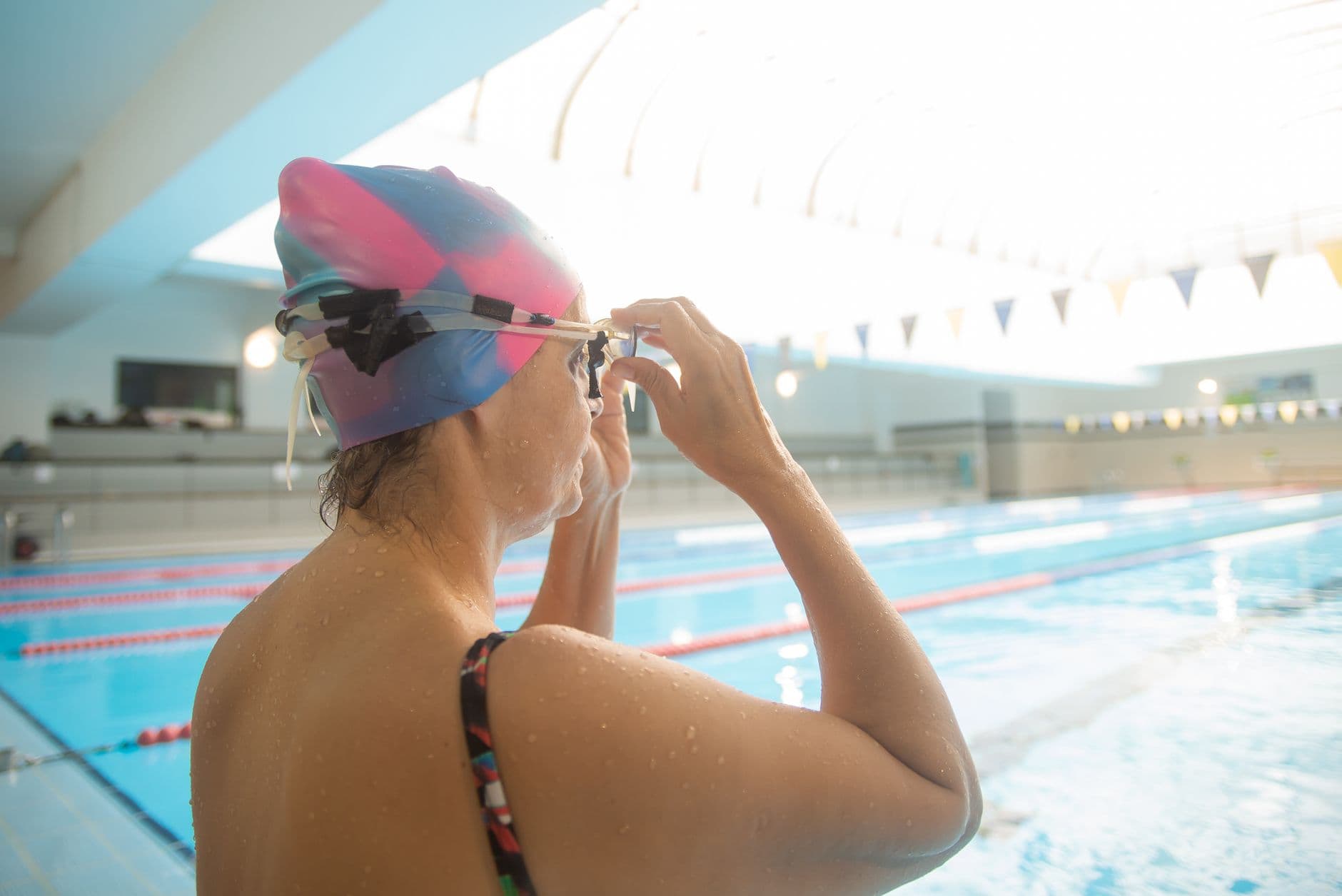
Search "swimming while pregnant" and you get a wall of reassurance with nothing behind it. Swimming is on every official list of the safest activities in pregnancy, and almost none of the pages saying so will tell you how long, how hard, how warm the water can be, or what should make you get out.
The guidance exists, and it has numbers in it. This page takes the figure the health bodies publish — 150 minutes of moderate activity a week — and turns it into pool sessions, with the water temperature limit from the one systematic review that measured it, the warning signs verbatim from the people who wrote them, and the swimming-specific parts general pregnancy advice leaves out.
This page summarises published guidance. It is not medical advice and it cannot clear you to train. Every official document starts from the same condition: an uncomplicated pregnancy with no obstetric or medical contraindications. Whether yours is one of those is a clinical judgement, so talk to your midwife or ob-gyn before you start or change anything — early, at a routine appointment, not after something goes wrong.
What the guidance actually says, in four lines
Here is the whole official position. The rest of the page is where each piece comes from and what it means at the pool.
- 150 minutes of moderate-intensity aerobic activity a week. Both ACOG and the NHS give the same number, and the NHS points out it is the same advice given to all adults. Pregnancy does not lower the target.
- Swimming is specifically named as one of the safest options. ACOG lists "swimming and water workouts" alongside walking and stationary cycling, on the grounds that the water supports your weight so you avoid injury and muscle strain.
- Moderate means you can talk but not sing. That is the test in both documents. Not a heart rate, not a pace — a sentence.
- If you were already swimming, you can carry on. ACOG's Committee Opinion 804 is explicit that women who were physically active before pregnancy can continue during it. What you should not do is take up a new vigorous sport now; the NHS says starting something like running in pregnancy is not recommended.
Why 150 minutes a week is not 150 lengths
The target counts minutes of moderate activity, not minutes in the building. A 45-minute trip that includes ten minutes changing, five standing at the shallow end and six rest stops is not 45 minutes of activity. It might be 25. That is fine — it is just worth knowing which number you are counting.
ACOG offers two ways to break the target up: 30 minutes on five days a week, or blocks of about ten minutes spread through the day. The NHS says the same and adds the line that matters most if you are tired and nauseated: "If you cannot do 150 minutes each week, do what you can. Any activity is better than none."
Neither body expects a beginner to arrive at 150. ACOG says start with as little as five minutes a day and add five a week until you can stay active for 30; the NHS suggests starting around ten minutes a day. Our guide to how many laps make a good swim workout sets out the usual beginner-to-regular range — read it as the ceiling you are walking towards, not a standard to hit this week.
The NHS also asks for two sessions of muscle-strengthening work a week on top of the aerobic minutes. Swimming does not count for that, which is a point most swimming pages skip.
Use the talk test, not your heart rate zones
If you train with a watch, this is the section that will annoy you: the official intensity test in pregnancy is not a number. ACOG defines moderate intensity as "moving enough to raise your heart rate and start sweating" while "you still can talk normally, but you cannot sing". The NHS wording is "you should be able to talk but not sing".
There is a physiological reason the guidance does not hand you a target heart rate, and it is doubly true in water. Pregnancy raises your resting heart rate, which shifts every zone you had. Immersion pushes it the other way: in a small comparative study, seven women at 25 weeks' gestation cycled on land and in water at the same 70% of maximum oxygen uptake, and heart rates and systolic blood pressures were significantly lower during the immersion trial at identical effort. Same work, different number on the watch.
So a heart rate that looks easy may not be, and one that looks hard may not be either. If you train by heart rate, read our guide to swimming heart rate zones for what those zones assume — then set them aside and go by whether you can hold a conversation at the wall. Same for pace work: a CSS test is a maximal effort by design, which is exactly what this period is not for.
What the water is actually doing for you
The reason swimming keeps appearing on the safe list is not vague. Three measured effects do the work.
It takes the weight off, and the amount has been measured. Eleven women at around 32 weeks were weighed while immersed to the xiphoid process — roughly chest-deep. Their apparent weight fell by a mean of 82.9% of body weight (SD 6.5). In the same study, three standing water exercises produced peak vertical ground reaction forces of only 0.67 to 0.72 times body weight, which the authors describe as low odds for musculoskeletal injury. That is the argument for water in one figure: the load that bothers your pelvis and lower back largely stops existing.
It moves fluid out of your legs. Nine women in the second or third trimester with marked swelling did a single 45-minute upright water exercise session. Lower leg volume, measured by water displacement, fell by 112 ml on the left and 84 ml on the right. Nine women is nine women, and it was one session — but the mechanism is well understood, and it is why swimmers so often report their legs feel better after a swim than before.
It keeps you cooler than the same effort on land. Water carries heat away from you far faster than air does — which matters more here than in any other sport, and comes with an actual number. Next section.
What the trials show, and where the evidence thins out
It is worth being straight about the strength of the evidence here, because enthusiasm runs ahead of data.
A 2022 systematic review and meta-analysis pooled 17 randomised controlled trials covering 2,439 women. Aquatic exercise prevented excessive maternal weight gain, mean difference −1.66 kg (95% CI −2.67 to −0.66), and was associated with a small reduction in birth weight, mean difference −89 g (95% CI −143 to −35). The authors also reported better body image, less sick leave for low back pain and improved glucose tolerance.
And then the honest part, from the same paper: the average methodological quality of those trials scored 5.05 on the PEDro scale, which is middling, and the authors say more research is needed on fitness outcomes. ACOG's position is similarly measured — activity in pregnancy is "associated with minimal risks" and benefits "most women". Reasonable to act on; not the same as proven.
Where these numbers come from
The 150-minute target, the talk test and the warning-sign list are from ACOG's patient FAQ on exercise during pregnancy (reviewed November 2025) and the NHS page on exercise in pregnancy (reviewed September 2026), cross-checked against ACOG Committee Opinion 804 (2020, reaffirmed 2023). The buoyancy and ground-reaction-force figures are from Alberton and colleagues (2019), eleven women at 32 weeks; the leg volumes from Hartmann and Huch (2005), nine women; the heart rate comparison from Katz and colleagues (1990), seven women at 25 weeks; the temperature limits from Ravanelli and colleagues (2019), twelve studies totalling 347 women. Every swimming study here is small, and the one pooled estimate rests on trials of average quality.
Water temperature: the one number worth knowing
"Don't get overheated" is the standard advice and it is useless without a threshold. There is one, from a 2019 systematic review in the British Journal of Sports Medicine that set out to replace exactly this ambiguity.
The concern is maternal core temperature reaching 39.0 °C, the level associated with risk to the fetus. The review pooled twelve studies covering 347 pregnant women across exercise and passive heat exposure. No woman exceeded 39.0 °C. The highest single reading anywhere in that literature was 38.9 °C, during land-based exercise. For water immersion exercise, mean core temperature at the end of the trial was 37.5 °C (95% CI 37.3 to 37.7) — a degree and a half below the threshold.
From that, the authors put a figure on it: immersion exercise in water up to 33.4 °C for up to 45 minutes, at any stage of pregnancy, without core temperature approaching the threshold.
Now put that next to a real pool. World Aquatics requires competition pools to be held between 25.0 °C and 28.0 °C (about 77–82 °F) under article 15.11.1 of its facility rules, and ordinary lap pools sit in the same region — five to eight degrees below the review's limit. A lap pool is not the thing to worry about.
What is worth checking is anything warmer: hydrotherapy and baby-swim pools often run at 33–35 °C, at or past that figure, and hot tubs, saunas and steam rooms are a separate question — ACOG's instruction is to avoid becoming overheated, especially in the first trimester. If your pool feels noticeably warm, ask what it is set to and raise it with your midwife rather than guessing.
Why your usual pace feels so much harder
This is the part general pregnancy advice cannot tell you, and it is the most common thing swimmers notice: the set you did on 2:00 last season now feels like a test, and it is not because you have lost fitness.
A U.S. Masters Swimming review of the physiology makes the mechanism plain. Pregnancy increases the volume of air you move per minute, and total lung capacity does not change — but maximum ventilation during swimming drops significantly, because the hydrostatic pressure of the water and the growing uterus pressing upwards both restrict how far the diaphragm can move, and because swimming dictates when you are allowed to breathe at all. Maximal oxygen uptake holds up in most sports during pregnancy and appears to decrease specifically in swimming. On top of that, the energy cost of a given pace rises with body mass.
So the same pace is a higher percentage of a lower ceiling, through a smaller breath. Your times are supposed to slow down. The practical response is to stop training off last year's intervals: lengthen every send-off, make the rest long enough that you start each repeat able to talk, and if you are counting anything, count it with our pace calculator after the session rather than chasing a clock during it. Our guide to breathing in freestyle is worth a re-read — breathing every two strokes instead of every three is the right call here, not a step backwards.
That article dates from 2002 and quotes the 1994 ACOG guidelines, superseded twice over since. Use it for the swimming physiology, which has not changed, and ACOG and the NHS for what to actually do.
Three pool weeks that add up
Nothing below is prescribed by any guideline — the guidelines give you 150 minutes and a talk test, and these are three ways of arranging them. Adjust everything to what your midwife says and to how you feel on the day.
New to the water. Three visits a week, 15–20 minutes of swimming each, one or two lengths at a time with as long as you like at the wall. Walking widths, flutter kick on the wall and easy breaststroke all count. Build duration first; our guide to learning to swim as an adult covers the sequence, and lane etiquette saves you the awkwardness of a shared lane.
Already swimming twice a week. Three or four sessions of 30 minutes: long easy warm-up, a middle block of 50s or 100s with full recovery, genuinely slow cool-down. Our swim warm-up guide applies unchanged; drop anything described as a sprint, a time trial or a broken set.
Masters swimmer. Keep the schedule, the drills and the technique work. Skip race pace, skip the dives, and tell your coach — a coach who knows will stop writing you into the fast lane's descend set. Swimming every day is not off the table if you were already doing it and the days are easy.
What changes by trimester
The trimester-by-trimester guidance from Tommy's, a UK pregnancy charity whose pages are clinically reviewed, lines up with the NHS and translates well to a pool.
First trimester (to week 12). Start gently if you are starting, carry on if you are carrying on. This is where overheating gets the most emphasis, which is an argument for the pool rather than against it. The obstacle is usually nausea and exhaustion, not technique — and "do what you can" is the official answer to that, not a concession.
Second trimester (weeks 13–28). Tommy's suggests swapping high-impact activity for low-impact, and swimming is the swap. Your centre of gravity has moved, which ACOG flags as a fall risk — that applies on the wet tiles and the ladder far more than in the water. This is also where the advice not to lie flat on your back for more than a few minutes starts to appear.
Third trimester (weeks 29+). This is where the water earns its reputation: the 82.9% apparent weight reduction was measured at about 32 weeks, and the pool is the only place in your week where that load comes off. Expect to be breathless sooner, expect push-offs to provoke reflux, and plan how you get out before you need to. Tommy's says you can stay active right up to the birth if you feel well — and also says not to wear yourself out.
The swimming-specific things the pregnancy lists leave out
General pregnancy advice was not written with a lane swimmer in mind. These are the gaps.
- No breath-holding. None. No hypoxic sets, no underwater lengths, no seeing how far you get on one breath. Breath-hold work can cause a blackout with no warning in anyone, and the consequence in water is drowning. It is the clearest rule on this page, and it has nothing to do with pregnancy except that the margin is smaller. Our guide on lung capacity and swimming explains why those sets never did what people think.
- Never swim alone. Lifeguarded pool, always, and that goes double for open water.
- Dives and racing starts are out. ACOG's list of activities to avoid is built around impact and fall risk, and a head-first start off a block is both. Get in by the steps.
- Think twice about flip turns. There is no guidance either way — that is the honest answer. What there is: a shifted centre of gravity, more reflux and a short inverted rotation. If a tumble turn makes you dizzy or sick, use an open turn; our flip turn guide is there for when you come back.
- Backstroke is a question for your midwife. The instruction is to avoid lying still on your back for more than a few minutes, because at rest the uterus can press on the vein returning blood to the heart. Swimming backstroke is not lying still, and no guidance document addresses it — the evidence genuinely stops here. If you feel dizzy, sick or short of breath on your back, roll over and swim freestyle.
- Scuba diving is explicitly ruled out by both ACOG and the NHS. Surface snorkelling is not the same activity; breath-hold freediving is covered by the first bullet.
- Open water adds everything else. Cold shock, no wall, no lifeguard in reach, currents and navigation. Our guides to your first open water swim and cramp while swimming cover risks that are there before pregnancy changes anything.
- Eat first, and take a bottle to the wall. The NHS warns that exercising on an empty stomach can make you faint, and blood glucose falls faster and further during exercise in pregnancy. You also will not notice sweating in a pool.
When to stop, and who to call
ACOG publishes a list of warning signs that mean stop exercising and call your ob-gyn. It is short, and worth knowing before you need it rather than reading on a phone at the poolside.
- Bleeding from the vagina
- Feeling dizzy or faint
- Shortness of breath before starting exercise
- Chest pain
- Headache
- Muscle weakness
- Calf pain or swelling
- Regular, painful contractions of the uterus
- Fluid gushing or leaking from the vagina
Any of those means out of the water and a phone call, not wait-and-see. The NHS adds the broader version: stop if you feel uncomfortable, too hot or unwell. "Calf pain or swelling" is on the list for a specific reason — the risk of a clot is raised in pregnancy — so do not file it as a cramp without saying so. And if you have a condition you already know about, the NHS is direct: speak to your midwife about which activities are safe for you, before you start.
Two practical notes. Getting out of a pool is a strength movement with a shifted centre of gravity on a wet surface: use the steps and a handrail through the third trimester. And tell the lifeguard as well as the instructor — the NHS asks you to tell the instructor, and the lifeguard is the one who would come in for you.
How to see progress when your times are going the wrong way
If you measure training by the clock, pregnancy will read as nine months of decline. That is the measurement failing, not you — a slower pace through a restricted breath is the expected outcome, not a sign you did it wrong.
Efficiency metrics behave better, because they are about technique rather than output. Stroke count per length and SWOLF — your time for a length plus the strokes it took — both reward smoother swimming at any speed, and you can hold or improve them while getting slower. Count your strokes on an easy 50 now and again, run it through our SWOLF calculator, and that is your progress chart. Our guide to what SWOLF is explains how to read it and where it misleads.
It is also the right time for the technique work you never get round to: body position, head position, a two-beat kick, bilateral breathing. None of it needs intensity, all of it keeps its value, and you come back with a better stroke than you left with.
Frequently asked questions
Is swimming safe during pregnancy?
In an uncomplicated pregnancy, yes — ACOG lists swimming and water workouts among the activities experts agree are safest, because the water supports your weight and you avoid injury and muscle strain. The caveat is the one every guideline opens with: no obstetric or medical contraindications. Whether that describes your pregnancy is a decision for your midwife or ob-gyn, so ask at a routine appointment.
How long should a pregnant woman swim for?
Aim for 150 minutes of moderate activity across the week, which ACOG suggests splitting into 30 minutes on five days or into ten-minute blocks. Count the minutes you are actually moving, not the time at the pool. If you are new to it, start at five to ten minutes a day and add five minutes a week; the NHS is clear that any activity beats none.
How warm is too warm for a pool in pregnancy?
A 2019 systematic review in the British Journal of Sports Medicine put the limit at water up to 33.4 C for up to 45 minutes of immersion exercise, at any stage of pregnancy, without core temperature approaching the 39 C threshold of concern. Lap pools run far cooler — World Aquatics requires 25 to 28 C. Hydrotherapy pools, hot tubs and saunas are a separate question for your midwife.
Can you swim in the third trimester?
Tommy's says you can stay active right up to the birth if you feel well and comfortable, and the third trimester is when water helps most: immersion to chest depth cut apparent body weight by about 83% in women measured at 32 weeks. Expect to be breathless sooner, use the steps rather than hauling yourself out, and stop at any of ACOG's warning signs.
Why am I so much slower in the pool than before?
Because the ceiling moved, not your fitness. Maximum ventilation during swimming drops significantly in pregnancy — hydrostatic pressure and the growing uterus both limit the diaphragm — and swimming is the one sport where maximal oxygen uptake appears to fall. A given pace also costs more energy at a higher body mass. Lengthen your send-offs and track stroke efficiency instead.
Can you swim backstroke while pregnant?
No guideline addresses it, so this is a genuine gap rather than a hidden answer. The advice is to avoid lying still on your back for more than a few minutes, because at rest the uterus can compress the vein returning blood to the heart; swimming backstroke is not lying still. Ask your midwife, and roll onto your front if you feel dizzy or unwell.
Sources
- Exercise During Pregnancy, FAQ119 (reviewed November 2025) — American College of Obstetricians and Gynecologists
- Physical Activity and Exercise During Pregnancy and the Postpartum Period, Committee Opinion 804 (April 2020, reaffirmed 2023) — American College of Obstetricians and Gynecologists
- Exercise in pregnancy (reviewed 24 September 2026) — NHS
- How active should I be in pregnancy? (reviewed 11 September 2026) — Tommy's
- Ravanelli N. et al. (2019), Heat stress and fetal risk: environmental limits for exercise and passive heat stress during pregnancy — British Journal of Sports Medicine
- Alberton C.L. et al. (2019), Water-based exercises in pregnancy: apparent weight in immersion and ground reaction force at third trimester — Clinical Biomechanics
- Cancela-Carral J.M. et al. (2022), Therapeutic aquatic exercise in pregnancy: a systematic review and meta-analysis — Journal of Clinical Medicine
- Katz V.L. et al. (1990), Nonweightbearing exercise during pregnancy on land and during immersion — American Journal of Perinatology
- Hartmann S., Huch R. (2005), Response of pregnancy leg edema to a single immersion exercise session — Acta Obstetricia et Gynecologica Scandinavica
- Moore J. (2002), Swimming and Pregnancy — U.S. Masters Swimming
- Competition Regulations, Part Four, article 15.11.1 (water temperature) — World Aquatics
Read next
Are tech suits worth it? Read the rulebook before the price tag
A racing suit is the one piece of swim kit with its own rulebook and approval fee. What the rules demand, what the research measures, and who may not wear one.
How to taper for a swim meet: how long, how much less, what to keep
Two weeks, volume down 41-60%, intensity and frequency left alone. The numbers come from a meta-analysis of 27 taper studies rather than from club tradition.
What is a negative split in swimming, and does it make you faster?
A negative split is the second half of a swim being faster than the first. What the measured race splits and the pacing experiments say about whether it helps.
SwimFast is an independent publication. We are not a swim school, a coaching service or a governing body, and nothing here is medical advice. Training paces and test protocols are cited from the published research or federation documents linked on each page. Never swim alone, never attempt breath-hold work without supervision, and check with a doctor before starting a new training programme.