How to taper for a swim meet: how long, how much less, what to keep
Two weeks, volume down 41-60%, intensity and frequency left alone. The numbers come from a meta-analysis of 27 taper studies rather than from club tradition.
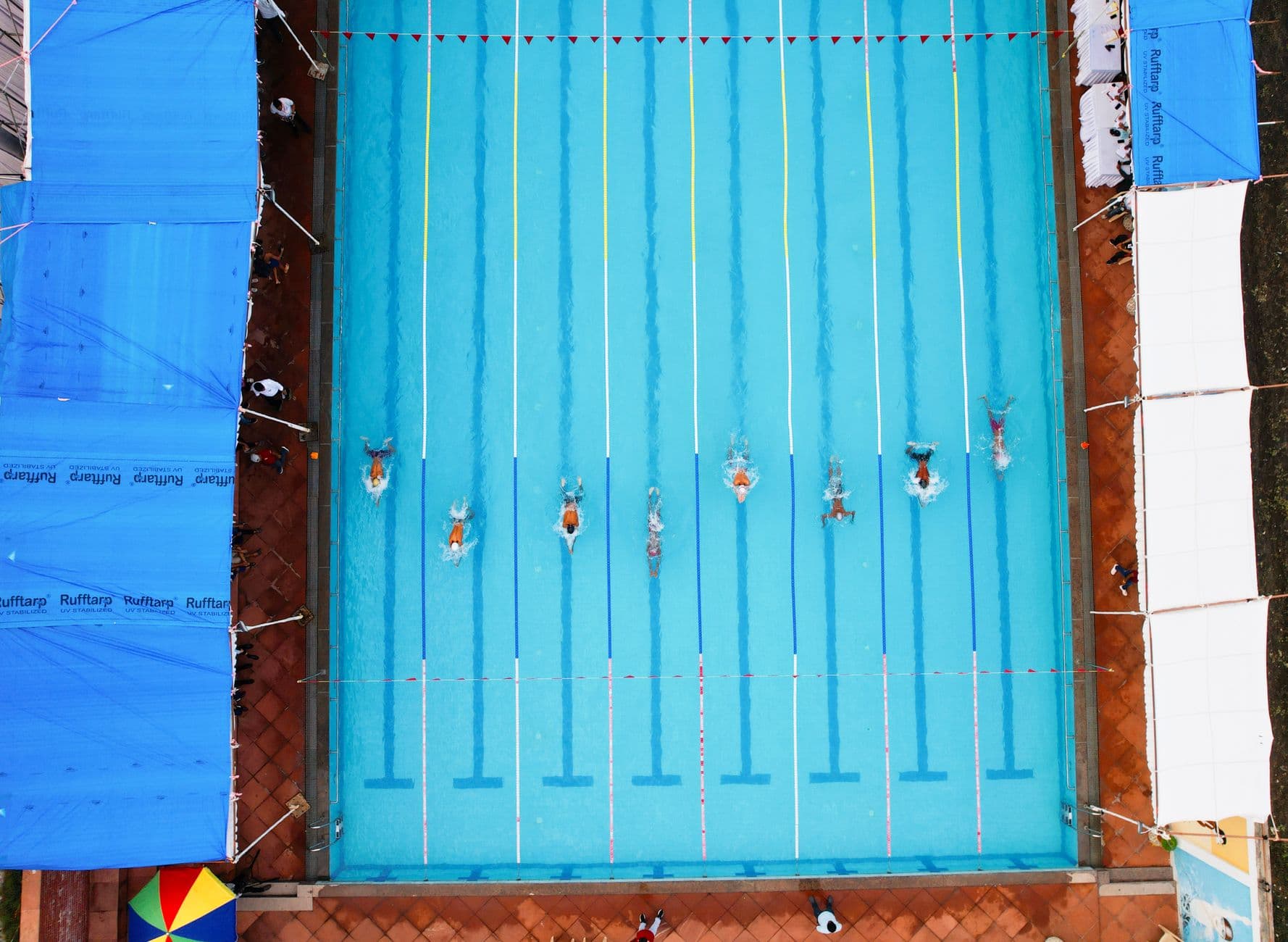
A taper is the stretch before a meet when you train less so you can race faster. Almost every swimmer has heard of it. What nobody seems to agree on is the part that actually matters: how long it should be, how much less you should swim, and which parts of training you are supposed to keep.
That disagreement is avoidable. Tapering is one of the few subjects in swimming with a genuine experimental literature behind it, including a meta-analysis that pulled apart the variables one at a time across 27 studies of competitive athletes. The numbers below come from that work rather than from club tradition. Where the evidence runs out — which happens sooner than you would like — this guide says so instead of filling the gap with a schedule somebody made up.
What a taper actually is
The standard definition, from the review that most coaching material quotes second-hand, is a progressive, non-linear reduction of the training load over a variable period, with the aim of reducing accumulated fatigue without giving up the adaptations you spent the season building.
That phrasing matters, because it names the whole trick. Training produces two things at once, and they move at different speeds. Fitness is slow to build and slow to lose. Fatigue is quick to build and quick to shed. For most of the season the two travel together, so you are fit and tired at the same time and your race times never show what you are capable of. A taper is the deliberate exploitation of that gap: you drop the input enough for the fatigue to drain away, and not for long enough that the fitness follows it.
Which also tells you what a taper is not. It is not a rest week. It is not stopping. It is not swimming easy for a fortnight and hoping.
A week of lighter work does not undo a season. As U.S. Masters Swimming puts it in its team taper plan, a well-conditioned athlete will not get out of shape in one week. The thing swimmers fear losing in a taper is the thing a taper is least able to take from them.
How long: two weeks is the best-supported answer
In 2007 Bosquet and colleagues screened 182 studies, kept the 27 that used competitive athletes, described how the load was actually reduced, and measured real competition or field performance. Then they tested each taper variable separately. The duration that came out on top was two weeks, with an overall effect size of 0.59 ± 0.33.
Two weeks is the default, not a law. The earlier review of the field put the useful range at anywhere from four days to more than 28, and a 2023 meta-analysis of 14 endurance studies found significant time-trial improvements in all three of its duration brackets — seven days or fewer, eight to fourteen days, and fifteen to twenty-one. Its conclusion was a ceiling rather than a target: up to about 21 days works.
The practical version for a swimmer with a date circled on the calendar:
- Two weeks is where the evidence is strongest. Start there.
- One week is a real taper, not a failed one. If the meet crept up on you, a seven-day cut still shows up in the research.
- Three weeks or more is defensible if you have been carrying a very heavy load for months, but you are past the part of the literature that has been tested properly and into the part where you are guessing.
How much less: cut volume, leave intensity alone
This is the finding worth tattooing somewhere. Of the three things you could reduce, only one of them is the lever.
In the Bosquet analysis, reducing volume by 41-60% in an exponential pattern produced the largest effect of any single manipulation: 0.72 ± 0.36. Changing training intensity produced 0.33 ± 0.14. Changing frequency produced 0.35 ± 0.17. The conclusion was that you cut the yardage and leave the other two where they are.
The swimming-specific reviews ask for deeper cuts than that. The 2003 review recommends reducing volume by up to 60-90% while maintaining intensity and trimming frequency by no more than 20%. The 1994 review written specifically about swimmers describes a successful taper as a graded 60-90% reduction in volume with daily high-intensity interval work over a 7- to 21-day window, and says frequency should fall by no more than 50% — with roughly 20% as the more conservative figure.
Those two answers look like a contradiction and mostly are not one. Read them against the starting point. The swimming reviews describe squad swimmers coming off five to ten kilometres a day, where cutting 50% still leaves a large session. The 41-60% band comes from pooling many sports with much lower baseline volumes. If you swim 3,000 m four times a week, you belong at the shallow end of that range, not the deep one. This is a reading of the two literatures rather than something either of them states, and it is worth saying so.
What you keep is the part people get wrong
A taper that goes wrong usually goes wrong here. Volume comes down, and intensity and frequency quietly come down with it, because an easy fortnight feels like what resting is supposed to be. Then race day arrives and nothing is sharp.
Three things stay:
- Race-pace work. The pace you intend to hold has to appear in training during the taper, with long rest around it. As the load drops, race pace starts to feel reachable — and that feeling is the information you need to pace the race. If you have never built a set around a target pace, the interval calculator and the pace clock are the two tools that make it possible.
- Frequency. Four sessions a week stays four sessions a week. Each one gets shorter.
- Technique detail. This is the part of the week that should expand, not shrink: streamlines, wall approaches, finishes, starts, turns, relay exchanges. All of it is low-fatigue and all of it is worth tenths. If your turns are approximate, taper fortnight is when that gets fixed.
One omission on purpose: coaching plans for race week often include breath-restricted or "hypoxic" sets. This guide leaves them out. Deliberate breath-holding in the water carries a drowning risk that no taper benefit justifies, and the reasons are set out in the guide on lung capacity and swimming.
What the gain actually looks like
The headline figure is about 3%, with a usual range of 0.5% to 6.0%. That is the number from the 2003 review across sports, and the swimming-specific review from 1994 reports the same consistent ~3% in competitive swimmers. On a 1:05 100 free, 3% is about two seconds.
Two honest qualifications. These are small samples — twelve to twenty-four swimmers each — of trained competitors inside a planned season, so the numbers describe what a taper can add to a body that has something to recover from. And the bottom bar is there deliberately: in the group of fourteen-year-olds, performance at the national championship was not significantly different from their season best after a two-week taper. A taper is a reliable effect, not an automatic one.
A two-week shape you can copy
The clearest published example aimed at adult swimmers is the U.S. Masters Swimming team plan, written for swimmers doing around 3,000 m a day, four days a week. It counts two quantities: total metres per session, and "quality metres" — the part swum at or near race pace. Volume comes down steadily; quality comes down last.
- Six weeks out — 2,400-2,800 m per session, of which 600-800 quality.
- Five weeks out — 2,400-2,800 m, of which 500-600 quality.
- Four weeks out — 2,200-2,400 m, of which 400-500 quality.
- Three weeks out — 2,200 m, of which 300-400 quality.
- Two weeks out — 2,000 m, of which 300 quality.
- Race week — 1,800-2,000 m, and no quality metres at all.
Two details that the numbers on their own do not show. Quality sets should appear only two or three times a week and never on consecutive days; the other sessions are the normal squad workout. And in race week the quality metres go to zero while the session length barely moves — what fills it is technique, starts, turns and finishes rather than hard swimming.
Scale it to your own training rather than copying the metres. If your normal session is 1,800 m, this plan is not your plan; the shape of it — volume down gradually, quality held then withdrawn, frequency untouched — is.
Race week: the last five to seven days
The last stretch has its own rule, and it is the one most swimmers break. All-out sprinting stops five to seven days before the meet. Recovery from maximal sprint efforts takes longer than recovery from almost anything else you do in the pool, and an all-out 50 three days out buys you nothing you can use on the day.
What replaces it: sets that build or descend to pace rather than start at it, with the fastest swim last; short repeats with two to four times the swim duration as rest; and a lot of time on the things that are free. Then sleep. Sleep through the whole taper and especially the night before, which is the single piece of advice every source in this guide agrees on without qualification.
And nothing new. Not a new suit, not new goggles, not a new warm-up, not a first massage, not a dive you have not practised. The warm-up you use on race day should be one you have already swum several times.
If you train four times a week, your taper is different
Most published taper research studies squad or collegiate swimmers. Most people reading this are not one. The adjustment is not complicated, but it is the opposite of what people expect.
If you have not trained hard enough to accumulate fatigue, resting will not do much for you. There has to be something to shed. A swimmer who trains three steady sessions a week and never finishes one tired has no fatigue debt for a taper to clear, and two weeks of less will mostly produce two weeks of less. In that situation the honest answer is that the race will be decided by the season, not the fortnight — and the work worth doing is in building the base before the next one.
At the other end, a swimmer who has been grinding very high volume for months may need considerably longer than two weeks to feel fresh. Age shifts it too, in both directions at once: older swimmers generally take longer to recover, and also tend to be carrying less total load to recover from. The guides on how often to swim and Masters age groups cover the surrounding context.
Sprinter, 200 swimmer, distance swimmer
The same two weeks should not look the same for a 50 freestyler and a 1500 swimmer, and the difference is mostly about how much of the work counts as damaging.
The USMS plan handles this with a weighting that is crude and useful: for a sprinter, 100% of a sprint set counts as quality metres — three broken 100s plus six fast 50s is 600 quality metres, full stop. For a middle-distance or distance swimmer, pace work is weighted at about 66%, because the tissue damage and glycogen cost per metre are lower. Ten 50s at 1500 pace counts as roughly 330.
Beyond the arithmetic:
- Sprinters thrive on short, intense, well-rested efforts through the taper, and need the hard stop a week out most of all.
- Distance swimmers tend to lose their feel and their focus if they back off too much. They need the volume cut to be the gentler end of the range.
- 200 swimmers are the hardest to taper, because the event has both halves in it. The usual compromise is to separate them — sprint quality one day, pace work another — rather than blend them. If you race the 200, the guide on negative splitting and the one on swimming the 100 faster are the two that bear on it directly.
Why you feel worse in the middle of a taper
This is the most useful thing in the research and almost nobody mentions it. When Trinity and colleagues measured maximal arm power every week through a collegiate taper, the gain did not arrive smoothly. It arrived in two instalments: roughly 50% of the total increase in the first week, about 5% in the second, and the remaining 45% in the third. That biphasic pattern was the most common individual response, not an average artefact.
So a swimmer who feels sharp after week one, flat and heavy through week two, and then good again in race week is following the documented curve. The failure mode is reacting to the middle week — adding a hard set, deciding the taper is not working, or panicking into a race-pace test. The second week is not evidence of anything.
Mood moves with it. In the 2024 study of competitive swimmers, two weeks of progressive volume reduction improved mood subscale scores by 20.8% to 47.8% and total mood disturbance by 14.4%, and the change in total mood disturbance correlated with the 50 m front crawl result (r = -0.63) in the tapering group. Feeling better and swimming faster travelled together — which is interesting, and also a correlation in 24 swimmers rather than a mechanism.
Diet, shaving and the rest of the folklore
The taper attracts rituals. Some of them hold up and some are just old.
On food, the guidance from the USMS performance dietitian is almost entirely deflationary. Carbohydrate matters throughout training, not as a single pasta dinner the night before; during the taper you keep eating the way you eat on hard training days, just less of it overall, because you are swimming less. Protein and fat do not get dropped. Be careful with a big jump in fibre in the 48 hours before racing, especially if it is not something you normally eat. Drink enough that urine stays light yellow to nearly clear, without drinking so much you are in the bathroom every ten minutes. And above all, introduce nothing new — no new foods, no new supplements, nothing that is not already part of your routine. Detail on the pre-race meal itself is in the guide on what to eat before swimming.
Shaving down is a separate question with its own measured evidence, and it is not covered here rather than being waved away. The suit and goggles question has a one-line answer: whatever you race in, you have already swum in.
When the taper does not work
Three explanations cover almost every disappointing taper, and only one of them is about the taper.
- There was not enough training behind it. No accumulated fatigue, nothing to shed. Covered above, and by far the most common case among adult swimmers.
- It was too much or too long. Volume cut too hard, too early, or intensity dropped along with it. The feeling is flat and disconnected from the water rather than fresh.
- It was never the taper. A mis-paced race, a bad turn, a season that did not build what the event needed. The fortnight gets blamed for the ten months.
Telling those apart requires having written something down, which is the real argument for keeping a log. In the study of young swimmers, training load estimated from session ratings of perceived exertion tracked load measured from lactate-based intensity zones closely (r = 0.80), and the swimmers whose load dropped most between the fourth week out and the last week were the ones who improved most (r = 0.63). A simple weekly note on how hard each session felt is enough to make the next taper a decision rather than a repeat.
A mid-season taper, treated as a rehearsal, is the cheapest way to find out how you personally respond — and the only way, since none of the published ranges can tell you where in them you sit.
Fatigue that does not lift with a week or two of reduced training is not a taper problem. Persistent heaviness, disturbed sleep, or performance that keeps falling despite rest are the signs that get labelled overtraining, and they are worth taking to a doctor or sports physician rather than training through. The same goes for pain: a taper does not resolve shoulder pain, and racing on it is how a niggle becomes a season.
Measure it instead of guessing
Everything above is a range, and ranges only become a plan once you know where you sit in them. Two numbers make the taper legible.
The first is your pace. A critical swim speed test taken before the taper starts gives you the pace your race-pace sets should be built around — and the CSS calculator turns the two time trials into that number. Do not run the test inside the taper: a maximal effort is exactly the sort of fatigue you are trying to get rid of, and the result will be distorted by the state you took it in anyway.
The second is the target itself. Work out the split you intend to hold with the pace calculator, then swim that split in training until it feels ordinary. A taper that ends with you knowing exactly what your race pace feels like, rested, has done its job. The rest of the workouts section covers the season that has to come first.
Frequently asked questions
How long should you taper for a swim meet?
About two weeks. That is the duration with the strongest support in the meta-analysis of 27 taper studies, and the one to start from. Seven days is still a real taper if the meet arrived sooner than planned, and the evidence stretches to around 21 days, but past three weeks you are beyond what has been properly tested.
How much should you cut your training volume during a taper?
Cut volume by roughly 41-60% and leave intensity and frequency alone — that combination produced the largest measured effect. Swimming-specific reviews recommend deeper cuts of 60-90%, but they describe squad swimmers doing five to ten kilometres a day. If you swim 3,000 m four times a week, the shallow end of that range is yours.
What does a swim taper mean, in plain terms?
It means progressively reducing how much you swim in the weeks before a race, without reducing how hard or how often. Fitness is slow to build and slow to lose; fatigue is quick to build and quick to shed. A taper opens a gap between the two so you arrive still fit but no longer tired.
Should sprinters taper differently from distance swimmers?
Yes, mainly in how much hard work counts. Sprint efforts are harder to recover from, so all of a sprinter's fast work counts against their quality total and all-out sprinting should stop five to seven days out. Distance swimmers lose feel if they back off too far, so they want the gentler end of the volume cut.
What should you eat during a taper?
Roughly what you already eat on training days, in smaller amounts, since you are swimming less. Keep carbohydrate through the whole taper rather than loading the night before, keep protein and fat, and go easy on unfamiliar high-fibre food in the last 48 hours. Introduce nothing new, including supplements.
Why do I feel slow and heavy in the middle of my taper?
Because that is the documented shape of the response. Measured arm power in collegiate swimmers rose sharply in the first taper week, barely moved in the second, then rose again in the third. The flat middle week is normal and is not a reason to add a hard set or test your race pace.
Sources
- Bosquet L, Montpetit J, Arvisais D, Mujika I. Effects of tapering on performance: a meta-analysis. Med Sci Sports Exerc, 2007 — Med Sci Sports Exerc
- Mujika I, Padilla S. Scientific bases for precompetition tapering strategies. Med Sci Sports Exerc, 2003 — Med Sci Sports Exerc
- Houmard JA, Johns RA. Effects of taper on swim performance: practical implications. Sports Med, 1994 — Sports Medicine
- Wang Z et al. Effects of tapering on performance in endurance athletes: a systematic review and meta-analysis. PLoS One, 2023 — PLoS One
- Trinity JD, Pahnke MD, Reese EC, Coyle EF. Maximal mechanical power during a taper in elite swimmers. Med Sci Sports Exerc, 2006 — Med Sci Sports Exerc
- Aouani H et al. Optimizing performance and mood state in competitive swimmers through tapering strategies. Front Psychol, 2024 — Frontiers in Psychology
- Ribeiro FA et al. Effects of training and taper on neuromuscular fatigue profile on 100-m swimming performance. Int J Sports Med, 2023 — International Journal of Sports Medicine
- Papoti M et al. Effects of taper on swimming force and swimmer performance after an experimental ten-week training program. J Strength Cond Res, 2007 — J Strength Cond Res
- Toubekis AG et al. Competitive performance, training load and physiological responses during tapering in young swimmers. J Hum Kinet, 2013 — Journal of Human Kinetics
- U.S. Masters Swimming — Six-Week Taper Plan for Your Entire Team — U.S. Masters Swimming
- U.S. Masters Swimming — What to Consider When Planning Your Taper — U.S. Masters Swimming
- U.S. Masters Swimming — The Dos and Don'ts of Your Taper Diet — U.S. Masters Swimming
Read next
Are tech suits worth it? Read the rulebook before the price tag
A racing suit is the one piece of swim kit with its own rulebook and approval fee. What the rules demand, what the research measures, and who may not wear one.
Swimming while pregnant: what the guidance actually says
The official 150-minute target turned into pool sessions, the water temperature limit from the review that measured it, and the warning signs that mean get out.
What is a negative split in swimming, and does it make you faster?
A negative split is the second half of a swim being faster than the first. What the measured race splits and the pacing experiments say about whether it helps.
SwimFast is an independent publication. We are not a swim school, a coaching service or a governing body, and nothing here is medical advice. Training paces and test protocols are cited from the published research or federation documents linked on each page. Never swim alone, never attempt breath-hold work without supervision, and check with a doctor before starting a new training programme.