How to read the pace clock and leave on the right interval
The top, the bottom, what "on the 1:30" means, and how to keep count of a set without following the swimmer in front. The clock skill nobody teaches adults.
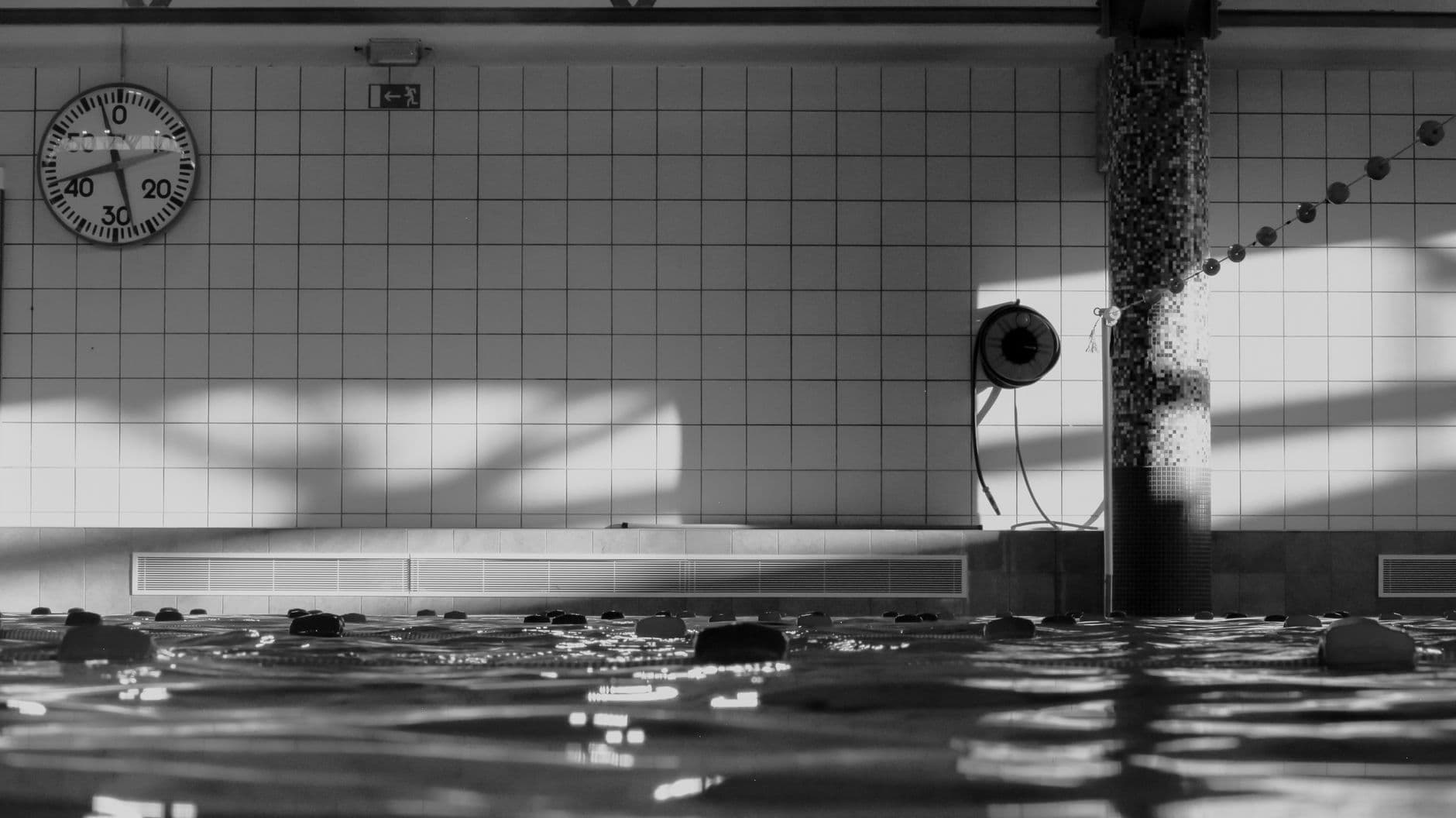
A swimming workout is written in a language that assumes one piece of equipment nobody ever taught you to use: the big clock on the pool wall. "8 × 50 on the 1:00, leaving on the top" is precise and unambiguous to the swimmer in lane one, and completely opaque until somebody explains the three or four conventions behind it. Most adult swimmers get around that by watching the person in front and pushing off a beat later, which works until the person in front is slower than you, or stops for a chat, or is not there.
This page is the explanation, in the order you need it standing at the wall.
What the clock on the wall is actually counting
A pace clock is not telling you the time of day, and letting go of that is the first step. It counts one minute, over and over: the long hand sweeps the face once every 60 seconds and then starts again, which is why U.S. Masters Swimming calls the traditional type a sweep clock. The face is numbered 0 — or 60, which is the same place — at the top, then 5, 10, 15 and round to 55. Those numbers are seconds, not minutes.
A smaller hand counts whole minutes, so a repeat longer than a minute still has somewhere to live. On a digital clock the same information arrives as mm:ss, counting upwards, and rolls over when the coach resets it.
None of this is modern. The pace clock arrived alongside circle swimming, interval training and the training logbook, all of them pioneered in the same Sydney squads by Forbes and Ursula Carlile from the 1950s on, which is how the International Swimming Hall of Fame records their contribution. The wall clock is the oldest piece of sports science in the building.
The top, the bottom, and why those two words do all the work
"Leaving on the top" means pushing off when the sweep hand reaches 0/60, the 12 o'clock position. "Leaving on the bottom" means pushing off at 30 seconds, the 6 o'clock position, half a minute later. On a digital clock they are :00 and :30. Between them they cover most of what a coach will ask of you.
The reason those two positions matter more than the other fifty-eight is that they let a lane split in half. Half the lane leaves on the top, half on the bottom, and the two groups stay 30 seconds apart all set without anybody needing to be told again. The same logic extends down the face: "on the five" is 5 seconds past the top, "on the 20" is the 20 mark, and so on.
Say the number out loud before you push off. It sounds childish, and it is the single thing that stops you from leaving on the wrong mark on repeat four, when you are breathing hard and the face is a blur.
Which hand to watch on an analog face
If your pool has an analog clock, two hands are moving and only one of them is giving you your send-off. The long hand that visibly travels while you look at it is the seconds hand: that is the one you follow. The short one creeping round is counting minutes, and you only need it for repeats longer than 60 seconds.
The face itself is usually printed in contrasting red and black — Kiefer lists exactly that in the specification of its convertible clock — and the colours are not decoration. They exist so that a hand position reads as a shape from the far end of a lane, at a glance, which is the whole design brief of the thing. The practical test for which hand is yours stays the same: it is the one that moves while you are looking at it.
If the clock in your pool has more than one long hand, do not guess. Ask which one the lane is following before the set starts, because a hand half a minute out of phase with the one you want will put you half a minute out on every repeat.
A practical note that has nothing to do with technique: if you cannot read the face through fogged lenses, you are not swimming to a pace at all, you are guessing. That problem has its own fix, in how to stop goggles fogging.
Digital clocks, and what changes
Newer pools run LED clocks — the manufacturers sell them as pace clocks with the same name — and several of them on a deck can be synchronised so every lane sees the identical number, with some models adding lap timers and split displays on top of the basic count. Colorado Time Systems publishes the configurations and user guides if you want to know what the box on your wall can do.
What changes for you is small but real. A digital readout is easier to read exactly, which is better for taking your own time. An analog face is easier to read at a glance, because "a quarter past" is a shape rather than a number, and a shape survives being seen for a tenth of a second between breaths. Swimmers who learnt on sweep clocks often miss them for exactly that reason.
The vocabulary carries over unchanged: :00 is still the top, :30 is still the bottom.
What "on the 1:30" means
An interval, or send-off, is the total time allowed per repeat — swim and rest together, measured from the moment you push off to the moment you push off again. "10 × 100 on the 1:30" means you leave every 90 seconds, ten times. If the 100 takes you 1:20, you get 10 seconds on the wall. If it takes 1:28, you get 2 seconds and you are in trouble.
That is the whole mechanism, and it is why coaches write sets this way rather than saying "rest 15 seconds": the faster you swim, the more rest you earn, so the set polices itself. It also means two swimmers on the same send-off are doing genuinely different workouts, which is the point.
| Your 100 time | Rest on a 1:30 send-off |
|---|---|
| 1:05 | 25 s |
| 1:10 | 20 s |
| 1:15 | 15 s |
| 1:20 | 10 s |
| 1:25 | 5 s |
Read that table from the top down and you can see the set changing character. Twenty-five seconds on the wall is comfortable aerobic work; fifteen is threshold territory; ten is hard but workable for most adult swimmers; five is not a set at all, it is a countdown to the repeat where you stop. The arithmetic is trivial and the implication is not: your rest is whatever the send-off leaves over, so a send-off chosen five seconds too tight does not make you five seconds fitter, it deletes a third of your recovery. The interval calculator does this in the other direction — you give it a pace and the rest you want, it gives you the send-off, rounded to a mark you can actually read.
Rest interval versus send-off
Some coaches give a rest interval instead, written "RI :20" or just "20 seconds rest". You swim, you rest 20 seconds from the moment you touch, you go again. It is easier to execute and, as U.S. Masters Swimming points out in its own primer, easier to swim: you cannot miss it, so there is no pressure to earn your rest.
Which one you want depends on the day. A fixed rest interval is the better tool when the set is about technique, when the lane is mixed in speed, or when you are coming back from a layoff. A send-off is the better tool when you are training a pace, because it attaches a consequence to slowing down. Beginners are often handed fixed rest for weeks before anyone mentions a send-off, and that order is sensible.
Your first set on the clock, step by step
Try 8 × 50 on the 1:15. Here is the whole procedure.
- Stand at the wall and find the sweep hand. Wait for it to come round to the top.
- Push off exactly as it hits the top. Not when you feel ready — on the mark.
- Swim your 50. Touch, and look up at the clock immediately: that number is your time for the repeat.
- Work out your next leave mark: 1:15 after the top is the 15. Watch for it and push off there.
- Repeat. Your leave marks for the eight repeats are the top, 15, 30, 45, top, 15, 30, 45.
That pattern is worth noticing, because it is what turns the clock from a puzzle into a cue: a 1:15 send-off advances your leave mark by 15 seconds every repeat and comes back to the top every fourth one. A 1:30 send-off alternates top, bottom, top, bottom. A 1:20 cycles top, 20, 40. Learn the shape of the set you swim most and you stop doing arithmetic in the water.
If 50s are new to you as a unit of work, the four beginner sessions build up to exactly this, and the 500-yard progression uses clock sets to get from broken swimming to continuous.
How not to lose count in the middle of a set
Everybody loses count. The fix is not concentration, it is a system, and there are three that work.
Count down, not up. "Six left" is one piece of information; "I have done two of eight" is two. The brain under load keeps one.
Use the leave marks as a counter. On a 1:15 send-off, the top only comes round on repeats one and five. If you are at the top and you think you are on repeat three, you are wrong, and the clock has just told you.
Keep a hand on the wall. Count repeats on your fingers against the tiles between reps. It looks ridiculous and it is infallible.
And if you genuinely cannot work out where you are, finish on distance rather than on count — swim until you have done the yardage and let the repeat number go. Abandoning the set because the bookkeeping failed is the worst available outcome. Counting lengths rather than repeats has the same problem and the same fixes; how many laps makes a workout goes into the counting side.
When you miss the interval
Missing your interval means the repeat took longer than the send-off, so your next leave mark has already gone past. It happens to everyone and it is not a moral failure. What matters is what you do about it.
Miss one and leave on the next mark: you have had a couple of seconds' rest, the set survives. Miss two in a row and you are now swimming a continuous effort with a coach's name on it. Miss three and the send-off is simply wrong for today — move to the next 5-second mark, 1:35 instead of 1:30, and finish the set there.
That is not softness. A completed set at a send-off you can hold trains more than a heroic one you fall off halfway through, and fitness varies day to day by more than five seconds per 100. If you are missing the same send-off every session, the problem is upstream: the pace you built the set from is out of date.
Picking a send-off you can actually hold
There are two ways to choose. The quick way: swim one repeat of the distance at the effort you intend to hold, take the time off the clock, add the rest you want, round up to the next 5-second mark. For a 50 that comes out around 20 seconds of rest for most adult swimmers starting out.
The better way is to anchor the whole thing to a measured pace. Swim a critical swim speed test, put the two times into the CSS calculator, and it hands back paces for recovery, endurance and threshold work. The pace calculator turns any of those into per-100 splits you can read off the wall, and the interval calculator turns them into send-offs. That chain is the difference between a workout and a swim, and everything in the workouts section assumes it.
One caution on the rest numbers themselves: the conventions — roughly 10 to 15 seconds per 100 for threshold work, 30 seconds or more per 50 for sprinting — are coaching consensus rather than laboratory findings. They are a reasonable starting point, not a law, and if your own experience disagrees consistently, trust your experience. Where the evidence is firmer is on effort distribution, which is the subject of heart rate zones in swimming.
Leaving in a lane with other people in it
A send-off assumes you have the lane to yourself. In a shared lane, swimmers leave five seconds apart: the first on the top, the second on the five, the third on the ten. Your personal leave marks are then your send-off pattern shifted by your position, so on a 1:30 send-off from the five you leave on the five, the 35, the five, the 35.
Two things go wrong with this. The first is a swimmer who leaves early because the gap feels too long, which produces a tap on the foot within one length. The second is a lane where the speed spread is larger than the gap, in which case no send-off saves you and the lane needs reordering. Both are covered in lane etiquette, which is worth reading before your first club session rather than after.
If your pool runs lane swimming with no clock discipline at all, you can still use the clock for yourself: take your own times, keep your own send-off, and let go of the idea that everyone has to be on the same one.
The same set is different numbers in a different pool
A send-off is tied to a distance, and the distance depends on the pool. A 50 in a 25-yard pool is two lengths of 25 yards; a 50 in a 25-metre pool is two lengths of 25 metres, which is about 9 per cent further. The clock does not know which pool it is on, so a set you hold comfortably at home can be undoable on holiday, and the explanation is arithmetic rather than fitness.
Fifty-metre pools change it again: one length instead of two, one fewer push-off, and for most swimmers that alone is worth a second or two per 50. The course time converter moves times between yards, short-course metres and long-course metres, and short course versus long course explains why the gap exists at all. When you travel, convert the pace first and rebuild the send-off from it.
When there is no clock, or the clock is lying
Plenty of public pools have no pace clock, or have one with a flat battery, or one that somebody set to the wrong minute. A watch on your wrist does the job, with the caveat that you have to remember to press it, which under fatigue is a real failure mode.
The lower-tech substitute is to drop the send-off and keep the structure: fixed rest counted in breaths, or a set shape of swim-and-recover that you can run without numbers. You lose precision and keep most of the training effect. What you should not do is guess at paces and then record those guesses as data, because a training log built on invented numbers is worse than no log.
If the clock is visibly wrong, ignore the absolute numbers and use it as a stopwatch: the interval between two positions on the face is correct even when the face is offset.
The safety line the clock can push you across
Never hold your breath to make an interval, and never practise breath-holding or no-breath lengths. Hypoxic blackout can happen without warning, and a blackout in water is silent. The joint statement from the American Red Cross, USA Swimming and the YMCA of the USA is explicit about this. A send-off you can only make by cutting breaths out is the wrong send-off: change the number. Swim where a lifeguard is watching, and if you get chest pain, unusual breathlessness, dizziness or shoulder pain that lingers after a session, stop and see a doctor or a physiotherapist before you time anything else.
The clock is also very good at persuading you to swim through pain, because a number falling is more visible than a shoulder complaining. Treat a tightening send-off as information, not as an instruction.
The short version
The clock counts 60 seconds and repeats. The top is 0/60 and the bottom is 30. A send-off is swim plus rest measured from push-off to push-off, so your rest is the leftover. Leave on your mark, count down, and move to the next 5-second mark when the set stops working rather than abandoning it.
Once that is automatic you have the thing the clock was invented for: a repeatable measurement. Every pace number on this site — CSS, threshold, your 100 split — only means something if you can read it off a wall while breathing hard, and that is a skill, not knowledge. It takes about three sessions.
Frequently asked questions
How do you use a pace clock in swimming?
Wait for the sweep hand to reach an agreed mark, usually the top of the face, and push off exactly as it arrives. Look at the clock the moment you touch at the end of the repeat: that is your time. Then leave again on the next mark your send-off gives you.
What does leaving on the top mean?
It means pushing off when the sweep hand reaches 0/60, the 12 o'clock position on the face, or :00 on a digital clock. Leaving on the bottom means pushing off at the 30-second mark, half a minute later. Splitting a lane between the two keeps two groups 30 seconds apart all set.
What does "on the 1:30" mean in a swim set?
It is the send-off: you push off every 90 seconds, swim and rest included. If the repeat takes you 1:15 you get 15 seconds on the wall; if it takes 1:25 you get five. The rest is the leftover, which is why the send-off rewards swimming faster rather than resting longer.
What if I keep missing the interval?
Move to the next 5-second mark and finish the set there. One miss is a bad repeat, three in a row means the send-off is wrong for today. If it happens every session, the pace you built the set from is out of date and a fresh CSS test will fix more than willpower will.
Is a digital pace clock different from an analog one?
Only in how you read it. A digital clock shows mm:ss and is easier to read exactly; an analog sweep face is easier to read at a glance, because a hand position is a shape rather than a number. The vocabulary is identical: :00 is the top, :30 is the bottom.
Sources
- Harper J. Masters Swimming 101: How Do I Use the Pace Clock? — U.S. Masters Swimming
- Harper J. Masters Swimming 101: Lingo You're Likely to Hear at Practice — U.S. Masters Swimming
- Grant S. (2005). Lane Etiquette — U.S. Masters Swimming
- Ursula Carlile, honoree citation (pace clocks, circle swimming and interval training) — International Swimming Hall of Fame
- Kiefer 15-inch Convertible Pace Clock — face markings, minute hand and power specification — Kiefer
- Pace Clocks for Training — models, display modes and user guides — Colorado Time Systems
- Joint Statement on Hypoxic Blackout and Inaccurate Use of the Terminology Shallow Water Blackout (2022) — American Red Cross, USA Swimming and YMCA of the USA
Read next
Are tech suits worth it? Read the rulebook before the price tag
A racing suit is the one piece of swim kit with its own rulebook and approval fee. What the rules demand, what the research measures, and who may not wear one.
Swimming while pregnant: what the guidance actually says
The official 150-minute target turned into pool sessions, the water temperature limit from the review that measured it, and the warning signs that mean get out.
How to taper for a swim meet: how long, how much less, what to keep
Two weeks, volume down 41-60%, intensity and frequency left alone. The numbers come from a meta-analysis of 27 taper studies rather than from club tradition.
SwimFast is an independent publication. We are not a swim school, a coaching service or a governing body, and nothing here is medical advice. Training paces and test protocols are cited from the published research or federation documents linked on each page. Never swim alone, never attempt breath-hold work without supervision, and check with a doctor before starting a new training programme.