Why swimmers get disqualified: the calls officials make
A disqualification is a procedure, not an opinion. Who is allowed to call one, what goes on the slip, what the code means, and how it can be challenged.
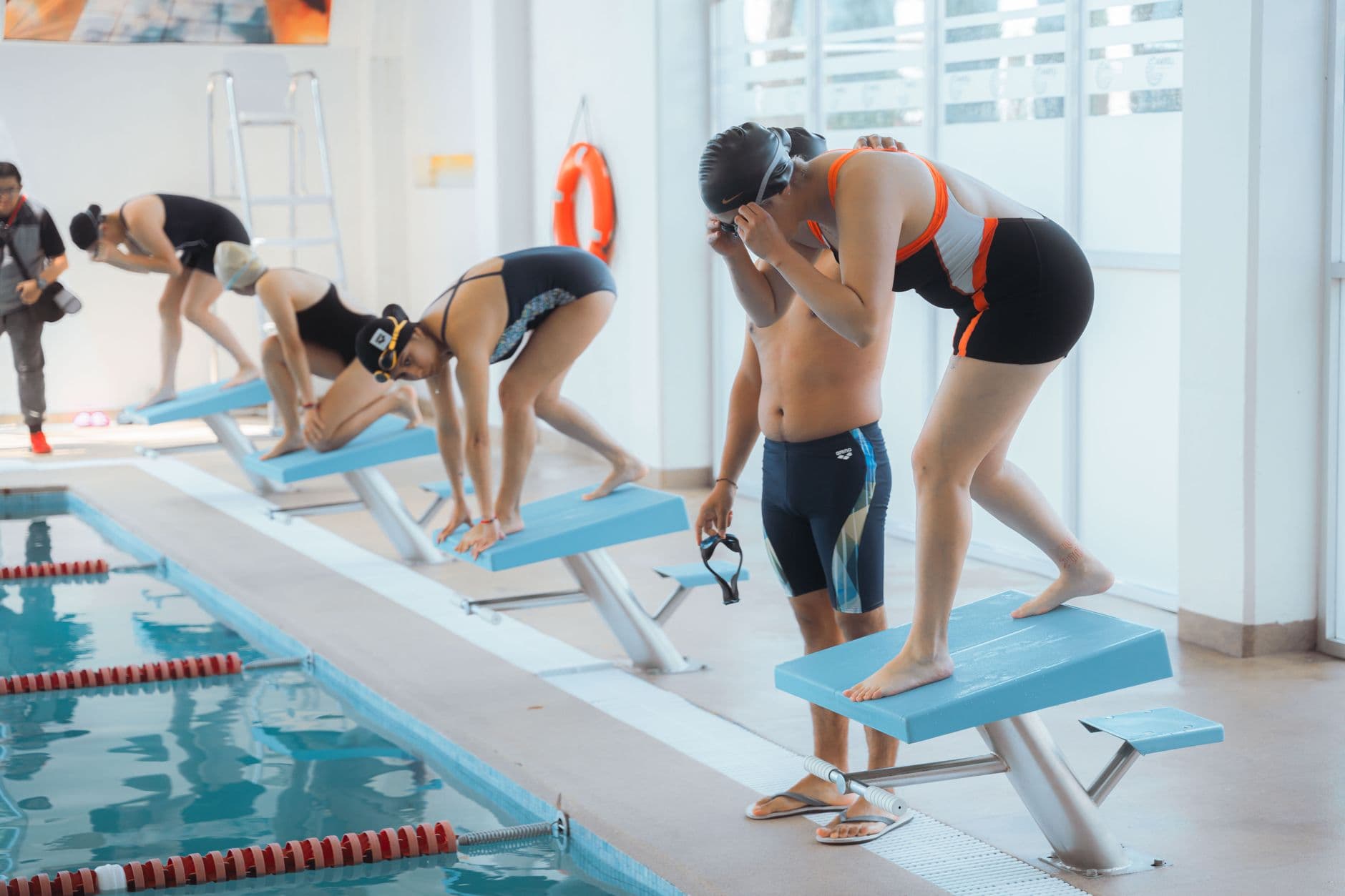
A disqualification is not an opinion about whether someone swam well. It is a procedure with more moving parts than most swimmers ever see: a judge with a defined patch of water, a raised hand, a signed slip, a referee who confirms it, and a protest route that closes in thirty minutes. Get the procedure wrong and a correct call does not stand.
This page is about that procedure, not about swimming each stroke legally. The stroke rules are written up elsewhere here — the breaststroke pullout, the butterfly kick timing, the backstroke start and turn, the medley transitions — and that is where the infractions live. What follows is the part nobody writes down, referenced throughout to the rulebooks in force in 2026: World Aquatics of February 2026, USA Swimming, and U.S. Masters Swimming. Where they disagree, the difference is flagged.
Who is actually allowed to call one
Under USA Swimming rule 102.21.1, a disqualification can be made only by the official within whose jurisdiction the infraction was committed. The stroke judge who saw it is the one who calls it. The referee has authority over everyone and under 102.11.1 can overrule any official on a point of rule interpretation, or on a judgment decision about something the referee personally observed — but the call originates with the judge standing there.
Under World Aquatics, only the referee disqualifies. Inspectors of Turns and Judges of Stroke report what they saw (articles 2.8.9 and 2.9.3) and the referee decides. Article 2.3.7 draws a line most people miss: if the referee personally observes a breach, the referee will disqualify; if another official reports it verbally, the referee may. A reported infraction is discretionary. One the referee saw is not.
No raised hand, no disqualification
This is the most useful sentence in either American rulebook, and almost nobody outside the officiating course knows it.
USA Swimming 102.21.1: the referee, stroke, turn, or relay take-off judge, upon observing an infraction, shall immediately raise one hand overhead. If the official does not do so, there shall be no disqualification — unless the meet is being run under World Aquatics procedures. Masters carries identical wording in 102.13.1. It binds the referee too: USA Swimming 102.11.2 requires the raised hand for a violation the referee personally observed, and says that without the signal there shall be no disqualification. The one carve-out is false starts.
The raised hand is a timestamp, not a courtesy to the crowd. It fixes the moment the official decided, in front of witnesses, before anyone knows whether the swim was a record.
Two exceptions exist, both because the call is made by two people in writing rather than one person on the spot: relay take-offs under dual confirmation (USA Swimming 102.13.6B), and in Masters, dual-confirmed false starts under 103.8.6.
Note the limit: the World Aquatics regulations impose no hand-signal requirement at all, so at an international meet no raised hand means nothing.
The window each judge is allowed to judge in
An official cannot call what they saw outside their patch, and the patches are tight. World Aquatics puts one Inspector of Turns in each lane at each end (2.8.1) and Judges of Stroke on each side (2.9.1), then bounds them in time:
- At the start end (2.8.2): from the starting signal to the completion of the first arm stroke — except breaststroke, where it runs to the second.
- At each turn (2.8.3): from the beginning of the last arm stroke before touching to the completion of the first arm stroke after the turn — again, the second in breaststroke.
- At the finish (2.8.4): from the beginning of the last arm stroke before touching the wall.
The breaststroke extension is not a quirk: the legal pullout is one arm stroke long, so a window closing after the first stroke would close before the swimmer had finished the thing most likely to be illegal.
USA Swimming handles it administratively. Rule 102.13.5 requires the referee to set the areas of stroke and turn responsibility before competition begins, while ensuring fair, equitable and uniform judging conditions — so the windows are fixed on the day, and what you are owed is uniformity rather than any particular arrangement.
What is actually written on the slip
People search for the DQ slip as though it were a secret document. It is a form, and the rulebooks specify its contents.
USA Swimming 102.13.3 and 102.13.4 require the stroke judge and turn judge to report violations to the referee on signed slips detailing the event, the heat number, the lane number and the infraction. World Aquatics 2.3.7 differs tellingly: the reporting official completes and signs a card giving the event, lane number and infraction only after the referee has confirmed the disqualification. The card records a decision already made.
The British Swimming disqualification card, version 25 June 2026, shows what that looks like. It is a checkbox sheet: event, heat/semi/final and lane at the top, then a page of specific infractions to tick, each with its rule number beside it. There are blanks for which turn the call happened at, and for relays a field for the exchange number and the measured time differential where automatic equipment was available. And two signature lines — the judge's and the referee's. Both names go on it.
The “codes” everyone is looking for are rule numbers
Searches for swimming disqualification codes want one thing: the short number on the slip. There is no separate code system. The code is the article number of the rule that was broken.
World Aquatics publishes the pairing directly. Its Swimming Rule Quick Reference Infraction Sheet, in force from 13 March 2026, is a one-page list for starters, judges of stroke and inspectors of turns, giving each infraction in the words a judge would use with its rule number alongside. They group by family:
- 4.4 — initiating a start before the signal. The whole of the start, in one line.
- 5.x to 8.x — freestyle, backstroke, breaststroke, butterfly.
- 9.x — medley: stroke order and the freestyle section.
- 10.2.x — conduct of the race: distance, lane, touching the wall, standing, the lane rope, obstruction.
- 10.4.x — relays, including the declared order and the take-off.
- 14.2 to 14.4 — equipment: non-approved devices or suits, and taping of fingers or toes.
The sheet says of itself that it does not cover every infraction: it is a writing aid for judges, which is how to read it.
The trap: a code only means something against the rulebook that meet was run under. Special Olympics published its two-hand touch infraction at Berlin 2023 as code 7.6 and its relay take-off as 10.11. Under the February 2026 World Aquatics regulations those same calls are 7.7 and 8.5 for the touch and 10.4.5 for the take-off. Same offence, different number. Decode a slip from the rulebook, not from a list you found online.
Which calls actually get made
Here is an honest answer where most pages give a confident one: no federation publishes a frequency table. Any ranked list of the commonest disqualifications online is someone's impression of their own deck.
The one published breakdown we could verify comes from a meet run under a different ruleset. Special Olympics reported 308 disqualifications at the Berlin 2023 World Games, with the six commonest broken out. Its divisioning rules are not USA Swimming's and its athletes are not an age-group field, so read it as indicative of where calls cluster, not as your pool's numbers.
Special Olympics, Common Disqualifications from Berlin 2023 World Games. Ruleset and population differ from USA Swimming meets.
Strip out the Special Olympics-only category and the result is striking: the start and the relay take-off outrank every stroke-technique call. Those are the two moments judged against an instant rather than a movement, and the two where a swimmer has least room to be approximately right. The structural version of the same answer is to look for the rules with the narrowest windows — the two-hand touch (7.7 and 8.5), the 15 metre mark (5.3, 6.3 and 8.6), the pullout kick (7.1), the backstroke turn (6.4) and the relay take-off (10.4.5). Each is pass-or-fail at a single point in space or time.
False starts: why there is no recall once the field is away
The start has its own machinery, because a mistake there affects seven other swimmers — and it is the one call that always takes two officials. USA Swimming 101.1.3A disqualifies a swimmer who starts before the signal if the referee independently observes and confirms the starter's observation. World Aquatics 2.3.6 likewise requires the initiation to have been observed and confirmed by both starter and referee, and adds that where automatic officiating equipment is available the referee reviews the footage to verify it.
What happens next depends on timing. If the disqualification is declared before the starting signal, the signal is not given: World Aquatics 4.4.2 has the remaining athletes stood down and the referee restart from the long whistle. If the signal has already gone, USA Swimming 101.1.3B says the race continues without recall and the swimmer is disqualified on completion. World Aquatics 4.4.1 agrees. Nobody is called back once the field is swimming.
Three reliefs are written in:
- If the recall signal is activated, no swimmer shall be charged with a false start and the race is restarted (101.1.3C).
- A swimmer may be relieved of the charge if the false start was caused by their reaction to a “stand” command (101.1.3D).
- An illegal starting position is a disqualification only if it still exists when the signal is given (101.1.2E). Masters goes further — under 103.8.6E there is no disqualification for an illegal starting position if the race is permitted to proceed.
One other disqualification lives at the start without being a false start: under 101.1.5B a swimmer who fails to appear at the blocks ready to swim in time for the initial start of their heat is disqualified, and 101.1.5C says it is expressly not charged as one. If you plan your meet day around a tight warm-up, that is the rule that says be early.
Relay take-offs: the one call that needs two judges
Exchanges get their own apparatus because the thing being judged is whether two events were simultaneous, which a single pair of eyes is bad at.
The rule is simple. World Aquatics 10.4.5 requires the next swimmer's feet to stay in contact with the platform until their team-mate touches, and 10.4.4 requires exchanges to commence from the platform — no running start off the deck. USA Swimming 101.7.4F disqualifies the team of a swimmer whose feet left the platform early.
The judging is where it gets unusual. USA Swimming 102.13.6A places the judge so they can clearly see both the departing swimmer's feet and the incoming touch. Under dual confirmation (102.13.6B) the lane judge and side judge report independently, in writing, without the hand signal — and a relay is disqualified only if the lane judge reported an infraction and the assigned side judge confirmed the same one. Two independent observations, or no call. Where automatic exchange equipment is in use, 102.13.6C makes the printout the source, with back-up timing cameras available to the referee.
World Aquatics puts the same redundancy in the control room, where the supervisor checks the exchange printout and may review the video timing to confirm an early take-off (2.4.2, 2.4.3). And under 10.5 a relay breach disqualifies the team and the athlete who committed it.
What is not a disqualification
Several things swimmers and parents worry about are explicitly legal.
- Standing on the bottom in freestyle. USA Swimming 102.21.6: standing shall not disqualify a swimmer in a freestyle race — but you must not leave the pool, walk, or spring from the bottom. Standing during any other stroke is a disqualification. World Aquatics 10.2.4 permits it in freestyle events and the freestyle portion of a medley.
- A two-hand touch where the fingers brush. World Aquatics 7.7 and 8.5 define “separated” as meaning the hands cannot be stacked one on top of the other; it is not necessary to see space between them, and incidental contact at the fingers is permitted.
- Warming down in your lane — Masters only. U.S. Masters Swimming 102.13.7 lets a swimmer who has finished warm down in the assigned lane while the heat completes, with no disqualification provided they do not delay the next heat. USA Swimming has no equivalent and World Aquatics 10.2.8 requires leaving as soon as possible. If you swim Masters, that is a real difference.
From the raised hand to the result sheet
Once the hand goes up, a chain of paperwork runs that has nothing to do with the swimmer.
The judge reports to the referee; under World Aquatics the card is completed only after the referee confirms, while under USA Swimming the signed slip goes to the referee. Then someone is supposed to tell you. USA Swimming 102.21.2 and Masters 102.13.2 both require the official to make every reasonable effort to seek out the swimmer or their coach and give the reason — followed by the sentence that disappoints everyone: failure to notify does not negate the disqualification. The duty is to try, not to succeed.
What happens to the swim is absolute. USA Swimming 102.21.13: the time and place of a disqualified swimmer or relay shall not be recorded in that event's results, awards already given are returned and reissued, and if points were scored the event is rescored. The Masters version, 102.13.13, adds the initial splits — so a disqualified 200 leaves you no legal 100 split.
The reverse protects you. USA Swimming 102.21.14 and Masters 102.13.14: a time or place officially recorded shall not be nullified for violations occurring subsequent to that performance. A legal swim stays legal. And since the time converter works on recorded times only, a disqualified swim has nothing to convert — the practical cost of the call.
How to challenge one, and the kind you cannot
This is where most of the heat at a meet is wasted, because the two categories go to different places and one has no appeal at all.
A judgment call is final with the referee. USA Swimming 102.22.1 could not be plainer: protests against the judgment decisions of starters and of stroke, turn, place and relay take-off judges can only be considered by the referee, and the referee's decision shall be final. Masters 102.14.3 is identical. Whether the hands were stacked is a judgment, and there is nowhere above the referee to take it.
A question of rule interpretation goes higher, in writing. Under USA Swimming 102.22.5A, protests about interpretation of the rules go in writing within ten days to the Rules & Regulations Committee Chair, who rules within five days, finally and bindingly. Masters 102.14.4 routes the same thing to its own Rules Committee chair on the same ten-and-five clock. The distinction is the whole game: did you see it correctly is closed, does the rule mean that is open.
Everything else runs on a thirty-minute clock. USA Swimming 102.22.4 requires other competition-related protests in writing to the referee within thirty minutes of the race. Masters 102.14.5 matches it and adds the escalation: file with the LMSC chair, and if it is unresolved after ten days you have five more to appeal to the USMS Rules Committee chair. Meanwhile 102.22.6 withholds the results, awards and points of a protested race until it is resolved or withdrawn in writing.
At the top level the process is formal and costs money. World Aquatics Part One article 12 takes an official appeal form within thirty minutes of the event's completion with a 500 US dollar deposit, and in swimming the only ground is a referee's decision as to the consequence of a rule infraction. A dismissed appeal forfeits the deposit, and article 12.5.2 gives referees significant deference: the three-member Jury of Appeal will not substitute its own view unless shown clear evidence the decision was arbitrary, irrational, or an abuse of discretion.
One caveat matters more than all of that for an ordinary meet. World Aquatics article 12.1 applies the appeal process only at World Aquatics Events and the Olympic Games; at every other competition the organiser has full discretion over the protest procedure. Read your meet announcement — at your pool, the rules of protest are whatever the host wrote down.
Video review, and what it cannot do
Phones are everywhere and almost none of that footage is evidence.
At World Aquatics championship level, video is a staffed position. Video Review Judges watch turns and finishes and report infractions to the Video Review Supervisor, who also reviews them at the referee's request; where one is confirmed, the judge completes a disqualification card that reaches the referee (2.15.2 to 2.16.2). At that level, video can originate a call.
Below it the door is narrower. USA Swimming 102.21.15 allows video replay only from cameras approved in writing in advance of the competition by the Program & Events Coordinator or their designee. No advance approval, no review. Masters 102.13.16 adds the sharpest limit: video may review stroke or turn infractions called on deck, and the reviewing official may only confirm the call, overrule it, or report the review inconclusive. Masters video cannot create a disqualification nobody called, nor be used to hunt for one. Which answers the question parents ask: unapproved footage from the stands is not admissible at any level.
What to do with this at your pool
Read the meet announcement for the protest procedure: at a non-championship meet that document, not the international regulations, governs. Ask which rulebook the meet runs under, since it decides whether the raised hand is required at all. And if a call comes, take the reason and the rule number from the slip rather than from the deck, then decide which disagreement you actually have: a judgment you cannot appeal, or an interpretation you can.
Then practise the narrow moments rather than the whole stroke. The breaststroke kick and its pullout, the two-hand touch, the flip turn and the backstroke change of direction are where pass-or-fail lives. A short course event means more walls, and every wall is another window with a judge in it.
One safety line, because the 15 metre rule invites the wrong training. The underwater limits in articles 5.3, 6.3 and 8.6 tempt swimmers into practising longer and longer breath-holds. Do not. Repeated or extended breath-holding underwater can cause blackout without warning, as the American Red Cross, USA Swimming and the YMCA of the USA set out in their joint statement on hypoxic blackout. Work on underwater speed, never on duration, and never alone — always with a lifeguard or coach watching. If you have ever felt dizzy or blacked out in the water, see a doctor before training again.
Frequently asked questions
What does DQ mean in swimming?
DQ means disqualified: the swim broke a rule, so it does not count. Under USA Swimming rule 102.21.13 the time and place of a disqualified swimmer are not recorded in the results at all, any awards already given are returned, and if points were scored the event is rescored. The Masters version also removes the initial splits.
What are swimming disqualification codes?
They are rule article numbers, not a separate code system. The World Aquatics infraction sheet in force from 13 March 2026 pairs each infraction with its article: 4.4 is starting before the signal, 7.7 and 8.5 are the two-hand touch, 10.4.5 is a relay take-off. A code only means something against the rulebook that meet used.
Can a swimming disqualification be appealed?
It depends which kind of disagreement you have. A judgment call by a starter or a stroke, turn, place or relay take-off judge can only be considered by the referee, and under USA Swimming 102.22.1 that decision is final. A question of rule interpretation goes in writing within ten days to the Rules and Regulations Committee Chair, who rules within five.
Do officials have to tell you why you were disqualified?
They have to try. USA Swimming 102.21.2 and Masters 102.13.2 require the official to make every reasonable effort to find the swimmer or their coach and give the reason. Both rules then add that failure to notify does not negate the disqualification, so the call stands even if nobody reached you before the results went up.
What happens if the official does not raise their hand?
At a USA Swimming or Masters meet there is no disqualification. Rule 102.21.1 requires the judge to raise one hand overhead immediately on seeing the infraction, and says that if they do not, there shall be no disqualification. The exceptions are dual-confirmed relay take-offs and, in Masters, dual-confirmed false starts, which are reported in writing instead.
Is a phone video any use in disputing a disqualification?
No. USA Swimming 102.21.15 allows video replay only from cameras approved in writing before the competition, so footage from the stands is not evidence. Masters rule 102.13.16 is tighter still: video may only confirm a call already made on deck, overrule it, or be declared inconclusive. It cannot create a disqualification nobody called.
Sources
- World Aquatics Competition Regulations, Part Two: Swimming Rules — articles 2.2 to 2.18 (technical officials and their jurisdictions), 4.4 (the start), 5 to 9 (the strokes), 10.2 to 10.6 (the race and relays) and 14.2 to 14.4 (swimwear, technology and wearables), in force from February 2026 — World Aquatics
- World Aquatics Competition Regulations, Part One — article 12, appeals: the appeal form, the thirty-minute deadline, the 500 US dollar deposit, the Jury of Appeal and the standard of deference to referees — World Aquatics
- Swimming Rule Quick Reference Infraction Sheet, in force from 13 March 2026 — the official pairing of each written infraction with its rule article number — World Aquatics
- World Aquatics — Rules and Competition Regulations index (current and archived versions) — World Aquatics
- 2026 USA Swimming Rules and Regulations — rules 101.1 (starts and false starts), 101.7.4 (relays), 102.10 to 102.13 (officials, judges and their jurisdictions), 102.21 (disqualifications) and 102.22 (protests) — USA Swimming
- USA Swimming — Rules and Regulations page, including amendments that supersede the printed 2026 rulebook — USA Swimming
- 2026 U.S. Masters Swimming Rule Book, Part 1 — rules 102.13 (disqualifications, including the warm-down allowance and the limits on video review), 102.14 (protests) and 103.8.6 (false starts) — U.S. Masters Swimming
- British Swimming — Disqualification Card, version 25 June 2026: the checkbox form, the rule-number column and the judge and referee signature lines — British Swimming
- Common Disqualifications from the Berlin 2023 World Games — 308 disqualifications with the six most common broken out by code — Special Olympics
- Joint Statement on Hypoxic Blackout, November 2022 — American Red Cross, USA Swimming and YMCA of the USA
Read next
Why do swimmers wear two caps? To pin the goggle straps down
The second cap covers the goggle straps and stops the first one wrinkling. Two caps is explicitly legal, and two is the written maximum — here is the rule.

What age should a child start swim lessons?
The official answer is the first birthday for lessons, but babies can be in water long before that. Here is where each health body draws the line, and why it matters.

Can you wear contact lenses swimming? What the eye bodies actually say
The FDA, the CDC and UK and Australian eye bodies all say take your lenses out before you swim — and the reason is not chlorine. Here is what they are worried about.
SwimFast is an independent publication. We are not a swim school, a coaching service or a governing body, and nothing here is medical advice. Training paces and test protocols are cited from the published research or federation documents linked on each page. Never swim alone, never attempt breath-hold work without supervision, and check with a doctor before starting a new training programme.