What is a negative split in swimming, and does it make you faster?
A negative split is the second half of a swim being faster than the first. What the measured race splits and the pacing experiments say about whether it helps.
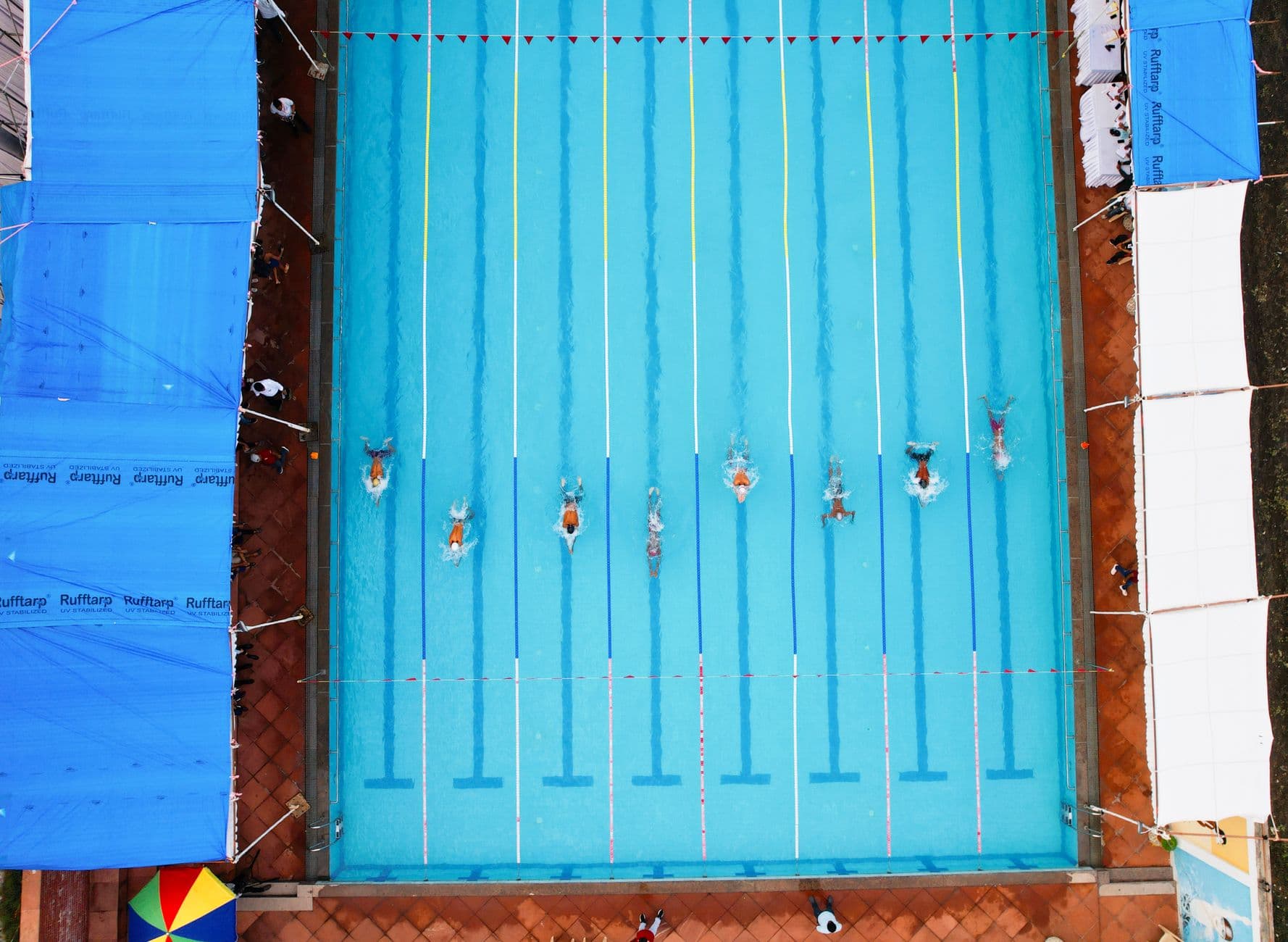
Ask a coach to swim a negative split and you are being asked for one thing: make the second half of the swim faster than the first. That is the whole definition. What the word does not tell you is whether it is a good idea, and that is where the swimming internet goes quiet or goes wrong.
So this page does both halves. First the vocabulary, with the arithmetic and a worked example, because a negative split you did not time is not a negative split. Then the awkward part: what the splits of real races actually look like, and what happens in the experiments where researchers force swimmers to pace one way or another. The short version is that the term is far more useful as a training discipline than as a race plan, and the data says so fairly plainly.
What a negative split actually is
A negative split means the later part of a continuous swim takes less time than the earlier part. U.S. Masters Swimming puts it as the last half in less time than the first half — hence negative. A 300 swum 2:05 then 2:01 is a negative split by four seconds. The same 4:06 swum 1:35, 1:43, 1:48 is the opposite, and coaches have a blunter word for it than “positive”: that article calls it a sucker split, because the first length felt free and the bill arrived later.
Two things follow from the definition and both get lost. The split is measured inside one swim, not across a set. And it is measured in seconds on a clock, not in effort. Those are the two errors that make most claimed negative splits imaginary.
Negative split or descending? Coaches mean two different things
These get used interchangeably on pool decks and they are not the same instruction. A negative split happens within a single continuous swim: one 400, one 500, one 1,000. Descending — written DEC on a whiteboard, which has annoyed every coach who can spell “descending” — happens across the repeats of a set: 3 × 100 DEC 1–3 means each 100 is faster than the one before it.
You can do either without the other. Swim 5 × 200 where every 200 is faster than the last and you have descended a set while possibly swimming all five of them as sucker splits. Swim one 400 negative and you have split a swim without descending anything. If you are still working out which number on the wall is which, the rest of that vocabulary is in our guide to reading the pace clock and leaving on the right interval.
How to work out your split, with a worked example
Take a 400 in 7:20. Three swimmers can produce that same total in three completely different ways, and the table shows what each one looks like when you write the splits down. The pair of numbers under each name is the first 200 and then the second 200.
| How the 400 was swum | The four 100s |
|---|---|
| Negative split 3:42 → 3:38 | 1:49 · 1:53 · 1:50 · 1:48 |
| Even split 3:40 → 3:40 | 1:50 · 1:50 · 1:50 · 1:50 |
| Positive split 3:34 → 3:46 | 1:44 · 1:50 · 1:53 · 1:53 |
Look at the top row again. The second 100 is the slowest of the four, and the swim is still a negative split by four seconds, because the comparison is halves and not consecutive repeats. That row is a negative split and not a descend, in one picture. The third row is the common one, and the only thing that separates it from the first is the 1:44 that felt easy. If you want to see what any target total means per 100 before you get in, put it through the pace calculator.
Why “I swam the second half harder” is not the same as faster
The USMS article carries a warning worth more than the technique in it: until you have real experience with pacing, your body will not give you honest feedback about your speed. The swimmer who faded from 1:44 to 1:53 genuinely felt like he worked harder in the back half, and he did. Effort went up while speed went down, which is exactly what fatigue feels like from the inside.
Which leads to the only reliable test. If you do not know your splits for a swim, it was not a negative split — it was a swim you have a feeling about. A pace clock, a watch, or a lane partner calling your 100s is the difference between pacing and guessing, and there is no amount of experience that removes the need for a number.
Does negative splitting make you faster? What the experiments say
Here is the part the niche skips. In 2026 a group in Madrid and Wisconsin published a systematic review and network meta-analysis of pacing strategies in Sports Medicine: 24 experimental studies, 302 participants, 765 observations across endurance sports including swimming, every one of them comparing an imposed strategy (fast start, even, slow start) against self-selected pacing or against each other.
The result was no difference. Standardised mean differences below 0.20 across the network, none statistically significant, and nothing separating the strategies on peak oxygen uptake or end-test lactate either. One finding did come out of the subgroup analysis, and it cuts against the negative-split sales pitch: prolonged slow starts were associated with impaired performance. The authors' conclusion is that self-pacing is a flexible, context-adaptive strategy and that imposing a profile on an athlete buys nothing on average.
Read that carefully, because it is not a licence to go out hard. It says the gain is not in the shape of the curve. It is in knowing where your own curve is, which is a training problem.
Why nobody negative splits a 100 or a 200
The clearest data on short races comes from an unusually large sample: 18,187 finishers across four FINA World Masters Championships between 2014 and 2019, all four strokes, every age group. In the 100, swimming speed fell in the second length — for every stroke and every age group, without exception. In the 200, the first length was the fastest — again for every stroke and every age group.
Part of that is structural and has nothing to do with pacing. The first length of a pool race starts with a racing dive, which puts you into the water travelling faster than any push-off from the wall can, so the opening split is flattered before you take a stroke. Our guide to diving in from the blocks covers where that speed comes from. The rest is simply that a 100 is too short to hold anything back and still be in the race, which is also why the advice in swimming a faster 100 freestyle is about the first 15 metres and the turn, not about pacing.
The 400 is a curve, not a straight line
Longer races do not produce a tidy two-halves story either. Lipinska and Hopkins analysed 381 swims by 20 elite female 400 freestylers across more than 150 competitions between 2004 and 2016, with 50 m splits throughout. Most of the profiles showed a curve rather than a slope: the fifth of the eight laps was the median slowest, and the first and last laps came in faster than the curve predicted by 5.6% and 1.9% respectively.
That is the shape of an actual distance race — quick away, settle into the middle, lift at the end. Lap-to-lap variability was 0.65%, which tells you how fine the control is at that level. The authors also found that about half of the swimmers might gain up to around 1% by changing the slope or curvature of their profile, which is real but modest, and it was individual: some needed a different first lap, some a different last one.
The 1500: the whole gain is at the start, not the finish
The mile is where you would most expect the negative split to pay, and the result is the most useful one on this page. McGibbon and colleagues classified 327 elite men's 1500 freestyle races from 2010 to 2019 by start strategy (laps 1–2), middle strategy (laps 3–28) and finish strategy (laps 29–30).
A slow or average start was worth 21.2 seconds over a fast start. An even middle was worth 8.4 seconds over a positive one. The finish made no measurable difference at all, with a p-value of 0.99. So the thing people call a negative split is mostly a way of describing having not blown the first 100 metres. The conclusion in the paper is exactly that: a relatively slower start conserves energy for the later stages. If you are pacing your own distance swims, the same logic sits behind our guides to how long it takes to swim 1 km and what counts as a good mile swim time.
Open water is where the end spurt really pays
Change the venue and the picture changes. Rodriguez and Veiga split the 2015 World Championship 10 km field into five performance groups — 69 men and 51 women — and the medallists and finalists swam at much the same speed as everyone else through the first three quarters, then raised their speed by 1.5–3% in the final quarter. The slower groups either held even or faded. The successful swimmers were also further back at the 25%, 50% and 75% marks than their finish positions suggested.
That is a genuine negative split and it is tactical rather than physiological: in a mass-start race with drafting and no lane ropes, sitting in and saving the move is a plan, which it cannot be in a 1500 in lane four. If open water is where you are headed, your first open water swim and sighting without losing rhythm matter more than your splits, and triathletes should read the pacing section of triathlon swim training before planning any end spurt at all.
Age-group swimmers finish faster too — except in the 100
None of this is elite-only. Nikolaidis and Knechtle looked at 4,481 swimmers in the 100 through 800 freestyle at the 2014 World Masters Championships, in age groups from 25–29 all the way to 90–94. The pattern was consistent: the largest increase in lap time came in the second lap, and lap time came back down in the last lap — in every event except the 100, where there is no room for it.
In other words the second lap is where distance swims go wrong for everybody, and the final-lap lift is a human reflex, not a coaching trick. The same study found larger lap-to-lap percentage changes in women than in men. If you compete as an adult, how Masters age groups work covers the bracket your splits get compared in.
The medley is the one event where the sexes pace differently
One result is worth flagging because it gets quoted out of context. A 12-year analysis of 1,643 individual medley swimmers across 26 international competitions found that men generally use a positive pacing strategy in the 200 and 400 IM and women a negative one, with men spending a smaller share of the race in breaststroke and a larger share in freestyle.
Be careful what you take from it. A medley split compares four different strokes, and they are not equally fast — breaststroke is the slowest of them, as you can see in the mechanics of the breaststroke kick. So a negative-split medley partly reflects stroke order, not just effort distribution. It is a real sex difference in race shape, and it is not evidence about how you should pace a 400 freestyle.
Your pacing profile is more stable than you think
Skorski and colleagues compared heats and finals for 158 male swimmers from 29 nations across two competitions about eight weeks apart. Total-time variation in finals ran between 0.8% and 1.3%, and split profiles repeated: 0.9–1.6% across all splits in the 200 freestyle, with breaststroke the loosest at 1.2–2.3%. The variability came from within swimmers, not from the competition.
There is an individual layer under that. In a study of 25 elite 200 freestylers, estimated muscle fibre typology predicted where they spent their race time: swimmers with a more fast-twitch profile distributed the third lap differently from the rest. Taken with the meta-analysis above, it says the same thing twice — your profile is yours, it is repeatable, and copying someone else's is not a plan.
How to build your first negative-split set
The honest case for practising negative splits is not that the shape wins races. It is that you cannot learn pace control any other way, and pace control is what stops the second lap from falling apart. Anchor the set to a number you measured rather than a feeling: work out your critical swim speed and use that pace as the middle of the swim. What CSS is and why it works as a threshold proxy is explained in what CSS pace means.
A starting point for an adult with a 45-minute slot, after the warm-up in how to warm up before swimming:
- 4 × 100, first 50 at CSS pace plus 3 seconds, second 50 at CSS pace. Short enough that you cannot hide.
- 3 × 200, first 100 at CSS plus 2 seconds, second 100 at CSS. Write the four numbers down afterwards.
- 1 × 400, halves, aiming for 2 to 4 seconds negative. Not 15 — see the fake splits below.
Pick send-offs you can hold for the whole set with the interval calculator, and if you would rather have the session built for you from your CSS, the workout generator does it. The USMS line is that anything over about 60 seconds should be swum even or negative, which for most adults means every single repeat longer than a 50.
Reading it on the clock without losing count
The practical obstacle is not fitness, it is arithmetic at the wall while out of breath. Three things make it manageable. Split on halves rather than quarters when you are starting, because two numbers are easier to hold than four. Pick a round send-off so that your mid-point is a clean number on the clock. And take the splits that matter rather than all of them — a 400 needs one mid-point, not seven.
Everything about which hand to watch, what the top and the bottom mean and how not to lose your place in a long set is in the pace clock guide, and the broader question of how much swimming a session should contain is covered in how many laps make a good workout.
Why a 25-metre pool flatters your second half
Splits are not comparable between pools, and this is the detail that trips people up when they repeat a set somewhere else. More walls mean more push-offs, and push-offs are faster than swimming. In a 25 m pool a 400 has seven turns; in a 50 m pool it has three. Your second half in the short-course pool is being helped by hardware.
Beyond that, the turn is a skill that fatigues: the walls late in a swim are usually worse than the walls early in it, which can turn a genuine negative split into a positive one without your stroke changing at all. Short course versus long course works through the full size of the effect, the time converter moves a time between courses with the turn count shown, and if the late walls are the problem, the flip turn guide is the fix. Watching your SWOLF across the two halves tells you whether you lost speed or lost efficiency.
Four ways a negative split can be fake
All four are common and all four are easy to spot once you look at the whole swim rather than the difference.
- Sandbagging the first half. A 15-second negative split in a 400 usually means the first 200 was a warm-up. The total is what counts, and an easy first half rarely produces a good one.
- Calling a descend a negative split. Five repeats getting faster says nothing about how any one of them was paced.
- Splitting by feel. Covered above, and still the most common. No numbers, no split.
- Cutting your breathing to find the speed. Going faster by breathing less is borrowing from the wrong account. Breathing in freestyle and bilateral breathing explain why the air is not the place to economise.
When finishing faster is the wrong goal
A negative split is a pacing exercise, not a reason to keep swimming through a warning sign. Stop at the wall if you feel dizzy, light-headed, sick, or any tightness or pressure in your chest, and get out — stopping mid-swim is the correct decision, not a failed set. Chest pain, breathlessness out of proportion to the effort, or fainting need a doctor, not a better split. Never chase a timed swim alone in a pool with no lifeguard, or in open water without a partner and a tow float, and never hold your breath to make the back half look quicker: breath-holding in water can cause blackout without warning. If pacing a swim regularly leaves you unwell rather than tired, that is worth a medical conversation.
Tiredness, for the record, is normal and has its own explanations — why swimming leaves you so tired and the zone table in swimming heart rate zones cover where the line sits.
The short version
A negative split is the second half of one continuous swim being faster than the first, measured on a clock, inside one swim. It is not descending, and it is not a feeling. As a race plan the experimental evidence does not support imposing it: no pacing strategy beat self-selected pacing across 24 studies, and prolonged slow starts made things worse. As a description of fast races it only fits the long ones, and even then the gain sits at the start — 21 seconds in a 1500 for not going out too hard, against nothing measurable for the finish.
What it is genuinely good for is training. Splitting swims teaches you where your own pace lives, which is the thing that keeps the second lap of a distance swim from collapsing, and open water is the one place where saving a move and spending it in the last quarter is a plan rather than a slogan. Build the sets off your workouts and your measured CSS, not off someone else's profile, and keep the times you actually swam.
Frequently asked questions
What is a negative split in swimming?
A negative split means the second half of a continuous swim takes less time than the first half. A 400 swum 3:42 then 3:38 is negative by four seconds. It is measured inside one swim, on a clock, and it is not the same as making each repeat of a set faster.
Is a negative split better than an even split?
Not on the evidence. A 2026 network meta-analysis of 24 experimental studies found no performance difference between imposed pacing strategies and self-selected pacing, and prolonged slow starts actually impaired performance. What the race data does support is avoiding a fast start in long events, which is not quite the same claim.
What is the difference between a negative split and descending?
A negative split is pacing within one continuous swim: the back half faster than the front half. Descending, written DEC on a whiteboard, is pacing across the repeats of a set, so 3 x 100 DEC 1-3 means each 100 beats the one before it. You can do either without the other.
Do Olympic swimmers negative split?
Almost never in pool races. In 18,187 championship swims the first length of a 100 and of a 200 was the fastest for every stroke and age group, partly because a racing dive carries more speed than a push-off. Elite 400s show a curve, and the 1500 rewards a conservative start rather than a fast finish.
How do I practise negative splitting?
Start on halves, not quarters, and anchor the pace to a measured number instead of feel. Try 4 x 100 with the first 50 three seconds above your CSS pace and the second 50 at it, then 3 x 200 the same way by 100s. Write the splits down: a swim you did not time was not a negative split.
Sources
- Hines, E. — What's All This About Negative Splits — U.S. Masters Swimming
- Ramos-Campo D.J. et al. (2026) — Comparative Effects of Pacing Strategies on Endurance Performance: A Systematic Review and Network Meta-Analysis (24 studies, 302 participants, 765 observations) — Sports Medicine
- Moser C. et al. (2020) — Pacing in World-Class Age Group Swimmers in 100 and 200 m Freestyle, Backstroke, Breaststroke and Butterfly (18,187 finishers, four FINA World Masters Championships) — Int J Environ Res Public Health
- Lipinska P. & Hopkins W.G. (2020) — Pacing Profiles and Competitive Performance of Elite Female 400-m Freestyle Swimmers (381 swims, 20 swimmers) — J Strength Cond Res
- McGibbon K.E. et al. (2021) — A Novel Method to Characterize the Pacing Profile of Elite Male 1500-m Freestyle Swimmers (327 races, 2010-2019) — Int J Sports Physiol Perform
- Rodriguez L. & Veiga S. (2018) — Effect of the Pacing Strategies on the Open-Water 10-km World Swimming Championships Performances — Int J Sports Physiol Perform
- Nikolaidis P.T. & Knechtle B. (2017) — Pacing in age-group freestyle swimmers at the XV FINA World Masters Championships (4,481 swimmers) — J Sports Sci
- Saavedra J.M. et al. (2012) — A 12-year analysis of pacing strategies in 200- and 400-m individual medley in international swimming competitions (1,643 swimmers) — J Strength Cond Res
- Skorski S. et al. (2014) — Reproducibility of pacing profiles in elite swimmers (158 swimmers, 29 nations) — Int J Sports Physiol Perform
- Mallett A. et al. (2021) — The Influence of Muscle Fiber Typology on the Pacing Strategy of 200-m Freestyle Swimmers — Int J Sports Physiol Perform
Read next
Are tech suits worth it? Read the rulebook before the price tag
A racing suit is the one piece of swim kit with its own rulebook and approval fee. What the rules demand, what the research measures, and who may not wear one.
Swimming while pregnant: what the guidance actually says
The official 150-minute target turned into pool sessions, the water temperature limit from the review that measured it, and the warning signs that mean get out.
How to taper for a swim meet: how long, how much less, what to keep
Two weeks, volume down 41-60%, intensity and frequency left alone. The numbers come from a meta-analysis of 27 taper studies rather than from club tradition.
SwimFast is an independent publication. We are not a swim school, a coaching service or a governing body, and nothing here is medical advice. Training paces and test protocols are cited from the published research or federation documents linked on each page. Never swim alone, never attempt breath-hold work without supervision, and check with a doctor before starting a new training programme.