How long does it take to swim 1 km? 17 to 22 minutes
Most regular adult swimmers take 17 to 22 minutes — a band measured from 1,360 recorded swims, not estimated. See the full spread by age, level and pace.
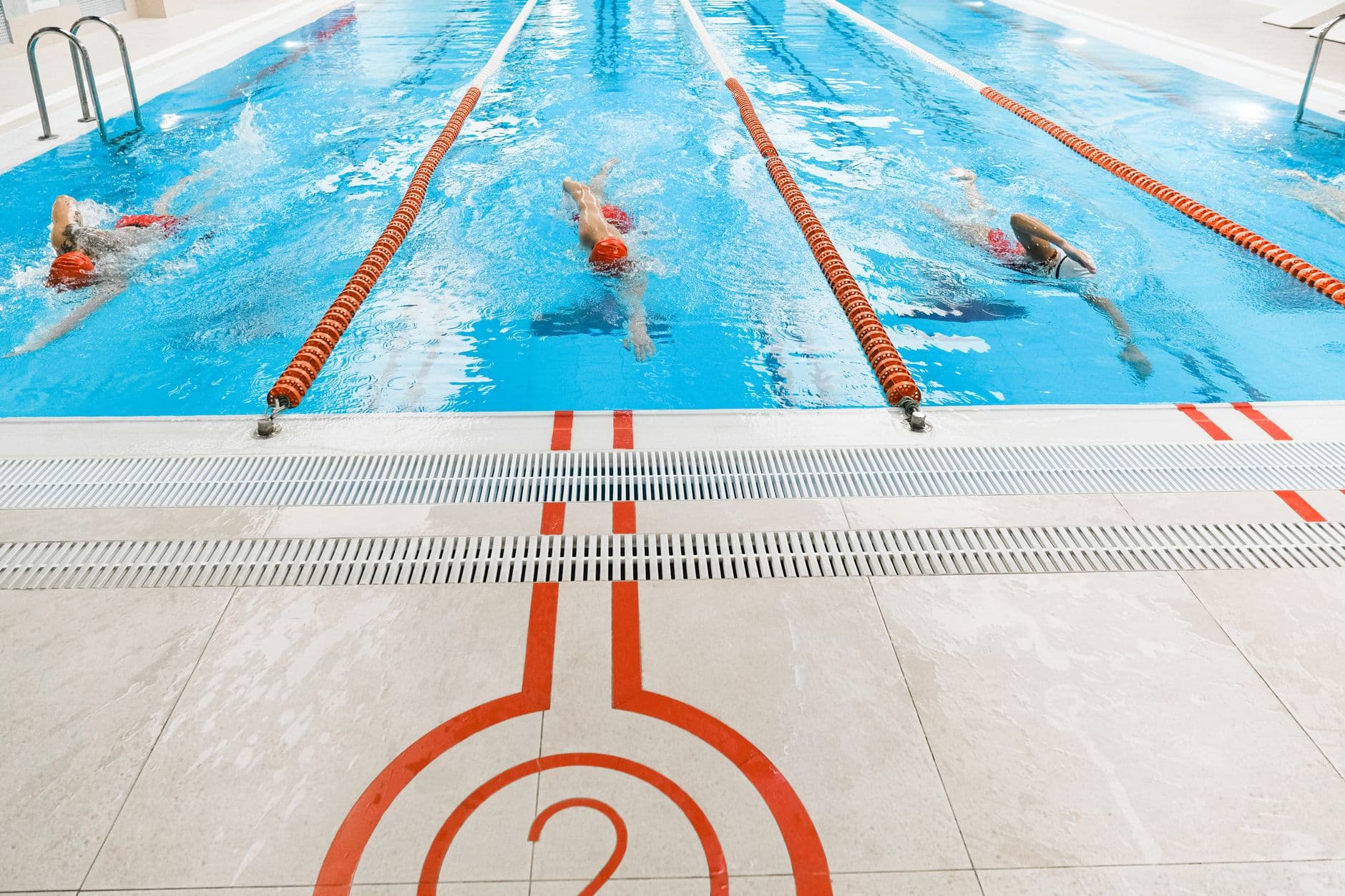
A kilometre is the first swim distance that feels like a real event rather than a set of lengths, which is why so many people want a number to judge it against. The trouble is that the numbers circulating online are almost entirely invented. No federation publishes an average 1 km swim time, and the tidy figures you have read — “20 minutes for a beginner, 15 for an intermediate” — trace back to nobody.
This page uses only published results. The centrepiece is the full result set of a national championship in which 1,360 adults swam for exactly one hour and had their distance recorded, which is the closest thing that exists to a measured population of adult distance swimmers. Around it sit the competitive time standards, the world records, and the arithmetic that turns any of them into a kilometre. If you already know your pace per 100 and just want the total, the pace calculator does it in one step.
How long does it take to swim 1 km?
Most adults who swim regularly cover a kilometre in 17 to 22 minutes, a pace of roughly 1:45 to 2:10 per 100 m. Faster club swimmers go under 15 minutes, beginners who can hold the distance without stopping are often above 25, and the world-record holder over 1500 m would pass 1 km in about 9:38. The spread is enormous and all of it is normal.
That range is not a guess. It comes from the 2018 U.S. Masters Swimming 1-Hour ePostal National Championship, where the median man covered 3,770 yards in the hour and the median woman 3,395 — paces of 17:24 and 19:20 per kilometre. Everything below explains where those numbers come from, who they describe, and how far they are from describing you.
What is the average time it takes to swim 1 km?
There is no measured average for the general public, because nobody times recreational swims. The closest published figures are medians from a field of 1,360 adult masters swimmers: 17:24 per kilometre for men and 19:20 for women, held for a full hour. Casual lap swimmers are slower than that field.
To publish an average you need a defined population and a measurement of all of it. Swimming has neither. The overwhelming majority of kilometres swum in the world are swum untimed, in pools of different lengths, with a pause at the wall that nobody records. There is no register of those swims and no way to sample them.
So any page that states “the average swimmer takes 25 minutes” as a fact is reporting somebody's estimate as though it were data. That is why the figures differ from site to site and why none of them cite a source. What does exist is published results from events where the clock was running, and those are worth far more than an average, because you can see the whole distribution rather than a single midpoint.
What 1,360 real adults did in one hour
The One Hour ePostal is a virtual national championship that U.S. Masters Swimming has run every January since 1977. Swimmers do it at their own pool, on any day of the month, with a counter recording each 50, and the distance is rounded down to the last completed five yards. In 2018, 590 men and 770 women submitted results. That is a genuine, published, electronically counted dataset of adult swimmers, and it is the best evidence available for this question.
Here is the whole distribution, converted from yards per hour into a pace per kilometre. Read a percentile as “this share of entrants was slower than this” — the 25th percentile means a quarter of the field was below that pace.
| Percentile of the field | Men: distance in 1 hour | Men: pace per 1 km | Women: distance in 1 hour | Women: pace per 1 km |
|---|---|---|---|---|
| Fastest entrant | 5,745 yd | 11:25 | 5,215 yd | 12:35 |
| 90th | 4,710 yd | 13:56 | 4,380 yd | 14:59 |
| 75th | 4,315 yd | 15:12 | 3,935 yd | 16:41 |
| 50th (median) | 3,770 yd | 17:24 | 3,395 yd | 19:20 |
| 25th | 3,200 yd | 20:30 | 2,900 yd | 22:38 |
| 10th | 2,800 yd | 23:26 | 2,485 yd | 26:24 |
Three caveats, because they matter more than the table does.
- These people entered a national championship. They are committed swimmers who chose to be measured. A random person doing lengths at the local pool on a Tuesday is slower than this field, and that is not a criticism of anybody.
- This is an hour-long pace, not a time-trial pace. Nobody holds their kilometre speed for sixty minutes. A fresh, all-out kilometre is faster than the figure in the table for the same swimmer — treat the column as a floor rather than a prediction.
- Most of it was swum in 25-yard pools, so there is a wall every 22.86 m and a push-off with it. The same swimmer in a 50 m pool would be slower over the same distance, which is what the course converter exists to quantify.
The same data, by age
Splitting the field by decade shows the shape of the decline, and it is gentler than most people expect. These are median paces per kilometre within each band, again derived from the 2018 result sheets.
| Age band | Men: median pace per 1 km | Entrants | Women: median pace per 1 km | Entrants |
|---|---|---|---|---|
| 18–34 | 14:37 | 45 | 16:07 | 77 |
| 35–44 | 16:22 | 78 | 18:17 | 108 |
| 45–54 | 16:12 | 139 | 18:37 | 189 |
| 55–64 | 17:50 | 169 | 20:15 | 245 |
| 65–74 | 19:18 | 107 | 23:10 | 116 |
| 75 and over | 23:16 | 52 | 25:47 | 35 |
Note what happens between the thirties and the fifties: essentially nothing. The median 45–54 man in this field was marginally quicker than the median 35–44 man, which is a selection effect rather than a biological one — the older bands are much larger, and the people still entering national championships in their fifties have usually been swimming for decades. Technique keeps compounding long after raw power has stopped, which is the recurring theme of this sport.
The decade bands above are ours, collapsed from the narrower groups the sport itself uses; how Masters swimming age groups work explains why the real comparison you would be scored against is a five-year band, not a ten-year one.
What is a good time for a 1 km swim?
For an adult who swims regularly, under 20 minutes is a good 1 km time and under 17 minutes is a strong one. In the measured masters field, the median man held 17:24 and the median woman 19:20; the fastest quarter were under 15:12 and 16:41. Anything under 15 minutes is club-swimmer territory.
“Good” only means something against a named group, so name it. Against that championship field, 20:00 puts you ahead of roughly a third of the entrants. Against the people in the public lanes at your pool, the same swim is very likely one of the quickest of the session, because most of them never entered anything. And against your own age band the bar moves again: the median for men aged 65 to 74 was 19:18, and for women of the same age 23:10.
How long does a beginner take to swim 1 km?
Nobody has measured beginners as a group, so there is no honest average to quote. What can be said is arithmetic: a new swimmer who holds 2:30 to 3:30 per 100 m takes 25 to 35 minutes of actual swimming, and the pauses at the wall come on top of that. Your pace per 100 decides it, and the table below does the multiplication.
| Pace you can hold per 100 m | 1 km, swum without stopping | Where that sits in the measured masters field |
|---|---|---|
| 1:30 | 15:00 | About the fastest quarter of the men and the fastest tenth of the women |
| 1:45 | 17:30 | The median man (17:24) |
| 2:00 | 20:00 | 63% of entrants were quicker |
| 2:15 | 22:30 | The 25th-percentile woman (22:38) |
| 2:30 | 25:00 | Around the slowest tenth (23:26 men, 26:24 women) |
| 3:00 | 30:00 | 96% of entrants were quicker |
| 3:30 | 35:00 | Slower than almost the entire field, and a perfectly normal first kilometre |
The middle column assumes you never stop, and beginners do stop, which is fine. In a 25 m pool a kilometre has 39 walls; five seconds of rest at each one adds 3:15 to the total, and fifteen seconds adds nearly ten minutes. That is how a swimming pace worth 30 minutes turns into 35 or 40 on the pool clock. If you do not know your pace per 100 yet, time four lengths of a 25 m pool at an effort you could repeat and put the result into the pace calculator; it projects the kilometre and every distance either side of it.
Two things matter more than the number at this stage. First, covering the distance at all comes before covering it quickly, and the route there is short repeats with rest rather than one long struggle — the plan for swimming 500 yards without stopping is the half-way mark. Second, stopping at the wall to get your breath back is the correct response to being out of breath. Never push on through dizziness or a tight chest to protect a time.
The competitive ladder, converted to a kilometre
USA Swimming publishes National Age Group Motivational Time Standards for every event and age band, derived from what registered swimmers actually did in the previous four-year cycle. There is no 1000 m standard, but there is a 1500 m one, and distance pace holds well enough across that gap that two-thirds of a 1500 time is a fair kilometre equivalent. Here are the 2024–2028 long-course standards handled that way, at the entry level (B) and the top level (AAAA). The four rungs in between — BB, A, AA and AAA — and every other event are in the time standards table.
| Age group | 1500 m standard (B) | Equivalent 1 km | 1500 m standard (AAAA) | Equivalent 1 km |
|---|---|---|---|---|
| 11–12 girls | 26:06.89 | 17:25 | 19:35.19 | 13:03 |
| 11–12 boys | 25:51.79 | 17:15 | 19:23.89 | 12:56 |
| 13–14 girls | 24:28.39 | 16:19 | 18:21.29 | 12:14 |
| 13–14 boys | 23:04.59 | 15:23 | 17:18.49 | 11:32 |
| 17–18 girls | 23:20.89 | 15:34 | 17:30.69 | 11:40 |
| 17–18 boys | 21:45.79 | 14:31 | 16:19.39 | 10:53 |
The useful comparison is between this table and the previous one. A 17–18 boy scraping the slowest recognised standard in American age-group swimming would pass a kilometre in 14:31, which is quicker than 83% of the men and 93% of the women in that adult masters field. The entry rung of the junior competitive ladder is already faster than roughly seven out of eight committed adult swimmers, which is worth knowing before you measure yourself against a teenager. The next rung up in distance, and the one most adults actually enter, is the mile — what counts as a good 1 mile swim time runs the same exercise over 1,650 yards.
A kilometre at world-record pace
The men's 1500 m freestyle world record is 14:26.79, set by Johannes Liebmann at the European Championships in Paris on 15 August 2026 — the first swim under 14:30 in history. That is 1.73 m/s, or 57.8 seconds per 100 m held for a quarter of an hour, and it puts a kilometre at about 9:38.
The women's record is Katie Ledecky's 15:20.48 from 2018, which works out at 1.63 m/s and a kilometre in roughly 10:14. Put those next to the masters table and the whole sport fits inside a factor of about two and a half: the fastest human on record over this distance is a bit more than twice the speed of a typical fit adult, not ten times.
How many lengths is 1 km?
It depends entirely on the pool, and this is where a lot of people quietly swim the wrong distance.
| Pool | Lengths for 1 km | Note |
|---|---|---|
| 50 m | 20 | Ten there-and-back. Nineteen turns fewer than the short pool. |
| 33⅓ m | 30 | Common in older European and municipal pools. |
| 25 m | 40 | The standard club and gym pool in most of the world. |
| 25 yd | 43.7, so swim 44 | 44 lengths is 1,100 yd = 1,005.8 m. Forty lengths is only 914 m. |
The yard trap. A thousand yards is not a kilometre. It is 914.4 m — 8.6% short. If you swim in a 25-yard pool in the United States and count 40 lengths as “my kilometre”, you are about a minute and a half quicker than you think. The swimmers' mile is the same trap in reverse: 1,650 yd is 1,508.8 m, not 1,609.
Turns are not a rounding detail either. Twenty lengths of a long-course pool means 19 push-offs; forty lengths of a 25 m pool means 39, and a push-off is faster than swimming. That is why the same swimmer records a quicker kilometre in the short pool without having got any fitter, and why a competent flip turn is worth more over this distance than over any sprint.
Is swimming 1,000 m in 30 minutes good?
It is a solid result for someone who has recently learned to cover the distance, and a genuinely useful fitness pace. In the 2018 USMS one-hour championship, 96% of the 1,360 entrants were quicker than 30 minutes per kilometre — but that field was self-selected competitors. Against the general swimming population, holding 30 minutes without stopping is a real achievement.
Is it possible to swim 1 km in 20 minutes?
Yes, and it is a realistic medium-term target rather than an elite one. Twenty minutes is 2:00 per 100 m. In the masters one-hour data, 63% of entrants were already holding better than that pace for a full hour — 73% of the men and 55% of the women. For most adults it needs consistent swimming and better technique, not more effort.
The reason 2:00 per 100 is such a common wall is that it is roughly where drag stops being forgiving. Below that speed, an untidy body position costs you relatively little; above it, the water pushes back hard enough that sinking legs become the single largest thing standing between you and the time. Swimmers who break 20 minutes almost always do it by getting flatter, not by kicking harder.
Is swimming 1 km a good workout?
Yes, for most people it is a complete aerobic session. A kilometre takes the typical adult 17 to 25 minutes of continuous work, uses the whole body, and loads the cardiovascular system without loading the joints — which is exactly why swimming is the standard recommendation for anyone who cannot tolerate running.
Whether it is enough depends on what you want. As general fitness, a kilometre three times a week is a real training habit. As preparation for anything longer, a single continuous kilometre is a poor session, because it trains one pace and one pace only. The beginner sessions break the same distance into intervals, which is harder, more varied and considerably more useful.
Is swimming 1 km like running 5 km?
The rough 1:4 or 1:5 equivalence is a coaching rule of thumb, not a measured fact, and the records suggest it slightly overstates the swim. A kilometre at the 1500 m world-record pace takes 9:38; in that time, a runner at Joshua Cheptegei's 5000 m world-record pace of 12:35.36 covers about 3,825 m. At the very top, then, 1 km of swimming costs about the same time as 3.8 km of running.
For everyone else the ratio drifts, and it drifts in an unflattering direction: swimming punishes poor technique far more than running does, so a fit runner who swims badly will find their kilometre feels like considerably more than 4 km on foot. That is a skill gap, not a fitness gap, and it closes faster than fitness ever does.
If you are here because of a triathlon, the standard Olympic-distance swim is 1,500 m, so your kilometre is two-thirds of race day. Check your own event's athlete guide for its cut-off times rather than trusting a number from a forum — they vary by race and by organiser.
Why your open-water kilometre is slower
Every figure on this page comes from a pool, and a pool kilometre and an open-water kilometre are different events. Open water removes the push-offs, removes the lane rope that keeps you straight, and adds sighting — lifting the eyes every few strokes, which interrupts the body line each time. Add chop, current, a wetsuit you are not used to, and the fact that you cannot stop and stand up, and a swimmer who does 20 minutes in the pool may take considerably longer outside it.
If the kilometre you have in mind is a race rather than a training swim, the triathlon swim calculator does this arithmetic on the distances that are actually raced instead of a round kilometre — 750 m for a sprint, 1,500 m for the standard or Olympic swim — and it lists every correction it applies separately rather than folding them into one factor.
Do not treat that as a fitness problem. It is a navigation problem plus a nerves problem, and both improve with exposure. Build the distance in the pool, where it is safe to fail, and take it outside only in a supervised setting with people who know the water. What to expect the first time, and what to arrange before you go, is in the guide to your first open water swim.
Work out your own kilometre before you swim one
You do not need to time-trial a kilometre to know roughly what it will take. Two measurements are enough.
- Find your sustainable pace. Swim a 400 and a 200 as hard as you can hold each, with a full rest between them, and feed both into the critical swim speed calculator. CSS is the pace you can theoretically hold for a long time, and it is a far better predictor of a kilometre than any single sprint.
- Turn that pace into a total. Put your CSS pace per 100 into the pace calculator and read off the kilometre. Expect your real time to land slightly slower than the CSS projection, because CSS describes a threshold you are not obliged to hold perfectly for 15 to 25 minutes.
The advantage of doing it this way is that the number moves. A one-off kilometre time tells you what happened on one day; CSS gives you a pace to train at, and the same test six weeks later tells you whether the training worked. There is more on reading swim times honestly in the guide to the average 100 m swim time, and the rest of the sport's benchmarks live in the swim times section.
Getting your kilometre faster
In rough order of how much time each one returns for the effort spent:
- Body position first. Drag rises steeply with speed, and over a kilometre you pay for it on every single stroke. Fixing a low hip line is the largest single time saving available to most adult swimmers.
- Then breathing rhythm. A kilometre is not the place for a breathing pattern that leaves you short. Settle into a rhythm you can sustain from the first length, which usually means breathing more often than a sprinter would. The guide to freestyle breathing covers how to set it up.
- Then stroke count. Track your SWOLF score alongside the clock. If the time drops but SWOLF does not, you bought the improvement with effort rather than skill, and it will not hold over a full kilometre.
- Then volume. Consistent, repeated aerobic swimming is what eventually moves the number, and it is the slowest lever of the four. Broken sets at CSS pace beat grinding out continuous kilometres; the endurance guide lays out how to build them, and the workouts section has the sessions.
Before you time a kilometre
Never swim alone, and never practise breath-holding. Hypoxic sets, underwater lengths and “no breathing” drills can cause a blackout with no warning, and a blackout in water is silent and often fatal. Swim where a lifeguard is watching, and treat open water as a supervised activity every single time. If you get chest pain, unusual breathlessness, dizziness, or shoulder pain that persists after swimming, stop and see a doctor or a physiotherapist before you time anything else.
A continuous kilometre is a sustained aerobic effort. If you are new to hard exercise, coming back after a long break, pregnant, or have any cardiac history, speak to a doctor before attempting one. This page is general information about swimming performance and pacing, not medical advice, and none of it replaces a professional who can assess you in person.
And the number itself deserves less weight than it usually gets. A kilometre time is one measurement, taken in one pool, on one day, in one course length. Convert it before you compare it, repeat it before you believe it, and judge your training on the pace you can hold rather than the time you once managed.
Frequently asked questions
What is a good time for a 1 km swim?
For an adult who swims regularly, under 20 minutes is a good 1 km time and under 17 minutes is a strong one. In the 2018 USMS one-hour championship the median man held 17:24 per kilometre and the median woman 19:20, and the fastest quarter of each were under 15:12 and 16:41.
What is the average time it takes to swim 1 km?
No measured average exists for the general public, because recreational swims are not timed or recorded. The nearest published figures are medians from 1,360 adult masters swimmers in the 2018 USMS one-hour championship: 17:24 per kilometre for men and 19:20 for women. Casual lap swimmers are slower than that self-selected field.
How long does a beginner take to swim 1 km?
Nobody has measured beginners as a group, so the honest answer is arithmetic: a pace of 2:30 to 3:30 per 100 m works out at 25 to 35 minutes of actual swimming. Rests at the wall come on top, and five seconds at each of the 39 walls of a 25 m pool adds 3:15.
Is swimming 1000 m in 30 minutes good?
It is a solid result and a useful fitness pace, especially for someone who has recently learned to cover the distance without stopping. In the 2018 USMS one-hour national championship, 96% of the 1,360 entrants were faster than 30 minutes per kilometre, but that field was made up of committed competitors rather than the general swimming population.
Is it possible to swim 1 km in 20 minutes?
Yes. Twenty minutes is 2:00 per 100 m, and 63% of the entrants in the 2018 USMS one-hour championship held a better pace than that for a full hour. For most adults it is a realistic medium-term target reached through technique and consistency rather than through working harder in the water.
Is swimming 1 km a good workout?
For most people, yes. A kilometre is 17 to 25 minutes of continuous whole-body aerobic work with almost no joint loading, which makes it a complete session on its own. If you are training for something longer, though, breaking the same distance into intervals trains more paces and returns more than swimming it straight through.
Is swimming 1 km like running 5 km?
Not quite. At world-record pace a 1 km swim takes 9:38, and a runner at the 5000 m world-record pace covers about 3,825 m in the same time, so the elite equivalence is nearer 1:4 than 1:5. For less experienced swimmers the kilometre feels harder still, because swimming penalises poor technique far more than running does.
How many lengths is 1 km?
Twenty lengths of a 50 m pool, 40 lengths of a 25 m pool, or 30 lengths of a 33-and-a-third metre pool. In a 25-yard pool you need 44 lengths, because 40 lengths is only 914 m. That eight per cent shortfall is the most common way swimmers accidentally record a kilometre they did not swim.
Sources
- 2018 USMS 1-Hour ePostal National Championship, men's results (PDF) — U.S. Masters Swimming
- 2018 USMS 1-Hour ePostal National Championship, women's results (PDF) — U.S. Masters Swimming
- What is the One Hour Postal Championship (rules and scoring) — U.S. Masters Swimming
- 2024-2028 National Age Group Motivational Time Standards (PDF) — USA Swimming
- Paris 2026: Liebmann crushes the men's 1500m world record on day six — European Aquatics
- Ledecky's dominance: the 1500 freestyle world record progression — World Aquatics
- Ratified: Cheptegei's 5000m world record (12:35.36) — World Athletics
- Triathlon: Olympic history, rules and distances — International Olympic Committee
Read next
Masters swimming age groups: the 5-year bands and where you'd place
Masters age groups run in five-year bands from 25–29 (World Aquatics) or 18–24 (USMS), age usually counted on 31 December, and a 0.6%-a-year decline behind them.
Short course vs long course: why your two times differ
A 25 m pool has twice the walls of a 50 m pool, and walls are free speed. One study of 26,000 swims put the average gap at 4.3%.
How to swim your 100 freestyle faster: where the seconds actually are
In a short course 100 there are four walls and three turns. For most adult swimmers there is more time in those than in the stroke they have been polishing.
SwimFast is an independent publication. We are not a swim school, a coaching service or a governing body, and nothing here is medical advice. Training paces and test protocols are cited from the published research or federation documents linked on each page. Never swim alone, never attempt breath-hold work without supervision, and check with a doctor before starting a new training programme.