The breaststroke pullout: the legal sequence, in order
One arm stroke, one dolphin kick, one breaststroke kick — and a rule that ends the pullout with a stroke, not a 15 metre mark. The sequence, and what gets called.
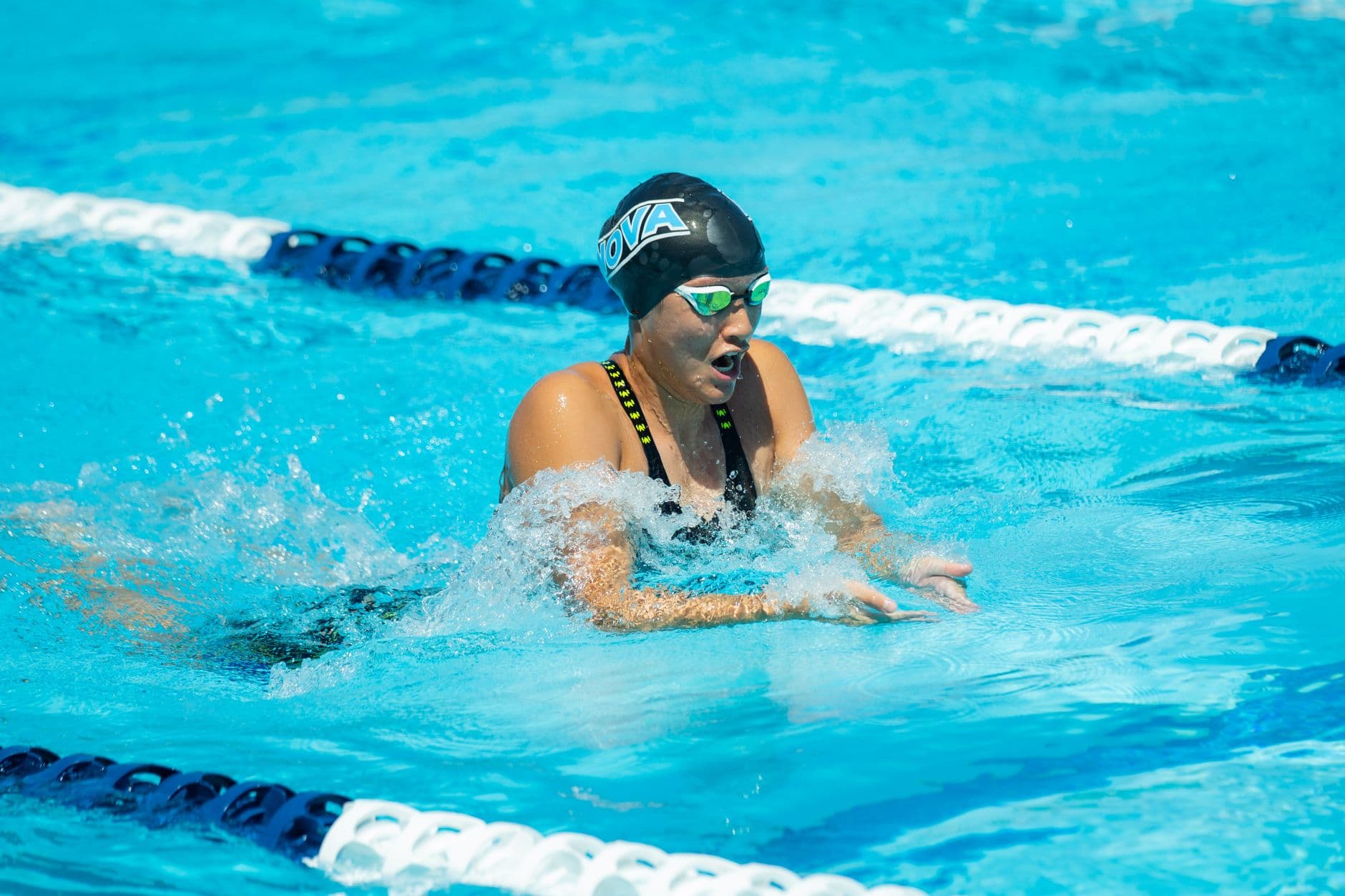
The breaststroke pullout is the only part of a breaststroke race where you are allowed to pull your hands past your hips, and the only place where one extra kick turns a good swim into a disqualification. The order is fixed, the dolphin kick is not, and almost every question people ask about it is really a question about which of those two is which.
Below is the sequence as the rule books write it, the three versions elite swimmers use, and what the research says about whether any is faster. If the kick is your problem rather than the wall, start with why your breaststroke kick goes nowhere.
The sequence, in the order it has to happen
One legal pullout, from the wall to the surface:
- Push off streamlined and glide. Hands stacked, arms locked overhead, head neutral. Nothing else has happened yet.
- One dolphin kick — optional, and it can go almost anywhere. The rule allows a single one at any point before your first breaststroke kick. Most swimmers now put it here, at the front.
- One arm stroke completely back to the legs. This is the pulldown: hands sweep out, down and back until they finish at the hips or thighs. This is the one stroke in the race where going past the hip line is legal.
- Glide with the arms at the sides. Short, and the first thing fatigue eats.
- Recover the arms forward along the body, under the chin, back to full extension.
- One breaststroke kick that carries you to the surface.
- Break the surface — and the head must do it before the hands turn inward at the widest part of the second stroke.
Race analysts cut the same movement into eight measured phases — first glide, dolphin kick, pulldown, second glide, arm recovery, leg recovery, propulsive kick, third glide — which is how the studies further down this page compare one swimmer against another.
What the rule book actually says
Article 7.1 of the World Aquatics swimming rules, in force from February 2026, is three sentences long and does all the work:
“After the start and after each turn, the Athlete may take one arm stroke completely back to the legs during which the Athlete may be submerged. At any time prior to the first Breaststroke kick after the start and after each turn a single Butterfly kick is permitted. The head must break the surface of the water before the hands turn inward at the widest part of the second stroke.”
Read it twice and two things stand out. The dolphin kick has no fixed position — at any time before the first breaststroke kick. And the pullout has no distance limit. What ends it is a stroke, not a mark on the wall.
There is no 15 metre rule in breaststroke
This is the part that catches people out, including swimmers who have been racing for years. Freestyle, backstroke and butterfly all cap the underwater phase at 15 metres: the relevant articles are 5.3, 6.3 and 8.6, and each says the head must have broken the surface by the 15 metre mark. Breaststroke has no such article.
Instead, breaststroke is limited by stroke count. The pullout is stroke one. You then have until the widest point of stroke two to get your head up. In practice one pullout does not reach 15 metres anyway, so nobody is exploiting the gap — but if you surfaced beyond it, no rule would have been broken. U.S. Masters Swimming calls it a quirk of the stroke, and that is a fair description.
Where the dolphin kick is allowed to go
The allowance arrived in 2005, after the controversy at the 2004 Olympics, and the wording has loosened since. Today, one dolphin kick is legal at any moment before the first breaststroke kick: before the pulldown starts, overlapping it, or after it finishes. All three are legal, which is exactly why elite swimmers do not agree on where to put it.
What is not legal is short and worth memorising:
- Two dolphin kicks. One per wall, one off the start. Not one at the front and another at the end.
- A dolphin kick after the breaststroke kick. The window closes the moment the first breaststroke kick begins.
- A downward dolphin kick after your feet break the surface. The rule allows the feet to break the surface, but not if a downward butterfly kick follows.
- A dolphin kick anywhere else in the race. The allowance is only after the start and after each turn.
If the two-kick rhythm itself is what you are trying to feel, the butterfly two-kick timing guide covers the same movement in the stroke where you get more than one.
The three pullouts elite swimmers actually use
A study of 150 races from the World Championships of 2015, 2017 and 2019 and the 2016 Olympics — 60 breaststroke finalists, 26 men and 34 women — classified every pullout into one of three patterns, defined purely by where the dolphin kick sits relative to the pulldown:
- Fly-Kick First. The dolphin kick is finished before the pulldown starts. Clean handover from legs to arms.
- Combined. The pulldown starts before the dolphin kick has finished, so the two overlap.
- Pull-Down First. The arms finish at the sides before the dolphin kick completes — the only pattern where the arms move first.
The split moves over time and by sex. Combined led until 2019, when Fly-Kick First became the most common at the World Championships; Pull-Down First has declined steadily. Men in that sample favoured Combined, women favoured Fly-Kick First. The authors' blunt conclusion was that coaches should stop prescribing one model to everybody.
Which one is faster: the honest answer
Mostly, none of them. Across the 50, 100 and 200 metre events, start and turn times did not differ significantly between the three techniques, and the effect sizes were small. One exception showed up: in the women's 100 metre turn, the Pull-Down First technique came out 0.24 s — about 2 per cent — faster than Combined, which is awkward for a technique that is going out of fashion.
Two other studies point the same way. In a 200 metre breaststroke swum in a 25 metre pool, 12 of 13 swimmers performed the pulldown after the dolphin kick, and across the race the glides got shorter — the time gap between the end of the dolphin kick and the start of the pulldown shrank turn by turn, which is fatigue showing up as a rushed pullout. And in a 25 metre comparison of Fly-Kick First against Combined, Fly-Kick First produced more underwater distance in both sexes, but the only performance difference was small and limited to the women.
So the practical reading is: pick the one you can repeat when you are tired, and defend the glide. The pattern matters less than whether lap seven looks like lap one.
The hip line, and the only stroke where you may cross it
Article 7.4 is explicit: the hands must not be brought back beyond the hip line, except during the first stroke after the start and after each turn. That exception is the pullout, and nothing else. Every other stroke in the race has to finish its pull in front of the hips.
This is why “arms past the hip line” is one of the more common breaststroke disqualifications. It is rarely deliberate. It happens when a tired swimmer lets the hands drift back past the chest on the recovery, or when someone who has drilled pullouts all week carries the long pull into their surface stroke. The same article keeps the elbows under water except on the last stroke before the turn, during the turn, and on the last stroke at the finish.
Who is watching, and how far their jurisdiction runs
Here is a detail almost nobody writes down. An Inspector of Turns normally has jurisdiction from the start signal until the completion of the first arm stroke. In breaststroke, both at the start and at every turn, it runs to the completion of the second arm stroke.
That is written into articles 2.8.2 and 2.8.3 for exactly the reason you would guess: the pullout is stroke one, so judging it means watching the stroke after it as well. If you surface and think you are clear, you are not. The official is still on you for one more full cycle — which is also the cycle in which your head has to have broken the surface.
The disqualifications that actually get called
| What happens | Why it is a disqualification |
|---|---|
| A second dolphin kick, or one after the breaststroke kick | Only one is permitted, and only before the first breaststroke kick (7.1, 7.6) |
| Scissor kick — one foot turned out, the other turned in | The feet must be turned outwards during the propulsive part of the kick (7.6) |
| A flutter from feet that separated during the pause | Alternating leg movements are not permitted (7.5, 7.6) |
| Arms or legs out of sync | All arm and all leg movements must be simultaneous (7.3, 7.5) |
| Hands pulled past the hips on a surface stroke | Legal on the pullout only (7.4) |
| Head still under at the widest part of the second stroke | The head must break the surface before that point (7.1) |
| Arms recovered completely out of the water | Rare, but the recovery must be on or under the surface (7.4) |
The pattern is that most of these are accidents of fatigue rather than ignorance, and most of them happen in the two or three metres after the pullout — which is precisely where the official is still looking.
How much of the race this is, in seconds
In the same set of finals, the two timed sections that contain the pullouts came out like this. Start time is from the signal until the head reaches 15 metres; turn time is from the hands touching the wall until the head reaches 15 metres out.
| 100 m long course finalists | Start to 15 m | Turn to 15 m | Mean race time | Share of the race |
|---|---|---|---|---|
| Men | 6.39 s | 8.88 s | 58.87 s | about 26% |
| Women | 7.63 s | 9.96 s | 66.23 s | about 27% |
The share column is our arithmetic, not theirs: the two section times added together and divided by the mean final time. It is not “a quarter of the race is spent underwater” — these sections include surface swimming out to the 15 metre mark. What it does say is that roughly a quarter of a 100 metre breaststroke race is decided in the two stretches the pullout governs.
For scale on why that matters: in one laboratory comparison, trained male swimmers reached a peak of 3.29 m/s on the underwater path, against roughly 1.7 m/s average velocity for a 58.9 s hundred. The fastest you move in a breaststroke race is before your head comes up.
A 25 metre pool against a 50 metre pool
A 100 metre race in a 25 metre pool has three turns. The same race in a 50 metre pool has one. That is four pullouts against two, and it is the single biggest reason some swimmers are noticeably better at short course breaststroke than long course. U.S. Masters Swimming goes further and notes that some elite short course breaststrokers spend more time performing pullouts than swimming on the surface.
It also means a short course personal best and a long course one are not the same achievement. Before you compare them, run them through the course time converter and read short course against long course — breaststroke is the stroke where the gap is widest.
How to practise it without a coach on deck
The pullout rewards patience and punishes guessing, and you can work on it alone in a lap lane as long as you respect the breathing warning further down.
- One pullout, then stop. Push off, execute the sequence, surface, stand up. Pick a fixed mark — a lane rope colour change, a tile line, anything that does not move — and note where your head comes up. Consistency first, distance later.
- Pullout plus one stroke. This is the drill that trains the rule. Surface, take one stroke, stop. If you were still under as the second pull reached its widest point, you were late.
- Separate the pieces. Dolphin kick in streamline only, no arms. Then pulldown only, no fly kick. Then put them together in the order you chose.
- Film it from the side. A phone held above the water at the side of the pool is enough to identify which of the three patterns you are actually doing. In the study above, above-water footage agreed with underwater cameras almost perfectly when classifying technique, so you do not need special equipment to audit your own sequence.
- Ask an official. At a meet warm-up, a stroke-and-turn judge will usually tell you in ten seconds what a video will not.
If your push-off itself is the weak link rather than the pullout, the turn mechanics are worth fixing first — a bad wall cannot be rescued by a good pulldown.
How to tell whether yours is helping or costing you
Two measurements settle it. First, time a 25 from a push with the dolphin kick and then without it, four repetitions each, rested. If the difference is inside your own repetition-to-repetition scatter, you do not yet have a fly kick that pays. Second, split the 25 in your head: push to surface, then surface to wall. A pullout that is getting longer while the surface section gets slower is a pullout that has stopped being free.
Put the numbers somewhere they mean something. The pace calculator turns a 25 or a 50 into a per-100 pace you can compare week to week, and the SWOLF calculator is useful here with one caveat: a pullout replaces a stroke, so only compare SWOLF scores from swims with the same number of walls. Comparing a short course SWOLF to a long course one tells you about the pool, not about you.
The child swimmer and the adult learner
For a child, the order comes first and the dolphin kick comes much later. A nine-year-old who can do a clean pulldown, recovery and kick in sequence will beat one who adds a fly kick and loses the sequence, and a large share of age-group breaststroke disqualifications are exactly that: an extra kick, or legs that stopped being simultaneous while the swimmer thought about the arms.
For an adult learning or returning, the limiting factor is usually shoulder range of motion on the pulldown and the fact that the whole thing is a breath-hold under load. Build the sequence at a walking pace before you make it fast, and if your shoulder complains during the sweep, read what swimmer's shoulder actually is before you drill it another hundred times. Adults new to the stroke will get more from learning to swim as an adult first.
Where the rule books differ, slightly
All three books say the same thing about the pullout itself, almost sentence for sentence: one arm stroke back to the legs, one dolphin kick at any time before the first breaststroke kick, head up before the widest part of the second stroke. What you practise is what will be judged, and the Masters age group guide covers how those meets run.
The one difference is framing. World Aquatics ties the body-on-the-breast requirement to the beginning of the first arm stroke; the USA Swimming and U.S. Masters Swimming books say the body shall be kept on the breast from when the swimmer leaves the wall. No judge is measuring the roll of your hips during a streamlined glide, but if you push off slightly off-centre, the domestic wording is the stricter one and it is the one applied at your meet.
The breathing rule that belongs on every pullout set. The American Red Cross, USA Swimming and the YMCA of the USA issued a joint statement in November 2022: hyperventilating before underwater swimming and extended breath-holding in the water are dangerous and potentially deadly, and the correct term for the result is hypoxic blackout, not shallow water blackout. Their instructors are taught to limit swimmers to a single inhalation before submerging. Apply the same rule to yourself — one normal breath, never a series of deep ones, never a set built around holding your breath longer. Do not practise pullouts alone, stop the set if you feel light-headed or tingling, and take any episode of dizziness or near-blackout in the water to a doctor rather than to the next repetition.
What the pullout will not fix
A pullout is worth a fraction of a second per wall, and it gives that fraction straight back if you surface into a stroke that does not go anywhere. If your breaststroke is slow on the surface, the wall is not your problem: the kick is where almost all breaststroke propulsion comes from, and a perfect sequence off the wall simply delivers a slow swimmer to the 10 metre mark slightly sooner.
It also will not make a short course time into a long course time, win back a disqualification, or substitute for a push-off that leaves the wall crooked. Fix it because it is a quarter of the race and it is cheap to get right — not because it is the thing standing between you and a different swimmer. The rest of the technique guides cover the parts that are.
Frequently asked questions
How many dolphin kicks are allowed in the breaststroke pullout?
One, after the start and after each turn. The rule allows a single butterfly kick at any time before your first breaststroke kick, so it can come before the pulldown, during it or after it. A second kick, or one taken after the breaststroke kick has begun, is a disqualification.
What is the correct order of the breaststroke pullout?
Glide streamlined off the wall, take the optional single dolphin kick, pull one arm stroke completely back to the legs, recover the arms forward under the body, then take one breaststroke kick that brings you to the surface. Your head must break the surface before the second stroke reaches its widest point.
Is there a 15 metre rule in breaststroke?
No. Freestyle, backstroke and butterfly all require the head to break the surface by the 15 metre mark, but the breaststroke articles contain no distance limit at all. Breaststroke is limited by stroke count instead: the head must surface before the hands turn inward at the widest part of the second stroke.
Can you be disqualified for pulling past your hips in breaststroke?
Yes, on every stroke except the first one after the start and each turn. The pullout is the single exception that lets the hands come back beyond the hip line. Carrying that long pull into your surface strokes, which tired swimmers do without noticing, is one of the more commonly called breaststroke disqualifications.
Which pullout technique is fastest?
In a study of 150 World Championship and Olympic finals, start and turn times did not differ significantly between the three patterns used by elite swimmers. Men tended to prefer the Combined technique and women the Fly-Kick First, and the authors concluded that selection should follow individual preference rather than one model.
Sources
- World Aquatics Competition Regulations, Part Two: Swimming Rules — articles 7.1 to 7.7 (breaststroke), 5.3, 6.3 and 8.6 (the 15 metre limits) and 2.8.2 to 2.8.3 (Inspector of Turns), in force from February 2026 — World Aquatics
- 2026 USA Swimming Rules and Regulations — article 101.2, breaststroke — USA Swimming
- 2026 U.S. Masters Swimming Rule Book, Part 1 — articles 101.2.2 to 101.2.4 — U.S. Masters Swimming
- McCabe C, Mosscrop E, Hodierne R, Tor E (2022). The characteristics of the breaststroke pullout in elite swimming — Frontiers in Sports and Active Living
- Gonjo T, Olstad BH, Šťastný J, Conceição A, Seifert L (2023). Intra- and inter-individual variability in the underwater pull-out technique in 200 m breaststroke turns — PLoS One
- Santos CC et al. (2024). Understanding the Kinematic Profile of 2 Underwater Pullout Breaststroke Techniques — Int J Sports Physiol Perform
- Costa MJ, Gay A, Ferreira FA, Vilas-Boas JP, Santos CC (2025). Relationship Between Dryland Profile and Kinematics of Breaststroke Pullout Techniques — Int J Sports Med
- Joint Statement from the American Red Cross, USA Swimming and the YMCA of the USA on Hypoxic Blackout, November 2022 — American Red Cross
- U.S. Masters Swimming — Breaststroke guide, pullout and disqualification sections — U.S. Masters Swimming
Read next
How to tread water without getting tired
Treading water has a measured energy cost, and the technique everyone recommends is the one that tires beginners fastest. What the research actually found.
Chlorine, hair and skin: what it does and what actually helps
What chlorinated pool water really does to hair and skin, why the green tint is copper rather than chlorine, and which protective steps have evidence behind them.

Swimmer's ear: what prevents it and what is folklore
What causes swimmer's ear, which prevention advice has clinical backing, which has never been tested, and the point at which it stops being an article's problem.
SwimFast is an independent publication. We are not a swim school, a coaching service or a governing body, and nothing here is medical advice. Training paces and test protocols are cited from the published research or federation documents linked on each page. Never swim alone, never attempt breath-hold work without supervision, and check with a doctor before starting a new training programme.