How to swim backstroke straight without hitting the lane rope
You cannot see where you are going. Straightness comes from a symmetrical stroke plus the markings the pool already carries: colour-coded ropes, flags and a stroke count.
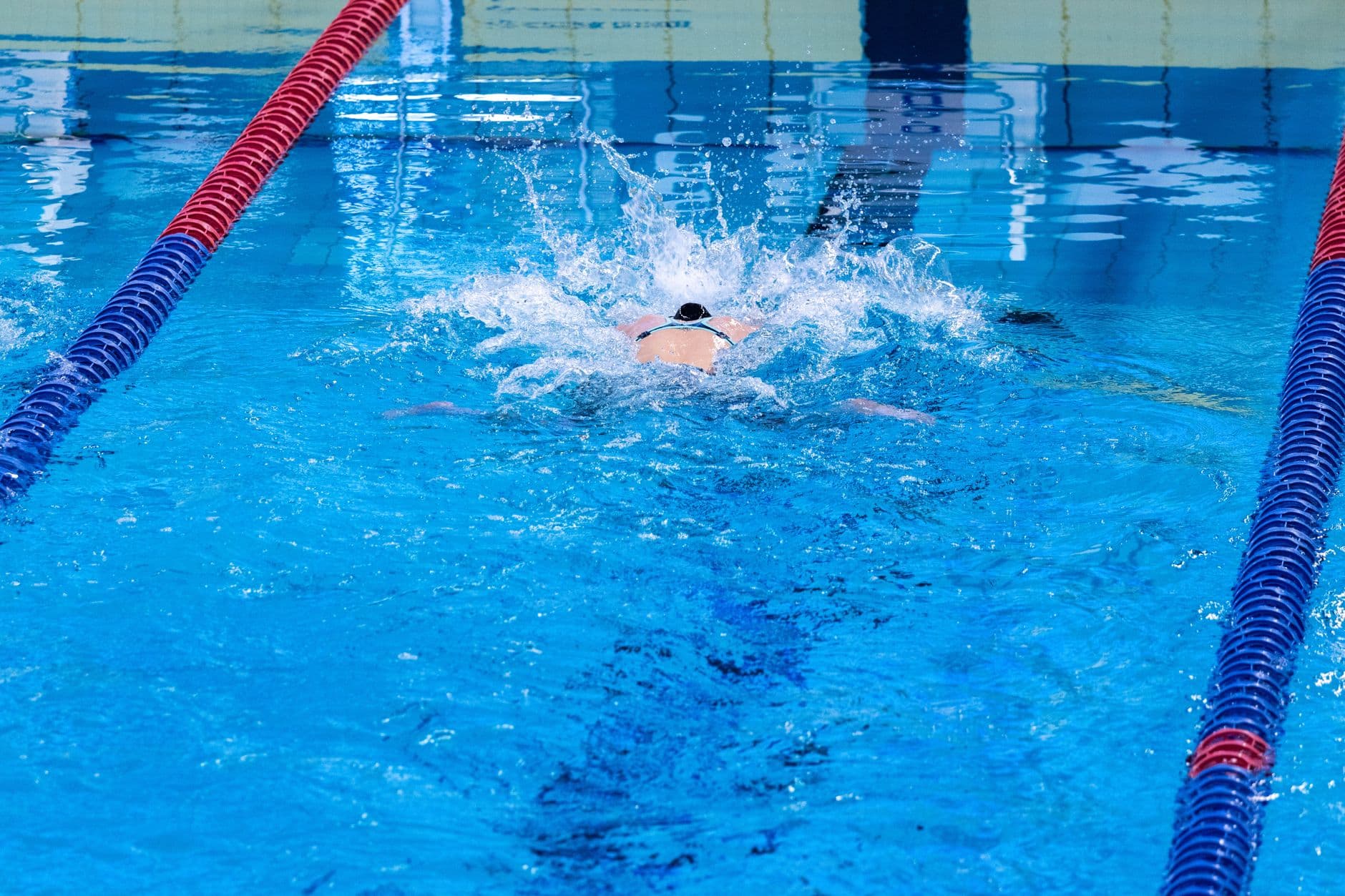
Backstroke is the most comfortable stroke to breathe in and the most stressful to swim, for one reason: you have no idea where you are going.
The solution is not to look. It is to build a stroke that goes straight, and then to read the instruments the pool already gives you — because a competition pool is marked out for precisely this problem, at distances written into the rule book, and almost nobody swimming lengths on their back is using the markings.
Why you drift
Drift is not random. If it were, you would wander both ways and average out. Almost everyone drifts consistently towards one side, which means the cause is a consistent asymmetry.
The usual suspects, in rough order:
An uneven entry. One hand enters wide of the shoulder line while the other enters closer to the head. The wide entry pushes you sideways every cycle.
An uneven pull. One arm goes deeper or sweeps further out than the other, producing more lateral force on that side.
Uneven rotation. Your body rolls further to one side than the other, often because of shoulder mobility rather than technique. The stroke on the restricted side is genuinely different.
Notice that all three are invisible from inside the stroke. That is why the fix starts with finding out which one you have, not with trying to steer.
How much drift you can actually afford
It is worth doing the arithmetic, because the margin is smaller than it feels and that explains why a stroke that seems fine still ends up on the rope.
The U.S. Masters Swimming rule book sets the minimum lane width for competitive swimming at 7 feet, which is 2.13 m. At the other end of the scale, World Aquatics requires 2.5 m lanes at the Olympic Games, and 2.5 m for the middle eight of the ten lanes at its World Championships. Public lap lanes vary and many are narrower than either figure, so measure yours rather than assume.
Take the minimum-width lane and put yourself in the middle of it. That is 1.065 m from the centre line to each rope. Your hand enters roughly in line with the shoulder, so call it 20 cm off your midline for an adult. What is left between your entry and the rope is about 85 cm.
| Lane width | Where you meet it | Room beside your hand | Sideways error that reaches the rope in one 25 m length | … in one 50 m length |
|---|---|---|---|---|
| 2.13 m (7 ft) | The minimum the rule book allows for competition | about 85 cm | about 4 cm per stroke | about 2 cm per stroke |
| 2.5 m | Olympic and World Championship lanes | about 1.05 m | about 5 cm per stroke | about 2.5 cm per stroke |
The last two columns assume about twenty strokes per 25 m, which is a fair figure for an adult holding a steady backstroke; substitute your own count and the numbers move, but not by much. The conclusion survives either way: an error of around four centimetres per stroke — three fingers' width — is enough to take you from the middle of the lane to the rope inside a single short length. You are not failing at something easy.
And notice the last column. In a 50 m pool the same budget is spread over twice as many strokes, so the tolerance halves to roughly two centimetres. Long course is not just longer, it is less forgiving of asymmetry, which is one more entry on the list of ways the two pools are different events rather than different distances — see short course versus long course.
The head is the rudder
Before anything else: in backstroke the head does not move.
Eyes up, water at about the level of your ears, chin neither tucked to the chest nor thrown back. The body rotates from side to side underneath a head that stays put.
Any turn of the head steers you, in the same way a small rudder movement steers a boat. And any lift of the head drops the hips, which is the same drag penalty described in why your legs sink when you swim — worse in backstroke, because there is nothing to counterbalance it.
So the instinct to have a quick look is doubly expensive: it puts you off line and it slows you down. Everything below exists so that you never need to.
The ceiling, and what to do outdoors
Most indoor pools have beams, light fittings or roof panels running the length of the building. Pick one line and hold it in the centre of your vision. If it drifts to one side, so are you.
This is the single most effective correction available and it costs nothing, because it needs no head movement at all — the line is already where you are looking. Choose a feature that runs along the pool rather than across it, and choose it before you push off rather than hunting for one mid-length.
Outdoor pools remove that reference, which is why swimmers who are straight indoors wander outdoors. Clouds move and are useless. What works is a fixed object high enough to stay in view — a building edge, a mast, a tree line — plus more attention on the ropes, because you have lost your best instrument.
The lane rope is a ruler, not just a boundary
This is the part almost every swimmer misses. A competition lane rope is not a uniform line of floats: it is colour-coded to tell you where you are.
Under the rule book, the floats are between 5 cm and 15 cm in diameter, and the ones covering the last 5 m before each wall must be a distinct colour from the rest — 15 feet rather than 5 m in a short course yards pool. There is also a distinctive float, or a marker running right around the circumference, at 15 m from each end wall, in both short and long course pools.
For a backstroker that is a gift, because the ropes sit in your peripheral vision on both sides already. You do not need to look at them. You need to notice two things: when one gets closer, and when the colour changes. The colour change is a wall warning that arrives independently of the flags, and the 15 m marker tells you how much of the length you have left.
Why 15 m is marked at all. It is the limit on being underwater. The rules let a backstroker be completely submerged during the turn and for no more than 15 m after the start and each turn, and by that point the head must have broken the surface. The fixed marks on the deck or walls are what officials judge against; the coloured floats are aligned to them.
One caution: these are competition specifications, so a municipal pool with old ropes may have none of it. Learn what your own pool actually uses rather than expecting a particular shade.
Using the flags properly
Most adult swimmers treat the flags as a decoration, or at best a warning. They are a measuring instrument, and the measurement is specified.
The rule book calls for at least three triangular pennants per lane, 6 to 12 inches wide at the base and 12 to 18 inches long, in two or more alternating contrasting colours. Where they hang is the part that matters:
| Course | Distance from each end wall | Height above the water |
|---|---|---|
| Long course and short course metres | 5 m | 1.8 m minimum, 2.5 m maximum |
| Short course yards | 15 feet (4.57 m) | 7 feet |
The flags move when the pool changes. A yards pool puts them 43 cm closer to the wall than a metric pool does. If you learned your stroke count in a 25-yard pool and then swim a 25 m pool, the count you memorised now stops you short of the wall — and in the other direction it runs you into it. Re-measure whenever the course changes, which is the same trap that makes times incomparable across courses; the course converter handles the times, but only you can re-count the strokes.
Counting from the flags to the wall
The method: swim a length at your normal pace and count how many strokes it takes you from passing under the flags to touching the wall. Do it three or four times until the number is consistent.
From then on you do not look. You pass the flags, count, and on the last stroke you either finish or begin the turn. That is how backstrokers avoid both hitting the wall and stopping short of it.
As a sanity check on whatever you measure: if you cover around 1.2 m per arm stroke, which is a reasonable figure for an adult with a settled backstroke, then 5 m is about four strokes and 15 feet is about three or four. Most adults land somewhere between three and five. Treat that as a range to confirm your own count against, not a number to adopt — your distance per stroke is yours.
Your count will also differ by pace, with fewer strokes when sprinting than when swimming easy, so it is worth holding two numbers if you swim at two speeds. If you want to track distance per stroke properly rather than eyeball it, the SWOLF calculator turns your time and stroke count for a length into a single efficiency number, and stroke rate or stroke length explains which of the two to chase.
What the stroke should look like underneath
Straightness is a by-product of a decent stroke, so it is worth knowing what the underlying shape should be.
The entry. Little finger first, arm straight, hand entering in line with the shoulder — not out at the side and not across the midline above your head. Wide entries steer you; crossed entries wreck your shoulder over time.
The catch. Once the hand is in, the elbow bends and the forearm turns to face the feet, so you are pressing water backwards rather than pushing it down. This is the part most self-taught backstrokers never find, and it is why their stroke feels like windmilling.
The rotation. The body rolls from side to side around a stable spine, roughly to the same angle each way. This is what gives the arm something to pull against, and uneven rotation is one of the three drift causes above.
The kick. Small, fast, from the hips, toes just breaking the surface. Its main job here is the same as in freestyle: hold the legs up so the body stays flat.
If the hips are sitting low, nothing else on this list will produce a straight line, because you are steering a body that is angled through the water rather than lying on it.
Fixing the asymmetry itself
References let you correct. Symmetry means you need to correct less. Three ways to find yours:
Single-arm backstroke. One arm at your side, the other doing the full stroke, alternating by length. You will immediately notice that one side feels coordinated and the other does not. That is the side to work on.
Count strokes per length for each arm. Swim a length leading with the left arm only, then one leading with the right, and compare the counts. A difference of one stroke is noise. A difference of two or three is a real imbalance in how much water each arm is moving, and it is the same measurement that feeds a SWOLF score, so you can log it rather than remember it.
Get filmed from the end of the lane. Asymmetry is instantly visible from outside and almost invisible from inside. Thirty seconds of phone video tells you more than a month of feeling for it, and backstroke is the easiest stroke to film because your face is above the water the whole time.
Once you know which side is the problem, the corrections are usually simple: enter with the hand in line with the shoulder rather than wide, and make sure the rotation is equal in both directions.
What the rules actually require
You do not need to race to benefit from knowing these, because each one explains why a piece of the technique is the way it is.
- Stay on your back. You push off on the back and keep swimming on the back for the whole race. Some part of you must break the surface throughout.
- Fifteen metres underwater, maximum. You may be fully submerged during the turn and for no more than 15 m after the start and each turn, and your head must have broken the surface by then.
- The turn is a defined movement. On reaching the wall the shoulders may turn past vertical towards the breast, after which an immediate continuous single-arm pull, or a simultaneous double-arm pull, may be used to start the turn. Once you have left the position on your back, every kick and pull has to be part of one continuous turning action, and you must be back on your back when you leave the wall.
- The finish is touched on the back, and you may submerge only after your head has passed the final 5-metre mark — the 5-yard mark in a yards pool.
The practical consequence is the one that matters here: a backstroke turn is not something you improvise when the wall appears. It is a sequence you commit to on a stroke count, which is why the counting above is not a nicety. The mechanics of rotating and pushing off are covered in the flip turn guide.
How much slower is backstroke than freestyle?
A fair question once your backstroke is straight enough to time, and one published standards answer rather than opinion. USA Swimming's motivational standards list both events for the same age groups and levels, so the ratio between them is measurable.
| Group, 25 yd pool | 100 back, B | 100 free, B | Gap | 100 back, AAAA | 100 free, AAAA | Gap |
|---|---|---|---|---|---|---|
| 13–14 girls | 1:16.89 | 1:10.99 | +8.3% | 57.69 | 53.29 | +8.3% |
| 13–14 boys | 1:11.29 | 1:04.99 | +9.7% | 53.49 | 48.69 | +9.9% |
| 17–18 girls | 1:13.39 | 1:08.09 | +7.8% | 54.99 | 51.09 | +7.6% |
| 17–18 boys | 1:05.19 | 1:00.29 | +8.1% | 48.89 | 45.29 | +7.9% |
From 13 upwards the gap is remarkably stable: backstroke sits roughly 8 to 10% behind freestyle over 100 yards, and that holds at every level from the entry standard to the fastest one. In a 50 m pool the same comparison runs wider, around 10.5 to 11.5%. The likely reason is that short course gives backstroke more turns and more underwater per length, where it loses least — but that is reasoning from the shape of the tables, not something the standards themselves state.
One band breaks the pattern. At 11–12 the gap stretches to 11–16% in yards and up to 18% in metres, which is far more plausibly a skill gap than a physiological one: most swimmers that age have had years of freestyle and comparatively little backstroke. If your own gap is much worse than 10%, that is the likeliest explanation for you too, and it is good news, because skill closes faster than fitness.
The full six levels, every age band and all three courses are in the time standards table, and if you want to turn a target time into a pace per 100 to train at, use the pace calculator. Bear in mind these are age group standards for registered swimmers, so read them as a ladder rather than as a verdict on an adult — the honest way to interpret any swim time is set out in the average 100 m swim time.
Sharing a lane on your back
A practical section, because most adults swim backstroke in a public lane with people coming the other way, and that is where the anxiety comes from rather than from the stroke itself. The general rules, including which way round to circle, are in lane etiquette; what follows is the part specific to swimming on your back.
Stay firmly on your side of the lane. If you drift, you drift into someone. Correcting early using the ceiling line is not perfectionism here; it is courtesy.
Use one arm as a bumper when you must. If you genuinely do not know where the rope is, letting the fingertips brush it on the entry is better than a full head turn. It costs a little and tells you a lot.
Be predictable at the walls. Since you cannot see behind you, the swimmer following you cannot see what you are about to do either. A consistent stroke count from the flags makes you readable.
Pick your moment. A busy lane at peak hour is not where to learn backstroke. Ten minutes in a quiet lane teaches more than half an hour spent worrying about collisions.
None of this is a reason to avoid the stroke. It is a reason to build the straightness deliberately rather than hoping for it.
Why bother with backstroke at all
If you never intend to race it, there are still two good reasons.
It moves the shoulder through a different range from freestyle, which matters for anyone swimming several times a week — the argument in should you swim every day about varying the stroke applies directly, and it is one of the better hedges against the problem described in swimmer's shoulder.
And it is the easiest stroke to breathe in, which makes it the natural choice for recovery lengths inside a hard session, or for the easy days that make the hard days possible. The rest of the stroke work is in technique, and the sessions in workouts.
Before you push off
Never practise breath-holding, and never swim alone. The 15 m rule above is a competition limit, not a training target: hypoxic sets and deliberate underwater lengths can cause a blackout with no warning, and a blackout in water is silent and often fatal. Swim where a lifeguard is watching. If backstroke produces shoulder pain rather than just awkwardness, or you get dizziness or numbness in the arm, stop and see a doctor or a physiotherapist before you train through it.
Beyond that, the order of work is the order of this page. Get the hips up and the head still, pick a line on the ceiling, learn what your pool's ropes and flags are telling you, then count. Straight backstroke is not a talent; it is a stroke that is the same on both sides, swum by somebody who knows where the wall is.
This is general technique information, not coaching for your shoulders. The figures come from the rule books and standards linked below; check them against your own pool, which may not meet competition specifications. Spotted an error? Tell us and we will correct it and date the change.
Frequently asked questions
Why do I always drift the same way?
Because the cause is a consistent asymmetry rather than random error. Usually one arm enters wider than the other, or pulls deeper, or your body rotation is bigger to one side. Every stroke pushes you a fraction in the same direction, and over a length that accumulates into a lane rope.
How far from the wall are the backstroke flags?
It depends on the pool, which is the part most swimmers miss. The rule book puts them 5 m from each end in long course and short course metres, but only 15 feet — 4.57 m — in a 25-yard pool. They hang at least 1.8 m above the water in metric pools and 7 feet in yards pools.
Can I look where I am going?
You can, and it costs you twice. Turning the head steers you off line, because the head acts as a rudder, and lifting it drops the hips and increases drag. Everything in this article is about getting the information you need without moving your head.
How much can I drift before I hit the rope?
Less than it feels. The minimum lane width for competitive swimming is 7 feet, about 2.13 m, which leaves roughly 85 cm each side of a swimmer in the middle. Spread over about twenty strokes in a 25 m length, that is only some 4 cm of sideways error per stroke.
How do I turn if I cannot see the wall?
By counting strokes from the flags. The rules require you to stay on your back except during the turn, where a continuous turning action is allowed, so the sequence has to be started deliberately on a count rather than improvised when the wall appears underneath you.
Should my head move at all?
No. In backstroke the head stays still, eyes up, with the water at about the level of your ears and the chin neither tucked to the chest nor thrown back. The body rotates underneath a head that does not move — that stillness is what makes a straight line possible.
Sources
- 2026 U.S. Masters Swimming Rule Book, Part 1 — articles 101.4 (backstroke), 106.2.2 (lane width), 106.13 (lane dividers and markings) and 106.14 (backstroke flags) — U.S. Masters Swimming
- World Aquatics Competition Regulations, 18 February 2026 — article 15.6, pool lanes — World Aquatics
- 2024–2028 Motivational Time Standards, age group (revision of 10 October 2025) — USA Swimming
- U.S. Masters Swimming — Backstroke pull and body position guides — U.S. Masters Swimming
- U.S. Masters Swimming — Backstroke kick guide — U.S. Masters Swimming
- U.S. Masters Swimming — Turns guide — U.S. Masters Swimming
Read next
Chlorine, hair and skin: what it does and what actually helps
What chlorinated pool water really does to hair and skin, why the green tint is copper rather than chlorine, and which protective steps have evidence behind them.
Swimmer's ear: what prevents it and what is folklore
What causes swimmer's ear, which prevention advice has clinical backing, which has never been tested, and the point at which it stops being an article's problem.
Swim goggles that fog: what works and what is folklore
Fog is condensation on a lens colder than the air inside it. Which remedies have a mechanism, which are harmless folklore, and which one ends the goggles.
SwimFast is an independent publication. We are not a swim school, a coaching service or a governing body, and nothing here is medical advice. Training paces and test protocols are cited from the published research or federation documents linked on each page. Never swim alone, never attempt breath-hold work without supervision, and check with a doctor before starting a new training programme.