Butterfly for mortals: the two-kick timing that makes it possible
Butterfly is exhausting when the timing is wrong and merely hard when it is right. The whole thing turns on where the two kicks land in the arm cycle.
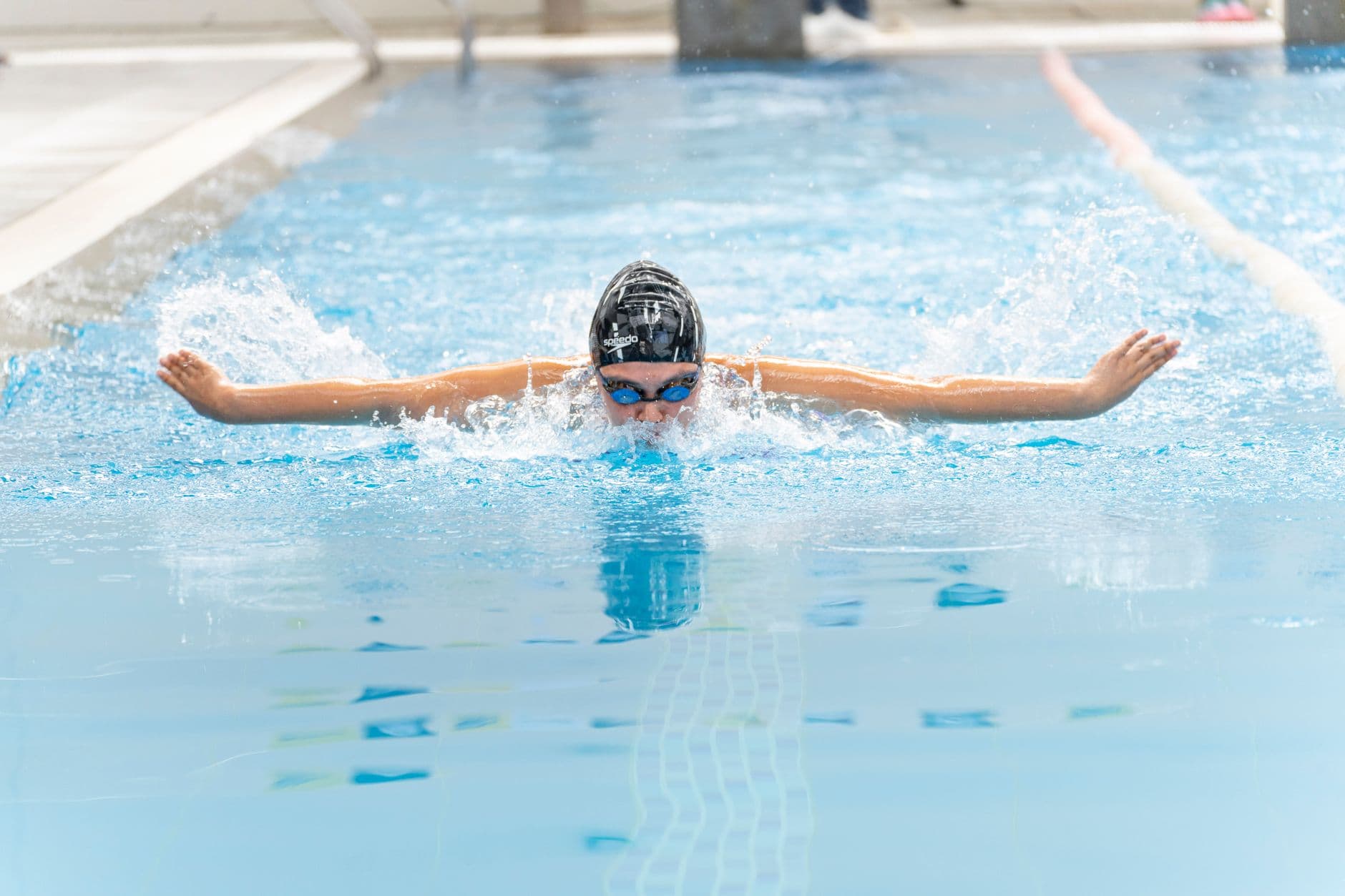
Butterfly has a reputation as the stroke for the strong, which is mostly wrong. It is the stroke for the well-timed. Get the rhythm right and it is hard work; get it wrong and it is impossible, regardless of how much you can bench.
Almost all of the difference is in where two kicks land.
The rules, briefly, because they shape the stroke
Butterfly is the most tightly defined of the four strokes. The competition regulations require that both arms be brought forward together over the water and brought backward simultaneously, and that all up and down movements of the legs and feet be simultaneous — the legs may not alternate.
That matters for a learner because it removes the improvisation available in other strokes. You cannot quietly turn a struggling butterfly into a modified freestyle; the stroke either has the shape or it does not.
It also explains why the rhythm is so unforgiving. With both arms recovering at once, there is a moment in every cycle where nothing is propelling you and both arms are out of the water. Everything depends on arriving at that moment with momentum.
The two kicks, and what each is for
This is the core of the article.
There are two kicks per arm cycle, and they are not interchangeable.
Kick one lands as the hands enter the water at the front of the stroke. Its job is to press the hips up and set the body position for the catch. Miss it and you enter flat and low.
Kick two lands as the hands finish the pull and leave the water at the back. Its job is to drive the hips down so the chest and shoulders rise — which is what carries your arms up and over for the recovery.
The second one is the one that changes everything for adult learners. The recovery is not lifted by the shoulders. It is thrown by the second kick.
If your arms feel like lead by the fourth stroke, this is almost certainly why: you are performing with muscle a movement that is supposed to be free.
The rhythm, out loud
A cue that works better than any description of angles. Count the cycle as:
Kick — pull — kick — recover.
Or, if you prefer the version people say on pool decks: kick your hands in, kick your hands out.
That single sentence is most of butterfly. The first kick goes with the hands going in at the front; the second goes with the hands coming out at the back.
The reason it beats a technical description is that butterfly happens too fast to think about. By the time you have decided where your hips should be, the cycle has moved on. A count runs underneath conscious thought, which is where a rhythm belongs.
Say it in your head while you swim. It sounds simplistic and it is the fastest route to the timing, because butterfly is a rhythm problem and rhythms respond to counting rather than to analysis.
Counting also gives you the only honest measure of whether the timing is improving rather than your fitness. Take the strokes and the time for one length together as SWOLF: when the kicks land in the right places, the same 25 costs fewer strokes at the same time, and the number drops. Read it only against your own previous butterfly, in the same pool and at the same effort: the published SWOLF bands describe freestyle in a 25 m pool and say nothing about a butterfly number, so there is no target to hit here, only a direction of travel. The related trade-off between turnover and distance per stroke is in stroke rate or stroke length.
The arms: less than you think
Because butterfly looks so physical, adults assume the arms are doing enormous work. They are doing normal work in an unusual pattern, and the pattern is where the difficulty lies.
The pull is roughly a keyhole shape: hands enter about shoulder width, press out and back, sweep in under the chest, and accelerate out past the hips. The critical part is the finish — the hands should accelerate all the way past the hips before leaving the water, because that acceleration plus the second kick is what launches the recovery.
A pull that stops short at the ribs leaves you trying to lift your arms from a dead position, and no amount of shoulder strength makes that comfortable.
The recovery itself should be low and relaxed, arms swinging around rather than lifting up, thumbs down or palms out, elbows soft. Adults tend to recover high and tense, which costs energy and drops the shoulders into a position they do not enjoy over many repetitions.
If the arms are the part that fails first, the fault is nearly always upstream: a missing second kick, or a pull that does not finish.
The undulation, and where it should come from
Butterfly involves a wave through the body, and the wave is where most people injure themselves.
It should be driven from the chest and hips, with a relatively small range, and the legs following. It should not be produced by arching and flattening the lower back, which is what happens when swimmers try to make the wave bigger than it needs to be.
A useful correction: think of pressing the chest down rather than lifting the hips up. The same shape results, but the effort comes from a place that tolerates it.
If your lower back aches after butterfly, that is the signal to reduce the range and rebuild rather than to keep going. Persistent pain is a reason to stop and get it looked at, in the same way shoulder pain is — the mechanism is different from swimmer's shoulder, but the principle of not swimming through it is identical.
Breathing without wrecking the stroke
The breath is where a decent butterfly falls apart, because lifting the head high enough to breathe drops the hips at exactly the wrong moment.
Two rules. Look forward and slightly down, not up. The chin should stay close to the water and the eyes should be pointing at the surface a short distance ahead, not at the far wall. And get the head back in before the hands enter, so you are not entering the water with your head still up.
While learning, breathe every stroke. The advice to breathe every second stroke belongs to swimmers who already have the timing, and applying it early guarantees an oxygen debt that destroys the rhythm within five metres.
The same principle that governs freestyle applies: an oxygen-starved swimmer cannot hold technique. That argument is made at length in how to breathe while swimming freestyle and it is even more true here.
How to learn it without a week of soreness
The mistake is to attempt lengths. Butterfly with bad timing costs several times what good timing costs, so lengths early produce exhaustion, poor technique and a sore back — and teach the wrong pattern.
A sequence that works:
Body dolphin, no arms. Arms at your sides or extended, undulating from the chest. This teaches the wave without any of the load.
Single strokes. Push off, one full butterfly stroke, then stop and stand or glide. Repeat. You are practising the timing of one cycle, which is the only thing that matters at this stage.
Three strokes, then freestyle. 3 butterfly, then freestyle to the end of the length. Enough repetitions to find the rhythm, few enough that fatigue does not corrupt it.
25s with generous rest. Only once the three-stroke version feels rhythmic rather than effortful.
"Generous" is worth turning into a number, because in butterfly the rest is the part that protects the timing. Work from the send-off rather than from how you feel: put your 25 time into the interval calculator and pick a send-off that leaves you resting at least as long as you swam. A freestyle set often runs on ten or fifteen seconds of rest; butterfly learned this way needs far more, and a send-off decides that for you instead of leaving it to a tiring swimmer’s judgement.
Notice that lengths appear last. Butterfly is the one stroke where volume before technique is actively counterproductive, and the advice in should you swim every day about varying the stroke applies with extra force: a little butterfly, often, beats a lot of it occasionally.
A reasonable dose while learning is 100 to 200 m of butterfly work spread through a session, in pieces of three to eight strokes, two or three times a week. That is enough repetition for the timing to consolidate and little enough that the stroke never degrades into flailing.
Why bother at all
A fair question if you are never going to race it.
Two reasons. The undulation and the dolphin kick are what drive the underwater phase off every wall in every stroke, and that phase is worth real time — the rules allow up to 15 m of it, and it is covered in how to swim your 100 free faster.
And it moves your shoulders through a completely different range from freestyle, which for an adult swimming several times a week is a genuine benefit rather than a nicety.
The other strokes are in technique and the sets in workouts.
This is general technique information rather than coaching for your body. Butterfly loads the lower back and shoulders in ways that not everyone tolerates; if something hurts, stop and ask a professional. Spotted an error? Tell us and we will correct it and date the change.
Frequently asked questions
How many kicks are there per stroke?
Two, and they do different jobs. The first lands roughly as the hands enter the water at the front. The second lands as the hands finish the pull and leave the water at the back. Swimmers who kick once per cycle, or who kick at random, find butterfly enormously harder than it needs to be.
Why can I not get my arms out of the water?
Because you are asking your shoulders to do a job the second kick is supposed to do. That kick drives the hips down and the upper body up, and the recovery rides on that momentum. Without it you are lifting two tired arms out of the water with muscle alone, which nobody can sustain.
Do I need to be strong to swim butterfly?
Less than you would think. Butterfly punishes bad timing far more than it rewards strength, which is why some slight swimmers make it look easy and some strong ones cannot complete a length. Strength helps at speed; timing determines whether the stroke works at all.
Should I breathe every stroke?
While learning, yes. The advice to breathe every second stroke is for people who already have the timing, and applying it early produces an oxygen-starved swimmer whose technique collapses in five metres. Breathe every stroke, get the rhythm, and reduce later if you want to race it.
Why does my lower back hurt?
Usually because the undulation is coming from arching the back rather than from the hips, and often because the head is lifting too high to breathe. It is a signal to stop and rebuild the stroke in short pieces, not to push through — and if it persists, to see a professional.
Sources
Read next
Chlorine, hair and skin: what it does and what actually helps
What chlorinated pool water really does to hair and skin, why the green tint is copper rather than chlorine, and which protective steps have evidence behind them.
Swimmer's ear: what prevents it and what is folklore
What causes swimmer's ear, which prevention advice has clinical backing, which has never been tested, and the point at which it stops being an article's problem.
Swim goggles that fog: what works and what is folklore
Fog is condensation on a lens colder than the air inside it. Which remedies have a mechanism, which are harmless folklore, and which one ends the goggles.
SwimFast is an independent publication. We are not a swim school, a coaching service or a governing body, and nothing here is medical advice. Training paces and test protocols are cited from the published research or federation documents linked on each page. Never swim alone, never attempt breath-hold work without supervision, and check with a doctor before starting a new training programme.