Breaststroke kick: why yours goes nowhere
In breaststroke the legs do most of the work, so a kick that does not propel is not a small problem. Four faults account for almost all of it.
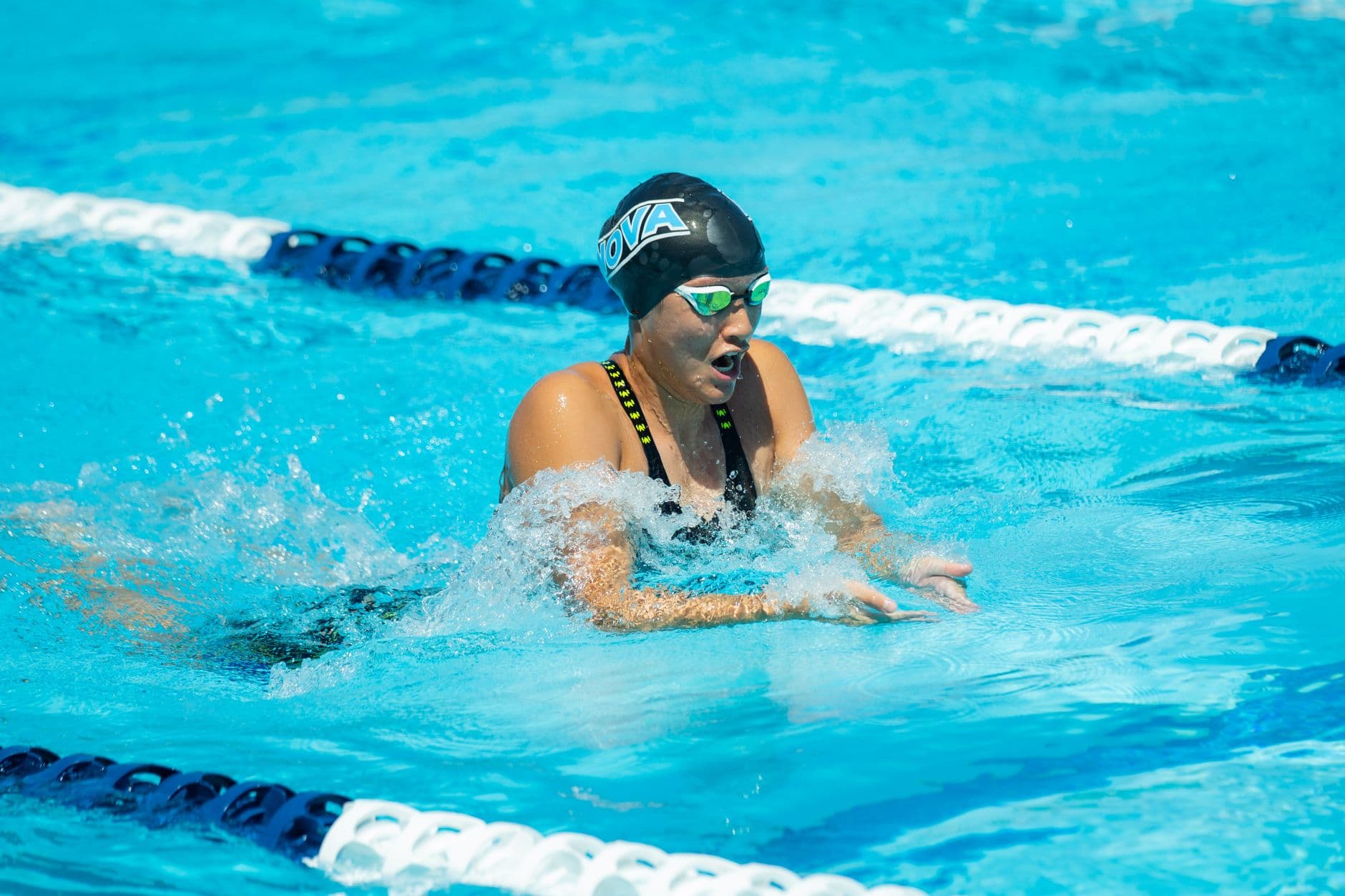
Breaststroke is the stroke adults are most likely to have taught themselves, and the one where self-teaching costs the most. Every other stroke will move you forward on the arms alone. This one will not.
Why the kick matters more here
In freestyle, the legs are a minority contributor. A tethered-swimming study of 23 national-level swimmers estimated the relative contributions of arm stroke and leg kick at roughly 70% arms to 30% legs for men and 67% to 33% for women — measured in front crawl, over a 30-second maximal effort.
That is freestyle. In breaststroke the balance inverts: the legs are the primary engine and the arms contribute a much smaller share. Which is why a broken freestyle kick is a drag problem you can partly work around, and a broken breaststroke kick is simply not swimming.
It is also why the fault is so demoralising. You can be fit, strong and trying hard, and travel a metre per stroke.
What actually produces the propulsion
Here is the mental model that fixes most people.
The kick is not a frog-like opening and closing of the legs. The propulsion happens in a specific window: after the feet have been drawn up and turned out, the insteps and the inner surfaces of the feet press backwards and inwards against the water, and the legs finish together.
Everything else — the draw-up, the turn-out, the finish — exists to put those surfaces where they can push. If your feet are not turned out, there is nothing to push with, and the strength of your legs is irrelevant.
That is the whole thing. The rest of this article is the four ways people get it wrong.
Fault one: pointed toes
This is the big one, and it accounts for most "my kick does nothing" cases.
Every other stroke you have ever swum wants a pointed foot. Freestyle, backstroke and butterfly all kick with the toes extended, and if you have spent years doing those, extending the ankle is what your legs default to.
Breaststroke wants the opposite: the ankle flexed, the toes turned out towards the sides of the pool, so the sole and instep face backwards. With pointed toes, the same movement becomes a scissor that pushes water down and sideways — which is why swimmers with this fault often find their hips rising and their legs sinking at the same time.
The diagnosis is easy: kick a length on your back, slowly, and look at your feet at the moment before they sweep. If you can see your soles, you are close. If you can see the tops of your feet, that is the fault.
Fault two: the wide, slow recovery
The recovery — drawing the heels up towards the backside — is the part of the kick that produces no propulsion at all. It is pure cost, and the only thing to do with it is make it cheap.
Two things make it expensive. Width: knees drawn out to the sides turn your thighs into two flat plates facing the oncoming water. Time: a slow recovery holds that shape for longer.
The fix is to bring the heels to the backside rather than the knees to the chest, and to do it quickly. The knees will separate, but they should not lead the movement.
If you have ever wondered why a swimmer with a beautiful, slow, wide breaststroke goes slower than someone with a compact and unglamorous one, this is the reason.
Fault three: asymmetry
One leg does more than the other, or the two are slightly out of phase. It is common in adults with an old knee or hip injury, and in swimmers who learned by copying rather than being taught.
Beyond the propulsion you lose, this one has a rules consequence: the competition regulations require the leg movements in breaststroke to be simultaneous and in the same horizontal plane, without alternating. A scissor or flutter action is a disqualification, not a personal style.
You usually cannot feel it. Ask someone to watch from behind, or film a length from the deck — asymmetry is instantly visible on video and almost invisible from inside the stroke.
Fault four: the timing
The kick can be technically correct and still waste itself by arriving at the wrong moment.
The sequence that works is pull, breathe, kick, glide — the kick finishing as the arms extend forward, so the propulsion arrives when the body is at its most streamlined. Kick while your arms are still sweeping wide and you are accelerating a shape that is fighting the water.
A useful self-check: at the end of every stroke cycle you should be briefly long and flat, arms extended, legs together. If you never reach that position, the kick is landing too early.
Adults often find the timing before they find the kick, because timing is a rhythm and rhythms are easier to copy. That produces the frustrating case of a swimmer with a perfect-looking stroke who is barely moving — everything is right except the surface doing the pushing.
The two cues that do most of the work
Technique articles tend to list ten things to think about, which is nine more than anyone can hold in their head mid-length. If you take two cues into the water, take these.
"Toes to the walls." Before the sweep, the toes should point out towards the side walls of the pool, not down towards the bottom. It is a spatial instruction rather than an anatomical one, and adults act on it far more reliably than on "dorsiflex your ankles".
"Heels to the backside, not knees to the chest." This fixes the width and the timing of the recovery in one instruction, because it is physically difficult to draw the heels up while splaying the knees.
Work on one of them per session. Trying to fix the ankle and the recovery in the same length usually produces a kick that is worse than the one you started with, because both are being consciously controlled and neither is smooth.
And swim some full stroke every session, even while the kick is a work in progress. A drill that never gets integrated is a party trick.
How to work on it without wasting months
In this order, and do not skip to the last one.
Vertical kicking, in deep water, arms crossed on the chest. There is nowhere to hide: if the kick does not propel, you sink. Short repeats, long rests.
Kick on your back, hands at your sides, so you can see what your feet are doing. This is where you fix the ankle position, because it is the only drill where you get visual feedback in real time.
Kick on your front with a board, but treat it as a fitness drill rather than a technique one — the board changes your body position and hides what your hips are doing. Its limits are covered in is kickboard work worth it.
Two kicks, one pull, full stroke, so the kick has to carry the swim.
Ankle range is the one component that responds slowly. If you genuinely cannot turn your feet out, that is worth knowing early so you set your expectations accordingly rather than assuming you are doing it wrong.
How long this takes
Longer than you want, and it is fairer to say so. The ankle position in particular is a movement most adults have never asked their legs to perform, and the first sessions often feel like the kick has got worse — because a consciously controlled movement is always clumsier than an automatic one.
A reasonable expectation is that the ankle turn-out starts to feel normal within a few weeks of regular short sessions, and that it survives into full-stroke swimming some time after that. The gap between those two points is where most people give up.
Measure it rather than feeling for it. Count your strokes for one length of breaststroke at an easy pace, once a week, at the same effort. If the count is coming down while the time holds, the kick is working. That is a far more reliable signal than whether the stroke felt good.
Strokes and time together have a name: SWOLF, the sum of the two for one length. It is the cleanest number for this particular job, because a kick that starts working shows up as the same time for fewer strokes, and a single stroke count alone cannot tell you whether you simply swam slower. One limit matters here: the published SWOLF reference bands are for freestyle in a 25 m pool, so they do not describe a breaststroke figure at all. Compare a breaststroke SWOLF only against your own earlier breaststroke, in the same pool, at the same effort. Which direction it sits relative to your freestyle is not something the published data settles, and it does not matter for this purpose — the trend in your own number is the whole signal. If you want the pace side of it instead, the pace calculator turns one timed length into the per-100 figure that sets are written in.
What this does not fix
If your body position is poor, a good kick is propelling a bad hull, and the return is small. Breaststroke is unusually punishing here because the head lifts every stroke. The general problem is covered in why your legs sink.
And if breaststroke is the only stroke you swim because it is the only one where you can breathe comfortably, the real fix is elsewhere: breathing in freestyle is a solvable problem, and solving it opens up training that breaststroke alone cannot give you.
The rest of the stroke work is in technique, and the sets in workouts.
This is general information, not coaching for your body. Knee pain in breaststroke in particular is worth taking to a professional rather than working through. Spotted an error? Tell us and we will correct it and date the change.
Frequently asked questions
Why do my legs feel strong but I do not move?
Almost always because your feet are pointed. Propulsion in a breaststroke kick comes from the insteps and the inner surfaces of the feet pressing backwards against the water. If the toes are extended, those surfaces face downwards instead of backwards, and a strong, well-timed effort produces a lot of turbulence and very little forward motion.
How wide should my knees go?
Narrower than most adults think. The width that matters is the width of the feet at the end of the recovery, not the width of the knees. Knees drawn wide drag the thighs across the flow and cost you more in drag than the kick returns in propulsion. A useful cue is to keep the knees roughly inside the line of the hips.
Is it my ankles?
Sometimes, and it is the one fault that is not purely technical. The kick asks for ankle flexibility in a direction most adults never use, and limited range there genuinely limits how much surface you can present. That does not mean you cannot improve it, but it does mean progress can be slower than for a swimmer who has been doing this since childhood.
What is a scissor kick and why does it matter?
It is when the legs do different things — one sweeping, one trailing, or the two moving out of phase. The competition rules require the leg movements to be simultaneous and in the same horizontal plane, so an asymmetric kick is a disqualification in a race. Outside a race, it still means half your engine is not firing.
Should I use fins to fix it?
Not for breaststroke kick. Fins extend the foot and reward a pointed-toe action, which is the opposite of what this kick needs. If you want equipment, a board that keeps your upper body still while you concentrate on the legs is more useful, and even that has limits discussed in our article on kick sets.
Sources
Read next
Chlorine, hair and skin: what it does and what actually helps
What chlorinated pool water really does to hair and skin, why the green tint is copper rather than chlorine, and which protective steps have evidence behind them.
Swimmer's ear: what prevents it and what is folklore
What causes swimmer's ear, which prevention advice has clinical backing, which has never been tested, and the point at which it stops being an article's problem.
Swim goggles that fog: what works and what is folklore
Fog is condensation on a lens colder than the air inside it. Which remedies have a mechanism, which are harmless folklore, and which one ends the goggles.
SwimFast is an independent publication. We are not a swim school, a coaching service or a governing body, and nothing here is medical advice. Training paces and test protocols are cited from the published research or federation documents linked on each page. Never swim alone, never attempt breath-hold work without supervision, and check with a doctor before starting a new training programme.