The backstroke start and the flags: what the rules actually say
Where your hands and toes have to be, what the ledge is allowed to do, and why the flags sit five yards out in a yards pool and five metres out in a metres pool.
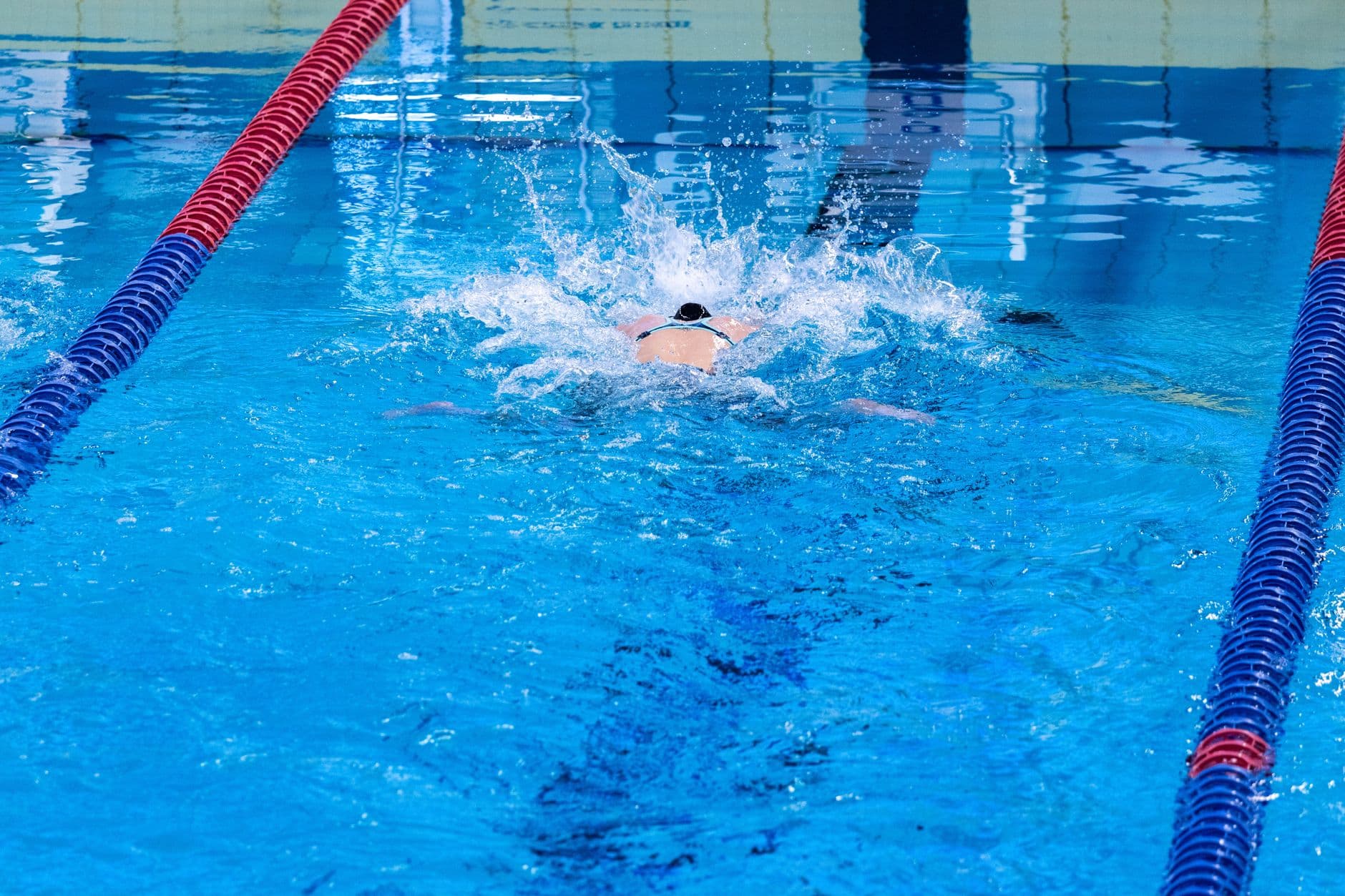
Every other race in the pool begins above the water. Backstroke begins in it, holding onto the block, feet on a vertical wall and head tipped back — and almost every detail of that position is written down. So is the exact height and distance of the coloured flags strung across the pool, which exist so that a swimmer who cannot see the wall knows when it is coming.
This guide puts the rule text and the measurements in one place, says where the two main rule books disagree, and then does the part no rule book covers: turning "the flags are five metres out" into a stroke count you can trust at race speed.
Where the race actually starts: in the water, not on the block
World Aquatics splits the start in two. For freestyle, breaststroke, butterfly and individual medley, article 4.1 says the start is with a dive. For backstroke and medley relay races, article 4.2 says the start "will be in the water". There is no version of a legal backstroke start that begins with you standing on top of the block.
That single sentence is why the backstroke start is a different skill from a front dive. In a dive you are falling and steering. Here you hang off a fixed handle, load your legs against a wall, and the only way to generate anything is to pull your hips up to your hands before you throw them backwards. The block is not a platform; it is an anchor.
It also means the medley relay has one swimmer who gets into the water while three others stand on the deck: the backstroke leg starts from exactly the position described below.
The whistles, in order, and what each one means
The sequence in article 4.2 is fixed, and knowing it stops you from arriving at the wall out of breath. First, once everyone has taken their clothing off, the Referee gives a short series of whistles, which invites swimmers to get ready at the starting end. Then a long whistle, which means enter the water immediately.
Then — and this is the one people forget — a second long whistle, at which swimmers "return without undue delay to the starting position". That is your cue to come back to the wall and take hold of the grips. The gap between the first long whistle and the second is your only window to get wet, settle your goggles and push off the wall once.
After that the Referee raises an outstretched arm, which hands the heat over to the Starter and stays raised until the signal. The Starter says "take your marks" only once every swimmer has assumed a legal position, and gives the signal only when every swimmer is stationary. At the Olympics and the World Championships the command is in English through loudspeakers at each starting platform, so the lane nearest the Starter has no advantage.
Move before the signal and article 4.4 says you may be disqualified. If the signal has already gone, the race is swum and the disqualification declared at the end; if it has not, the heat is stood down with the words "stand down please".
What the rule says about your hands and your feet
Article 6.1 is short enough to quote in full in substance. Swimmers line up in the water facing the starting end, with both hands holding the starting grips. Standing in or on the gutter is prohibited. Bending the toes over the lip of the gutter is prohibited.
That is the whole position: hands on the grips, feet on the wall below the surface, nothing hooked over the gutter to cheat the pull. Nothing in the rule says how high your feet must be, whether they must be level, or whether they may be parallel or staggered — all of that is coaching preference, not law. What is not legal is using the gutter as a foothold.
USA Swimming's rule 101.4.1 is the same idea with two differences worth knowing: it allows both hands "on the gutter or on the starting grips", and it explicitly bans placing the toes above the lip of the gutter as well as bending them over it, "before or after the start". If you train under USA Swimming rules and race under World Aquatics rules, the hands-on-the-gutter habit is the one to drop.
The ledge: what it is, and what the rule lets it do
The backstroke ledge — most swimmers call it the wedge — is a small adjustable step that hangs off the block into the water and gives your feet a horizontal surface instead of a vertical wall. World Aquatics article 15.10 sets the specification, and the numbers are tighter than most people assume:
- It must be adjustable to 4 cm above or 4 cm below the water level, and may not be used outside that range.
- It must be a minimum of 60 cm in length.
- It must be 8 cm in height and 2 cm in width, with 10 degrees of slope.
So the ledge does not lift you clear of the water. At its highest legal setting your feet are four centimetres above the surface — about the thickness of two fingers. A backstroke start with the swimmer perched well above the water line is not something the rule allows.
Two operational details matter at a meet. Article 2.8.5 puts the ledge in the officials' hands: each Inspector of Turns at the starting end installs and removes the ledge in their own lane, and once installed it is set at zero. And when a ledge is used, article 6.1 changes the foot rule — at least one toe of each foot must be in contact with the end wall or the face of the touchpad, and bending the toes over the top of the touchpad is prohibited. Feet entirely on the ledge, with no contact on the wall or the pad, is not a legal position.
Does the ledge make you faster? What the research says
Yes, in a specific and limited sense. A 2023 systematic review in Sports Biomechanics gathered 25 studies on back plates and wedges across both ventral and dorsal starts and rated them fair quality. Its finding for backstroke: the start with the wedge "improved performance through a greater centre of mass vertical position at take-off, horizontal and vertical position at entry and underwater velocity".
That is a statement about geometry, not about a time saving. The ledge gets your hips higher when you leave the wall and puts you into the water in a better shape, so you carry more speed underwater. The review reports no single number of seconds, because the studies it pooled used different swimmers, protocols and definitions — so anyone quoting you "the wedge is worth 0.2 seconds" is quoting a blog, not this literature.
The practical version: the gain is not automatic. The studies that measured a benefit used swimmers who had trained the position, and a first attempt on an unfamiliar ledge is more likely to cost you the start than win it.
Horizontal or vertical handgrip: the measured answer
Modern blocks offer more than one place to hold. Since 2008, the approved competition block has carried two horizontal backstroke handgrips and one vertical one, and swimmers argue about which is better.
A study of ten competitive backstroke swimmers tested exactly that. After four weeks of training to familiarise them with both variants, each swam six maximal 15 m trials — three with the hands on the highest horizontal grip, three on the vertical grip — with surface EMG on six muscles and eight cameras recording joint angles. The conclusion: the different handgrips "did not affect EMG, kinematics and temporal profile", and the 15 m times did not separate either.
Ten swimmers is a small sample and the finding is an absence of difference rather than proof of equivalence. But it is the measurement that exists, and it points the same way as common sense: pick the grip that lets you get your hips highest, and spend the training time on the pull-up and the throw rather than on the choice.
The 15 metre rule, and the one thing that has to break the surface
Article 6.3 is the rule that catches people. At least one part of your body must break the surface of the water throughout the race — except during the turn, and for a distance of not more than 15 metres after the start and after each turn. By the 15 metre mark, your head must have broken the surface.
Two separate requirements hide in there. Within the first 15 metres you may be fully submerged. At 15 metres it is specifically your head that has to be out, not a hand or a knee. After that, something has to stay visible for the rest of the length.
The 15 metre mark is physically present in a competition pool: article 15.9.1 requires distinctive marks on both sides of the pool and, where possible, on each lane rope, 15.0 metres from each end wall — usually a change in the colour of the lane rope floats. Your underwater dolphin kick off the start lives entirely inside that 15 metres, which in a 25 metre pool is more than half the length.
What the flags are, and exactly where they hang
The flags are not decoration and they are not a finish line. They are a ranging mark, and the rule book calls them backstroke turn indicators. World Aquatics article 15.9.1 specifies flagged ropes suspended across the pool, 1.8 metres above the water surface, from fixed standards placed 5.0 metres from each end wall.
Article 15.9.2 tells you what you are looking at: triangular flags, 0.20 m along the side attached to the rope and 0.40 m on the other two sides, spaced 0.25 m apart. USA Swimming's rule 103.17.1 describes the same object in inches — at least three triangular pennants, six to twelve inches wide at the base and twelve to eighteen long, in two or more alternating contrasting colours — and requires them over every lane, during all warm-up periods as well as competition, for backstroke, individual medley and medley relay events.
Someone is responsible for them being there: article 2.9.4 makes the Judges of Stroke confirm the indicators are installed at 5 metres from each end wall before each backstroke or medley event. At a pool not set up for competition nobody has that job, which is the practical warning U.S. Masters Swimming gives — check the flags are up before you push off into backstroke at an unfamiliar pool, because early-morning lap swim often predates whoever hangs them.
The yards pool trap: five yards is not five metres
Here is the detail that ruins stroke counts, and it is in the rule book rather than in any coaching article. USA Swimming's rule 103.17.2 sets the flag position by course:
Five yards is fifteen feet is 4.57 metres. So the flags are not at a fixed distance in absolute terms: they are five of whatever unit the pool is measured in, and the yards pool puts them 43 centimetres closer to the wall. The height differs too, and by more: a yards pool hangs them at seven feet (2.13 m) above the water, while a metres pool runs from a minimum of 1.8 m to a maximum of 2.5 m, with 1.8 m required at championship level.
Forty-three centimetres is roughly a third of a stroke for an adult backstroker — not enough to explain a missed wall on its own, but it is one more reason a stroke count learned in a yards pool does not transfer. The rest of what changes between courses is in short course against long course, and the time converter handles the arithmetic.
How to find your own stroke count from the flags
No rule book can tell you how many strokes you take in five metres, because it depends on your speed, your stroke length and the length of your arms. U.S. Masters Swimming publishes the method that works, and it is a search rather than a calculation.
Start in the middle of the pool and swim normal backstroke towards the wall. As you pass under the flags, take exactly two strokes and stop, with one arm extended above your head. Look at how far you are from the wall. Go again and take three. Keep adding one until the extended hand arrives at the wall. That number is your count for a finish.
Then do it again for the turn, because the two counts differ: a finish needs you close enough to reach the wall with a stroke, while a flip turn needs you to roll and get your feet round, which starts earlier. Have a coach or a training partner watch from the side, or film it — your own sense of distance while lying on your back is the least reliable instrument involved.
The turn: what the rule lets you do once you roll over
Article 6.4 is more permissive than most swimmers realise, and it is worth reading before you learn the turn. On completing each length you must touch the wall with at least one part of your body. During the turn the shoulders may be turned over the vertical to the breast — and then, to initiate the turn, you may use either an immediate continuous single arm pull or an immediate continuous simultaneous double arm pull. You must have returned to a position on your back when you leave the wall.
The two words doing the work are "immediate" and "continuous". Once you roll to your front the turn has to start and keep going; a glide on your chest, a pause, or a second pull is where the disqualification comes from. And the double-arm version is legal, which contradicts the coaching shorthand that backstroke turns use "one arm only".
Downstream of the touch it is the same mechanics as a freestyle turn, so if your somersault is the weak part, the flip turn guide covers it. What is specific to backstroke is the approach: you arrive blind, off a stroke count, and the roll has to happen on the stroke you planned rather than the one that feels right.
The finish, and why you are allowed to disappear
Article 6.5 gives you one legal submersion at the end of the race: once your head has passed the 5 metre mark — the flags — you may be completely submerged, and at the finish you must touch the wall while on your back. USA Swimming's 101.4.2 says the same thing and spells out the courses: the final 5-metre mark in long course and short course metres, the 5-yard mark in short course yards.
This is why elite backstrokers vanish under the surface in the last few metres and stretch into the wall with their face underwater. It is deliberate and legal, and it is the reason the flags are the last thing a backstroker sees before the touch.
What it does not license is finishing off your back. Rolling onto your side or front to reach the pad is a disqualification however good the time looked, and it is a common one in age-group meets: the swimmer runs out of count, panics and twists. One more stroke on your back beats a lunge off it.
Counting at race speed against counting in warm-up
A stroke count is only valid at the speed you measured it. In warm-up you travel less distance per stroke and glide less, so the count you proved at an easy pace will leave you short of the wall at race pace. That is not a flaw in the method; it is what the method is measuring.
The fix is to find two counts: one in warm-up, which protects your head during a long easy set, and one at race pace. Masters Swimming makes the same point — the count changes with proficiency, with the course and with speed, and it will change again as you get stronger.
It also changes if your stroke changes. Shorten your stroke to raise your rate and your count from the flags goes up, which is the trade-off stroke rate against stroke length is about. And if you still drift across your lane on the way in, the count is not your first problem: swimming backstroke straight comes first, because a swimmer who arrives diagonally arrives at a different distance.
Depth, and the rule that exists for a reason. USA Swimming requires a minimum water depth of 6 feet (1.84 m) for teaching any racing start before a swimmer is certified, measured from 1.0 m to 5.0 m out from the end wall, and all such instruction must happen under the direct supervision of a member coach. Before certification, every racing start must be made from a position in the water and without the ledge, regardless of how deep the pool is. After certification, racing starts may be practised in 4 feet (1.22 m) and deeper, and rule 103.15.4 bars the ledge itself from water shallower than 4 feet. Backstroke feels like the safe start because you are already in the water, but the entry is a blind backwards one and the depth limits apply to it in full. Do not teach it, or learn it, in a shallow pool or without a coach on deck — and take any head, neck or shoulder pain after a start to a doctor rather than to the next repetition.
Where the depth rules land in a normal pool
The six-foot figure rules out most of the shallow ends swimmers actually train in, and that is the point of it. The measurement is taken over the zone from one metre to five metres from the wall, because that is where a body entering backwards off a block arrives.
If your pool does not meet the number for what you are doing, the answer is to do something else that session, not to do a smaller version of the start. There is plenty of useful backstroke work that happens away from the wall, and the technique guides have most of it.
Where the rule books differ, and what your meet actually uses
Three differences are worth carrying in your head, because they are the ones that change what you do:
- Hands. World Aquatics article 6.1 wants both hands on the starting grips. USA Swimming 101.4.1 allows the gutter or the grips.
- Flag distance and height. World Aquatics specifies 5.0 m and 1.8 m. USA Swimming matches that for metres pools but allows 1.8 m to 2.5 m of height outside championship meets, and sets yards pools at 15 feet and 7 feet.
- Ledges. World Aquatics requires conforming ledges to be used at its events. USA Swimming adopts the same specification and adds a depth floor and a requirement that identical ledges be provided for every lane if any are used.
High school and collegiate associations in the United States run their own rule books, and some have restricted the ledge. Read the meet information rather than assume: if your entry packet does not mention ledges, plan the start you can do from the wall. At Masters competition the warm-up rules go as far as letting the Management Committee designate a whole lane for backstroke start practice when ledges are available — use it, because practising starts in a lane full of swimmers doing laps is how people get hit.
What the start will not fix
The backstroke start is worth tenths, and the 15 metres after it are worth more than the start itself. If your underwater phase is weak, a better hold on the grips delivers you to the same place slightly sooner and you give the margin straight back. The same is true of the flags: a perfect stroke count attached to a stroke that wanders is a precise measurement of the wrong distance.
Treat both as cheap, learnable details. Get the position legal, learn two counts, check the flags are up, and then do the work that actually moves the clock — the pace calculator will tell you what a tenth is worth over your event, and it is usually worth less than the fitness. It just costs an afternoon rather than a season.
For the other stroke where reading the regulation changes what you do, see the breaststroke pullout. If you are teaching a child to count strokes from the flags, teaching a child to swim has the sequencing, and lane etiquette covers sharing a lane while you practise it.
Frequently asked questions
How far are backstroke flags from the wall?
Five metres from each end wall in a long course or short course metres pool, and five yards — fifteen feet, or 4.57 metres — in a short course yards pool. Height differs too: 1.8 metres above the water under World Aquatics rules, and seven feet in a yards pool. So the flags are five of whatever unit the pool is measured in.
Can you push off the gutter on a backstroke start?
No. World Aquatics article 6.1 prohibits standing in or on the gutter and bending the toes over its lip, and USA Swimming also bans placing the toes above the lip, before or after the start. Your feet go on the wall below the surface, or on a legal backstroke ledge with at least one toe of each foot touching the wall or touchpad.
Is the backstroke ledge allowed, and does it make you faster?
It is allowed where the meet provides conforming ledges: adjustable only 4 cm above or below the water line, at least 60 cm long, and not in water under four feet deep. A 2023 systematic review of 25 studies found the wedge improved take-off and entry position and underwater velocity, but reported no single time saving, and the benefit came from swimmers who had trained on it.
How many strokes should you take after the flags in backstroke?
There is no universal number, because it depends on your speed, stroke length and arm length. Find yours by swimming at the wall, taking exactly two strokes after passing the flags and stopping with one arm extended, then repeating with one more stroke until your hand reaches the wall. Measure a separate count for turns and for race pace.
Do you have to stay on your back for the whole backstroke race?
Almost. You must push off and swim on your back, with a roll of up to but not including 90 degrees from horizontal allowed, and you must touch the finish wall while on your back. The only exception is the turn, where the shoulders may pass the vertical onto the breast for one immediate continuous arm pull, single or double, to start the somersault.
When can a backstroker be underwater?
For up to 15 metres after the start and after each turn, with the head having broken the surface by the 15 metre mark, and again in the last five metres: once your head passes the 5 metre mark before the finish you may be completely submerged until you touch. Between those zones some part of you must break the surface throughout.
Sources
- World Aquatics Competition Regulations, Part Two: Swimming Rules — articles 4.1 to 4.4 (the start), 6.1 to 6.5 (backstroke), 2.8.5 (Inspector of Turns and the ledge), 2.9.4 (Judges of Stroke and the turn indicators), 15.9 (backstroke turn indicators) and 15.10 (backstroke ledge), in force from February 2026 — World Aquatics
- World Aquatics — Rules and Competition Regulations index (current and archived versions) — World Aquatics
- 2026 USA Swimming Rules and Regulations — rule 101.4 (backstroke), 103.2 (water depth and teaching racing starts), 103.15 (backstroke ledge) and 103.17 (backstroke flags and lines) — USA Swimming
- USA Swimming — Rules and Regulations page, including amendments that supersede the printed 2026 rulebook — USA Swimming
- Bay S. (5 March 2024). How to Use Backstroke Flags in Swimming — U.S. Masters Swimming
- de Jesus K, de Jesus K, Fernandes RJ, Vilas-Boas JP (2023). Back plate and wedge use and individual ventral and dorsal swimming start performance: a systematic review — Sports Biomechanics
- de Jesus K et al. (2015). Neuromuscular Activity of Upper and Lower Limbs during two Backstroke Swimming Start Variants — Journal of Sports Science and Medicine
Read next
Why do swimmers wear two caps? To pin the goggle straps down
The second cap covers the goggle straps and stops the first one wrinkling. Two caps is explicitly legal, and two is the written maximum — here is the rule.
What age should a child start swim lessons?
The official answer is the first birthday for lessons, but babies can be in water long before that. Here is where each health body draws the line, and why it matters.
Why swimmers get disqualified: the calls officials make
A disqualification is a procedure, not an opinion. Who is allowed to call one, what goes on the slip, what the code means, and how it can be challenged.
SwimFast is an independent publication. We are not a swim school, a coaching service or a governing body, and nothing here is medical advice. Training paces and test protocols are cited from the published research or federation documents linked on each page. Never swim alone, never attempt breath-hold work without supervision, and check with a doctor before starting a new training programme.