What is a good 50 freestyle time, by age and by course?
USA Swimming's ladder runs 31.39 to 23.49 for 17-18 girls in yards. The course moves it by 3.8 seconds, and the 50 is the one race that can have no turn.
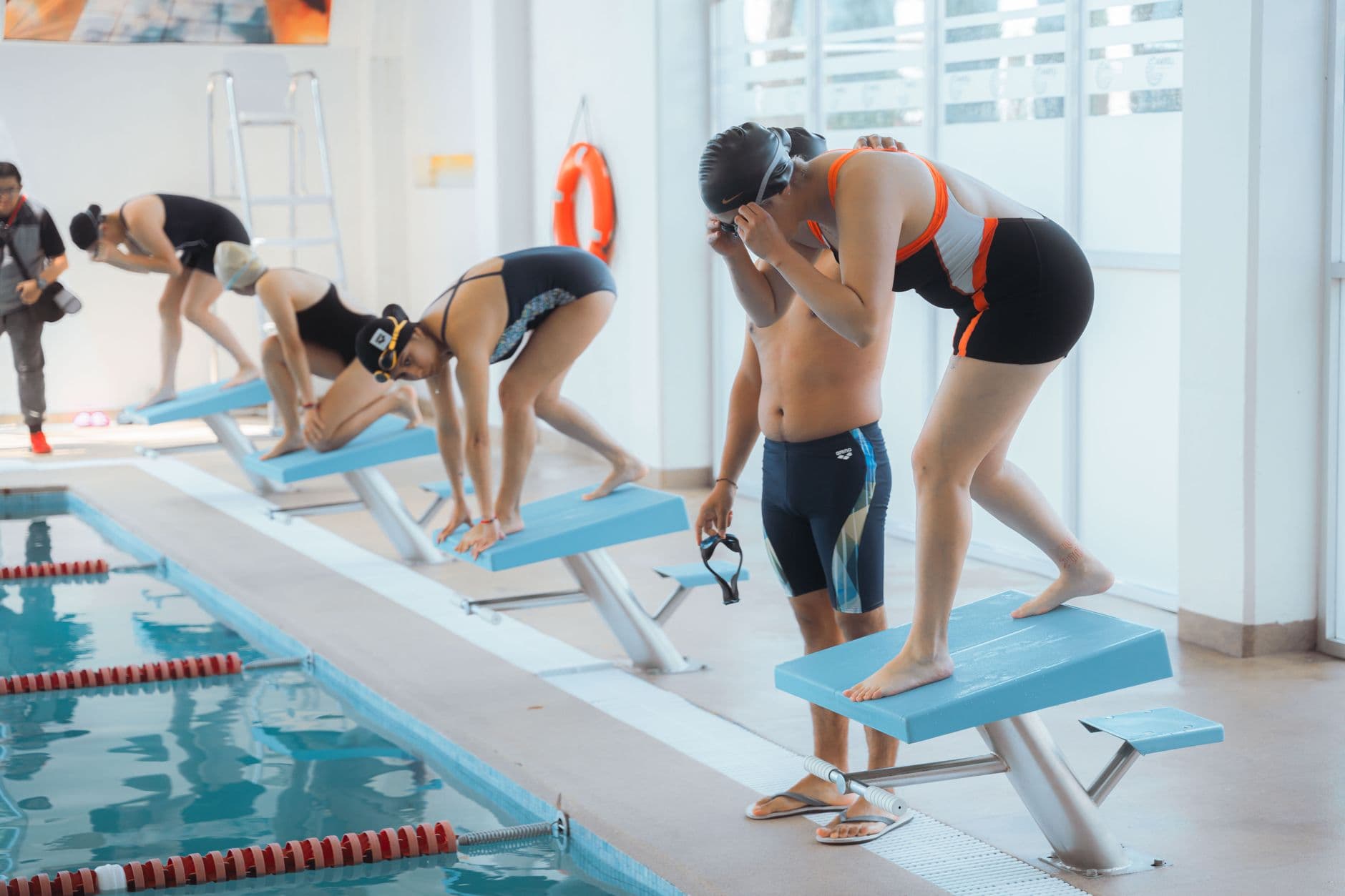
There is no single answer to this until you say which 50 you mean. A 50 swum in a 25-yard pool and a 50 swum in a 50-metre pool are two different races over two different distances, and the times people quote at each other online are usually a mix of both. That is the main reason the numbers you find disagree.
So this page does it in order: what counts as good at each age on the one nationally published ladder, then the course problem, then the three things that make the 50 behave unlike every other race — it can be swum without a single turn, a conversion factor mishandles it, and a third of it happens before you take a stroke.
What is a good 50 free time?
For a 17-18 swimmer in a 25-yard pool, USA Swimming’s published ladder runs from 31.39 to 23.49 for girls and 27.59 to 20.69 for boys, slowest marker to fastest. The middle rung, the A standard, is 26.89 and 23.59. Those are the numbers a club swimmer measures against.
If you are not a club swimmer, that ladder is still the honest reference, because it is published and checkable — but read it as a scale, not a verdict. A masters swimmer, a triathlete and a fourteen-year-old chasing a state cut are asking three different questions with the same words. What follows gives you the whole scale so you can find your own place on it rather than take someone’s invented average.
Before you compare anything: check whether the time you are holding is yards or metres, and whether it was swum from a dive or a push-off. Those two facts change a 50 by more than a season of training does.
First: is it 50 yards or 50 metres?
The USA Swimming rulebook defines the courses in one line each: long course is 50 metres, short course is 25 yards or 25 metres. So three races share the name “50 free”:
- 50 yards in a 25-yard pool — two lengths, one turn. This is the default in American high school and college swimming.
- 50 metres in a 25-metre pool — two lengths, one turn. The common winter format outside the United States.
- 50 metres in a 50-metre pool — one length, no turn. The Olympic version.
Fifty yards is 45.72 m. The metric race is 4.28 m longer — 9.4 per cent more water — and it is the shortest race in the sport, so that extra distance is a large share of it. Quoting a yards time against a metres time without converting flatters the yards swim twice: it is shorter, and in the yards version you also get a wall to push off. Put both through the course time converter before you draw any conclusion.
The published ladder: USA Swimming’s standards
USA Swimming publishes motivational time standards for every age group event, six levels deep, in the 2024-2028 set revised in October 2025. They are the closest thing to a national answer, and they are markers rather than entry requirements: a meet that uses qualifying cuts publishes its own, which are usually different.
Here is the A standard — the middle rung, and the one usually meant by “good” — for the 50 free in a 25-yard pool.
- 10 & under — 32.09 girls, 31.09 boys
- 11-12 — 29.29 girls, 28.09 boys
- 13-14 — 27.89 girls, 25.59 boys
- 15-16 — 27.29 girls, 24.19 boys
- 17-18 — 26.89 girls, 23.59 boys
Source: USA Swimming 2024-2028 motivational standards, age group, revision of 10 October 2025. The A standard, 50 yards, in seconds.
A single rung is only half the picture, because the ladder is six deep. Taking the oldest group to show the whole range:
- B — 31.39 girls, 27.59 boys
- BB — 29.09 girls, 25.59 boys
- A — 26.89 girls, 23.59 boys
- AA — 25.79 girls, 22.59 boys
- AAA — 24.69 girls, 21.69 boys
- AAAA — 23.49 girls, 20.69 boys
Source: as above. All six standards, 17-18 age group, 50 yards, in seconds.
From B to AAAA is 7.9 seconds for girls and 6.9 for boys, and the rungs are roughly a second apart. In a race this short, one second is an enormous distance — it is the difference between a swimmer who scores at a league meet and one who does not. Across every age the published scale runs from 39.79 for a ten-year-old girl at B to 20.69 for an eighteen-year-old boy at AAAA, which is why a single “average 50 free time” cannot mean much. The complete six-level table for every event, age and course is in the time standards tool.
The same standard in metres
The A standard for the oldest group again, this time in each of the three pools, so you can see what the course alone is worth:
- 25 yd pool, a 50-yard race — 26.89 girls, 23.59 boys
- 25 m pool, a 50-metre race — 29.69 girls, 26.09 boys
- 50 m pool, a 50-metre race — 30.69 girls, 27.39 boys
Source: as above. The A standard, 17-18 age group, in seconds. In a 25-yard pool the race is 50 yards; in the other two it is 50 metres.
For a 17-18 girl the A standard is 26.89 in yards and 30.69 in a 50-metre pool: 3.8 seconds, for the same level of swimmer. Nobody got slower in between. This is the most common reason a swimmer thinks they have regressed over the summer, when all that happened was the pool got longer — the mechanism is set out in the guide on short course against long course.
What is a good 50 free time for high school?
There is no national high school time standard to be good against. The NFHS writes the rules American high school swimming is run under, but qualifying times for state and sectional meets are set by each state association, so a cut that reaches the state final in one state would not in another. There is no way around looking up your own state’s list.
What you can use nationally is the age-group ladder above. High school ages fall in the 15-16 and 17-18 bands, so in yards: a boy at the A standard swims 24.19 to 23.59 and a girl 27.29 to 26.89, with the AAAA markers at 21.19 to 20.69 and 23.89 to 23.49. A swimmer at the A standard is a solid varsity sprinter in most places; the AAAA markers are the territory where state finals and college recruiting start.
What about 11, 12, 13 and 14 year olds?
The first table above answers it directly. In a 25-yard pool the A standard is 29.29 for an 11-12 girl and 28.09 for a boy; at 13-14 it is 27.89 and 25.59. The entry rung at 11-12, the B marker, is 33.99 and 32.79, and the top of the ladder at that age is 25.79 and 24.59.
Resist averaging within an age. Two thirteen-year-olds can be years apart in physical development and both be exactly where they should be, and the 50 is the event where that shows most, because it rewards size and power more than any other distance. The ladder is useful precisely because it gives a band instead of a number. For adults the published ladder stops at 18, and the honest answer is to compare against your own previous 50s and against your own age group — the masters age bands guide explains how those are drawn.
The 50 is the only race that can have no turn at all
Count the walls. A 50 in a 50-metre pool is one length: you dive, you swim, you finish, and you never touch a wall in between. Every other race in the sport, in every course, has at least one turn. The same 50 in a 25-yard or 25-metre pool is two lengths and one turn.
That makes the course question different in kind for this event. In a 100 or a 200, short course is faster mainly because walls are free speed, and the longer the race the more walls you collect. In the 50 the comparison is one turn against none, plus a distance difference — and in the yards version those two advantages stack. If the turn is the weak part of your race, a long-course 50 is the one event that hides it completely; the flip turn guide is where to work if it is costing you in the short-course version.
Why a conversion factor over-converts a 50
Two reasonable ways exist to turn a 50-yard time into a 50-metre one, and in this event they disagree more than usual.
- The distance ratio, which is arithmetic: 50 ÷ 45.72 = 1.0936. A 24.00 in yards becomes 26.25.
- The seeding factor used to enter swimmers who only have times from another course, 1.1591 for yards to long course metres. The same 24.00 becomes 27.82.
That is 1.57 seconds apart on one swim, and the gap grows with slower times. The reason is that a seeding factor is fitted to average race data across distances, so it carries an average turn effect inside it — and a long-course 50 has no turn for that effect to describe. Neither number is wrong; they answer different questions. The converter shows both side by side along with the turn count, which is the honest way to present a figure that genuinely has two defensible values.
How much of a 50 happens before you swim
Article 5.3 of the World Aquatics swimming rules lets a freestyle swimmer stay fully submerged for up to 15 metres after the start, and article 5.4 allows it again once the head passes the 5-metre mark before the finish. In a 50-metre race that is 15 metres off the start and 5 at the end: 40 per cent of the race falls under clauses written for being underwater, and 30 per cent of it is the start alone.
No other event concentrates that much of its outcome in the entry and the breakout, simply because no other event is this short. How far out to carry the underwater is covered in the dolphin kick guide, and the entry itself in how to dive into a pool — which also covers the water depth a racing dive needs, a question that matters more than technique if you train in a shallow pool.
Beyond the rule arithmetic, how to distribute a 50’s effort is coaching consensus rather than settled science, and it is worth labelling as such: sprinters are generally taught to accelerate into the race and accept that speed falls, which is the opposite of the pacing logic in longer events.
The ceiling, and why it is closer than it looks
World Aquatics publishes base times for its points table, and each one is the world record approved by a cut-off date. For 2026 the 50 free base times are 20.91 for men and 23.61 for women in a 50-metre pool, and 19.90 and 22.83 in a 25-metre pool. The cut-offs matter: the long course table uses records approved by 31 December 2025 and the short course table by 31 August 2026, so a record set inside the window scores above 1000 points rather than moving the base — the points calculator explains that arithmetic.
To qualify for the 2027 NCAA Division I championships a swimmer needs 19.22 in the 50-yard freestyle, or 22.26 for women. Because yards and metres cannot be compared directly, the chart below uses average speed, which can be:
Base times from the World Aquatics 2026 points tables, NCAA Division I qualifying standards for 2027 (updated 15 June 2026), and USA Swimming’s 2024-2028 motivational standards. One caveat: the yards races include a turn and the long-course race does not, which flatters the yards speeds.
The men’s D1 qualifying speed lands within half a per cent of world-record speed, and that is as much a fact about the 50-yard format — shorter, with a wall in the middle — as it is about the swimmers. It is also why a 17-18 AAAA swimmer sits closer to the top of this chart than to the bottom. In the shortest race in the sport, the whole competitive world is compressed into a few seconds.
How to time your own 50 honestly
Most 50 times that get compared online were not swum under the same conditions, and three details account for nearly all of it:
- Dive or push-off. A 50 from a push-off in the water is not the same event as a 50 from the blocks. If you are comparing against the standards above, those are dive times.
- Hand timing. A stopwatch held by a person carries a reaction error in both directions. For a race this short that error is a real fraction of the result, so treat a hand time as a band rather than a figure.
- Which wall you finished on. In a short-course 50 you finish at the end you started from; in long course you do not. It sounds trivial and it causes miscounted swims.
Time it the same way every time and the number becomes useful even when it is imprecise. The pace clock guide covers reading the wall clock without stopping, and the pace calculator turns a 50 into the per-100 pace the rest of your training is written in.
Where the seconds are, and one warning
In a 50 the levers are the start, the breakout, and holding stroke length while the rate climbs — not endurance, which is why swimmers who train only distance often have a disappointing 50. The trade-off between stroke rate and stroke length is the one to understand first, and much of what applies to the 100 freestyle applies here with the pacing removed. The rest of the times section puts the 50 next to the other distances.
The warning is specific to this event. Because a 50 is short enough to swim on very little air, it invites deliberate breath-holding and underwater repeats, and that is how shallow water blackout happens — it gives no warning and it has killed strong swimmers. The joint statement from the American Red Cross, USA Swimming and the YMCA of the USA is explicit that hypoxic training of that kind should not be used. Breathe as you need to, never train breath-holding, and never swim a sprint set alone in a pool with nobody watching. Shoulder pain that arrives with sprint work is worth reading about in the swimmer’s shoulder guide and, if it persists, taking to a physiotherapist or doctor rather than training through.
Frequently asked questions
Is 30 seconds a good 50 free time?
It depends on the course and the age. A 30-second 50 in a 25-yard pool sits just above the B marker for a 17-18 girl and below it for a boy of that age, but it is close to the A standard for a 10-and-under. In a 50-metre pool the same 30 seconds is a notably better swim, because that race is 4.28 m longer and has no turn.
What is a good 50 free time for a 12 year old?
In a 25-yard pool, USA Swimming's 11-12 markers run from 33.99 at B to 25.79 at AAAA for girls, and 32.79 to 24.59 for boys. The A standard in the middle is 29.29 and 28.09. Avoid treating any single number as the average for an age: twelve-year-olds differ enormously in development, and the 50 rewards size and power more than any other event.
Is a 50 yard time the same as a 50 metre time?
No. Fifty yards is 45.72 m, so the metric race is 9.4 per cent longer, and a 50-metre race in a 50-metre pool also has no turn while the yards race has one. Both differences favour the yards time. Convert before comparing, and expect the two methods — distance ratio and seeding factor — to give answers about 1.6 seconds apart.
What is the world record for the 50 freestyle?
World Aquatics' 2026 points tables use base times of 20.91 for men and 23.61 for women in a 50-metre pool, and 19.90 and 22.83 in a 25-metre pool. Each base time is the world record approved by a cut-off date — 31 December 2025 for long course, 31 August 2026 for short course — so a newer record can exist without having changed the table yet.
Do you have to swim front crawl in a 50 free?
No. Article 5.1 of the World Aquatics rules says that in a freestyle race the swimmer may swim any style. Front crawl is used because it is the fastest, not because it is required. The only constraint is in medley events, where the freestyle leg may not be backstroke, breaststroke or butterfly, since those have already been swum.
Sources
- 2024-2028 Motivational Time Standards, age group (revision of 10 October 2025) — USA Swimming
- 2026 USA Swimming Rules and Regulations — course definitions: long course 50 m, short course 25 yards or 25 metres — USA Swimming
- World Aquatics Competition Regulations, Part Two: Swimming Rules — articles 5.1 to 5.4 (freestyle, the 15 metre limit and the 5 metre finish clause), in force from February 2026 — World Aquatics
- World Aquatics Points – Base Times, SCM and LCM 2026 (PDF): 50 m freestyle 20.91 and 23.61 long course, 19.90 and 22.83 short course — World Aquatics
- Swimming points — formula, base times and validity periods — World Aquatics
- 2027 Division I Swimming and Diving Qualifying Standards, updated 15 June 2026: 50 freestyle 19.22 men and 22.26 women — NCAA
- Swimming and Diving — the body that writes high school playing rules; qualifying times are set by state associations — National Federation of State High School Associations
- Joint Statement on Hypoxic Blackout, November 2022 — American Red Cross, USA Swimming and YMCA of the USA
- Course conversion factors used for meet seeding — Colorado Timing Systems
Read next
How a swim meet works: heats, lanes, seeding and scoring
Heats, lane assignments, circle seeding, scratches, DQs and team points, explained straight from the rulebook that meet officials actually work from.
How deep is an Olympic pool? The rule book, not the guesses
An Olympic pool must be at least 2.5 m deep. The two metres you keep reading is a different championship. Every figure here is quoted from the World Aquatics rule book.
Masters swimming age groups: the 5-year bands and where you'd place
Masters age groups run in five-year bands from 25–29 (World Aquatics) or 18–24 (USMS), age usually counted on 31 December, and a 0.6%-a-year decline behind them.
SwimFast is an independent publication. We are not a swim school, a coaching service or a governing body, and nothing here is medical advice. Training paces and test protocols are cited from the published research or federation documents linked on each page. Never swim alone, never attempt breath-hold work without supervision, and check with a doctor before starting a new training programme.