Why the medley relay order is not the IM order
The individual medley is fly, back, breast, free; the medley relay is back, breast, fly, free. The rules behind both orders, and the three transitions that end races.

In an individual medley one swimmer covers all four strokes in this order: butterfly, backstroke, breaststroke, freestyle. In a medley relay four swimmers go in a different order: backstroke, breaststroke, butterfly, freestyle. Both are written into the same rule of the World Aquatics Competition Regulations, articles 9.1 and 9.2, and they really are different — which is why so many searches for one of them are actually about the other.
The order is the easy part. What ends races is the three stroke changes inside an IM, because each one is judged as a finish, not as a turn. That distinction sits in the rulebook in a single sentence, and almost nothing written about the medley mentions it.
The two orders, side by side
Article 9.1 covers the individual medley: the swimmer performs the four strokes, each for one quarter of the total distance, in the order butterfly, backstroke, breaststroke, freestyle. Article 9.2 covers the medley relay: the four athletes perform the strokes, each for one quarter of the distance, in the order backstroke, breaststroke, butterfly, freestyle.
- Individual medley (one swimmer): butterfly, backstroke, breaststroke, freestyle.
- Medley relay (four swimmers): backstroke, breaststroke, butterfly, freestyle.
Two strokes keep their place. Freestyle is always last, and breaststroke is always second-to-last in the IM and second in the relay. What swaps is butterfly and backstroke: butterfly opens the IM and backstroke opens the relay. USA Swimming writes the same two orders into rules 101.6 and 101.7.2 of its 2026 rulebook, so there is no American-versus-international difference to worry about here.
One more thing the same rule says, and it catches people: in a medley, freestyle does not mean any stroke. Article 5.1 defines it as any style other than backstroke, breaststroke or butterfly. You cannot finish an IM on your back.
Why the relay order is not the same: the backstroke start is in the water
The regulations do not explain their own reasoning, but the rules that surround articles 9.1 and 9.2 leave only one arrangement that works mechanically.
Article 4.2 says the start in backstroke races and in medley relay races will be in the water. A backstroke leg can only begin from the water, hanging off the starting grips. Article 10.4.4 then says relay exchanges must commence from the starting platform and must not be a running start from the deck, and article 10.4.5 says the feet of the next swimmer must stay in contact with the platform until their team-mate touches.
Put those together: a swimmer taking over mid-relay has to be standing on the block with their feet in contact. They cannot be floating in the water waiting, because then they are not on the platform — and they would be in the way of the swimmer arriving at that same wall. So a backstroke leg can only be the leg that starts the race. Backstroke goes first in a medley relay because it is the only place it can go.
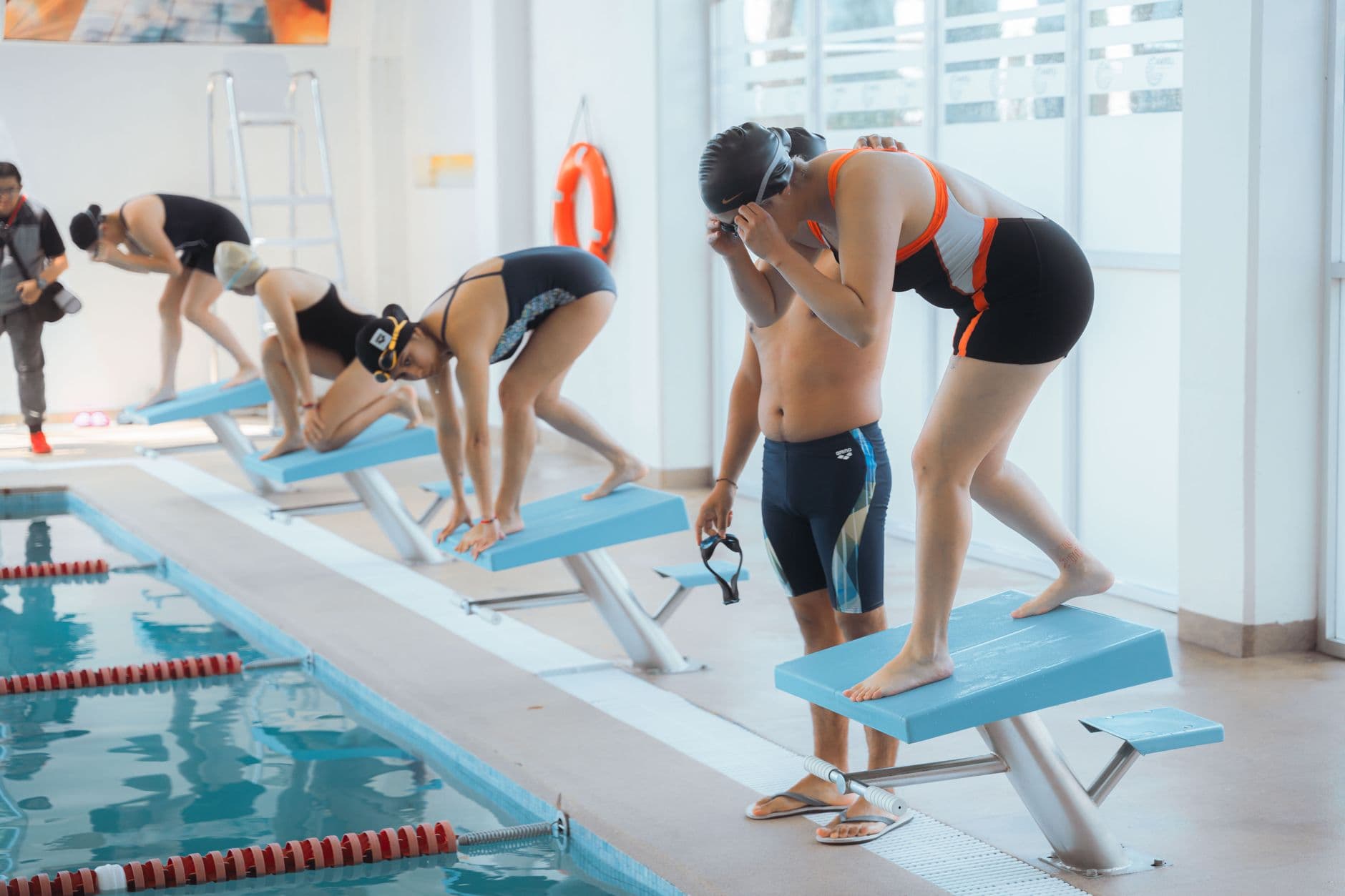
That is also why the medley relay looks odd on the blocks: one swimmer gets into the water while three team-mates stand on the deck. We cover that start position in detail in our guide to the backstroke start and the flags.
The deeper reason: a medley relay has no transition turns
Here is the part that explains why the relay can afford a different order at all, and it is worth sitting with for a moment.
In an individual medley, one swimmer changes stroke three times, and each change happens at a wall in the middle of their own race. In a medley relay, nobody changes stroke. Each athlete swims one stroke from their start to their finish, and the stroke changes happen at the exchanges, between two different people.
So a medley relay contains zero stroke transitions in the water. Every wall a relay swimmer touches mid-leg is an ordinary turn in their own stroke. USA Swimming states the consequence plainly in rule 101.7.2: at the end of each leg, the finish rule for that stroke applies. A backstroke leg ends like a backstroke race ends, and then a different human being starts a breaststroke race.
Why it matters: the IM order is constrained by what a single body can legally do at a wall between two different strokes. The relay order is not constrained that way at all, so it is free to put backstroke first and solve the in-water start. Same four strokes, two different problems.
What actually disqualifies swimmers is not the order
Nobody swims the IM in the wrong order by accident. Officials still have a code for it — more on that card below — but in practice the stroke changes are where races are lost.
The governing sentence is article 9.4: each stroke section must be finished in accordance with the applicable rules for that stroke. USA Swimming says the same thing in a way that is easier to hold in your head, in rule 101.6.3: intermediate turns within each stroke follow the turn rules for that stroke, but the turns when changing from one stroke to another shall conform to the finish rules for the stroke just completed.
Read that again, because it is the whole article. When you leave butterfly for backstroke, you are not doing a butterfly turn. You are finishing a butterfly race, and then starting a backstroke one. The finish rules are stricter than the turn rules for every stroke involved, which is why a swimmer who has a clean flip turn can still be disqualified at a stroke change.
Butterfly to backstroke: two hands, then get onto your back
Butterfly article 8.5 requires the touch at each turn and at the finish to be made with both hands separated and simultaneously, at, above, or below the surface. The regulations spell out what separated means: the hands cannot be stacked one on top of the other. You do not need visible space between them, and incidental contact at the fingertips is allowed.
Because this is a finish under article 9.4, there is no version of this where one hand touches first. Then backstroke article 6.2 takes over: at the starting signal and after each turn the athlete must push off and swim on their back. So the sequence is two hands on the wall, tuck, and leave on your back.
The common fault is a late, lazy second hand when the lungs are burning at the end of the butterfly leg — exactly the moment covered in our guide to butterfly timing and the two kicks. Practise the two-hand touch tired, not fresh.
Backstroke to breaststroke: the touch has to happen on your back
This is the transition that disqualifies more medley swimmers than any other, and the reason is a single word in the rulebook.
Backstroke has two different rules for walls. Article 6.4 governs turns: during the turn the shoulders may be turned over the vertical to the breast, after which an immediate continuous arm pull may be used to initiate the turn. Article 6.5 governs the finish: at the finish of the race, the athlete must touch the finish wall while on the back.
In an IM, the end of the backstroke leg is a finish, not a turn. So article 6.4 does not apply and you may not roll onto your front and flip into the breaststroke. You have to touch the wall while still on your back, and only then rotate.
The trap: a swimmer who trains 100 and 200 backstroke drills the 6.4 turn hundreds of times, where rolling onto the breast before the wall is legal and fast. Carry that habit into the second change of an IM and it is a disqualification, because at that wall you are finishing a backstroke section.
After the touch, breaststroke article 7.3 lets you turn in any manner, as long as the body is on the breast from the beginning of the first arm stroke after leaving the wall. World Aquatics tightened the reading of that in a commentary issued to national federations on 6 August 2026: athletes must not kick until they have returned past the vertical to the breast after the turn. Rotate first, kick second.
Breaststroke to freestyle: two hands, and no kick until you are past vertical
Breaststroke article 7.7 requires the touch at each turn and at the finish to be with both hands, separated and simultaneously. Again, under article 9.4 the end of the breaststroke leg is a finish, so both hands it is.
Then comes the one genuine piece of freedom in the whole IM. Article 9.3 says that during the freestyle section the body must be on the breast except when executing a turn, and that leaving the wall on the back is permissible — but no kicking action is permitted until the athlete has returned past the vertical to the breast, at which point kicking, including one or more butterfly kicks, may commence.
So you may push off on your back off that last wall, which many swimmers find a faster, more streamlined way out of a breaststroke touch. What you may not do is kick while you are still on your back. That is the infraction officials write up most often in the freestyle leg, and it is a timing problem rather than a strength one — the same body-position question as in our guide to the underwater dolphin kick. If you are not confident where vertical is, push off on your front and lose nothing legally.
Worth knowing for the same leg: article 10.2.4 lets athletes stand on the pool bottom during freestyle events and during the freestyle portion of medley events. You will be last, but you will not be disqualified. For the breaststroke leg itself, including the one underwater pull-down allowed after each wall, see the breaststroke pullout.
The five medley infractions on the officials' card
World Aquatics publishes a Swimming Rule Quick Reference Infraction Sheet for starters, judges of strokes and inspectors of turns. The version in force from 13 March 2026 lists exactly five things under the heading MEDLEY, with the rule each one hangs on:
- Backstroke, breaststroke or butterfly swum in the freestyle section — rule 5.1
- Incorrect individual medley stroke order — rule 9.1
- Incorrect medley relay stroke order — rule 9.2
- In the freestyle section, did not return to the breast before any kick or stroke — rule 9.3
- Finish of section not in accordance with rule of the stroke concerned — rule 9.4
Notice the shape of that list. Two of the five are the orders themselves, which hardly ever happen. The other three are all about the transitions, and the last one is written as a cross-reference: the official records it together with the specific stroke infraction. In other words, a transition disqualification in a medley is filed as a butterfly or backstroke offence, under rule 9.4. The card itself says it does not cover every infraction and is no substitute for knowing the rules.
How many turns your IM actually has
This is pure arithmetic from the distance and the pool, and it changes how the race feels more than most swimmers expect. Each stroke gets one quarter of the distance, so the number of lengths per stroke decides how many of your walls are ordinary turns and how many are transitions. There are always exactly three transitions.
Lengths divided by four strokes; three stroke changes in every case. Cross-checked against the lap arithmetic used by our course converter.
The two extremes are instructive. In a 100 IM short course, or a 200 IM long course, every single wall is a stroke change — there is no such thing as a plain turn in those races. In a 400 IM short course, 12 of the 15 walls are ordinary turns and only 3 are changes. If you are comparing your times between pools, the number of walls is most of the difference: see short course versus long course and run the numbers in the course time converter.
And it explains an oddity in the event programmes. Masters events under Part Eight of the regulations list the 100 IM in short course only; long course offers the 200 and the 400. In a 50 m pool a 100 IM would give each stroke 25 m, half a length, so three of the four changes would have to happen in open water with no wall to touch. The arithmetic simply does not allow the event. Our guide to Masters age groups covers how those events are organised.
The relay: the order is declared before the race, and the exchange has its own rules
A medley relay never has transition turns, but it has three exchanges, and those carry their own disqualifications.
- The order is locked in advance. Article 10.4.2 requires the team leader to specify the order of the relay team members before the race, by the deadline the organisers set. Swimming in a different order from the one notified disqualifies the team — it is a separate line on the infraction card.
- Feet on the platform until the touch. Article 10.4.5: until an athlete touches the wall, the feet of the next swimmer must remain in contact with the starting platform. USA Swimming rule 101.7.4 says the same, and its clause H adds that the second, third and fourth swimmers may not start from the top of the adjustable back plate; part of one foot must be on the platform in front of it.
- No running starts. Article 10.4.4 requires exchanges to commence from the starting platform, not from the deck.
- Substitutions are tightly limited. After the deadline, one team member can replace another only in an evidenced medical emergency and with prior permission. The composition may change between heats and finals, provided everyone is eligible.
So in a relay, the thing to rehearse is not a stroke change, it is timing on the blocks. A good exchange is worth more than any technical gain, and a bad one costs the whole team.
Mixed medley relays: same stroke order, a real choice for the team
Mixed medley relays use the same order as any medley relay — backstroke, breaststroke, butterfly, freestyle. Article 10.4.1 requires each mixed relay team to be two men and two women, and that is the only constraint it places. Which two legs the men swim is up to the team.
That makes the mixed medley relay the one medley event with a genuine strategic decision in it, because the stroke order is fixed but the assignment is not. The 4x100 m mixed medley relay is on the World Aquatics Championships programme and short course adds a 4x50 m version.
USA Swimming also requires two men and two women in mixed category relays, with an exception below LSC championship level: other compositions may be allowed if the meet announcement says so, but those times are not loaded into the SWIMS database — except an eligible lead-off time, which still counts.
What to practise, and the one thing to check at your pool
If you take one thing from the rulebook into the water, make it this: swim the three transitions as finishes. Touch the butterfly leg like you are finishing a 100 fly. Touch the backstroke leg on your back like you are finishing a 100 back. Touch the breaststroke leg with two hands like you are finishing a 100 breast. Everything legal follows from that.
Two practical notes. First, drill the changes when you are tired, at the end of a session, because all three failures are fatigue failures — the second hand that arrives late, the shoulder that rolls early, the kick that fires before the hips come round. Our warm-up guide has a sequence you can bolt transitions onto.
Second, check the officials at your meet. Local and age-group meets vary in how strictly the back-to-breast touch is called, and the only honest answer about any specific meet is to read the meet announcement and ask the referee which rulebook is in force. Rules are also amended between printings: USA Swimming publishes amendments that supersede the printed rulebook, so the web page is more current than the PDF on your hard drive.
A safety note on the underwater phases. The 15 metre limit after each start and turn is a maximum, not a target. Extending underwater work to chase it means repeated breath-holding, which carries a real risk of blacking out without warning. Never practise breath-holding or extended underwaters alone, or without a lifeguard who knows what you are doing, and do not let children do it at all. If you feel dizzy, surface and stop for the day; if that keeps happening, talk to a doctor rather than training through it.
Everything above is read from the regulations in force from February 2026, the officials' infraction card of 13 March 2026 and the 2026 USA Swimming rulebook, all linked below. Where the regulations do not state a reason — the question of why backstroke leads the relay — this guide says so and reasons from the rules that do exist, rather than repeating an explanation nobody can source. For more on race structure and pacing, start at our technique guides.
Frequently asked questions
What is the order of strokes in the individual medley?
Butterfly, backstroke, breaststroke, then freestyle, with each stroke covering one quarter of the distance. That order is article 9.1 of the World Aquatics Competition Regulations and rule 101.6 of the USA Swimming rulebook. In a medley, freestyle means any style other than backstroke, breaststroke or butterfly, so you cannot finish on your back.
Why is the medley relay order different from the individual medley?
Because a backstroke leg can only start in the water. Article 4.2 puts the medley relay start in the water, while article 10.4.5 requires the next swimmer's feet to stay on the starting platform until their team-mate touches. A swimmer taking over mid-relay must be on the block, so backstroke can only be the opening leg.
Do you have to touch with two hands in an individual medley?
Yes, at the end of the butterfly and breaststroke sections. Article 9.4 says each stroke section must be finished under the rules for that stroke, and both the butterfly and breaststroke finish rules require both hands, separated and simultaneously. The hands must not be stacked, though incidental fingertip contact is allowed.
Can you flip over at the end of the backstroke leg of an IM?
No. The backstroke turn rule that allows rolling onto the breast before the wall applies only to turns within a backstroke race. In an IM the end of the backstroke leg is a finish, so article 6.5 applies and you must touch the wall while on your back. You rotate afterwards, and you must not kick until past the vertical.
How many turns are in a 200 IM?
Seven in a 25 metre or 25 yard pool, of which three are stroke changes and four are ordinary turns within a stroke. In a 50 metre pool a 200 IM has only three walls, and all three are stroke changes, because each stroke is exactly one length. A 400 IM short course has 15 walls and still only three changes.
Sources
- World Aquatics Competition Regulations, Part Two: Swimming Rules — articles 4.2 (in-water start), 5.1 (freestyle in a medley), 6.2 to 6.5 (backstroke turn and finish), 7.3 and 7.7 (breaststroke), 8.5 (butterfly touch), 9.1 to 9.4 (medley swimming) and 10.4.1 to 10.4.5 (relays), in force from February 2026 — World Aquatics
- Swimming Rule Quick Reference Infraction Sheet, in force from 13 March 2026 — the five MEDLEY infractions and the relay lines 10.4.2, 10.4.4 and 10.4.5 — World Aquatics
- Commentary on the World Aquatics Competition Regulations, 6 August 2026 — Technical Swimming Committee guidance, including the breaststroke article 7.3 clarification that athletes must not kick until past the vertical to the breast — World Aquatics
- 2026 USA Swimming Rules and Regulations — rule 101.6 (individual medley, including 101.6.3 on transition turns), 101.7.2 (medley relay) and 101.7.4 (relay exchange rules) — USA Swimming
- USA Swimming — Rules and Regulations page, including amendments that supersede the printed 2026 rulebook — USA Swimming
- World Aquatics — Rules and Competition Regulations index (current and archived versions) — World Aquatics
- Joint Statement on Hypoxic Blackout, November 2022 — American Red Cross, USA Swimming and YMCA of the USA
Read next

Why do swimmers wear two caps? To pin the goggle straps down
The second cap covers the goggle straps and stops the first one wrinkling. Two caps is explicitly legal, and two is the written maximum — here is the rule.

What age should a child start swim lessons?
The official answer is the first birthday for lessons, but babies can be in water long before that. Here is where each health body draws the line, and why it matters.
Why swimmers get disqualified: the calls officials make
A disqualification is a procedure, not an opinion. Who is allowed to call one, what goes on the slip, what the code means, and how it can be challenged.
SwimFast is an independent publication. We are not a swim school, a coaching service or a governing body, and nothing here is medical advice. Training paces and test protocols are cited from the published research or federation documents linked on each page. Never swim alone, never attempt breath-hold work without supervision, and check with a doctor before starting a new training programme.