Stroke rate or stroke length: which one to change first
Speed is rate multiplied by length, so you can raise either one. Which lever to pull depends on the distance you are swimming and on which one you are currently wasting.
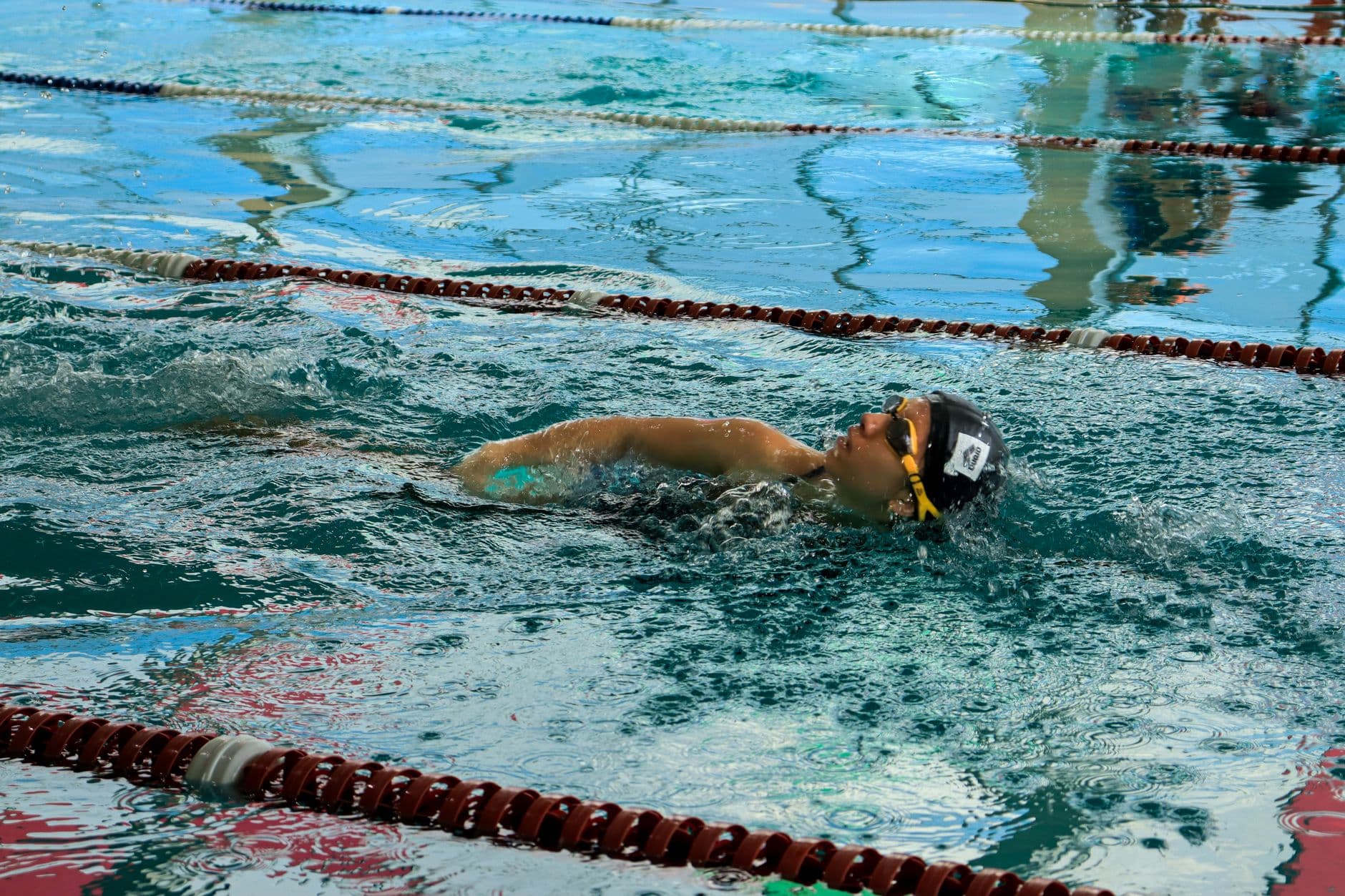
Every swimmer who has been coached for more than a week has been told to lengthen their stroke. Fewer have been told why, and almost nobody is told what it costs. The result is a pool full of adults gliding gracefully and slowly, convinced they are doing the right thing.
The physics here is unusually simple, which is what makes the confusion so avoidable.
The identity everything hangs on
Swimming speed is stroke rate multiplied by stroke length.
That is not a metaphor or a coaching model. It is an identity, in the same way that distance equals speed multiplied by time. If you take 30 stroke cycles per minute and travel 1.4 m per cycle, you are moving at 42 m per minute, and there is no third variable hiding anywhere.
Which gives you exactly two ways to get faster: take more strokes per minute, or travel further per stroke. And one way to stay exactly where you are, which is to improve one while quietly giving away the other.
That last case is what happens to most people who set out to lengthen their stroke. They add a glide, the count drops, the improvement feels real — and the clock does not move, because the rate fell by the same proportion.
Get your baseline before you touch anything
You cannot manage a trade-off you are not measuring. Two numbers, taken on the same day, at the same effort:
Strokes per length. Count arm entries for one full length at an easy, repeatable pace. Do it four times and take the typical value, not the best one.
The time for that length. Same lengths, same effort.
Write both down. From here on, a change is only an improvement if the time drops and the count does not rise, or the count drops and the time does not rise. Anything else is a trade, and trades need to be justified.
If you have never done this, expect the first surprise: most adult swimmers are far less consistent than they think, and the spread between four supposedly identical lengths is often two or three strokes.
What the evidence actually says
This is where an honest article has to be more careful than the coaching consensus.
A 2025 biomechanical study of 12 male competitive freestyle swimmers, analysing 25 m efforts with 2D motion analysis, found swimming time negatively correlated with stroke frequency and glide time, and positively correlated with stroke length. In plain terms: in that sample, over that distance, the swimmers who took more strokes per minute were faster, and longer strokes went with slower times.
Two things need saying about that immediately. First, n = 12 over a single 25 m sprint is a small study of a very specific case, and a sprint is precisely where rate should dominate. Second, correlation across swimmers is not the same as what happens when you change something — the fastest swimmers in a group may simply be the strongest ones.
What it does do is puncture the idea that length is universally the thing to chase. The relationship is distance-dependent, and the popular version of the advice quietly drops that qualifier.
The related work on speed fluctuation points at the mechanism. Speed within a stroke cycle is not constant: it rises during propulsion and falls between. A long stroke with a dead spot in it is a stroke with a deep trough, and every deceleration has to be paid for again by the next pull.
The glide trap
Here is the failure mode in slow motion, because almost every adult swimmer meets it.
You are told to lengthen. You reach further, hold the extended arm out front a fraction longer, and wait. The stroke count drops from 20 to 17. It feels smooth and controlled.
What actually happened during that pause is that nothing was propelling you, and drag was still working. Your body slowed, and the next pull started from a lower speed than it otherwise would. You did not travel further per stroke because you were more efficient; you travelled further per stroke because each stroke lasted longer.
The distinction matters because only one of them is free. Real length comes from a better catch, less drag and better body position — the things that make you travel further at the same tempo. Fake length comes from waiting, and it costs exactly what it appears to save.
If your legs drop during that pause, the cost is worse still, and that has its own article: why your legs sink when you swim.
Which lever, and when
The practical answer depends on the distance you are training for and on which side of the equation you are currently wasting.
If your stroke count is high and your time is slow, you are spinning: lots of rate, very little return per stroke. Work on the catch and on body position. This is the classic beginner profile, and it is the one case where chasing length is unambiguously right.
If your stroke count is very low and your time is slow, you are gliding. Add rate and watch what the count does. If it barely moves and the time drops, you have just found free speed that was sitting in a dead spot.
If you are training for sprints, rate is the lever. Over 50 m there is not enough distance for economy to pay back and not enough time for fatigue to arrive.
If you are training for distance, the target is holding length as rate rises. That is what a distance set is actually testing, and it is why coaches ask for stroke counts on repeats rather than on single lengths.
For open water the same logic applies with one addition: a rate that survives chop and sighting is worth more than a rate that only exists in a flat pool. That is covered in swim training for triathlon.
How to test a change properly
Change one variable, hold the other, and let the clock decide. A simple protocol that works:
Swim 8 × 50 m on a comfortable send-off. On the first four, hold your normal stroke and record count and time for each. On the second four, deliberately add two strokes per length — that is, raise the rate — and record both again.
Then read the sheet, not your feelings. If the faster-tempo repeats are quicker without the count exploding, rate was the lever. If they are slower and the count jumped, you were already near your useful rate and the extra strokes bought nothing.
Repeat the same test in the other direction — subtract two strokes per length — and you will know within one session which side of the trade-off you are on. That is a better use of forty minutes than a month of stroke drills chosen at random.
If you want to convert those 50 m times into a pace you can hold over a longer swim, the pace calculator does the arithmetic, and the CSS calculator turns two time trials into a training pace.
A note on comparing yourself to elite swimmers
Stroke counts get quoted as targets — six strokes a length, eight strokes a length — usually attributed to somebody who swims for a living. Two reasons those numbers are useless to you.
They are usually measured in a 25 m pool by someone who leaves the wall with a 15 m underwater, which is the maximum the competition rules allow before the head must break the surface. A swimmer who covers 15 of 25 m without taking a stroke will always post a low count, and that count says nothing about their stroke.
And elite swimmers are tall. Stroke length scales with the length of the lever, so comparing your count to theirs is comparing your arm span to theirs with extra steps.
Compare your count to your own count last month. That is the only comparison that tells you anything.
What this does not solve
Three honest limits.
First, both levers sit on top of drag. If your body position is poor, you are optimising the shape of a stroke that is fighting a hull problem. Fix the hull first.
Second, rate is bounded by what you can sustain, and that bound is fitness, not technique. If your rate collapses in the last 100 m of every swim, the answer is not a tempo trainer — it is the work described in how to build swim endurance.
Third, in a short race a large share of the time is not spent swimming at all. A short course 100 has a start, three turns and four push-offs, and neither lever touches them. If your target is a faster 100, where the seconds are in a 100 freestyle starts by timing your walls before you change anything in the stroke.
The rest of the stroke articles are in technique, and the sets that use these numbers are in workouts.
This is general information, not coaching for your specific stroke. If something here does not match what your coach sees from the deck, they can see you swim and we cannot. Found an error? Tell us and we will correct it and date the change.
Frequently asked questions
What is stroke length, exactly?
The distance your body travels per stroke cycle. In practice you do not measure it directly — you count strokes per length and divide the pool length by that count. If you take 20 strokes in a 25 m pool, your average stroke length is 1.25 m. That number, tracked over time, is the only honest way to know whether a technique change did anything.
Is a lower stroke count always better?
No, and this is the most damaging piece of received wisdom in adult swimming. Stroke count only matters relative to the time it took. Eighteen strokes in 30 seconds is better than 14 strokes in 34. If you drop your count and your time gets worse, you have not improved your technique — you have added glide, which is not the same thing.
How do I measure my stroke rate?
Count the strokes you take in a fixed time, or the time it takes to complete a fixed number of strokes. Ten cycles timed with a watch is enough to get a usable number. Many swim watches report it directly in strokes per minute. What matters is that you use the same method every time so the numbers are comparable.
Which one do sprinters change?
Rate. Over 50 m there is not enough distance for an efficient, low-rate stroke to pay off, and the cost of a high rate — which is fatigue — barely has time to arrive. Over 1,500 m the arithmetic reverses: a rate you cannot hold for 30 minutes is not a rate you have.
Should I use a tempo trainer?
It is the cleanest way to change one variable at a time, which is the whole point of this article. Set a rate, hold it, and watch what happens to your stroke count and your time. If the count stays and the time drops, the rate was worth adding. If the count climbs sharply, you have bought rate by giving away length and gained nothing.
Sources
- Kayapınar E et al. (2025). The relationship between stroke length, stroke frequency, glide time and performance in swimmers: a biomechanical study. BMC Sports Sci Med Rehabil
- Morais JE et al. Identifying Differences in Swimming Speed Fluctuation in Age-Group Swimmers. J Sports Sci Med
- U.S. Masters Swimming — Freestyle technique guide
- World Aquatics — Competition Regulations
Read next
Chlorine, hair and skin: what it does and what actually helps
What chlorinated pool water really does to hair and skin, why the green tint is copper rather than chlorine, and which protective steps have evidence behind them.

Swimmer's ear: what prevents it and what is folklore
What causes swimmer's ear, which prevention advice has clinical backing, which has never been tested, and the point at which it stops being an article's problem.
Swim goggles that fog: what works and what is folklore
Fog is condensation on a lens colder than the air inside it. Which remedies have a mechanism, which are harmless folklore, and which one ends the goggles.
SwimFast is an independent publication. We are not a swim school, a coaching service or a governing body, and nothing here is medical advice. Training paces and test protocols are cited from the published research or federation documents linked on each page. Never swim alone, never attempt breath-hold work without supervision, and check with a doctor before starting a new training programme.