How to build swim endurance when you can barely finish a length
Gassing out after two lengths is usually an efficiency problem, not a lung problem. How to tell which you have, plus an eight-week fix built on your own paces.
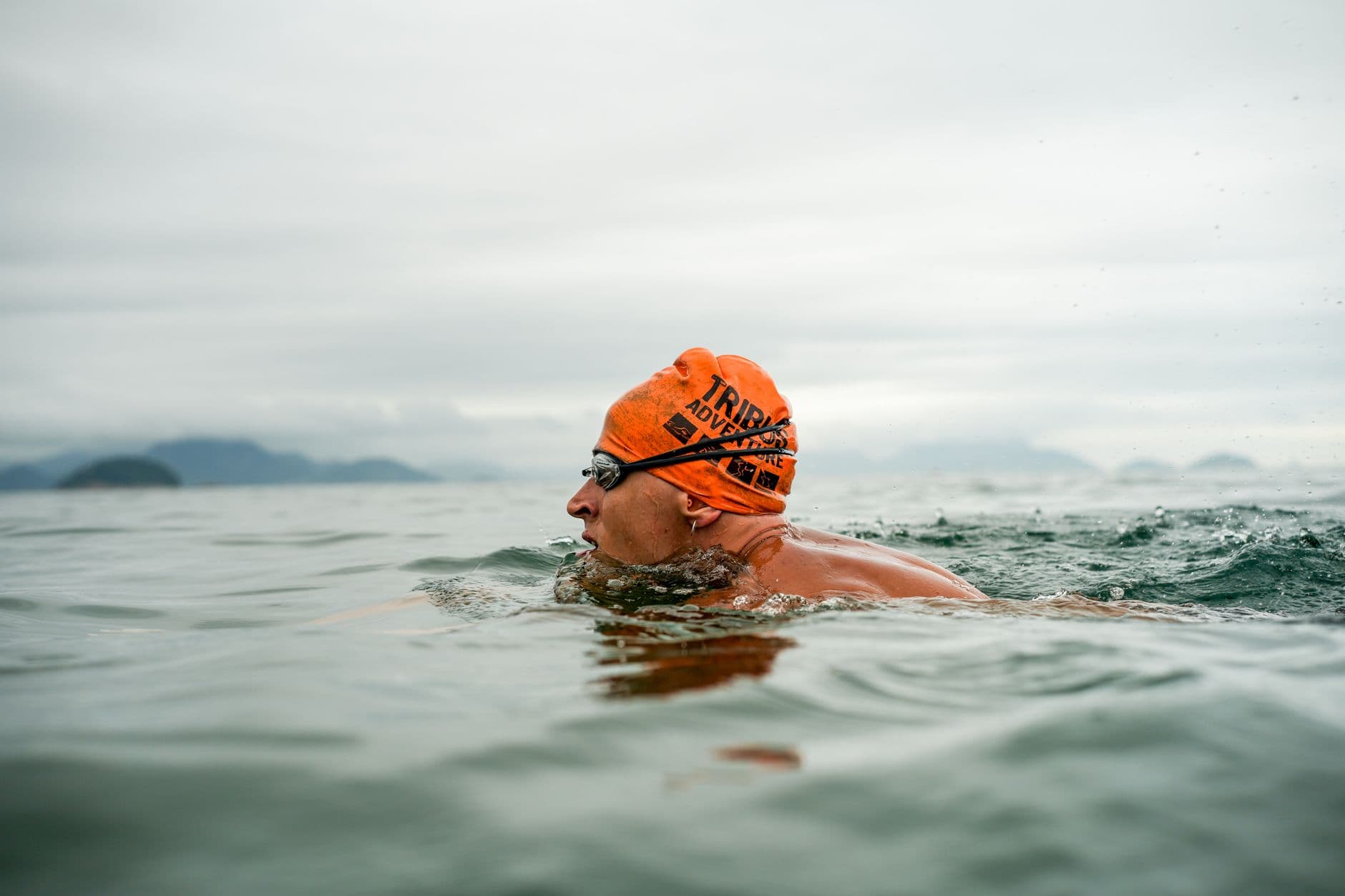
You push off, you swim one length, and by the far wall your heart is somewhere near your ears and you are hanging on the lane rope. It happens to people who run half marathons. It happens to people who cycle a hundred kilometres on a Sunday. The obvious conclusion — that you are unfit, or that your lungs are somehow wrong for water — is almost always the wrong one.
The real reason is measurable, and it has been measured. At the speeds a new swimmer actually swims, most of the effort goes into shoving water backwards rather than moving you forwards. That is a stroke problem wearing a fitness problem's clothes, and it responds to completely different training. This guide gives you the two numbers that tell the problems apart, then an eight-week progression built on paces you work out for yourself. Nothing in it asks you to hold your breath.
Why can't I swim more than two laps?
Because at beginner speeds a large share of your power output goes into moving water backwards instead of moving you forwards. That is a skill limit, not an aerobic one. A well-trained runner and a trained swimmer can have the same engine and produce very different swimming speeds, because the swimmer wastes far less of what the engine makes.
The clearest demonstration of this is a 1990 study by Huub Toussaint that compared six competitive swimmers with five triathletes at the same power input. The two groups did not differ in gross efficiency, in stroke frequency, or in work per stroke. Where they differed was in where the power went: the competitive swimmers put 49 W into overcoming drag against the triathletes' 35 W, and spent 32 W moving water backwards against the triathletes' 45 W. Expressed as propelling efficiency — power used against drag, divided by total power output — that came to 61 ± 6% for the swimmers and 44 ± 3% for the triathletes.
The visible consequence was distance per stroke: 1.23 m per stroke for the swimmers against 0.92 m for the triathletes, which produced swimming speeds of 1.17 m/s and 0.95 m/s. Same work, same stroke rate, different result. Toussaint's own conclusion was blunt: triathletes should work on technique rather than on their capacity to do work.
The practical version: if you are gasping after 25 m, adding more laps trains you to be exhausted more often. Adding distance per stroke changes the arithmetic that made you exhausted in the first place. If your target is a specific continuous distance rather than a general sense of fitness, swimming 500 yards without stopping lays out the same idea as a week-by-week progression.
Why is swimming more tiring than running?
Because drag in water rises with the square of your speed, so a small increase in pace costs a disproportionate amount of energy. Water is roughly eight hundred times denser than air, you are horizontal with your face submerged, and your breathing is rationed by your own stroke timing. Running has none of those constraints.
The physics is standard: drag force is D = ½ · ρ · v² · S · Cd, where ρ is water density, v is swimming speed, S is frontal surface area and Cd is the drag coefficient. A 2022 systematic review of active-drag measurement methods notes that because drag depends on the square of velocity, comparing two swimmers is only meaningful at identical absolute speeds — and, crucially, that the drag coefficient falls as technical efficiency rises.
That last clause is where your leverage is. You cannot change the density of water and you cannot make yourself much narrower. You can change Cd and you can change S, and the way you do it is by fixing body position. If your legs hang low, your frontal area is larger at every single speed you will ever swim. That is the whole argument of our guide on why your legs sink when you swim, and it is worth reading before you buy a training plan.
Where the evidence stops: the published active-drag values come from laboratory methods, and none of them can be applied to you at a public pool. Nobody can tell you your personal drag coefficient. What is solid is the shape of the relationship, not a number you can put on your own swimming.
Why do I get out of breath when swimming freestyle?
Usually because you are holding air in rather than running short of oxygen. The urge to breathe is driven mainly by carbon dioxide building up, so if you keep a full chest between breaths the CO₂ has nowhere to go and you feel starved of air within a few strokes. The fix is a continuous exhale into the water, not a bigger inhale.
This is the single most common thing that makes an otherwise fit adult stop at the wall. Most beginners inhale, put their face down, hold, then try to blow out and breathe in during the same brief window when the mouth clears the water. That window is not long enough for both. Breathe out steadily the whole time your face is down, and the window only has to serve the inhale.
There is a second, quieter version of the same problem: breathing every stroke because you are anxious about air, which wrecks the body position that was making you tired to begin with. The full sequence, including what to do with your head, is in how to breathe while swimming freestyle.
The two numbers that tell you which problem you have
Before you plan eight weeks of anything, spend one session measuring. Two numbers between them separate the efficiency problem from the fitness problem, and they take about twenty minutes to collect.
1. Strokes per length
Count your hand entries across one length at an easy, sustainable effort. Do it four times and take the range, not the average — the spread tells you as much as the number.
U.S. Masters Swimming gives a useful reference point: a swimmer around six feet tall with roughly a five-foot arm span, swimming at what they call 100% stroke distance efficiency, would travel about five feet per arm stroke and so cross a 25-yard pool in about 12 strokes, or six stroke cycles. Taller swimmers land nearer 11, shorter swimmers nearer 13 or 14. If you are taking 25 strokes to cross a 25-yard pool, your problem is not your heart.
2. SWOLF
SWOLF is your time for one length plus the strokes you took in it. It catches the thing stroke counting alone misses: gliding forever with beautiful long strokes lowers your stroke count and does nothing for your speed. Work it out with the SWOLF calculator, which also spells out the caveat most apps leave off — SWOLF is comparable only against your own previous SWOLF, in the same pool length and the same stroke.
If your stroke count is high and your SWOLF is high, you have an efficiency problem and the eight weeks below should be mostly easy swimming with drills. If your stroke count is respectable and you still cannot hold a set, you have an aerobic problem, and the next section is the one that matters.
Find the pace you can actually hold
Critical swim speed is the pace you can theoretically sustain without the wheels coming off, and unlike a heart-rate zone it costs nothing to measure. Swim a hard 400, rest five to ten minutes, swim a hard 200, and subtract: CSS = (400 − 200) / (time for 400 − time for 200). The CSS calculator does the arithmetic and returns your five training paces.
The concept comes from Wakayoshi and colleagues in 1992, who tested nine trained college swimmers in a swimming flume. Their critical velocities ranged from 1.062 to 1.262 m/s, with a mean of 1.166 ± 0.052 m/s, and correlated strongly with the velocity at the onset of blood lactate accumulation (r = 0.949) and with mean 400 m freestyle velocity (r = 0.864). Those are good correlations, but nine flume-tested college swimmers is a small and unrepresentative sample: treat CSS as a solid working estimate of your threshold, not a physiological verdict.
One detail that matters more than it sounds: the training zones are percentages of speed, so a pace is divided by them, never multiplied. Several calculators on the web get this backwards, which quietly turns their recovery pace into something faster than threshold. Here is what the zones look like for a swimmer whose CSS works out at 2:20 per 100 m.
| Zone | % of CSS speed | Pace per 100 m | What it is for |
|---|---|---|---|
| Recovery | 70% | 3:20 | Flushing between hard sets and on easy days |
| Endurance 1 | 80% | 2:55 | Aerobic base — slow enough to think about your stroke |
| Endurance 2 | 87.5% | 2:40 | Steady work, breathing hard but controlled |
| Threshold | 95% | 2:27 | The zone that actually moves CSS |
| VO₂max | 105% | 2:13 | Short, hard and expensive; use sparingly |
If 2:55 per 100 m sounds insultingly slow for a set called endurance, that is the point. Almost everyone who cannot finish a length is doing all of their swimming somewhere between threshold and flat out, which is exactly why none of it accumulates.
An eight-week progression that adds endurance, not junk
This is a build, not a workout. Each week has one change from the week before, so that when something works you know what it was. Everything is at Endurance 1 pace unless it says otherwise, and every session sits between a 200 m warm-up and a 200 m easy swim-down.
| Week | Main set | Rest | What has to be true to move on |
|---|---|---|---|
| 1–2 | 8 × 50 m | 30 s | Stroke count on the last repeat within two of the first |
| 3 | 6 × 75 m | 30 s | You finished the set without a repeat falling apart |
| 4 | 6 × 75 m + one continuous 200 m | 30 s | The 200 stays at Endurance 1 pace throughout |
| 5 | 5 × 100 m | 25 s | Spread across repeats under 5 s |
| 6 | 5 × 100 m at Endurance 2 | 25 s | Last repeat no more than 3 s slower than the first |
| 7 | 4 × 150 m at Endurance 2 | 20 s | Stroke count has not climbed by more than three |
| 8 | Retest: 400 m + 200 m, then an easy continuous 400 m | — | New CSS becomes the basis for the next eight weeks |
Two rules make the table work. First, never add distance and cut rest in the same week; if you do, you learn nothing about which one your body responded to. Second, if the condition in the last column is not met, repeat the week. Repeating a week is not falling behind, it is the plan doing its job. If you want the same idea written out as complete sessions rather than a grid, the four in swim workouts for beginners slot in directly. The rest column is written as fixed rest; if your squad runs on send-offs instead, the interval calculator turns each week's pace and rest into a clock time.
How long does it take to build swimming endurance?
Expect the first clear change in three to six weeks and a meaningful change in continuous distance in eight to twelve, assuming two or three swims a week. Those are coaching bands rather than trial results — no controlled study tracks adult beginners over a normal build — and they move a lot depending on how much of your limit was technique.
The reason honest sources give wide bands is that the two underlying problems improve on completely different clocks. Efficiency can change within a single session, because a cue that fixes your head position changes your drag immediately. Aerobic capacity does not do that; it accumulates over weeks of unremarkable, repeatable work.
This is also why the retest in week eight matters more than any individual session. A CSS number you measured in week one and again in week eight is a real before-and-after. How a swim felt is not.
How many times a week should I swim to build endurance?
Two or three sessions a week is where the returns are, and frequency beats duration at every level below competitive. U.S. Masters Swimming starts new adult swimmers at 30 minutes once or twice a week, swimming 30 seconds at a stretch and resting 30, then stretching the swimming to 45 seconds and cutting the rest to 15 as it gets easier.
Three thirty-minute swims build more than one ninety-minute swim, for a reason specific to this sport: swimming is a skill under fatigue, and skill responds to repetition spread out in time. A single long session gives you one chance a week to practise a good stroke and several hundred metres of practising a bad one after you tire.
Their beginner guidance also contains the most useful sentence written anywhere about starting out: if a few back-to-back lengths is beyond your endurance right now, add in as many breaks as you need. Rest written into a set is training. Rest you took because you had to is a measurement.
Two or three is also close to the ceiling for most adults, and the case for and against going further — daily swimming, and what it costs your shoulders and your sleep — is set out in should you swim every day.
What to do when the progression stalls
Stalling is normal around weeks four and five, and it usually has one of three causes. Work through them in this order, because the first is free and the last is expensive.
- Your easy pace is not easy. Time one Endurance 1 repeat honestly. If it is landing at threshold pace, the whole set has been the wrong set and no amount of extra volume will fix it.
- Your stroke count climbs across the set. That is fatigue arriving as technique loss. Cut the repeat length in half, keep the total distance, and let the stroke count stay flat for two weeks before rebuilding.
- You are recovering badly between sessions. Three hard swims in four days is not a build, it is a slow accumulation of tiredness. Put a genuine recovery-pace swim in the middle.
What almost never helps at this stage is a new toy. Fins and a pull buoy both make you faster on the spot by hiding the exact problem you are trying to fix, which is why they belong in short drill sets rather than in the main set of an endurance build. What each piece of kit does train is set out in swim paddles and fins.
Does a 25 m pool flatter your endurance?
Yes, and it is worth knowing by how much before you compare yourself to anyone. Every turn is a push-off, and a push-off is the fastest you travel in the whole length. A 400 m swim in a 25 m pool contains fifteen turns; the same 400 m in a 50 m pool contains seven. That is eight extra free accelerations.
So when you move to a long-course pool and your times fall apart, nothing has gone wrong with your fitness — you have removed half your rests. The course time converter shows the difference for your own times, and it shows the exact turn count behind the conversion instead of just handing you a factor.
The same warning applies to comparing yourself with other people. If you want a sane sense of where your times sit, what the average 100 m swim time actually means explains what the published numbers do and do not include.
Adults and children are not solving the same problem
An adult learning to hold a set is usually fighting a body-position habit and a breathing reflex at the same time, with a nervous system that no longer picks up new movement patterns for free. A child is generally fighting neither, which is why coaching advice written for age-group squads transfers badly.
The practical difference is where you spend your first eight weeks. A ten-year-old can be given yardage and will sort the stroke out along the way. An adult given yardage tends to reinforce whatever the stroke already was. If you are in your first year in the water, the order laid out in learning to swim as an adult is worth following before any endurance build at all.
The second difference is recovery. Adults returning to sport generally need a day between hard swims where a teenager needs hours. That is not a reason to train less often; it is a reason to make one of the three weekly swims genuinely easy.
The two safety rules that are not negotiable
No breath-holding sets, and no swimming alone. In a joint statement issued in November 2022, the American Red Cross, USA Swimming and the YMCA of the USA describe hyperventilation before underwater swimming and extended breath-holding in the water as dangerous and potentially deadly, because they can put the body into a state of hypoxia that leads to unconsciousness. All three organisations use the term hypoxic blackout for this and train instructors and lifeguards to prevent it. No endurance benefit exists that would justify the risk, and none of the sets on this page requires it.
Always swim where a lifeguard is on duty or with someone who is watching you, and treat that as a condition of training rather than as advice. The failure mode here is silent: someone who loses consciousness in the water does not thrash or call out.
The other rule is about pain. Shoulder pain that arrives with swimming and stays after it, pain that wakes you at night, numbness in the arm, or breathlessness that seems out of proportion to the effort are all reasons to stop and see a doctor or physiotherapist. This page cannot assess any of them, and pushing an eight-week build through a shoulder that hurts is how a fixable irritation becomes a season off. Ear pain after sessions belongs on the same list, especially as your weekly time in the water goes up; the signs are in swimmer's ear.
What to measure so you know it worked
Three things, recorded in the same notebook every week, and nothing else:
- Strokes per length on the first and last repeat of the main set. This is your efficiency, and it is the number that moves first. Paired with the time for the same length it becomes a SWOLF score, which is harder to fool by simply swimming slower.
- The spread across the set — fastest repeat to slowest. A shrinking spread is aerobic fitness arriving, even when the average pace has not moved.
- Your CSS, retested every eight weeks and never more often than that. Use the pace calculator to turn it into per-100 splits you can actually read off a pace clock.
None of those three is your total weekly distance, and that omission is deliberate. Distance is the number that feels like progress and reports it least reliably, because it goes up when you swim badly for longer. Everything else on the workouts pages is built around the same idea: measure the thing that tells you something, then change one variable at a time.
Frequently asked questions
How do I swim longer without getting tired?
Slow down to a pace you measured rather than one you guessed, exhale continuously into the water, and build with short repeats and written-in rest instead of continuous lengths. Most people who cannot finish a length are swimming every metre near threshold, which is why none of it accumulates into endurance.
How long does it take to build swimming endurance?
Expect a first clear change in three to six weeks and a meaningful change in continuous distance in eight to twelve, on two or three swims a week. Those are coaching bands, not trial results. Efficiency improves fastest, sometimes within one session; aerobic capacity accumulates over weeks of unremarkable work.
How many times a week should I swim to build endurance?
Two or three sessions a week is where the returns are. U.S. Masters Swimming starts new adult swimmers at 30 minutes once or twice weekly, swimming 30 seconds at a stretch and resting 30. Frequency beats duration here, because swimming is a skill and skills respond to repetition spread out in time.
Why is swimming more tiring than running?
Drag in water rises with the square of your speed, so small increases in pace cost disproportionately more energy. You are also horizontal with your face submerged and your breathing rationed by your stroke timing. Running has none of those constraints, which is why aerobic fitness transfers into the pool poorly.
Should I use a pull buoy to swim further?
Not as your main set during an endurance build. A pull buoy lifts your hips artificially, so it hides the body-position problem that was making you tired and lets you swim further without fixing anything. Use it in short drill sets, then swim the main set without it and let the number tell the truth.
Sources
- Toussaint H.M. — Differences in propelling efficiency between competitive and triathlon swimmers — Medicine & Science in Sports & Exercise (1990)
- Wakayoshi K. et al. — Determination and validity of critical velocity as an index of swimming performance in the competitive swimmer — European Journal of Applied Physiology (1992)
- Lopes T.J. et al. — Numerical and experimental methods used to evaluate active drag in swimming: a systematic narrative review — Frontiers in Physiology (2022)
- Best Swimming Workouts for Beginners — U.S. Masters Swimming
- Distance Per Stroke — U.S. Masters Swimming
- Joint Statement on Hypoxic Blackout and Inaccurate Use of the Terminology Shallow Water Blackout (November 2022) — American Red Cross, USA Swimming and YMCA of the USA
Read next
Calories burned swimming: 170 to 540 in half an hour
Thirty minutes of freestyle costs 174 to 539 kcal depending on weight and pace. The published MET values, the arithmetic, and the 20% overestimate inside every calculator.
Lane etiquette: how to share a crowded lane without being the problem
Which way to circle in the US, Britain and Australia, picking a lane by seconds per length, the 5-second gap, passing and resting — and where the published rules disagree.
Swim paddles and fins: what they train and when they cost you
Paddles lower your training load at steady speed and a four-week block changed nothing; fins raise energy cost. What the measurements say and how to use both.
SwimFast is an independent publication. We are not a swim school, a coaching service or a governing body, and nothing here is medical advice. Training paces and test protocols are cited from the published research or federation documents linked on each page. Never swim alone, never attempt breath-hold work without supervision, and check with a doctor before starting a new training programme.