What is a good 1 mile swim time?
Two different distances get called the mile: 1,650 yards in the pool and 1,609 metres in open water. Published standards, real race data, and how to place your own time.
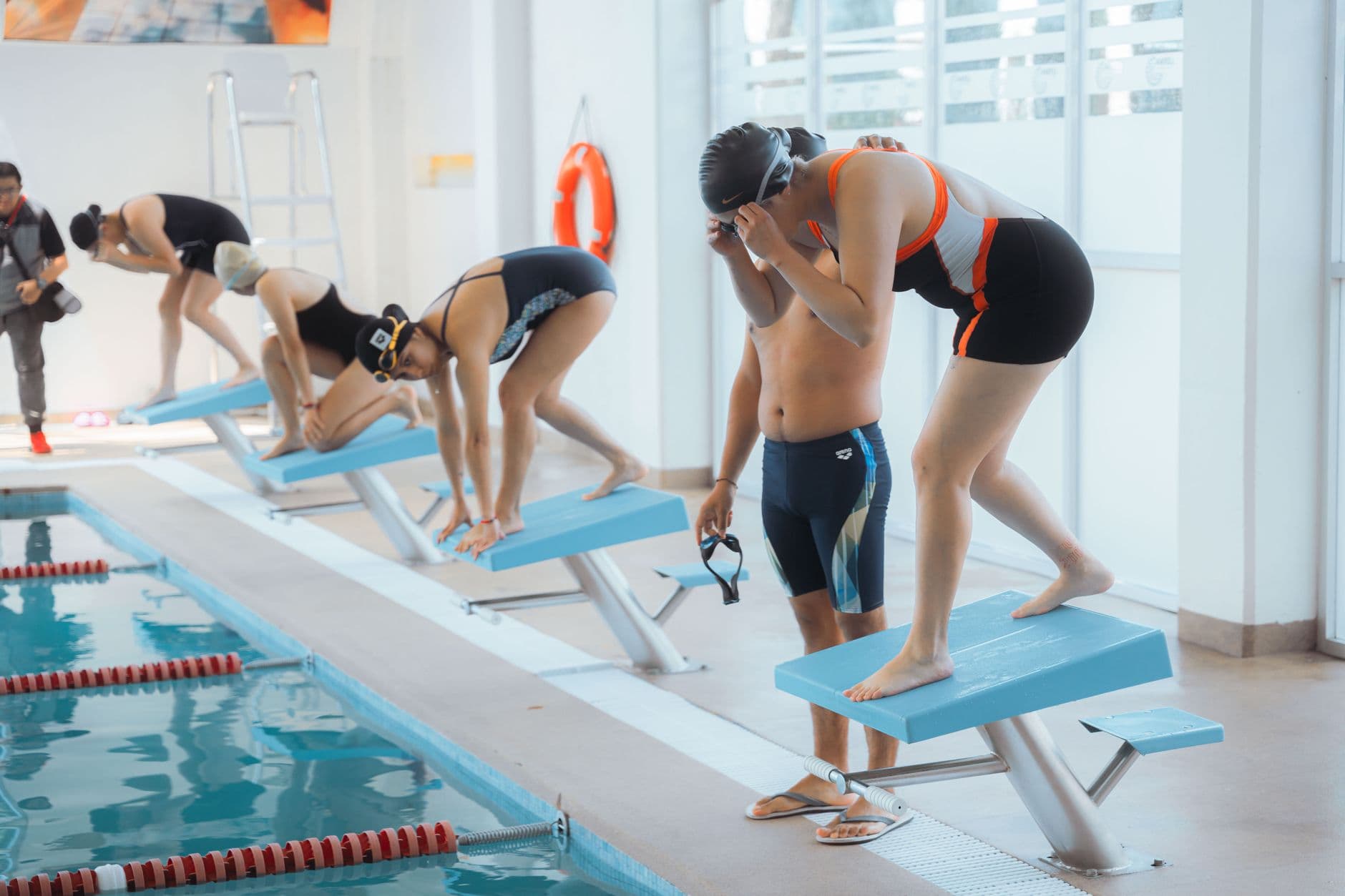
Ask what a good mile swim time is and you get a number back within seconds, usually somewhere between 25 and 45 minutes, usually with no source attached. The number is not the problem. The problem is that almost nobody says which mile they mean, and there are two of them: the one you race in an American pool, which is 1,650 yards, and the one you swim in a lake, which is 1,609 metres. They are not the same distance, they are not the same event, and a time from one does not transfer to the other.
This page uses only published standards — USA Swimming's age-group times, U.S. Masters Swimming's qualifying cuts and championship results, the NCAA's Division I marks and the current world record — and then shows you how to place your own swim on them. If you already have a time and want to know what pace it represents, the pace calculator does that step in one go.
What is a good 1 mile swim time?
For a fit adult swimming continuously, 30 to 40 minutes for a mile is a solid recreational time, and under 25 minutes puts you near competitive Masters territory. USA Swimming's A standard for the 1,650-yard freestyle is 19:31.89 for 17-18 girls and 18:07.69 for 17-18 boys. World-record pace would cover a true mile in about 15:30.
Those four numbers bracket almost everyone. What sits between them depends less on talent than on two things you control: whether you can hold one pace for half an hour, and whether you are counting the right distance in the first place.
The mile you race in a pool is not a mile
A statute mile is 1,760 yards, or 1,609.344 metres. The pool event everybody calls "the mile" in the United States is the 1,650-yard freestyle, and 1,650 divided by 1,760 is exactly 15/16. The race is 6.25% short of a mile — 110 yards, a little over 100 metres, missing from the end.
The metric version is shorter still. The 1,500-metre freestyle, the Olympic distance event and the one people call the metric mile, is 1,500 out of 1,609.344 metres: 6.8% short. Neither of the two events sold as a mile is one.
This is not a trivia point, because the gap runs one way. If you swim a 1,650 in 25:00 and tell people you swim a mile in 25 minutes, the real figure at that same pace is 26:40. Multiply any 1,650 time by 1.067 to get the honest mile equivalent, and any 1,500-metre time by 1.073.
Why 1,650 at all? It is the closest round number of lengths to a mile in a 25-yard pool. Sixty-six lengths is 1,650 yards; an exact mile would be 70.4 lengths, which nobody can swim. American short-course racing picked the tidy number and the name stuck.
How many laps is a mile swimming?
An exact mile is 70.4 lengths of a 25-yard pool, 64.4 lengths of a 25-metre pool, or 32.2 lengths of a 50-metre pool. None of those is a whole number, which is why every pool substitutes something close: 66 lengths of 25 yards for the 1,650, or 60 lengths of 25 metres for the 1,500.
The common mistake is carrying "66 lengths is a mile" across to a 25-metre pool. Sixty-six lengths of 25 metres is 1,650 metres — 1.025 miles, so you have overshot rather than come up short. If you want to know how many lengths any given swim actually is, the guide on how many laps make a good swim workout works through the counting properly.
| Pool | Exact mile | What is actually raced | Turns in the race |
|---|---|---|---|
| 25 yards | 70.4 lengths | 1,650 yd = 66 lengths | 65 |
| 25 metres | 64.4 lengths | 1,500 m = 60 lengths | 59 |
| 50 metres | 32.2 lengths | 1,500 m = 30 lengths | 29 |
Sixty-five turns is the other half of why a short-course mile is quicker than an open-water one. Every wall is a free push-off, and over 66 lengths those add up to a meaningful chunk of the swim. If your walls are costing you rather than paying you, the flip turn guide is where to start.
Good 1,650 times by age, from the body that publishes them
USA Swimming is the only organisation that publishes graded time standards by age for this event. Its 2024-2028 National Age Group Motivational Standards run from B, an entry benchmark, up to AAAA, which is close to national level, and they are calculated from historical fastest times rather than from any survey of the public. These are for the 1,650-yard freestyle in a 25-yard pool; the full time standards table carries the same six levels for every other event, age group and course.
| Age group | B | A | AAA | AAAA |
|---|---|---|---|---|
| 11-12 girls | 25:07.39 | 21:32.09 | 19:44.39 | 18:50.59 |
| 11-12 boys | 24:27.69 | 20:58.09 | 19:13.19 | 18:20.79 |
| 13-14 girls | 23:42.89 | 20:19.59 | 18:37.99 | 17:47.19 |
| 13-14 boys | 22:22.89 | 19:11.09 | 17:35.19 | 16:47.19 |
| 15-16 girls | 23:15.89 | 19:56.49 | 18:16.79 | 17:26.89 |
| 15-16 boys | 21:26.59 | 18:22.79 | 16:50.89 | 16:04.99 |
| 17-18 girls | 22:47.19 | 19:31.89 | 17:54.29 | 17:05.39 |
| 17-18 boys | 21:08.99 | 18:07.69 | 16:37.09 | 15:51.79 |
Read the B column first, because it is the one that answers the question honestly. A 17-18 girl swimming a registered, electronically timed 1,650 in 22:47 has hit the lowest published standard for her age. That is a trained swimmer in a club programme, and it is slower than most people assume the bottom of the scale to be.
The same standards exist in metres for the 1,500. For 17-18 boys in a 50-metre pool the B time is 21:45.79 and the AAAA is 16:19.39; for 17-18 girls, 23:20.89 and 17:30.69. If you want to move a time between courses properly rather than by eye, use the course converter, which shows both the distance-only answer and the empirical seeding factor.
What adults have to swim to enter the event
Adults do not get motivational standards. They get age groups instead, five years wide, and how Masters swimming age groups work explains how the band you are scored in is decided. What U.S. Masters Swimming publishes for the events themselves is a National Qualifying Time, and the 1,650 is one of the few events where meeting it is compulsory rather than optional: you can enter up to three other events without a qualifying time, but not this one. USMS builds each cut from three years of Top 10 results, averaging the tenth-place time and adding a 10% cushion for events of 200 and above.
| Age group | Women | Men |
|---|---|---|
| 25-29 | 21:56.24 | 20:09.13 |
| 35-39 | 22:14.28 | 21:29.17 |
| 45-49 | 23:27.51 | 21:01.95 |
| 55-59 | 23:01.39 | 20:54.69 |
| 65-69 | 25:22.44 | 22:41.92 |
| 75-79 | 33:05.54 | 28:30.72 |
Two things are worth saying plainly about that table. The first is that these are entry cut-offs, not norms: they describe the door to a national championship, not the middle of the adult swimming population. The second is that they move. The men's 2026 cuts are minutes slower than the 2025 set — 22:27.53 against 18:53.18 in the 18-24 group — because the formula reads whatever the last three years of Top 10 lists happen to contain. Treat any single year's cut as a snapshot of a small competitive field, not as a fixed measure of what a fast adult does.
USMS has published one more useful reference point. Looking at its own meet results database, the middle time of the top 500 women aged 25-29 in the 1,650 was around 21:45. Again, that is the median of the fastest five hundred adults who raced it, not the median of adults who swim.
The top end: NCAA cuts and the world record
The NCAA sets its Division I qualifying standard by taking the 64th best men's time and the 88th best women's time from the previous season. For 2027 that puts the men's 1,650 standard at 15:03.96 and the women's at 16:34.79. Those swimmers hold 54.8 and 60.3 seconds per 100 yards respectively, for sixty-six consecutive lengths.
Above that sits the 1,500-metre world record: 14:26.79, set by Johannes Liebmann at the 2026 European Championships in Paris. That is 1.73 metres per second sustained for a quarter of an hour. Applied to a genuine 1,609-metre mile, the same speed comes out at about 15:30.
That swim also shows how the World Aquatics scoring table lags behind the sport. The 2026 long course table was fixed from the records approved by 31 December 2025, when the base time was still 14:30.67, so Liebmann’s 14:26.79 scores 1013 points on the points calculator — more than a “perfect” 1000 until next year’s table catches up.
What a real mile looks like in open water
The 2025 U.S. Masters Swimming One-Mile Cable Open Water National Championship is the closest thing there is to a published set of real mile times swum by adults over an actual mile. It is a national championship, so the field is self-selected and fast at the front, and it is small: 32 men and 45 women finished. With that caveat, here is the whole distribution.
| Fastest | Upper quarter | Median | Lower quarter | Slowest | |
|---|---|---|---|---|---|
| Men (32 finishers) | 21:31.1 | 23:56.7 | 26:20.2 | 32:03.0 | 45:43.7 |
| Women (45 finishers) | 21:27.9 | 25:17.5 | 27:43.2 | 31:22.3 | 52:06.6 |
The spread is the finding. At a national championship, over one mile, the gap between the fastest and the slowest finisher was more than twenty minutes in each field, and the median swimmer took around 27 minutes. If you can complete a mile in open water in half an hour, you are not slow by the standard of the people who show up to race it. A good part of that spread is navigation rather than speed — a swimmer who wanders swims further than a mile, which is why sighting is worth more over this distance than any set you could do instead.
Note also that the fastest woman beat the fastest man in this particular race, by three seconds. In a field of 77 that is not a finding about anything; it is a reminder that a small Masters field is not a distribution, and that any table of "average mile times by age and gender" built from one is guesswork dressed as data.
Turn your mile into a per-100 pace
A single mile time tells you almost nothing you can train against. The same time expressed as a per-100 pace tells you a great deal, because that is the number you can hold or fail to hold on a repeat. A 1,650 is exactly 16.5 hundreds; a true mile in a 25-yard pool is 17.6 hundreds.
| Pace per 100 yd | 1,650 yd time | True mile time |
|---|---|---|
| 1:10 | 19:15 | 20:32 |
| 1:20 | 22:00 | 23:28 |
| 1:30 | 24:45 | 26:24 |
| 1:40 | 27:30 | 29:20 |
| 1:50 | 30:15 | 32:16 |
| 2:00 | 33:00 | 35:12 |
Work the table in both directions. If a mile takes you 33 minutes, you are holding two minutes per 100 yards, and the useful question becomes whether you can hold 1:55 for ten repeats with rest. If you can, your mile time is a pacing problem rather than a fitness one, and that is a much faster thing to fix. The pace calculator will do this for any distance and any course, including the metric versions.
Why your pool mile and your open water mile will not match
Expect an open water mile to come out slower than a pool 1,650 for the same swimmer, often by several minutes. Four reasons, in rough order of size: the distance is 6.25% longer to begin with; there are no walls, so you lose 65 push-offs; you have to sight, which lifts the head and drops the hips; and cold, chop and other swimmers all cost speed on top.
A wetsuit pushes back the other way. The triathlon swim guide goes through the measured drag reduction and the temperature rules in detail. What it does not do, and neither will this page, is hand you a single conversion number between pool and open water. There isn't one, and any site offering you one is guessing.
Where a mile does come with a fixed race context is triathlon. An IRONMAN 70.3 swim is 1.2 miles, or 1,931 m, close enough to a pool mile that the two are worth putting side by side, and the triathlon swim calculator shows each correction it applies to get from one to the other. Seeing them listed is the whole point: it is an estimate with its assumptions on display, which is a different thing from the single conversion number that does not exist.
Is swimming a mile the same as running a mile?
No, and the ratio people repeat is too high. The comparison that survives contact with a source is not a distance ratio at all — it is energy cost, and energy cost is published.
The unit is the MET, a multiple of resting metabolism, and the 2024 Adult Compendium of Physical Activities assigns MET values to specific swimming and running speeds. Multiply the MET value by the hours you spend and you get MET-hours, which is what lets you compare a 44-minute swim with a 13-minute run at all.
Three efforts, matched so the swim and the run are the same kind of day out: easy is 40 yd/min in the water against a 13:00 mile on the road, steady is 50 yd/min against 10:00, and fast is 75 yd/min against 8:00.
| Effort | Swim vs run | MET-hours |
|---|---|---|
| Easy | 3.0× | 4.25 vs 1.41 |
| Steady | 3.0× | 4.69 vs 1.55 |
| Fast | 2.6× | 4.11 vs 1.57 |
MET values: 2024 Adult Compendium of Physical Activities. Swimming 5.8, 8.0 and 10.5 for those three speeds; running 6.5, 9.3 and 11.8 for those three paces — both are the compendium's own speed bands, not interpolations. The swim times that follow from them over the 1,760 yards of a true mile are 44:00, 35:12 and 23:30. A MET-hour is the MET value multiplied by the hours spent, so the easy swim is 5.8 × (44/60) = 4.25.
So a mile of freestyle costs roughly two and a half to three running miles, not four. Across every pairing in the table the answer stays between 2.4 and 3.3, which is a narrower band than the question usually gets.
The reason it stays narrow is worth seeing. Energy cost per mile barely moves with speed in either sport — 4.1 to 4.7 MET-hours swimming, 1.4 to 1.7 running — because going faster buys you a higher MET value and a shorter time, and the two largely cancel. A mile is a mile in energy terms whether you take 23 minutes over it or 44. What changes with speed is the training stimulus, not the bill.
Three limits before you use this on yourself. Compendium values are population estimates fitted to average adults, not a measurement of you. Technique moves the swimming number far more than the running one: a swimmer whose legs hang low burns well above the table at the same speed, which is the whole subject of why legs sink. And energy is only one axis — swimming is not weight-bearing, so it does not load bone the way running does, and the two are not interchangeable as training even where the MET-hours match. The guide to laps and workout length has the full intensity table and what the public health guidelines actually ask for.
How to actually get faster over the mile
Over 25 to 35 minutes of swimming the limiter is almost never top speed. It is the pace you can sustain aerobically, and there is a published way to measure it: the critical swim speed test, two time trials, usually a 200 and a 400, whose difference gives the speed you can theoretically hold indefinitely. Feed the two times into the CSS calculator and you get a target pace per 100 to build sets around, instead of a vague instruction to swim more.
The second lever is efficiency, and the cheap measure of it is SWOLF: strokes plus seconds for a length. Two swimmers holding 1:40 per 100 can be doing it at very different metabolic costs, and the one taking fewer strokes has room to go faster without getting any fitter. The SWOLF calculator scores it, and the endurance guide covers how to structure the weeks that follow.
Third, and least glamorous: breathing pattern. Most people who fade badly over a mile are breathing on a rhythm that worked for 200 yards and does not deliver enough air at 25 minutes. The freestyle breathing guide covers how to change it without wrecking the stroke, and there is a wider set of published comparisons in the times section if you want to see where your other distances land.
Before you swim a mile in open water
Never swim in open water alone. Go with a boat, a kayak, a lifeguarded event, or at minimum a partner on the bank who can see you the whole way. A tow float makes you visible; it is not a flotation device to rely on.
Never practise breath-holding or hypoxic sets. Deliberately holding your breath before or during a swim can make you black out underwater without warning, and it kills competent swimmers every year. If you are trying to swim further on less air, change your pacing and your breathing pattern, not your oxygen.
Cold water is the specific risk over this distance. The first minute in cold water triggers an involuntary gasp and rapid breathing that willpower does not control; entering slowly and floating until it settles is the standard advice. If you get chest pain, shoulder pain that persists, dizziness or unusual breathlessness during or after a swim, stop and see a doctor or a physiotherapist. Nothing on this page is medical advice.
Beyond that, build to the distance rather than attempting it cold. If your longest continuous swim today is 500 yards, a mile is not next week's session — and if it is not yet 500, that is the rung to build first. Working up through structured beginner workouts gets you there in a way a single heroic attempt does not, and the guide on how long it takes to swim 1 km covers the step just below this one. If the mile will be your first swim outside a pool at all, read your first open water swim before you pick a date.
Frequently asked questions
How long does it take to swim a mile?
Most fit adults swim a mile in 30 to 40 minutes; well-trained swimmers go under 25 minutes and elite distance swimmers under 16. At the 2025 US one-mile open water national championship the median finisher took about 27 minutes, with the field spread across more than twenty minutes.
How many laps is a mile swimming?
An exact mile is 70.4 lengths of a 25-yard pool, 64.4 lengths of a 25-metre pool, or 32.2 lengths of a 50-metre pool. Because none of those is a whole number, American pools race 66 lengths (1,650 yards) and metric pools race 60 lengths of 25 metres (1,500 m) instead.
Is a 1,650 the same as a mile?
No. A 1,650-yard freestyle is 1,650 out of 1,760 yards, exactly fifteen-sixteenths of a mile, so it is 6.25% short. A 1,500-metre freestyle is 6.8% short. To convert a 1,650 time into a genuine mile at the same average pace, multiply it by 1.067.
How long does it take a beginner to swim a mile?
A beginner who can already swim continuously usually needs 40 to 50 minutes or more, often with stops along the way. That is a normal starting point, not a problem. Build the distance across several weeks rather than attempting a mile in one session, and never train the distance alone in open water.
What is a good mile swim time by age?
USA Swimming publishes graded 1,650-yard standards for junior swimmers: the entry-level B time is 22:47.19 for 17-18 girls and 21:08.99 for 17-18 boys, with the top AAAA marks at 17:05.39 and 15:51.79. No comparable graded table exists for adults; U.S. Masters Swimming publishes championship entry cut-offs instead.
Is swimming a mile equivalent to running 4 miles?
No — closer to two and a half or three. By 2024 Adult Compendium MET values, a mile of freestyle costs about 4.1 to 4.7 MET-hours and a mile of running about 1.4 to 1.7, at every pace in the table. That puts the honest ratio between 2.4 and 3.3, and no published source supports 4.
How many calories does swimming a mile burn?
Roughly 250 to 420 kcal for most adults. One MET-hour costs about one kcal per kilogram of body weight, and a mile of freestyle is 4.1 to 4.7 MET-hours, so a 70 kg swimmer lands near 290 to 330 and a 90 kg swimmer near 370 to 420. Treat it as a band rather than a measurement: these are population estimates, and a swimmer fighting low hips burns well above them.
Sources
- 2024-2028 National Age Group Motivational Time Standards (PDF) — USA Swimming
- Pool National Qualifying Times, 2026 Spring and Summer Nationals — U.S. Masters Swimming
- Open Water National Championships (2025 one-mile cable results) — U.S. Masters Swimming
- What Times Are Normal for Swimmers My Age? — U.S. Masters Swimming
- 2026-27 Division I Swimming and Diving Qualifying Standards (PDF) — NCAA
- Paris 2026: Liebmann crushes the men's 1500m world record on day six — European Aquatics
- 2024 Adult Compendium of Physical Activities — Water Activities — Compendium of Physical Activities
- 2024 Adult Compendium of Physical Activities — Running — Compendium of Physical Activities
Read next
Masters swimming age groups: the 5-year bands and where you'd place
Masters age groups run in five-year bands from 25–29 (World Aquatics) or 18–24 (USMS), age usually counted on 31 December, and a 0.6%-a-year decline behind them.
Short course vs long course: why your two times differ
A 25 m pool has twice the walls of a 50 m pool, and walls are free speed. One study of 26,000 swims put the average gap at 4.3%.
How to swim your 100 freestyle faster: where the seconds actually are
In a short course 100 there are four walls and three turns. For most adult swimmers there is more time in those than in the stroke they have been polishing.
SwimFast is an independent publication. We are not a swim school, a coaching service or a governing body, and nothing here is medical advice. Training paces and test protocols are cited from the published research or federation documents linked on each page. Never swim alone, never attempt breath-hold work without supervision, and check with a doctor before starting a new training programme.