Dryland training for swimmers: what actually transfers to the water
What land training has been shown to do for swimming, what is only coach consensus, and a 30-minute no-equipment session for the adult swimmer.
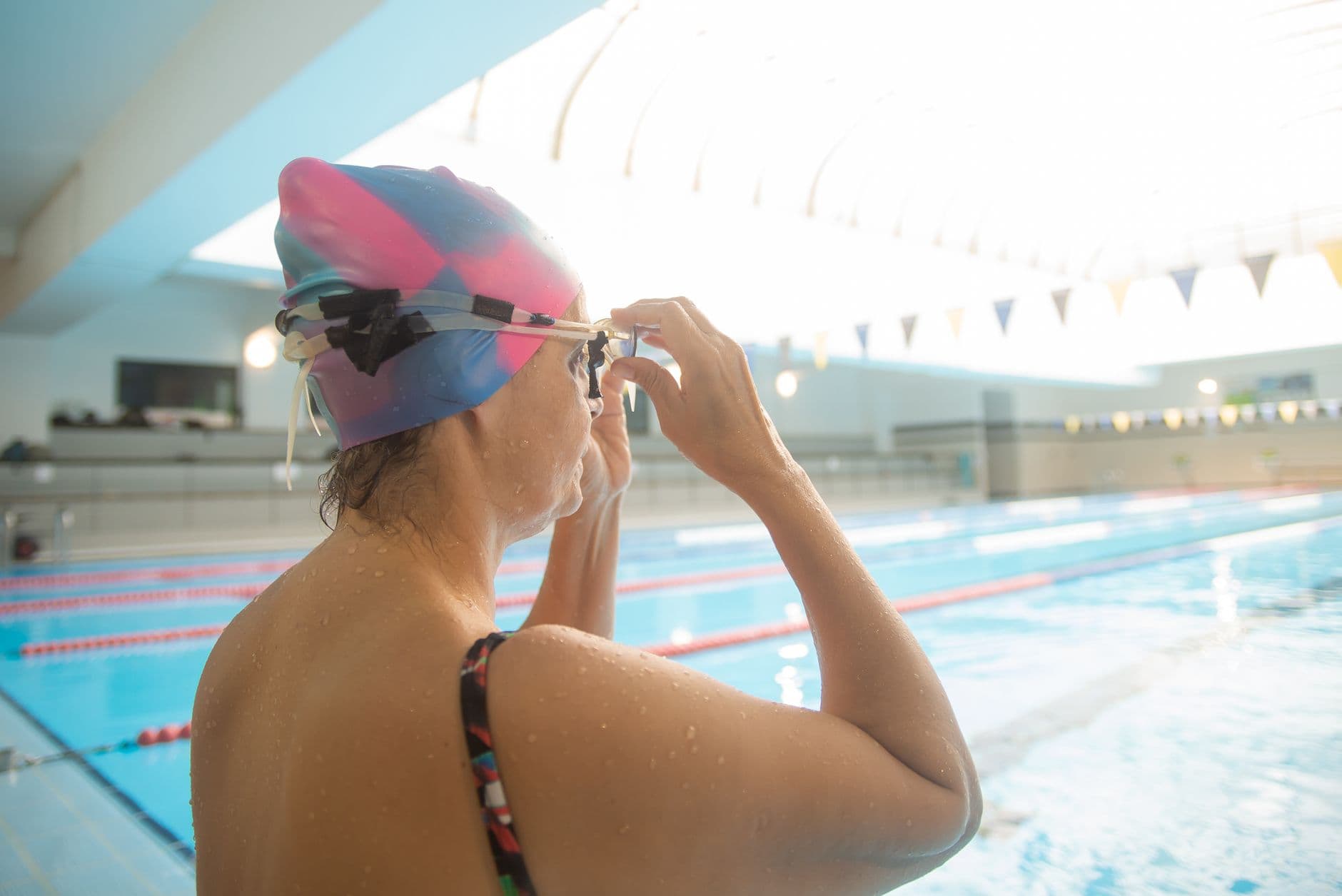
Search for dryland workouts for swimmers and Google finishes the phrase for you four ways: no equipment, at home, at gym, with weights. The equipment question is the one everybody asks and the least important one. What decides whether land training makes you faster is not the kit. It is whether the session was built around how swimming produces speed, or lifted from a general strength plan and relabelled.
Most of what circulates is the second thing. This page sorts the claims into three piles — what the research supports, what is coach consensus with thin evidence under it, and what is marketing — and then gives a 30-minute session that needs no equipment at all, because that is where most adult swimmers start and it is enough to begin with.
What the research supports, and how strongly
The largest pooled analysis to date is a two-tier network meta-analysis published in 2025, built from 36 randomised controlled trials and 844 competitive swimmers. It compared three things: training in the water, training on land, and doing both.
Doing both won, and not narrowly. Against a control group, combined training improved 100 m time by 2.01 seconds (95% confidence interval 2.87 to 1.16 seconds faster) and also moved swimming velocity, stroke rate and stroke length. In the second tier of the analysis, water plus dry-land resistance training ranked first at 50 m, at 100 m, and on the stroke measures. Core and power work came out as targeted add-ons rather than as the main course.
That pattern repeats. A systematic review of 27 studies found no consensus at all on which method of strength training is best — every method had groups that improved — but did find that swimming combined with strength work beat a swim-only approach.
Read the headline carefully. What has support is adding land work to a swimming programme. Nothing here says land work substitutes for metres.
The one transfer that is not in dispute: the start
If you only ever do one thing on land, this is the piece with the strongest evidence behind it. A systematic review of 16 studies on the swim start reported that start performance — measured as time to 5, 10 or 15 m — was near-perfectly related to vertical bodyweight jump height, with correlations above 0.90. Plyometric training produced improvements in start performance over a training block, and post-activation potentiation produced them acutely.
This is less surprising than it sounds. A block start is a jump taken from an unusual position, and the force has to be produced in roughly the same fraction of a second. How to dive into a pool covers the positions; land work is what supplies the push behind them. The same argument runs for the wall: a flip turn ends in a two-legged extension against a solid surface, which is the one moment in a race that looks like a gym exercise.
The caveat the reviewers flag themselves: most of those studies did not use the starting blocks or the technique current in elite swimming, so the size of the effect is less settled than its direction.
Why your 1,500 is not going to change much
Here is where the honest answer diverges from the marketing. A 2024 meta-analysis of 13 studies and 267 competitive swimmers found resistance training improved upper-limb maximum strength and front crawl times at 25, 50, 100 and 200 m — and that the improvement appeared to come from an increased stroke rate, not a longer stroke. Only two methods did it: concurrent resistance training and power training.
Note the distances. The longest outcome in that analysis is 200 m. A 2026 meta-analysis of plyometric work in swimmers aged 10 to 18 states the same boundary explicitly: transfer to longer distances was smaller in magnitude.
If your event is a mile, a 1,500, or an open-water swim, the thing holding you back is almost certainly aerobic and not muscular. That is a pool problem, and it is solved with the work described in how to build swimming endurance and measured by your CSS pace — run your own numbers in the CSS calculator. Land work is not a substitute for that, and the stroke-rate finding is worth reading next to stroke rate or stroke length, which is the trade-off it sits inside.
Core training: better evidence than you would guess, worse than the caption
Core work is the single most oversold item in this category, which makes the actual evidence a pleasant surprise. A 2025 meta-analysis of 16 controlled trials in youth swimmers (438 participants) found a moderate, statistically significant effect on swimming performance, with low residual heterogeneity. The effect concentrated at 50 m and in backstroke, and the parameters that worked were specific: eight weeks, no more than three sessions a week, sessions of between 30 and 60 minutes.
One of the underlying trials gives a sense of scale. In a randomised controlled trial of 18 male swimmers aged 13, six weeks of seven core exercises three times a week, on top of normal swimming, produced a 50 m freestyle improvement of 1.4 seconds against the control group.
Three things that caption never mentions. The participants were children and teenagers. The samples are small. And what was tested was a programmed session of several exercises, three times a week for eight weeks — not a plank held until it hurts. The reviewers' own conclusion asks for studies in adults before anyone claims this holds past eighteen.
How to tell a swimming routine from bodybuilding with a swimming name
Four questions will separate them, and all four come straight out of the evidence above.
| Ask this | A transfer-focused plan | A relabelled gym plan |
|---|---|---|
| Is there a jump in it? | Yes, and early in the session while you are fresh | No jumping anywhere |
| Pulling versus pressing | Pulls at least as often as it presses | Bench press, shoulder press, chest fly |
| Reps and intent | Low reps, moved fast, well short of failure | Three sets of twelve to failure, slow and heavy |
| Place in the week | Two sessions wrapped around the swimming | Five days of split training; the pool fits in somehow |
The reps-and-intent row is the one people argue about, so it is worth naming the source: a systematic review in Sports Medicine concluded that for optimal transfer, specific low-volume, high-velocity or high-force programmes are the ones that work, and that resisted swims — not land work — are the better tool for raising stroke rate.
The weekly dose, and the column swimming does not fill
Step back from performance for a second, because for most adult swimmers this is the better reason to do any of it. The Physical Activity Guidelines for Americans ask adults for at least 150 to 300 minutes a week of moderate-intensity aerobic activity, and muscle-strengthening activity — their examples are lifting weights and push-ups — on at least two days a week.
Swimming fills the first column generously. Four one-hour sessions a week and you are at the top of the recommended aerobic range without doing anything else. It does not fill the second column at all, because it is not weight-bearing and the guideline's own examples are not things you can do in a lane.
That reframes the question. Two half-hour sessions a week is not an elite add-on; it is the strength half of a standard public-health recommendation that swimmers, uniquely among endurance athletes, tend to skip entirely. Should you swim every day goes through the recovery side of the same arithmetic.
A 30-minute session with no equipment
This is the most-searched version of the question, so here is a concrete answer. U.S. Masters Swimming's own advice to adults who do not know where to begin is to master the bodyweight basics first — squat, push-up, hip hinge — starting at six repetitions, three rounds, and working up toward twelve as it gets comfortable. The session below is that advice with a jump and a pull added, for the reasons given earlier.
| Movement | Starting dose | Why it is in here |
|---|---|---|
| Squat jump | 3 × 5, landing quietly | The start and the push-off; do it first, while fresh |
| Bodyweight squat | 3 × 6 to 12 | Builds the position the jump is launched from |
| Hip hinge | 3 × 6 to 12 | The back of the body, which swimming barely loads |
| Push-up | 3 × 6 to 12 | Shoulder and trunk stability under load |
| Row, on a towel round a door frame | 3 × 6 to 12 | The pull that keeps the pressing honest |
| Side plank | 3 × 20 to 30 s each side | Resisting rotation, which is what the trunk does in freestyle |
Thirty minutes covers that with unhurried rests. The honest weakness of the no-equipment version is the pull: a towel row is a poor substitute for a real one, and it is the first thing to upgrade. If a movement hurts rather than feels hard, stop doing it and have someone look at it.
What to add when you get equipment, and in what order
The "at gym" and "with weights" searches expect a different programme. They should not get one: it is the same programme with load on it, added in this order.
- A resistance band, first. It costs the least and it is what the shoulder-injury trials actually used. It also fixes the towel-row problem.
- A pair of dumbbells, second. USMS's own next tier is the goblet squat, the deadlift and the single-arm row, starting light enough to learn the shape of the movement and adding weight slowly while writing down what you used.
- A barbell and a gym, last. Useful, not necessary, and the point at which supervision stops being optional.
Worth knowing: the other way to add resistance is in the water, which is where the review quoted earlier put resisted swims ahead of land work for stroke rate. What paddles and fins actually train sets out when that is a good idea, and what kickboard work is for covers the leg-only version. Neither replaces the land session; they answer a different question.
Shoulders: the part worth doing even if you never want to be faster
Shoulder pain is the main cause of missed or modified training in competitive swimmers, and this is the one area where land work has prevention evidence rather than performance evidence. A scoping review of 14 studies reports that a 6-to-8-week programme combining strengthening of the shoulder external rotators and the scapular retractors with stretching of the pectoral muscles can lower the incidence of shoulder pain in swimmers.
Two findings in that review deserve more attention than they get. Programmes longer than 12 weeks did raise external rotation peak force, endurance and the external-to-internal rotation ratio — but that was not associated with less pain, which is a useful reminder that a number improving in the gym is not the outcome you wanted. And for external rotation strength and endurance specifically, open kinetic chain exercises and a dry-land programme beat closed-chain exercises and water training.
The reviewers ask for caution because of the methodological limits of the underlying studies. And if your shoulder already hurts, this is not a programme to pick off a page: see a physiotherapist or doctor who can watch you move. The stroke faults that load the cuff covers what is happening in the water.
Where it goes in the week without wrecking your swimming
Every trial that produced a benefit ran the strength work alongside normal swim training. None of them replaced metres with repetitions, which rules out the most common mistake before you make it.
Beyond that, the specifics are coach consensus and should be labelled as such — the reviews above did not test what time of day to lift or which session to put first. What experienced coaches tend to settle on: two land sessions a week, placed so that neither lands the day before the session you care most about; if land and water fall on the same day, swim first and lift after, because technique degrades when you are already tired; and heavy leg work the day before a hard kick set is a bad trade.
Keep the first week deliberately easy. Soreness in the lats and the back of the shoulder changes how your catch feels, and a stroke that feels foreign is a stroke you will start fiddling with. A proper warm-up matters more in the weeks you are adding land work, and heart rate zones will tell you if the pool sessions are quietly costing more than they should.
Children: why the "kids" version needs a different answer
"Dryland workouts for swimmers kids" is one of the live autocomplete suggestions, and it is the version where the gap between confidence and evidence is widest.
The 2026 meta-analysis of plyometric training in swimmers aged 10 to 18 is admirably blunt about it. The point estimates for land-based explosive power and short-distance swimming were moderate to large, and appeared larger around peak height velocity — but none of the pooled estimates reached statistical significance under the primary analysis, the confidence intervals were wide, and the authors say their findings should be read as hypothesis-generating rather than as confirmation. A separate review of adolescent swimmers lands on low-intensity, high-speed resistance work as the recommendation.
So: the direction looks right, the magnitude is unproven, and the age bands matter. For a specific child, the load and the progression are a decision for their coach and someone qualified to supervise them in person, which is why this page gives a session for adults and not for twelve-year-olds. The public-health floor is simpler — 60 minutes a day of moderate-to-vigorous activity, including things that strengthen muscle and bone, which for a child mostly means climbing and jumping and playing.
How to know whether it is working
Measure the water, not the gym. Adding ten kilos to a deadlift is not the outcome you bought; a faster 50 is.
Three measurements worth taking before you start, because they are the ones the research actually links to land training. A vertical jump from standing, in centimetres — that is the variable with the near-perfect relationship to start performance, which makes it the cheapest monitoring tool you have. A 50 m from the block and a 50 m from a push, timed off the wall clock; reading a pace clock is enough and the gap between the two is your start. And a stroke count over a fixed distance, which is how you tell whether a faster swim came from turning the arms over quicker or from covering more water per stroke.
Put the last two together and you have SWOLF, which the SWOLF calculator will work out for you. Re-check after eight weeks, not two: the interventions that produced results ran six to twelve. If the target is a specific event, swimming a faster 100 freestyle walks through the rest of it.
Where the evidence runs out
Being clear about this is the difference between a useful page and a confident one. Taken together, the trials behind everything above share a shape: competitive swimmers, mostly adolescent or college-age, interventions of roughly four to twelve weeks, small samples, and outcomes measured between 25 and 200 m.
What that leaves uncovered is most of the people reading this. There is very little on masters swimmers, almost nothing on adult beginners, and nothing useful on 1,500 m or open water. The reviewers say so themselves: the core-training meta-analysis calls for studies in adults and for long-term interventions before claiming sustained benefit, the 2017 review notes that long-term intervention research is simply missing, and the 27-study review found no consensus on which method is best.
So the shape of the honest claim is this. That some land work helps competitive swimmers over short distances is reasonably well supported. That it helps a 45-year-old swimming 2,000 m three times a week is an extrapolation — a sensible one, backed by a general health recommendation that stands on its own, but an extrapolation. Anyone who tells you otherwise is quoting studies they have not read.
Where to start this week
Two 30-minute sessions on non-consecutive days, from the no-equipment table, at six repetitions and three rounds. First session, learn the movements and finish feeling like you could have done more. Add the band work for external rotation twice a week if your shoulders have ever complained.
Before the first session, write down three numbers: your standing vertical jump, a 50 from a push, and your stroke count for one length at an easy pace. Look at them again in eight weeks. If the plan is working you will see it there, and if it is not, you will have found that out for the price of twelve hours rather than a season. The workout generator will build the swimming around it, and the workouts section has the rest.
Frequently asked questions
How many days a week should swimmers do dryland training?
Two sessions a week is the dose with the most support behind it. The core-training trials that worked used no more than three sessions a week of 30 to 60 minutes, and the Physical Activity Guidelines for Americans ask adults for muscle-strengthening work on at least two days a week. More than three adds fatigue to your swimming without clear extra return.
Does dryland training actually make you a faster swimmer?
Over short distances, yes, modestly. Pooled trials of competitive swimmers found combined water and land training improved 100 m time by about two seconds against a control group, and the gain came through a faster stroke rate. The effect shrinks as distance grows, and at 1,500 m or in open water the limiter is aerobic fitness rather than strength.
Can you do dryland for swimming with no equipment?
Yes, and it is a reasonable place to start. Squat jumps, bodyweight squats, hip hinges, push-ups, a towel row and a side plank cover the main patterns in about 30 minutes. The weak point is the pulling movement, so a resistance band is the first thing worth buying — it is also what the shoulder-injury prevention studies used.
Should swimmers lift weights before or after swimming?
If both fall on the same day, most coaches swim first and lift afterwards, because stroke technique degrades once you are fatigued and a bad session in the water costs more than a slightly weaker lift. This is coach consensus rather than a tested finding: the reviews that showed a benefit did not compare the orderings.
What dryland work actually helps the start and turns?
Jumping. Time to 5, 10 and 15 m off the blocks correlates above 0.90 with vertical bodyweight jump height, and plyometric training has improved start performance across a training block. Squat jumps and box jumps done early in a session, while you are fresh, are the direct version. Your standing jump height also doubles as a cheap progress check.
Sources
- Wang Z. et al. (2025) — Comparative effectiveness of physical training modalities on swimming performance: a two-tier network meta-analysis (36 RCTs, 844 swimmers) — Frontiers in Physiology
- Thng S., Pearson S. & Keogh J.W.L. (2019) — Relationships between dry-land resistance training and swim start performance: a systematic review — Sports Medicine
- Crowley E., Harrison A.J. & Lyons M. (2017) — The impact of resistance training on swimming performance: a systematic review — Sports Medicine
- Jin G. et al. (2024) — The methodology of resistance training is crucial for improving short-medium distance front crawl performance: systematic review and meta-analysis — Frontiers in Physiology
- Fone L. & van den Tillaar R. (2022) — Effect of different types of strength training on swimming performance in competitive swimmers: a systematic review (27 studies) — Sports Medicine – Open
- Liu S. et al. (2025) — The effects of core stability training on swimming performance in youth swimmers: systematic review and meta-analysis (16 trials, n=438) — BMC Sports Science, Medicine and Rehabilitation
- Khiyami A. et al. (2022) — Efficacy of core training in swimming performance and neuromuscular parameters of young swimmers: a randomised control trial — Journal of Clinical Medicine
- Jin R. et al. (2026) — Effects of plyometric training on explosive power and swimming performance in adolescent swimmers: meta-analysis with dose-response analysis — BMC Sports Science, Medicine and Rehabilitation
- Guo W. et al. (2022) — Effect of resistance training methods and intensity on the adolescent swimmer's performance: a systematic review — Frontiers in Public Health
- Yoma M., Herrington L. & Mackenzie T.A. (2022) — The effect of exercise therapy interventions on shoulder pain and musculoskeletal risk factors in competitive swimmers: a scoping review — Journal of Sport Rehabilitation
- Physical Activity Guidelines for Americans, second edition — Top 10 Things to Know (150 to 300 minutes of aerobic activity and muscle-strengthening on 2 or more days a week) — U.S. Department of Health and Human Services (ODPHP)
- U.S. Masters Swimming — Busting three common swimmers' fears about strength training (bodyweight progression and starting dose) — U.S. Masters Swimming
Read next
Are tech suits worth it? Read the rulebook before the price tag
A racing suit is the one piece of swim kit with its own rulebook and approval fee. What the rules demand, what the research measures, and who may not wear one.
Swimming while pregnant: what the guidance actually says
The official 150-minute target turned into pool sessions, the water temperature limit from the review that measured it, and the warning signs that mean get out.
How to taper for a swim meet: how long, how much less, what to keep
Two weeks, volume down 41-60%, intensity and frequency left alone. The numbers come from a meta-analysis of 27 taper studies rather than from club tradition.
SwimFast is an independent publication. We are not a swim school, a coaching service or a governing body, and nothing here is medical advice. Training paces and test protocols are cited from the published research or federation documents linked on each page. Never swim alone, never attempt breath-hold work without supervision, and check with a doctor before starting a new training programme.