How to do a flip turn: the six steps, and the two everyone rushes
The flip turn broken into six steps, with the race data on what each one is worth. The two that decide your speed are not the somersault.
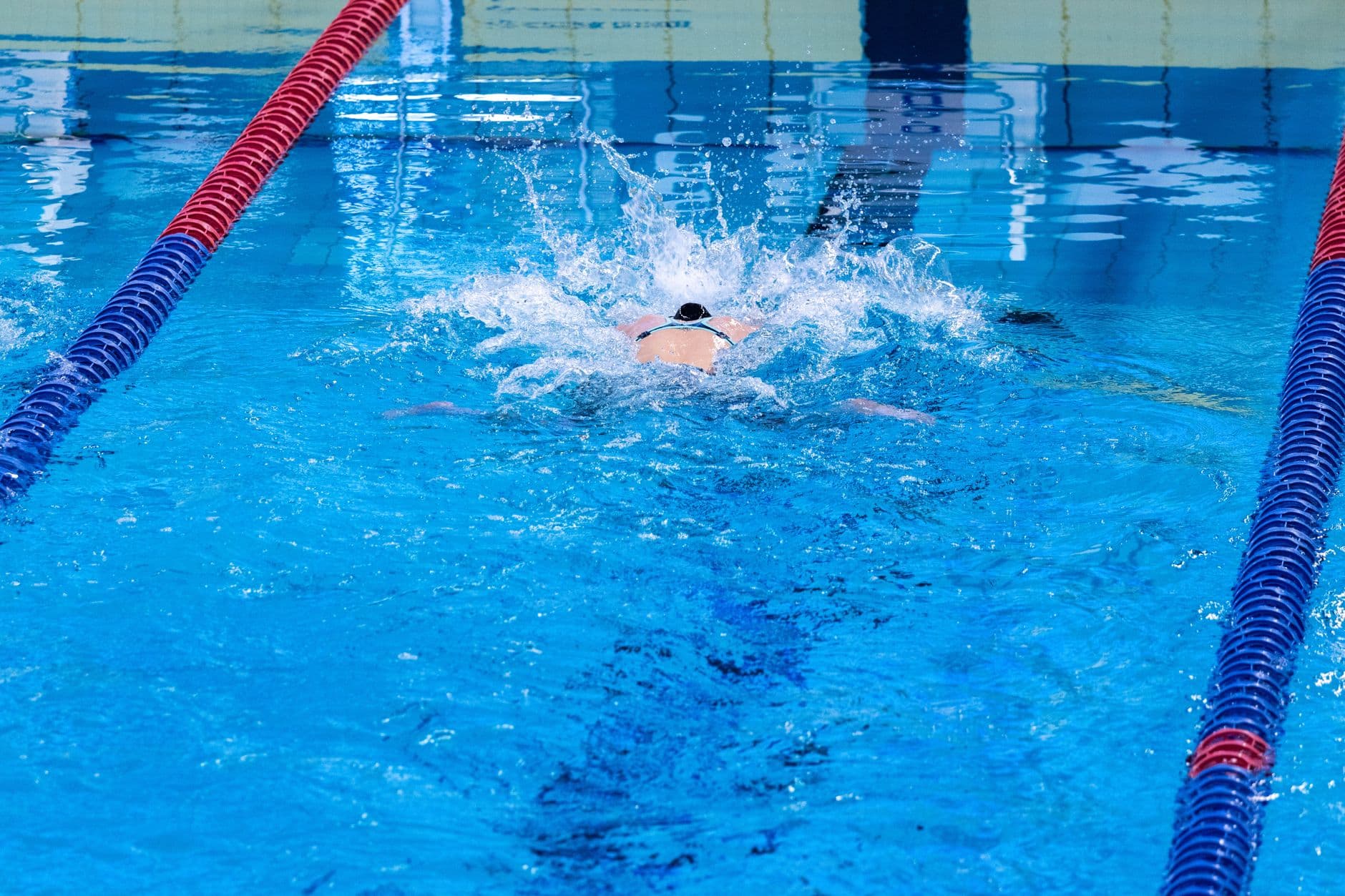
A flip turn is six things happening in about a second and a half, and most swimmers learning one spend all their attention on the somersault in the middle. The somersault is the easy part. The two steps that decide whether the turn is fast are the one before it and the one after it, and both of them get rushed.
That is not a coaching opinion. When researchers at Vrije Universiteit Amsterdam put national-level swimmers on a force plate and deliberately made them spend longer on the wall, the longer contact times came with faster turns, not slower ones. The instinct to bounce off the wall as quickly as possible is the instinct to fix.
This guide breaks the turn into its six parts, shows what the race data says each part is worth, and gives you a way to measure whether yours is improving. If you are still working on the swimming either side of the wall, start with why your legs sink and come back — a turn cannot rescue a body position problem.
How do you do a flip turn, step by step?
A flip turn is a forward somersault into the wall, feet planted, then a push-off on your back that rotates onto your front as you come out. You never touch the wall with your hands. You carry your speed into the flip instead of stopping at the wall, which is the entire point: the wall becomes a launch pad rather than a full stop.
It helps to be clear about what it is not. It is not a way to swim faster by swimming harder — it costs no fitness at all. It is not a breathing break. And it is not compulsory: plenty of very good masters swimmers use open turns by choice, and a well-executed open turn with a strong push-off beats a panicked flip every single time.
How much of a swim is actually the turn?
More than most people would guess, and the number depends entirely on where you draw the boundary of the turn — which is why you see wildly different figures quoted around the internet.
Polach and colleagues analysed all eight male finalists in the 1500 m freestyle at two World Championships, defining the turn as the section from 5 m before the wall to 5 m after it. In the short-course race that section accounted for 35.04% of total race time; in the long-course race, 16.53%. Same swimmers, same event, different pool — the difference is purely how many walls there are.
Cuenca-Fernández and colleagues used a wider boundary — 5 m in, 10 m out — on 256 swimmers at the 2019 European Short Course Championships. Over 200 m, turns took 32.92% of race time in a long-course pool and 50.84% in a short-course one. Half the race.
Sources: Polach et al., BMC Research Notes 2021 (1500 m, eight finalists per championship); Cuenca-Fernández et al., IJERPH 2022 (200 m, 2019 European Short Course Championships).
In the 1500 m study, turn-section velocity correlated with total race velocity at r = 0.81 short course and r = 0.83 long course. The authors judged that turn performance changed the final ranking for six of the eight short-course finalists and three of the eight long-course ones. At that level, turns sort the field.
The six steps of a flip turn
1. The approach
Hold your speed all the way in and finish on a full stroke. If your last stroke lands too far out you glide into the wall; too close and you take a useless half-stroke that kills the rotation before it starts. U.S. Masters Swimming's advice is to time your strokes into the wall deliberately in training until the count is automatic — most swimmers find it, then stop thinking about it.
2. The set-up
On that last stroke, let your body submerge slightly rather than staying flat on the surface. Rounding a corner at speed works better than a sharp ninety-degree change of direction, and a slightly submerged body enters the rotation smoothly instead of having to break the surface first.
3. The flip
Drive your knees to your chest, not your heels to your hips. This is the single most common correction in the whole movement. Knees to chest makes the tight ball; the heels follow on their own. Your arms stay pinned at your sides — flapping them creates drag and means your core is not doing the work.
4. Wall contact
Land both feet around the middle of the T marking, between hip-width and shoulder-width apart, toes pointing up. Feet too high on the wall sends you down; too low sends you straight to the surface with a weak push. Knee bend should be roughly what you would use on land if you were about to jump as high as you could.
5. The push-off
Clamp into a streamline — fingertips to toes in one line — and push hard and straight. U.S. Masters Swimming makes the point that after the dive off the blocks, the moment your feet leave the wall is the fastest you will move all race, and unlike the dive it happens at every single length. A sloppy streamline throws that speed away before you have used any of it.
6. The breakout
Come up gradually, like an aircraft taking off rather than a helicopter. Surfacing too steeply turns forward speed into upward speed and adds drag right when you are travelling fastest. Push off at a depth that lets you rise on a shallow angle and break out level, already moving at or above your swimming speed.
The two steps that everyone rushes
Steps one and five. The approach and the wall contact. Both get rushed for the same reason: the turn feels like an emergency, so everything inside it gets hurried, including the parts that reward patience.
The wall contact is the surprising one. David and colleagues had 18 Dutch national-level swimmers perform 29 turns each over a force plate and four underwater cameras, deliberately shortening and lengthening their wall contact time by 25% either side of their own preference. Within that range, longer contact times went with faster 5 m round-trip times, alongside higher exit velocity, higher peak push-off force and faster approach velocity. Reference contact times were 0.37 s for the men and 0.30 s for the women. Bouncing was not rewarded.
The same study measured how close swimmers tucked to the wall — hip distance from the wall as a proportion of hip height, which they call the tuck index. The men averaged 0.61 and the women 0.68, while the model's predicted optimum across the group was 0.70. In plain terms, the average swimmer, and the average man especially, flips a little too close to the wall to push properly. That said, this is 18 swimmers in one laboratory, so treat it as a direction to experiment in, not a target to hit.
What to take from it: stop trying to leave the wall quickly. Try to leave it fast. Those are different things, and only the second one shows up in your split.
What the rules actually require
The World Aquatics Competition Rules — the current version is 18, in force from February 2026 — are shorter on this than people expect.
- Freestyle (rule 5.2): at least one part of the body must touch the wall on completion of each length. One part. Your feet count, which is exactly why a flip turn is legal and why you never need a hand touch.
- Freestyle (rule 5.3): you may be completely submerged during the turn and for up to 15 m afterwards, but your head must have broken the surface by the 15 m mark.
- Backstroke (rule 6.4): you must touch the wall with at least one part of the body, the shoulders may turn past vertical onto the breast, and then a single continuous arm pull — or a simultaneous double pull — initiates the turn. You must have returned to the position on your back when you leave the wall.
- Any stroke (rule 10.2.3): you must make physical contact with the wall and must not take a stride or step off the bottom of the pool.
Butterfly and breaststroke are absent from that list because neither permits a flip at all: both require a simultaneous two-hand touch, so the turn is an open turn and the speed has to come from somewhere else — from butterfly's two-kick timing, and from how quickly the breaststroke kick reloads after the pullout, whose legal sequence is a subject of its own.
The backstroke rule is where turns are actually lost at meets. Roll onto your front too early and glide, and you have taken a freestyle stroke in a backstroke race. U.S. Masters Swimming's practical fix: count your strokes from the backstroke flags to the wall, then take one or two fewer than your finishing count before rolling over. Flags sit 5 yards out in a yards pool and 5 metres out in a metres pool — about 16 inches of difference, which is enough to matter, so re-count during warm-up in an unfamiliar pool. Counting from the flags only works if you arrived at them on a straight line, which is a skill of its own: swimming backstroke straight.
How to learn one if you have never done a somersault in water
Away from the wall first. This is the part adults skip and then wonder why the turn will not come together.
- Somersaults in open water, no wall. Push off into a glide, tuck, roll all the way over, stand up. Repeat until it stops feeling like an event.
- Somersault and plant. The same thing but a body length from the wall, aiming to land both feet flat on the tiles. You will miss. That is the drill working.
- Land and push, no swimming. Flip, plant, push off on your back in a streamline, glide until you stop. Ignore the somersault now and look only at where your feet land and how straight the glide is.
- Add the rotation. Push off on your back, then rotate to your front during the glide, before you start kicking.
- Join it to the swimming. Swim in at an easy pace, turn, breathe out through the whole thing, swim away.
Three to five focused sessions is a realistic timeframe for a swimmer who is already comfortable swimming a length, though there is no published trial putting a number on it. Adults tend to take longer than children, and the reason is not fitness — it is that being upside down underwater is unfamiliar, and unfamiliar reads as alarming. If you are still at the stage of building comfort in the water, the order that actually works for adult beginners matters more than any turn.
Breathing through the turn, and the one thing never to do
Breathe out steadily through your nose from the moment you start rotating until your feet leave the wall. That is what stops water going up your nose, and it also stops the turn becoming a breath-hold. Take your last breath on your second-to-last stroke into the wall, and your next one two or three strokes after the breakout.
Safety, and this is not a formality. Never practise turns by holding your breath deliberately, never do repeated hypoxic or breath-hold sets to get used to the turn, and never train turns alone in a pool without a lifeguard. Deliberate breath-holding in water can cause shallow water blackout — loss of consciousness with no warning and no struggle — and it has killed strong, fit swimmers. If turns leave you dizzy for more than a minute or two, or you feel dizzy at other times, stop and speak to a doctor rather than pushing through it.
If breathing is the part of freestyle that falls apart around the wall, the problem is usually upstream of the turn. Breathing without running out of air covers the exhale pattern that makes everything else possible.
When it still does not work
| What happens | Usual cause | What to change |
|---|---|---|
| Water up the nose every time | Not exhaling, or exhaling only through the mouth | Hum out through your nose the whole rotation. A nose clip while learning is a reasonable crutch, not a failure. |
| Feet land sideways, or only one foot lands | Arms steering instead of the core | Arms stay at your sides. Drive knees to chest and keep the head tucked. |
| You crash into the wall | Flipping too late, or gliding in and losing the read | Count strokes from the flags. Start the flip earlier than feels right — nearly everyone flips late. |
| You flip nowhere near the wall | Flipping too early, usually from nerves | Hold your speed and your last full stroke. Speed makes the flip easier, not harder. |
| Weak, slow push-off | Legs too straight at contact, or bouncing off | Land with a jumping-depth knee bend and accept a slightly longer contact time. |
| Dizziness afterwards | Rotation combined with breath-holding | Keep exhaling, fix your eyes on your knees during the roll, do fewer turns per set. Persistent dizziness is a doctor's question, not a coaching one. |
Why the turn is worth more in a 25 m pool
Because there are more walls, and that is the whole explanation for why short-course times look faster. A 100 in a 25 m pool has three turns. The same 100 in a 50 m pool has one. Nothing about your swimming changed; you simply pushed off two more times.
The seeding factors used across USA Swimming meets put a short-course-metres time at 1.0351 times its long-course equivalent — roughly 3.5% — and a short-course-yards time at 1.1591 times, though a good part of that second figure is the shorter distance rather than the walls. Our course conversion tool shows both the pure distance ratio and the empirical factor side by side, along with the turn count for each event, precisely because the gap between those two numbers is the turn effect.
Notice what this means for training. In a 25 m pool a bad turn is charged to you three times per 100, and it compounds with distance: a 500 in a yards pool is nineteen turns, which is why the walls are part of swimming 500 yards without stopping rather than a separate project you get to later. If you mostly swim short course, turns are not a detail of your training — they are a third to a half of it, depending on where you draw the line.
How to tell whether your turn is actually improving
Three measurements, none of which need equipment.
- Push-off glide distance. Turn, streamline, no kicking, and note where you stop relative to the lane markings. It is the cleanest single read on push-off and streamline quality, and it improves quickly.
- Your SWOLF at the turn end. SWOLF adds the seconds for a length to the strokes taken in it, so a better turn lowers it without you swimming any differently. Run the numbers in the SWOLF calculator and compare push-off lengths against mid-pool lengths in the same swim.
- Repeat times on a short set. Ten 50s off the same send-off, watching whether the last ones hold up. In the European short-course data, the finalists were not only faster at turning but more consistent across turns — a coefficient of variation of 0.74% against 0.91% for the swimmers who missed the final. Consistency is a measurable, trainable thing.
For the pacing side of that, the pace calculator converts any split to a per-100 pace, and if you want your repeat times anchored to something physiological rather than guessed, test your critical swim speed and work from the zones it gives you. More on where turns sit inside a session in our workouts section, and if you want to know what the resulting times mean, the average 100 m swim time puts them in context.
A turn set for any session
Fifteen minutes, dropped into a warm-up or between main sets. Easy pace throughout — this is a skill set, not a hard one.
- 4 × 25 flip in the middle of the pool, no wall. Just the rotation.
- 6 × 25 swim in, turn, streamline off the wall, glide until you stop. No kicking, no swimming. Mark where you stop each time.
- 8 × 50 easy, one turn each, alternating: odd repeats concentrate on the last full stroke in, even repeats on the push-off. One thought per repeat.
- 4 × 50 at a moderate pace with the whole turn joined up, exhaling through the nose the entire way round.
Do that twice a week for a month and the turn stops being a thing you brace for. If you are still assembling a weekly structure to put it in, four beginner sessions gives you somewhere to put it, and the rest of the technique section covers the swimming on either side of the wall.
Where these numbers come from
The race-time shares and turn correlations are from two peer-reviewed analyses of championship finals. The wall contact and tuck index figures come from one laboratory study of 18 national-level swimmers, which is a small sample and is described here as a direction rather than a prescription. The rules are quoted from the World Aquatics Competition Rules, version 18. The coaching points on approach, foot placement, streamline and backstroke flag counting reflect U.S. Masters Swimming's published guidance, which is coaching consensus rather than experimental evidence, and is labelled that way on purpose.
Frequently asked questions
Is a flip turn faster than an open turn?
For a trained swimmer, yes, because the flip keeps the speed you carried into the wall instead of stopping to breathe and re-accelerate. But no published trial has measured the gap for adult fitness swimmers, and a strong open turn with a good streamline beats a rushed flip with a weak push-off.
Do you have to touch the wall with your hands in freestyle?
No. World Aquatics rule 5.2 asks only that at least one part of the body touches the wall on completion of each length, and your feet satisfy that. This is precisely why the flip turn is legal in freestyle and backstroke, while breaststroke and butterfly require a two-hand touch.
Why do I get water up my nose during a flip turn?
Because you are not exhaling through your nose during the rotation. When you go upside down, water pushes into the nostrils unless a steady stream of air is pushing back. Hum out through your nose from the moment you start the flip until your feet leave the wall. A nose clip is a fine crutch while you learn.
How long does it take to learn a flip turn?
Most swimmers who can already swim a length comfortably get a workable turn in three to five focused sessions, though nothing has been published to put a firm number on it. The step people skip is practising somersaults away from the wall first, which is exactly the step that makes the rest quick.
Why do I feel dizzy after doing flip turns?
Usually the combination of rotating your head quickly and holding your breath while you do it. Keep exhaling through the whole turn, fix your eyes on your knees during the roll, and do fewer turns per set at first. If dizziness lasts more than a minute or two, or happens outside the pool, see a doctor.
Sources
- Competition Regulations, version 18 (Part Two: Swimming, rules 5, 6, 9 and 10) — World Aquatics
- Polach M, Thiel D, Kreník J, Born D-P (2021). Swimming turn performance: the distinguishing factor in 1500 m world championship freestyle races? — BMC Research Notes 14:248
- Cuenca-Fernández F, Ruiz-Navarro JJ, Polach M, Arellano R, Born D-P (2022). Turn Performance Variation in European Elite Short-Course Swimmers — Int J Environ Res Public Health 19(9):5033
- David S, Grove T, van Duijven M, Koster P, Beek PJ (2022). Improving tumble turn performance in swimming — the impact of wall contact time and tuck index — Frontiers in Sports and Active Living 4:936695
- Faster Flip Turns (turns guide) — U.S. Masters Swimming
- The Best Way to Learn a Flip Turn — U.S. Masters Swimming
- Shallow Water Blackout (StatPearls) — NCBI Bookshelf, National Library of Medicine
Read next
The breaststroke pullout: the legal sequence, in order
One arm stroke, one dolphin kick, one breaststroke kick — and a rule that ends the pullout with a stroke, not a 15 metre mark. The sequence, and what gets called.
How to tread water without getting tired
Treading water has a measured energy cost, and the technique everyone recommends is the one that tires beginners fastest. What the research actually found.
Chlorine, hair and skin: what it does and what actually helps
What chlorinated pool water really does to hair and skin, why the green tint is copper rather than chlorine, and which protective steps have evidence behind them.
SwimFast is an independent publication. We are not a swim school, a coaching service or a governing body, and nothing here is medical advice. Training paces and test protocols are cited from the published research or federation documents linked on each page. Never swim alone, never attempt breath-hold work without supervision, and check with a doctor before starting a new training programme.