Triathlon swim calculator
A pool pace does not survive contact with a lake. This turns the pace you hold in a lane into a swim split for a sprint, Olympic, 70.3 or full IRONMAN — and shows every correction it makes, so you can argue with any of them. It also answers the question that decides the race before it starts: whether a wetsuit is legal.
Predict your triathlon swim split
A pool pace in, a race time out — with every correction itemised, so you can disagree with any of them.
At 1:49 per 100 m in the water. The wetsuit studies span 4 % to 7 %, so the honest band is 27:03 to 27:55.
This is a projection from one pool number, not a prediction. Cold, chop, a washing-machine start and a bad line all cost more than any of the corrections below.
Where the time goes
Each row is one step of the calculation, in seconds, labelled with how well it is evidenced.
- Your pace over 1,500 m, unchanged+26:15arithmetic
- No walls to push off+1:23derived
- Race effort: At CSS (threshold)+1:27convention
- Wetsuit−1:45measured in studies
A 25 m pool gives you 3.00 push-offs in every 100 m and open water gives you none. The cost per wall is worked out from the seeding factors on the course converter, not measured in a lake. The race effort is a coaching convention, not a measured decay curve.
What a bad line costs
We do not publish an average, because we could not find one that traces back to a real measurement. Here is what each assumption is worth over this distance, so you can pick your own — and then check it against a GPS watch.
| Extra distance | Metres swum | Swim time | Cost |
|---|---|---|---|
| 0 % — a perfect line | 1,500 | 27:20 | — |
| 2 % | 1,530 | 27:53 | +0:33 |
| 5 % | 1,575 | 28:42 | +1:22 |
| 10 % | 1,650 | 30:05 | +2:44 |
Nobody swims the 0 % row. It is there to show what the buoys would cost you if you never looked up — which is why sighting practice pays for itself faster than fitness does.
Against the clock that matters
- World Triathlon maximum stay in water, age group, 1,001–1,500 m1:10:00Your projection is 42:40 inside it.
- Same limit, elite and junior fields30:00Tighter, because those races are draft-legal and run to a schedule.
World Triathlon Competition Rules 2026, section 4.3. IRONMAN does not publish one global swim cut-off: section 4.02(k) says it is set per race in the athlete information guide, so read yours rather than trusting a number off a forum.
Will a wetsuit be legal?
The two rulebooks disagree with each other, and most of what is written about this online quotes the elite thresholds at age-group athletes.
At 18.0 °C (64.4 °F) over 1,500 m
- World TriathlonAllowedOptional. Above 15.9 °C and below 22 °C it is your choice for this category and distance.
- IRONMANAllowedOptional. Age-group athletes may wear one up to and including 24.5 °C (76.1 °F).
World Triathlon rules 2026 section 4.2; IRONMAN rules 2026 section 4.02. The official water temperature is taken an hour before the start, at three points on the course and 60 cm deep, and the head referee’s call is the one that counts — not the reading on your watch. In cold water below 22 °C World Triathlon also adjusts the figure downwards for cold air, which can turn an optional swim into a mandatory one.
Why your pool pace flatters you
Three things change between a lane and a race course, and only one of them is fitness.
The walls go away. In a 25-metre pool you push off three times in every 100 metres, and each push-off is faster than any stroke you own. We can put a number on that without guessing, because the course converter already carries the seeding factors that USA Swimming meets use: converting a short-course-metres time to long-course costs 3.51 %, and the only thing that changed is two walls per 100. So one wall is worth about 1.75 %, and stripping the last one out of a long-course pace costs another 1.8 %. It is real, and it is also the smallest of the three.
You swim further than the course. This is the big one and it is the one nobody can quote a trustworthy figure for. Numbers between 5 % and 20 % circulate freely; none of the ones we chased traced back to a measurement we could check, so the calculator above does not publish an average. It asks you for a figure and shows what each one costs over your distance instead. Over a 1,500 m swim at 2:00 per 100, a 5 % surplus is 75 metres and a minute and a half — the difference between a good swim and a mediocre one, bought entirely with your neck rather than your fitness.
The effort is different. A threshold pace is defined around an hour of work. A sprint swim is over in twelve minutes and a full IRONMAN swim is not; treating all four as the same effort is why pool-based predictions come out fast for the long races. The calculator lets you set the effort as a share of your CSS, using the same zone percentages as the rest of the site, and says plainly that those are a coaching convention rather than a measured fade.
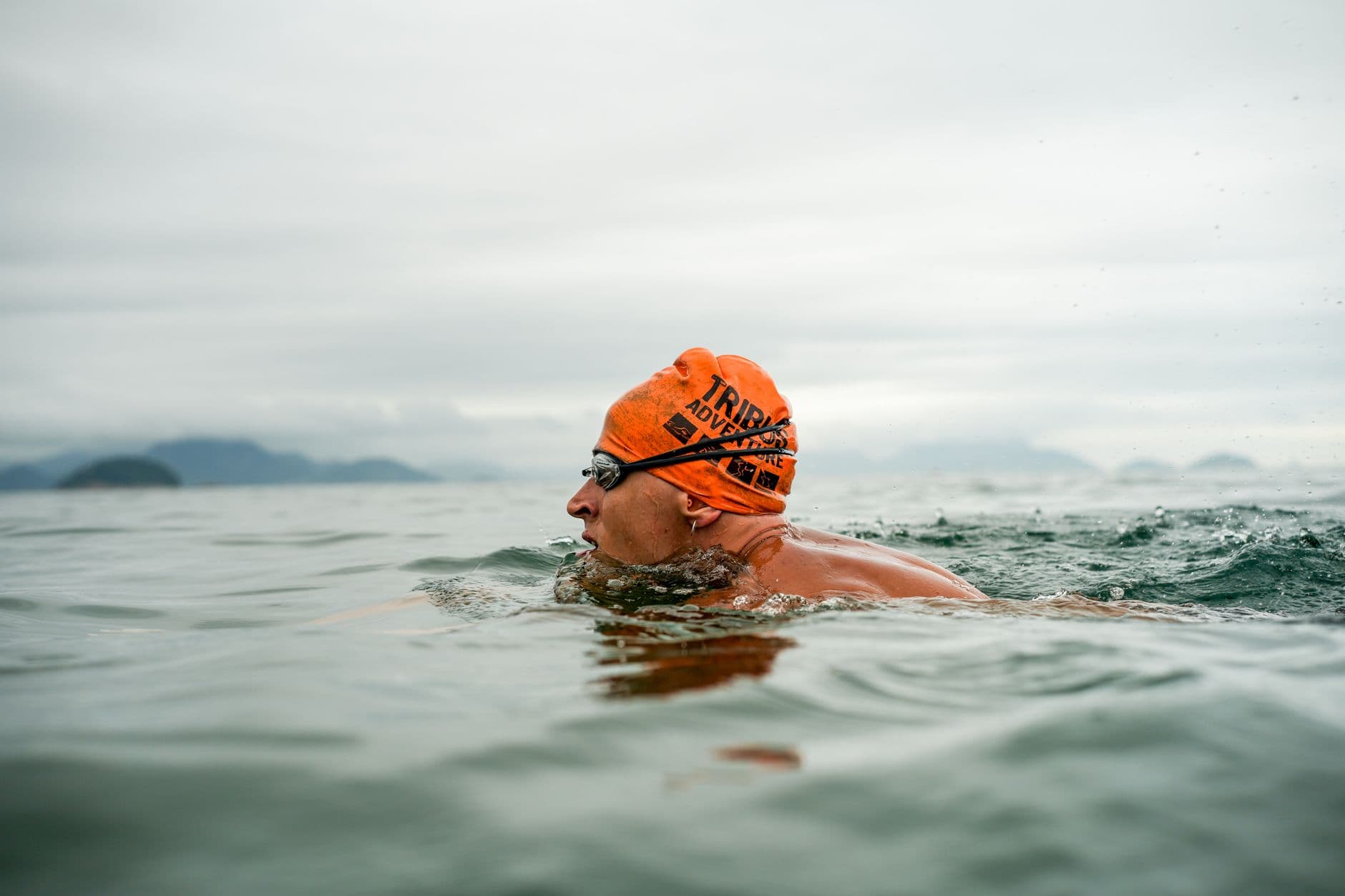
The official distances, in every unit you might need
The swim distances are set in metres by both governing bodies, which is why the yard and mile figures are all awkward. The two IRONMAN distances are the exception: those are defined in miles, and the metric numbers everyone quotes — 1.9 km and 3.8 km — are rounded conversions.
| Race | Metres | Yards | Miles | Lengths of a 25 m pool |
|---|---|---|---|---|
| Super sprint | 250–500 | 273–547 | 0.16–0.31 | 10–20 |
| Sprint | 750 | 820 | 0.47 | 30 |
| Standard (Olympic) | 1,500 | 1,640 | 0.93 | 60 |
| IRONMAN 70.3 | 1,931 | 2,112 | 1.2 | 77 |
| Full IRONMAN | 3,862 | 4,224 | 2.4 | 155 |
Super sprint, middle and long distance are ranges in the World Triathlon rules rather than fixed numbers — 250 to 500 m, 1,900 to 2,999 m and 3,000 to 4,000 m respectively. Sprint and standard are fixed. If you are training in a 25-yard pool, the practical consequence is that no round set matches a race: 800 yards is a shade under a sprint swim and 1,650 is a shade over a standard one. The short course versus long course guide covers why the two systems never line up neatly.
The wetsuit question, from the rulebooks rather than a forum
This is the single most misreported rule in the sport, and the reason is simple: World Triathlon publishes three tables, one for elites and two for age-groupers, and almost every summary quotes the elite one. The elite threshold is 20 °C for swims up to 1,500 m. The age-group threshold for the same swim is 22 °C. A page that tells a first-timer their wetsuit is banned at 20 °C is quoting a rule that does not apply to them.
| Who, and how far | Mandatory at or below | Forbidden at or above |
|---|---|---|
| World Triathlon — elite, U23, junior, youth, up to 1,500 m | 15.9 °C | 20 °C |
| World Triathlon — elite and under, 1,501 m and longer | 15.9 °C | 22 °C |
| World Triathlon — age group under 60, up to 1,500 m | 15.9 °C | 22 °C |
| World Triathlon — age group under 60, 1,501 m and longer | 15.9 °C | 24.6 °C |
| World Triathlon — age group 60 and over, all distances | 15.9 °C | 24.6 °C |
| IRONMAN — age group, relay and open division | 16 °C / 60.8 °F | above 24.5 °C / 76.1 °F |
| IRONMAN — professionals | 16 °C / 60.8 °F | above 21.9 °C / 71.5 °F |
Two details that decide real races. First, IRONMAN has a middle state the other rulebook does not: between 24.5 °C and 28.8 °C it may open a separate non-competitive wetsuit wave, and swimmers who take it give up age-group awards and World Championship slots. Second, World Triathlon adjusts the water temperature downwards when the air is cold — at or below 22 °C water with air at or below 15 °C, a published table shifts the effective figure, and a swim that looked optional becomes mandatory. In both systems the official temperature is taken an hour before the start, at three points on the course and 60 cm down, and the head referee’s call is the only one that counts.
What a wetsuit is worth once you are allowed one is better evidenced than most things in this sport. Gay and colleagues timed 33 swimmers over 400 m maximal front crawl in a 25 m pool in both kits and found about 6 % off the time; Tomikawa’s group put the velocity at VO₂max 5.4 % higher in a flume; Toussaint’s group measured the reason, 12 % to 14 % less drag at triathlon speeds, almost all of it buoyancy. The calculator uses 6 % and shows the 4 % to 7 % band. Our wetsuit guide covers fit, which matters more than the percentage does.
The time limit is a safety rule, not a race rule
World Triathlon publishes a maximum stay in water by swim length, and it is worth knowing before you enter rather than after. For age-group athletes it is 30 minutes up to 750 m, 1 hour 10 minutes up to 1,500 m, 1 hour 40 minutes up to 3,000 m and 2 hours 20 minutes up to 4,000 m. Past it, you are taken out of the water. The elite limits are tighter because those races run to a broadcast schedule.
IRONMAN works differently and the difference catches people out: its rulebook does not set a global swim cut-off at all. Section 4.02(k) says the cut-off is stated in the event-specific athlete information guide, which is why the figures quoted on forums vary from race to race and why none of them is authoritative for yours. The calculator checks your projection against the World Triathlon limit because that one is published; for an IRONMAN race, read the guide.
If the projected time is close to a limit, the answer is rarely to swim harder on the day. It is to build the sustained aerobic swim that makes the distance boring rather than frightening — the endurance guide is the long version, and swimming 500 yards without stopping is the honest first milestone for anyone who is not there yet.
Any stroke is legal, and so is stopping
Two rules that quietly take the pressure off a first race, both straight out of the books. World Triathlon rule 4.1(a): athletes may use any stroke to propel themselves through the water, and may also tread water or float. Rule 4.1(c): athletes may stand on the bottom, or rest by holding an inanimate object such as a buoy or a stationary boat. IRONMAN’s equivalent permits using course kayaks, boats and rafts as aid so long as no forward progress is made.
So breaststroke for the whole swim is legal. Rolling onto your back to get your breathing under control is legal. Holding a buoy for thirty seconds while the field goes past is legal. What is not legal in either book is being pulled or pushed along, or making forward progress while holding onto something. For most first-timers the useful version of this is: the swim cannot be failed by going slowly, only by running out of time or out of composure, and the second is the more common.
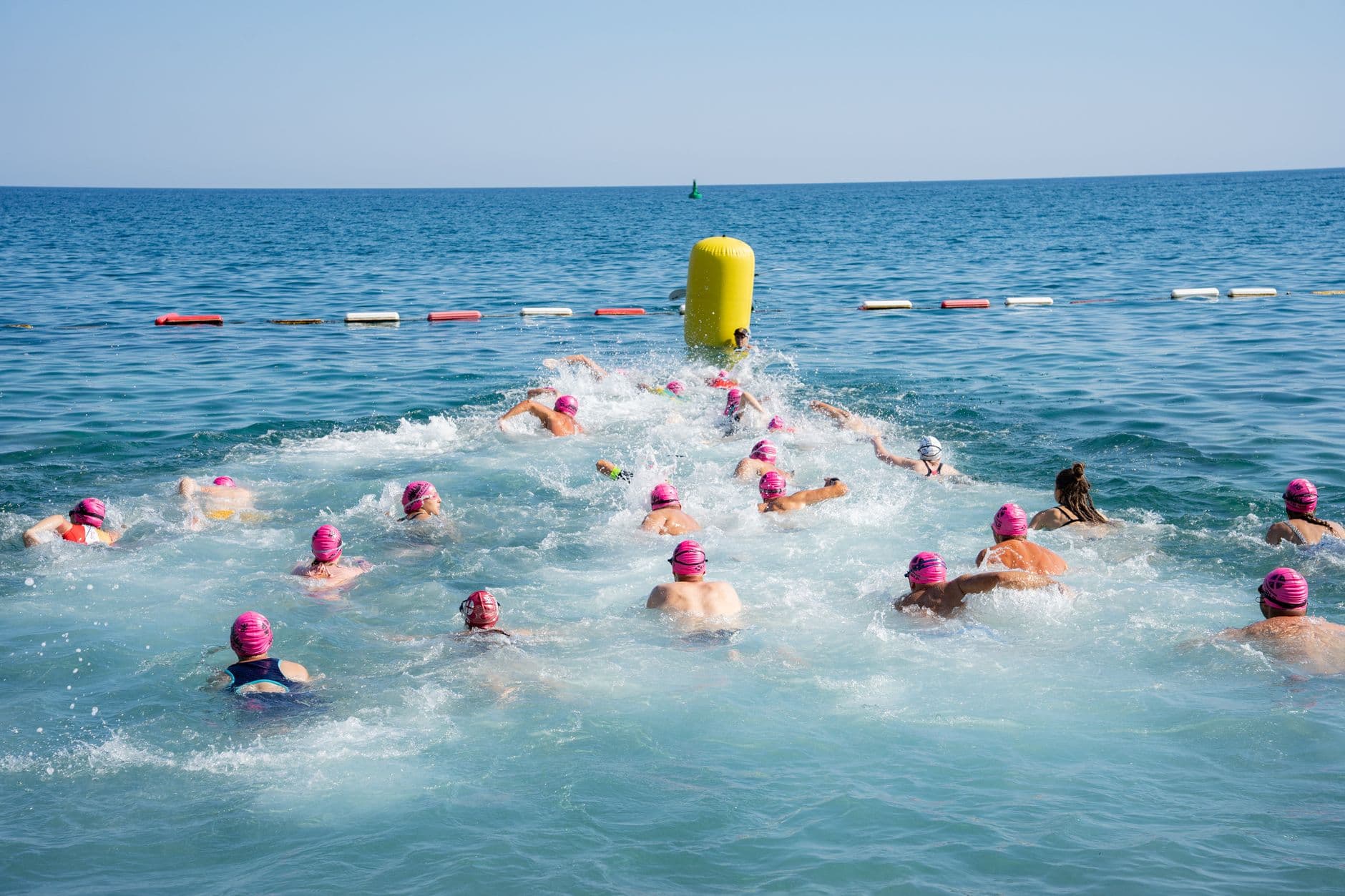
How to make the projection less of a guess
The number this page gives you is a projection from one pool figure, and it improves in the order below.
- Measure a real CSS rather than estimating a pace. Two time trials, one subtraction — the CSS calculator does the arithmetic and what CSS pace is explains why it is the right anchor for a swim this long.
- Measure your own navigation surplus. One open-water swim with a GPS watch, compared against the course distance, replaces the slider with a fact. Do it twice, because one bad day is not a habit.
- Swim a continuous rehearsal at race distance in the pool, without pushing off the walls — start each length from a float. It feels absurd and it is the closest a lane gets to the real thing.
- Check your stroke has not fallen apart. SWOLF across a long swim tells you whether your technique survived the distance or whether you simply worked harder to hold the pace, which is what most open-water fade actually is.
For the training that sits behind all of this, the triathlon swim training guide is the plan, and the first open-water swim guide is the one to read before you ever swim the projection.
Never swim in open water alone, and never practise breath-holding. Open water is not a pool with scenery: cold water takes your breath away in the first minute whatever your fitness, and a swimmer in trouble a hundred metres out is out of reach. Swim with a partner, in a supervised venue or with a lifeguarded event, and use a tow float. If a projection on this page is tempting you into a distance you have not built up to, build up to it instead. Anyone with a heart or lung condition, or who gets chest pain, dizziness or unusual breathlessness in the water, should talk to a doctor before entering a race — not to a calculator.
What this page will not tell you
It will not give you an average open-water slowdown, because the figures in circulation do not trace back to anything we could verify, and a plausible-looking number is worse than an honest blank. It will not predict a finish time for the whole race, because the bike and the run are not our subject. And it will not tell you the cut-off for a specific IRONMAN, because IRONMAN does not publish one centrally — that number lives in your race’s athlete guide and nowhere else.
What it does do is separate the parts of the calculation that are published rules from the parts that are a model, and label every one of them on screen. The distances, the temperature thresholds and the time limits are quoted from the two rulebooks. The wall effect is arithmetic on a measured seeding table, extended one step past where the table goes. The wetsuit figure comes from three studies. The navigation surplus is yours.
Frequently asked questions
How long is the swim in a triathlon?
It depends on the format. World Triathlon sets the sprint swim at 750 m and the standard, or Olympic, swim at 1,500 m. IRONMAN 70.3 is 1.2 miles (1,931 m) and a full IRONMAN is 2.4 miles (3,862 m). Super sprint races are shorter, anywhere from 250 m to 500 m.
What is the sprint triathlon swim distance in yards and miles?
A sprint triathlon swim is 750 metres, which is 820 yards or 0.47 of a mile. In a 25-yard pool that is 32.8 lengths, so the nearest round swim you can do is 800 yards. It is set as a metric distance in the rules, and races measure the course in metres regardless of the country.
Can you swim breaststroke in a triathlon?
Yes. World Triathlon's rules say athletes may use any stroke to propel themselves, and may also tread water or float. IRONMAN's rules do not restrict stroke either. Breaststroke is slower than freestyle for most swimmers and harder in a crowded field, but it is entirely legal for the whole swim.
Can you stand up or hold onto a buoy during the swim?
Yes, under both rulebooks. World Triathlon lets athletes stand on the bottom or rest by holding an inanimate object such as a buoy or a stationary boat. IRONMAN permits using course kayaks and rafts as long as no forward progress is made. What is banned in both is using an object to move yourself along.
What water temperature makes a wetsuit mandatory?
World Triathlon makes a wetsuit compulsory at 15.9 °C and below for every category and distance. IRONMAN makes it compulsory below 16 °C (60.8 °F). The forbidden thresholds differ far more: World Triathlon bans them at 22 °C for age-groupers over 1,500 m, IRONMAN not until 24.5 °C.
How much faster does a wetsuit make you swim?
About 4 % to 7 %. In the clearest test, Gay and colleagues timed 33 swimmers over 400 m maximal front crawl with and without a wetsuit and found roughly 6 % off the time. The mechanism is buoyancy: Toussaint's group measured 12 % to 14 % less drag at triathlon swimming speeds.
Is there a time limit on the triathlon swim?
Yes, and it is a safety rule rather than a race rule. World Triathlon publishes a maximum stay in water by distance — 1 hour 10 minutes for an age-group 1,500 m swim, 2 hours 20 minutes for 3,001 to 4,000 m. IRONMAN sets its swim cut-off per race in the athlete information guide, so read yours.
Sources
- World Triathlon Competition Rules 2026 — Appendix A, sections 4.2 and 4.3 — World Triathlon, edition of 13 December 2025
- 2026 IRONMAN Competition Rules — section 4.02, wetsuit rules — IRONMAN
- What is IRONMAN — the 140.6 and 70.3 distances — IRONMAN
- Gay A. et al. — Is swimmers' performance influenced by wetsuit use? — International Journal of Sports Physiology and Performance (2020)
- Tomikawa M. et al. — Factors related to the advantageous effects of wearing a wetsuit during swimming at different submaximal velocity in triathletes — Journal of Science and Medicine in Sport (2008)
- Toussaint H. M. et al. — Effect of a triathlon wet suit on drag during swimming — Medicine & Science in Sports & Exercise (1989)
Rules read from the World Triathlon Competition Rules 2026 (edition of 13 December 2025) and the 2026 IRONMAN Competition Rules, both checked on 20 September 2026. Not an official tool of either body; for anything that decides a race, read your event’s own athlete information guide.
SwimFast is an independent publication. We are not a swim school, a coaching service or a governing body, and nothing here is medical advice. Training paces and test protocols are cited from the published research or federation documents linked on each page. Never swim alone, never attempt breath-hold work without supervision, and check with a doctor before starting a new training programme.