Why do swimmers wear two caps? To pin the goggle straps down
The second cap covers the goggle straps and stops the first one wrinkling. Two caps is explicitly legal, and two is the written maximum — here is the rule.
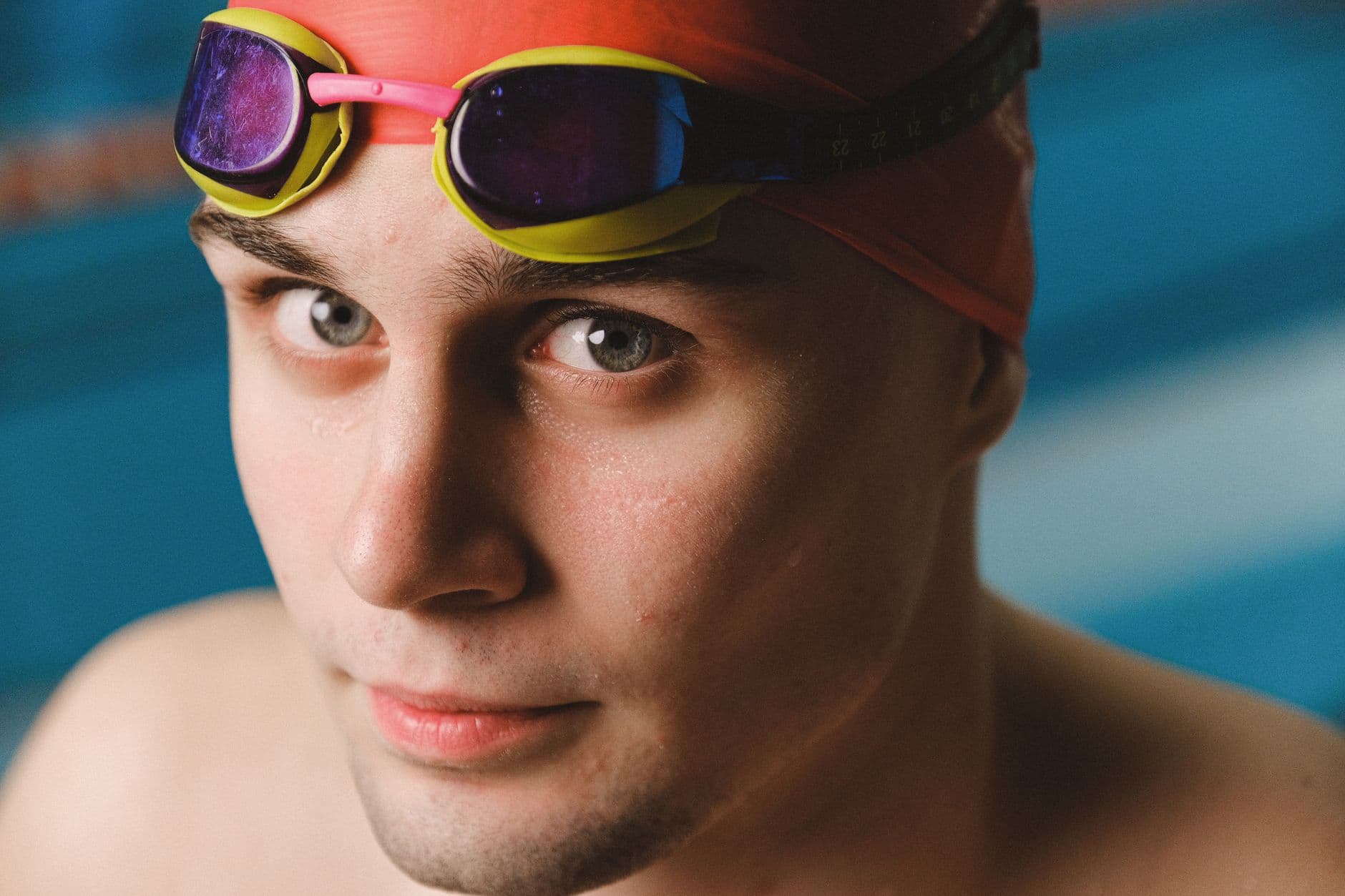
Swimmers wear two caps because the second one covers the goggle straps. The inner cap grips the head and gives the straps something to sit on; the outer cap pins them down and presents a smoother surface to the water. That is the whole trick, and it takes about four seconds to do.
What almost nobody writing about this mentions is that the arrangement is not a clever workaround that officials tolerate. It is written into the rulebook by number, with an explicit upper limit, and the cap itself goes through the same approval process as a racing suit. Below is what the rules actually say, what the measurements actually show, and the honest gap where the evidence runs out.
The short answer, and the number nobody quotes
Swimmers double up for two reasons that stack: goggle security and surface smoothness. A goggle strap sitting on bare hair or on bare silicone can creep during the impact of a dive or a turn, and goggles that fill on entry cost more than any cap ever saved. Tucking the strap between two caps is the cheapest insurance in the sport.
The second reason is the one people get wrong. It is not that silicone is magically faster than latex. It is that a cap which is pulled on over a strap, or stretched over a lumpy head of hair, develops wrinkles — and wrinkles are the thing that has actually been measured to cost drag. The outer cap exists to be the layer with no wrinkles in it.
And the number nobody quotes is two. Not "as many as you like". The limit is explicit in both the international and the American rulebooks, which we will get to, and it is the reason you will never see an athlete walk out behind the blocks wearing three.
What the second cap is physically doing
Think of the head as the leading edge of the body. During the glide off the start and off every wall, the head meets undisturbed water first and sets up the flow over everything behind it. Anything that trips that flow — a fold of latex, a strap standing proud, a seam running the wrong way — is a disturbance at the worst possible place.
The inner cap's job is grip. Latex clings to a wet scalp and does not slide. The outer cap's job is surface. Silicone is thicker, slipperier and holds its shape, and because it is pulled on last it goes over the straps rather than under them. U.S. Masters Swimming describes exactly this layering in its own guidance for members: a latex cap as the inner layer provides a sticky surface for goggles to cling to, and a silicone cap as the outer layer reduces resistance.
There is a second, duller benefit that distance and open water swimmers care about more than sprinters: two layers hold a little more heat, and they make a lost cap much less likely in a mass start where somebody's hand will find your head sooner or later.
What has actually been measured, and what has not
Three studies are worth knowing about, and none of them are from a blog.
Gatta, Zamparo and Cortesi towed sixteen swimmers at 1.5, 1.7 and 1.9 m/s wearing three different caps: a lycra cap, a standard silicone cap, and a seamless silicone "helmet" cap. Passive drag was 5 to 6.5% lower in the seamless helmet cap than in the standard silicone one across all speeds. The finding that gets left out of every summary is the other one: between the lycra and the standard silicone cap there was no measurable difference at any speed. The variable was not the material. It was the seams and the wrinkles.
The same group followed it up with ten swimmers towed at 60 cm depth, comparing a smooth helmet cap, a dimpled one and a deliberately wrinkled one. Smooth versus dimpled: no difference. Wrinkled versus dimpled, with the arms alongside the body: the wrinkled cap showed a 4.4% larger speed-specific drag coefficient. Wrinkles cost; texture did not.
And here is the gap, stated plainly because the rest of the internet will not state it: no published study has measured one cap against two caps. What has been measured is the mechanism — that wrinkles cost drag and that a strap-free surface is smoother. The size of the benefit of the second cap itself is an inference, not a number. Anyone quoting you a percentage for "two caps versus one" made it up.
One related finding is worth a sentence because it surprises people. A computational fluid dynamics study scanned an elite swimmer's head with and without goggles and simulated flow at 2 m/s. Total drag was highest with no goggles at all (12.99 N) and lowest with low-profile Swedish goggles (11.83 N). Goggles, properly fitted, appear to tidy the flow around the eye socket rather than disturb it. That is one scanned swimmer in a simulation, not a pool full of people, so treat it as a hint rather than a fact.
The rule: one cap or two, and never three
This is the part no article in the search results touches, and it is the part that settles the question.
The World Aquatics Competition Regulations in force from February 2026 say it twice, once for pool swimming and once for open water: "An Athlete may wear one (1) or two (2) caps." That is Article 7.7.9 for swimming and Article 7.8.6 for open water. Both passages add the same condition — if two caps are worn, both must comply with the identification requirements of that article. In practice that is why national team swimmers who double up wear two identical team caps rather than a club cap under a team one.
USA Swimming words it from the other direction in rule 102.8.1A: swimwear shall include only a swimsuit, cap and goggles, and "it is not permissible to wear more than two (2) caps". The open water section repeats it at 701.4.1 — a maximum of two caps may be used — and lists violating the swimwear rules among the things that get a swimmer disqualified.
It is not an American quirk either. Masters Swimming Australia's swimwear rules carry the same clause in its own words: swimwear includes goggles and caps, up to two caps may be worn. Three federations, three documents, one number.
What makes a cap legal in the first place
Since both caps have to be legal, it is worth knowing what legal means. Article 6.10 of the same regulations is short and surprisingly strict:
- The cap must be an independent item, not attached to or continuous with the suit, wetsuit or goggles — explicitly, no "hood" or "mask" effect.
- Its shape must follow the natural form of the head.
- The outer surface must not include artificial shaping such as rigs or spoilers.
- It must not be made from hard material. No helmets.
- Thickness must not exceed 2 mm at any location.
- Seams, if there are any, must be functional and must not create shapes or structures on the outer surface.
Read those together and the design philosophy is obvious: a cap is allowed to cover your head and nothing more. It may not be shaped to reduce drag, and it may not seal. The 2 mm ceiling is also why a thick neoprene thermal cap of the kind cold-water swimmers wear is not a legal cap at a World Aquatics event — useful to know before you travel to a cold race and discover it at the briefing. If you are heading into cold water, the piece of kit the rules actually change is the wetsuit, not the cap.
The cap is approved equipment, not an accessory
Here is the detail that reframes the whole topic. In these regulations, "Swimwear" is a defined term, and the definition reads: any swimsuit, wetsuit, swim cap, and goggles. Article 6.5 then requires athletes in swimming and open water competitions to use swimwear that both complies with Article 6 and is on the List of Approved Swimwear at the time of the competition.
So the cap goes through homologation, exactly like a racing suit does. World Aquatics' own approved-swimwear page sets out the process: one physical sample per model is posted to the office in Lausanne with a signed application, and the contribution fee is 750 EUR for each model of swim cap — against 1,000 EUR for a swimsuit or wetsuit. That is a real cost a manufacturer carries for every cap design it wants used at the top level, and it is the reason the racing cap range in any brand's catalogue is narrower than the training range.
If you have read our piece on whether tech suits are worth it, this will look familiar: the same approval machinery, the same published list, the same principle that nothing you wear may aid speed, buoyancy or endurance.
Open water: the cap you must start in
In the pool, a cap is optional. In open water under World Aquatics rules it is not. Part Three of the regulations says that in water at 18.0 °C or above an athlete must start the race wearing one or two caps, and the clause for water below 18.0 °C — where a wetsuit becomes compulsory — repeats the cap requirement word for word.
The enforcement is just as specific. The open water infraction table lists two separate red-flag disqualifications: starting without an approved swim cap, and — in its own row — using two swim caps where both are not approved. Somebody sat down and wrote a disqualification code for the double-cap case, which tells you how routine the practice is.
The reason behind the rule is not hydrodynamics, it is being seen. A bright cap is the one part of a swimmer that a safety kayaker can track from thirty metres away. If open water is new to you, that and a few other things nobody warns you about are covered in your first open water swim, and the skill that keeps you on course is in sighting.
Do swim caps keep your hair dry?
No. Not latex, not silicone, not the expensive one, and the regulations tell you why: a competition cap is forbidden from producing a hood or mask effect and must be an independent item that follows the natural shape of the head. By design it is an open-bottomed sleeve, not a seal. Water goes in at the hairline and at the nape, and the longer you swim the more of it gets in.
What a cap does achieve is a real reduction in exposure and a lot less tangling. A cap keeps most of the water off most of your hair for most of the swim, and it keeps long hair out of your face and out of your stroke. That is worth having. It is not dryness.
Notice also what the people who coach this assume. U.S. Masters Swimming's own advice on getting a cap on begins with wet your hair first, because dry hair grips latex and makes the cap hard to pull on. The federation's instructions take wet hair as the starting condition. Nobody in the sport thinks caps keep hair dry.
If protecting your hair is the actual goal, the cap is one layer of a routine and not the important one. The sequence that is supported by evidence — soak with clean water first, conditioner or a light oil underneath, cap over the top, rinse and wash within minutes of getting out — is set out with its sources in what chlorine does to hair and skin.
Latex, silicone, lycra and neoprene
Four materials, four jobs, and the marketing blurs them.
Latex is thin, cheap and grippy. It clings to the scalp and does not slide, which is what makes it the right inner layer. It is also the one that tears, the one that pulls hair, and the one to avoid if there is any chance of a latex allergy in the household.
Silicone is thicker, more durable, easier to pull on and off, and slides more readily — which is both why it is comfortable as a single cap and why it can creep backwards off a smooth head. It is the standard outer layer.
Lycra or polyester caps are fabric. They are the kindest to hair and the easiest to wear, they soak through completely, and on the measured evidence above they are no slower than a silicone cap in a straight comparison. They are a perfectly sensible choice for lap swimming, and a poor one for a race, where the seams are the problem.
Neoprene is for cold water and is a different product entirely — thick, insulating, usually chin-strapped, and over the 2 mm limit that makes a cap legal in competition.
How to put a cap on so it stays on
Most caps that come off in a race were put on badly, not chosen badly. The points U.S. Masters Swimming makes are specific and easy to check:
- Line up the seam. It should run front to back, from the middle of your forehead to the nape of your neck — not ear to ear. A seam across the crown is a ridge sitting in the flow.
- Sit it low enough. The front edge belongs in the middle of your forehead. A cap perched too high is the one that gets peeled off by the water on entry.
- Wet your hair first, or wet the cap, depending on the material. Some swimmers use a little conditioner for the same reason plus the hair protection.
- Tie long hair back before you start, rather than stuffing it into the bottom of the cap afterwards.
- Stretch a new cap a few times with your hands before the first attempt, and if front-to-back never works for you, try stretching it at the base of the head and going back to front.
- Dry it and dust it with talc after use. It stops the cap sticking to itself, discourages bacteria and makes it last.
Which cap goes on first, and where the goggles go
The order is: inner cap, goggles, outer cap. Latex underneath, straps on top of it, silicone over everything. If you own two silicone caps, it still works — the grip is just slightly worse.
Two things to get right. First, set the goggles properly before the outer cap goes on, because once that cap is down you cannot adjust the strap without starting again. Second, do not let the second cap become a substitute for a goggle that fits: if the seal is wrong, the cap will keep the strap in place while water comes in anyway. Fit, suction and the fogging problem are dealt with in goggles that fog.
If you are doing this for racing, practise it in training first. A diving entry is the moment the arrangement is tested, and that is covered in how to dive into a pool — including the depth question that decides whether you should be diving at all.
Should you wear two caps?
If you race, yes, on balance — the cost is four seconds and a spare cap, and the downside risk it removes (goggles full of water at the 15 m mark) is far larger than any drag it saves. Masters swimmers and age-groupers get the same benefit as anyone.
If you swim laps for fitness, no. There is nothing to protect against: no dive, no mass start, no wall taken at speed with your face down. One cap that fits is enough, and a fabric one is kinder to your hair.
For triathlon and open water, the decision is usually made for you by the race rules, which often issue a numbered cap you must wear outermost. A second cap underneath for warmth is common and legal under the one-or-two rule.
Before you spend anything chasing hundredths, be honest about the scale. The measured effects above are a few percent of passive drag during a glide, not a few percent off your time. If you want to see what a realistic change is actually worth over your distance, put your splits into the pace calculator and look at what a tenth of a second per length does across a 200. Then compare that with what fixing your streamline would do.
What two caps will not fix
A second cap is not safety equipment and it is not medical equipment, and two claims float around that are worth correcting.
It will not keep water out of your ears. A cap pulled over the ears appears on prevention lists and is a reasonable thing to try, but the evidence behind every ear-water remedy is thinner than people assume, and a second cap adds nothing to it. What is and is not supported is in swimmer's ear.
It will not substitute for the rest of a fast streamline, either. The head is the leading edge, but a cap can only tidy the surface of a head that is already in the right position. Our piece on why swimmers shave makes the same point about the body: the measurable gains from surface treatments are real and small, and they sit on top of technique rather than replacing it.
One safety note. Cold water is the hazard that a warm cap can disguise: two caps, or a neoprene one, will make the first minutes feel manageable without changing how fast you lose core heat. Never swim alone in open water, never treat a cap as flotation, and if a swim leaves you shivering, confused or clumsy, get out and get warm. If swimming reliably brings on breathlessness, chest tightness or ear pain, that is a question for a clinician, not for a kit decision.
The rest of the stroke work that these few percent sit on top of is collected in our technique guides.
Frequently asked questions
Why do Olympic swimmers wear two caps?
To hold the goggle straps and to present a wrinkle-free surface. The inner cap, usually latex, grips the head and gives the straps something to sit on. The outer silicone cap goes over the straps and stays smooth. Wrinkles have been measured to add drag at the head, which is the leading edge of the body.
Is it legal to wear two swim caps?
Yes, and it is written into the rules. World Aquatics states that an athlete may wear one or two caps, for both pool and open water, provided both comply with the identification requirements. USA Swimming puts the same limit the other way around: it is not permissible to wear more than two caps.
Can you wear three swim caps?
Not in competition. Two is the explicit maximum in the World Aquatics regulations, in the USA Swimming rulebook and in Masters Swimming Australia's swimwear rules. In open water there is a specific disqualification for using two caps where both are not approved, so officials check this routinely.
Do swim caps keep your hair dry?
No cap keeps hair dry. The regulations forbid a competition cap from producing a hood or mask effect, so it is an open-bottomed sleeve rather than a seal, and water enters at the hairline and nape. A cap reduces exposure and stops tangling, which is worth having, but it is not waterproofing.
Is a silicone cap faster than a latex one?
Not on the evidence. When sixteen swimmers were towed at three speeds, passive drag showed no measurable difference between a lycra cap and a standard silicone cap. What did differ was a seamless helmet cap, 5 to 6.5% lower than standard silicone. The variable is seams and wrinkles, not the material itself.
Which cap goes on first?
Latex first, goggles second, silicone on top. The latex inner layer grips the scalp so the goggle straps do not creep, and the silicone outer layer covers the straps and holds its shape. Set the goggles before the outer cap goes on, because you cannot adjust the strap afterwards without starting again.
Sources
- Competition Regulations, in force from February 2026 — Part One Art. 6.5, 6.10, 7.7.9 and 7.8.6; Part Three Art. 10.1-10.2 and the open water infraction table; definition 2.146 — World Aquatics
- Approved Swimwear — submission procedure, sample delivery and contribution fees (750 EUR per model of swim cap) — World Aquatics
- 2026 Rules and Regulations — 102.8.1A (swimwear design, not more than two caps) and 701.4.1 (open water) — USA Swimming
- Swimwear General Rules GR16 (2024) — swimwear includes goggles and caps, up to two caps may be worn — Masters Swimming Australia
- Gatta G., Zamparo P., Cortesi M. (2013). Effect of swim cap model on passive drag — Journal of Strength and Conditioning Research
- Gatta G., Cortesi M., Zamparo P. (2015). Effect of swim cap surface roughness on passive drag — Journal of Strength and Conditioning Research
- Marinho D.A. et al. (2021). Numerical simulations of a swimmer's head and cap wearing different types of goggles — Sports Biomechanics
- How Do I Put and Keep My Swim Cap On? — U.S. Masters Swimming
Read next

What age should a child start swim lessons?
The official answer is the first birthday for lessons, but babies can be in water long before that. Here is where each health body draws the line, and why it matters.
Why swimmers get disqualified: the calls officials make
A disqualification is a procedure, not an opinion. Who is allowed to call one, what goes on the slip, what the code means, and how it can be challenged.

Can you wear contact lenses swimming? What the eye bodies actually say
The FDA, the CDC and UK and Australian eye bodies all say take your lenses out before you swim — and the reason is not chlorine. Here is what they are worried about.
SwimFast is an independent publication. We are not a swim school, a coaching service or a governing body, and nothing here is medical advice. Training paces and test protocols are cited from the published research or federation documents linked on each page. Never swim alone, never attempt breath-hold work without supervision, and check with a doctor before starting a new training programme.