How to float on your back when your legs keep sinking
Floating is decided by lung volume and balance, not effort. The arithmetic behind a full breath, why your legs rotate down, and how to build a one-minute float.
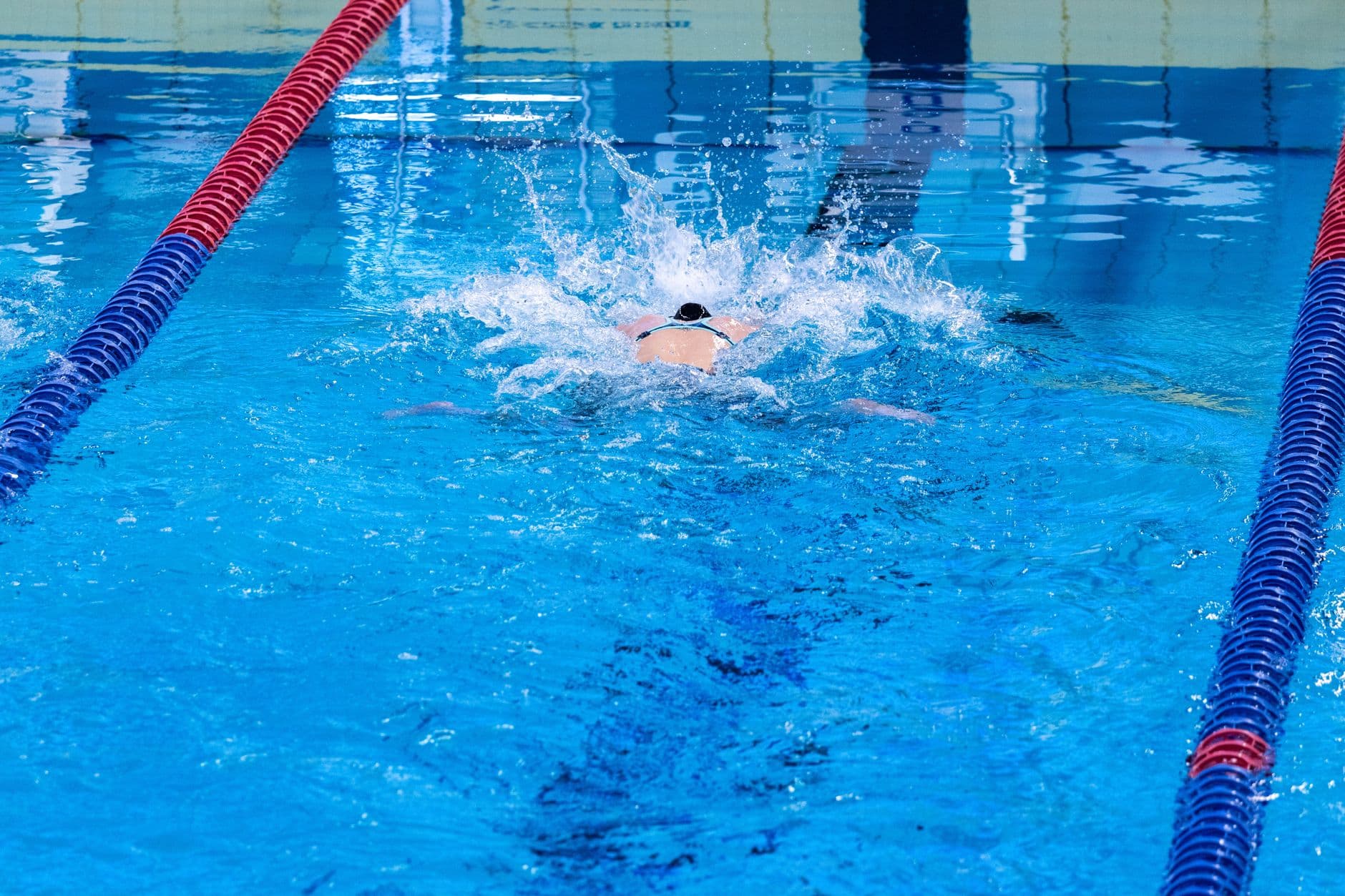
Floating on your back is the one swimming skill that does not respond to effort. Everything else in the pool gets better when you try harder; this one gets worse. If you have lain back, felt your legs swing down and ended up hanging upright with water lapping at your chin, nothing is wrong with your body and the answer is not a stronger core.
Three things decide the float: where your body carries its volume, how much air is in your chest, and what your head is doing. Two of those you can change in the next five minutes. This guide takes them in order, shows the arithmetic instead of asserting it, and finishes with the version of the float that lifeboat crews teach for the day you end up in cold water without planning to.
The short answer
Take a full breath and keep your lungs toward the top of their range. Tilt your head back until your ears are under the surface and you are looking straight up. Push your chest and hips up toward the sky, spread your arms out wide at shoulder height, and let your legs do whatever they want. Then breathe — small top-up breaths, never a held one.
That is the whole technique. The part most people get wrong is the last instruction. They lift their chin to check on their feet, which drops the hips; or they blow all their air out, which removes several kilograms of lift; or they fight the legs, which tenses everything that needs to be loose.
If your legs sink and your face stays clear, you are floating. The RNLI, which runs the lifeboats around Britain and Ireland, puts it in its own instructions: your legs may sink, and that is fine, because everyone floats differently. A float at forty-five degrees keeps you breathing just as well as a flat one.
Can everyone float on their back?
Almost everyone can float with their lungs full; far fewer float flat. Human tissue sits on both sides of water's density, so a deep breath is usually enough to keep the face clear. But if your chest stays up while your legs hang down, you have not failed to float — that is a float, in the shape your body makes.
The honest version of the answer has two parts. Whether you float at all is mostly out of your hands: it depends on body composition, skeletal mass and lung size. Whether you float horizontally is a separate question, and it depends on balance — the relationship between two points inside your body that we get to below. People conflate the two and conclude they are "a sinker" when what they actually have is a normal body and a tipping problem.
What decides it: the density arithmetic
Fresh water weighs almost exactly 1 gram per milliliter — 0.9998395 g/ml at 4 °C, according to the U.S. Geological Survey. Anything denser than that sinks; anything less dense floats. Your body is a mixture of tissues on both sides of the line.
The two-compartment models used in body composition labs assume fat mass has a density of 0.9007 g/cm³ and fat-free mass — muscle, bone, organs, water — a density of 1.1 g/cm³. Fat floats. Muscle and bone do not. Whole-body density lands somewhere between the two, which for most people means close enough to water that a few liters of air decide the outcome.
That is why the people who struggle most are often the fittest ones in the lane: a lean, muscular, heavy-boned swimmer sits lower in the water than a softer body of the same weight, and no amount of technique changes the tissue. It also explains why the same person floats differently at 25 and at 55. If your legs sink while you swim as well as while you float, the sinking-legs problem in freestyle has its own fixes, and they are mostly about drag rather than buoyancy.
Your lungs are the biggest lever you own
The air in your chest is the one term in the equation you control, and it is a big one. The reference equations used in hydrostatic weighing predict total lung capacity and residual volume — a chest as full as it goes, and a chest emptied as far as it will empty — from height and age:
| Swimmer | Full lungs (TLC) | Emptied lungs (RV) | The air in between | Lift it is worth |
|---|---|---|---|---|
| Man, 1.80 m (5 ft 11 in), 40 years | 7.3 L | 2.0 L | 5.3 L | ≈ 5.3 kg (11.7 lb) |
| Woman, 1.65 m (5 ft 5 in), 40 years | 5.1 L | 1.6 L | 3.5 L | ≈ 3.5 kg (7.7 lb) |
The formulas behind those rows are TLC = 7.99 × height in meters − 7.08 for men and 6.60 × height − 5.79 for women, with residual volume predicted from height and age. Because a liter of fresh water weighs about a kilogram, every liter of extra air in your chest is about a kilogram of upward force, for free. Nothing else available to a beginner comes close to five kilograms.
How large that term is shows up in the measurement labs too. In a 2024 study of 122 people, estimating body fat by underwater weighing shifted by roughly five percentage points depending on whether the lungs were full or emptied. Same body, same water, same scale — different amount of air.
Full lungs, not held lungs. Keeping your lungs toward the top of their range means breathing shallowly around a full chest: a small exhale, a small inhale, nothing dramatic. Never hold your breath to stay up, and never take a string of deep breaths beforehand to "load up" — hyperventilating before any water skill is how people black out without warning. If breathing on your back feels impossible, work on breathing while swimming first, in shallow water, with someone watching.
Why your legs sink even when your chest floats
Here is the part nobody explains. Your weight acts through one point, the center of mass. The upward push of the water acts through a different point, the center of buoyancy — the center of the volume you displace. Because your lungs are a large air-filled space high in your torso, your center of buoyancy sits closer to your head than your center of mass does. Two opposite forces at two different points make a couple, and a couple makes you rotate: chest up, legs down, until you are hanging vertically.
The gap has been measured. McLean and Hinrichs, working with 31 collegiate swimmers at Arizona State, found the distance between the center of buoyancy and the center of mass averaged 0.79 cm in the men and 0.16 cm in the women, with both points sitting at about 60 percent of body height measured up from the soles. The amount and the distribution of body fat together accounted for a quarter to nearly a third of the variance in that gap.
Under a centimeter sounds trivial. It is not, because the forces either side of it are your entire body weight: a small lever arm with a large force on each end is still a persistent rotation, and you feel it as your feet drifting down a few seconds after you lie back.
Two honest limits on that study. The subjects were collegiate swimmers, leaner than the general population, so the numbers describe the mechanism rather than your body specifically. And the same paper found that the gap did not explain how fast those swimmers kicked — so if you are slow, buoyancy is not your alibi.
The fix is leverage, not effort
You cannot move your center of mass much. You can move your center of buoyancy, and you can change which way the rotation points. Four adjustments, in order of how much they give you:
- Head back, ears underwater. This is the first instruction in the RNLI's float guidance and it is first for a reason. Tucking the chin to look down the body sends the hips straight to the bottom. Look up, let the water close over your ears, and accept that the horizon disappears.
- Arms out wide or overhead. Spreading the arms improves stability; taking them overhead moves displaced volume toward your head, which is exactly the lever McLean and Hinrichs examined in a follow-up study on arm position, lung volume and the center of buoyancy. Hands by your sides is the worst of the options.
- Ribs and hips up. Think of lying back over a barrel: chest pressed toward the surface, pelvis following it up, lower back long rather than arched hard.
- Legs loose, knees soft. A rigid, pointed, clenched leg is a lever hanging off your hips. Soften the knees slightly and let the feet sit wherever they sit.
How to get there, step by step
Do this in water about chest deep, in a pool, with someone standing next to you who can help you up. Not alone, and not in open water the first time.
- Stand with your back to the wall, arms resting along the edge, and get used to letting your head tip back until your ears are under.
- Take a full breath. Push your hips forward and up until your feet leave the bottom, keeping your hands on the edge.
- Stay there for ten seconds, breathing in small sips around a full chest. Notice that nothing bad happens when your ears fill with water.
- Let go of the wall with one hand, then both, and spread your arms out wide at shoulder height.
- Count to ten again. If your legs drop, let them. Keep the head back — this is the moment people lift their chin to look.
- To stand up: pull your knees to your chest, sweep your arms forward and down, let the head come up last, and plant your feet.
- Repeat until lying back is boring. Then build the clock: ten seconds, thirty, a minute.
- Only once a relaxed minute is easy, move to water over your head, still with someone watching.
The four mistakes that sink a float
- Lifting the chin. It feels like checking your position. It is a seesaw: head up, hips down.
- Emptying the chest. Long full exhales throw away the kilograms we just counted. Breathe at the top of the range, not the bottom.
- Bracing. Clenched glutes and a hard-arched back shorten the body and raise the heart rate. Tension and floating are opposites.
- Pressing down with the hands. Pushing water downward lifts your hands, not your body, and then your hands have to come back down again. Sweep outward and inward along the surface instead, palms flat, as if smoothing a sheet.
What to do when your legs still sink
Some bodies will not go flat, and the answer is not to keep trying harder — it is to use the float that your body does make.
Let the legs hang and float on the diagonal, head back, arms spread, face clear. Add a slow, small flutter from the hips if the feet drift so low that your mouth starts to dip, or scull gently with the hands near the surface. If even that feels like work, a vertical float with the head tipped back and the hands sculling is still a resting position — and it costs far less than treading water, which is work you do when you need your head high or your hands free.
A pull buoy between the thighs or a woggle under the knees will show you what a flat float feels like, which is useful as a reference. Just do not confuse the borrowed buoyancy with your own: the aim is to need less of it each week, not to practice with it forever.
Adults and children do not float the same
This section is coaching consensus rather than measurement, and it is worth saying so. Children usually learn the back float faster than adults, and not because they are braver — they are shorter, so the lever between the hips and the feet is smaller, and they carry less of the dense muscle mass that pulls an adult's legs down. They also have less to unlearn.
Adults arrive with tension, a history, and in many cases a bad memory of water. If lying back with your ears submerged brings on real anxiety, the float is not the first problem to solve — start with getting comfortable in the water again, then follow the progression in our guide to learning to swim as an adult. Either way, a child practicing floats needs an adult within arm's reach, every time; the Red Cross puts close supervision of children and weak swimmers on the same list as the swimming skills themselves.
Salt water, cold water and open water change the float
Water with salt dissolved in it is denser than fresh water, as the USGS explains, so the same body displaces less of it to stay up: you float higher in the sea than in a pool. That cuts both ways. A float you have only ever done at the coast may sit lower than you expect on your first pool attempt, and a float you have only practiced in a pool will feel generous in the sea.
Cold is the bigger variable. The RNLI counts anything below 15 °C (59 °F) as cold enough to cause cold water shock, which takes away control of your breathing and movement at the worst possible moment; it notes that the average sea temperature around Britain and Ireland is about 12 °C (54 °F), and that inland lakes and rivers run colder still, even in summer. Its advice is to take a minute, because the initial effects pass in under a minute, and to float while they do rather than trying to swim.
If you are heading for open water, the float belongs in your plan rather than in your emergencies: read our guides to your first open-water swim and to whether you need a wetsuit, remembering that neoprene adds buoyancy and will flatter your float.
Float to Live: the version that matters if you fall in
The RNLI's public guidance is five steps, and it is the shortest useful list in water safety: tilt your head back and submerge your ears; relax and control your breathing; move your hands and legs to help you stay afloat; expect your legs to sink, because everyone floats differently; and find your own float by practicing somewhere supervised. The charity says the advice has helped save the lives of more than 50 people — children caught in rip currents, runners who went into canals, fishermen off the side of a boat.
Read that list again next to the technique above and notice how much they agree. The float you practice on a Tuesday evening in a warm pool is the same skill, minus the adrenaline. That is the argument for making it dull on purpose.
How to know it is working
Use the standard the Red Cross uses. Its water competency list has five swimming skills: enter water over your head and return to the surface, float or tread water for at least one minute, turn over and turn around in the water, swim at least 25 yards, and exit the water — performed in each type of water you actually use, because a pool and a lake are not the same test.
A minute of relaxed back floating, with your breathing calm enough that you could speak, is the marker worth chasing. Not a minute of grim survival: a minute you could extend if you had to. After that, turning over from front to back and back again is the skill that makes the float usable mid-swim — the same control that lets you swim backstroke without drifting.
Once floating is a non-event and you are swimming lengths, the measuring moves from seconds to pace: the rest of our technique guides and the pace calculator pick up from there.
When to ask a professional
Get a qualified instructor if the float brings on panic rather than discomfort, if you cannot keep your face clear even with full lungs and a spotter, or if you have inhaled water more than once while trying. Those are teaching problems with known solutions, and an hour of lessons beats a month of guessing.
See a doctor before you keep practicing if floating leaves you dizzy or breathless, if you get ear pain or hearing changes after submerging your ears, or if you have a heart, lung, seizure or balance condition and nobody has cleared you for swimming. And the rule that does not bend: never practice floating alone. Swim where there are lifeguards, and tell someone what you are about to do.
Frequently asked questions
Can everyone float on their back?
Almost everyone can float with full lungs, but not everyone floats flat. Body composition, bone mass and lung size decide how high you sit, and none of them respond to effort. If your chest stays up and your legs hang down, that is still a float — your face is clear and you can breathe, which is the whole point.
Why do my legs sink when I float on my back?
Because the upward push of the water acts through your chest, where your lungs are, while your weight acts through a point lower down. Those two forces at two points rotate you, chest up and legs down. Measured in collegiate swimmers, the gap averaged 0.79 cm in men and 0.16 cm in women — small, but acting on your whole body weight.
How do you float on your back for beginners?
Stand chest deep with your back to the wall, hands on the edge. Take a full breath, tip your head back until your ears are under, and push your hips up until your feet leave the bottom. Breathe in small sips around a full chest, then let go of the wall and spread your arms wide. Build from ten seconds to a minute, always with someone next to you.
Does body fat make it easier to float?
Yes, and the reason is density. Body composition models treat fat mass as 0.9007 g/cm³ and fat-free mass as 1.1 g/cm³, while fresh water is about 1.0. Fat floats, muscle and bone do not, so a lean muscular swimmer sits lower than a softer body of the same weight. It is physics, not technique.
How long should I be able to float on my back?
One minute is the number to aim at. The American Red Cross includes floating or treading water for at least a minute among the five swimming skills that make up water competency, alongside entering deep water, turning over, swimming 25 yards and getting out — and it expects those skills in every type of water you use.
Sources
- Water Safety: water competency and the five swimming skills — American Red Cross
- Float to Live — Royal National Lifeboat Institution (RNLI)
- McLean S.P., Hinrichs R.N. (1998). Sex differences in the centre of buoyancy location of competitive swimmers — Journal of Sports Sciences 16(4):373-83
- McLean S.P., Hinrichs R.N. (2000). Influence of arm position and lung volume on the center of buoyancy of competitive swimmers — Research Quarterly for Exercise and Sport 71(2):182-9
- White E. et al. (2024). A more comfortable method for hydrostatic weighing: head above water at total lung capacity — Journal of Functional Morphology and Kinesiology 9(1):41
- Magee M.K. et al. (2025). A new estimation equation to assess body composition in an athletic population — Journal of the International Society of Sports Nutrition
- Water Density (Water Science School) — U.S. Geological Survey
Read next
The breaststroke pullout: the legal sequence, in order
One arm stroke, one dolphin kick, one breaststroke kick — and a rule that ends the pullout with a stroke, not a 15 metre mark. The sequence, and what gets called.
How to tread water without getting tired
Treading water has a measured energy cost, and the technique everyone recommends is the one that tires beginners fastest. What the research actually found.
Chlorine, hair and skin: what it does and what actually helps
What chlorinated pool water really does to hair and skin, why the green tint is copper rather than chlorine, and which protective steps have evidence behind them.
SwimFast is an independent publication. We are not a swim school, a coaching service or a governing body, and nothing here is medical advice. Training paces and test protocols are cited from the published research or federation documents linked on each page. Never swim alone, never attempt breath-hold work without supervision, and check with a doctor before starting a new training programme.