How many laps is a mile? And why the swimming mile is not a mile
A mile is 70.4 lengths of a 25-yard pool and 64.4 of a 25-metre pool. The exact count for every pool, and why the race called the mile is 6% shorter.
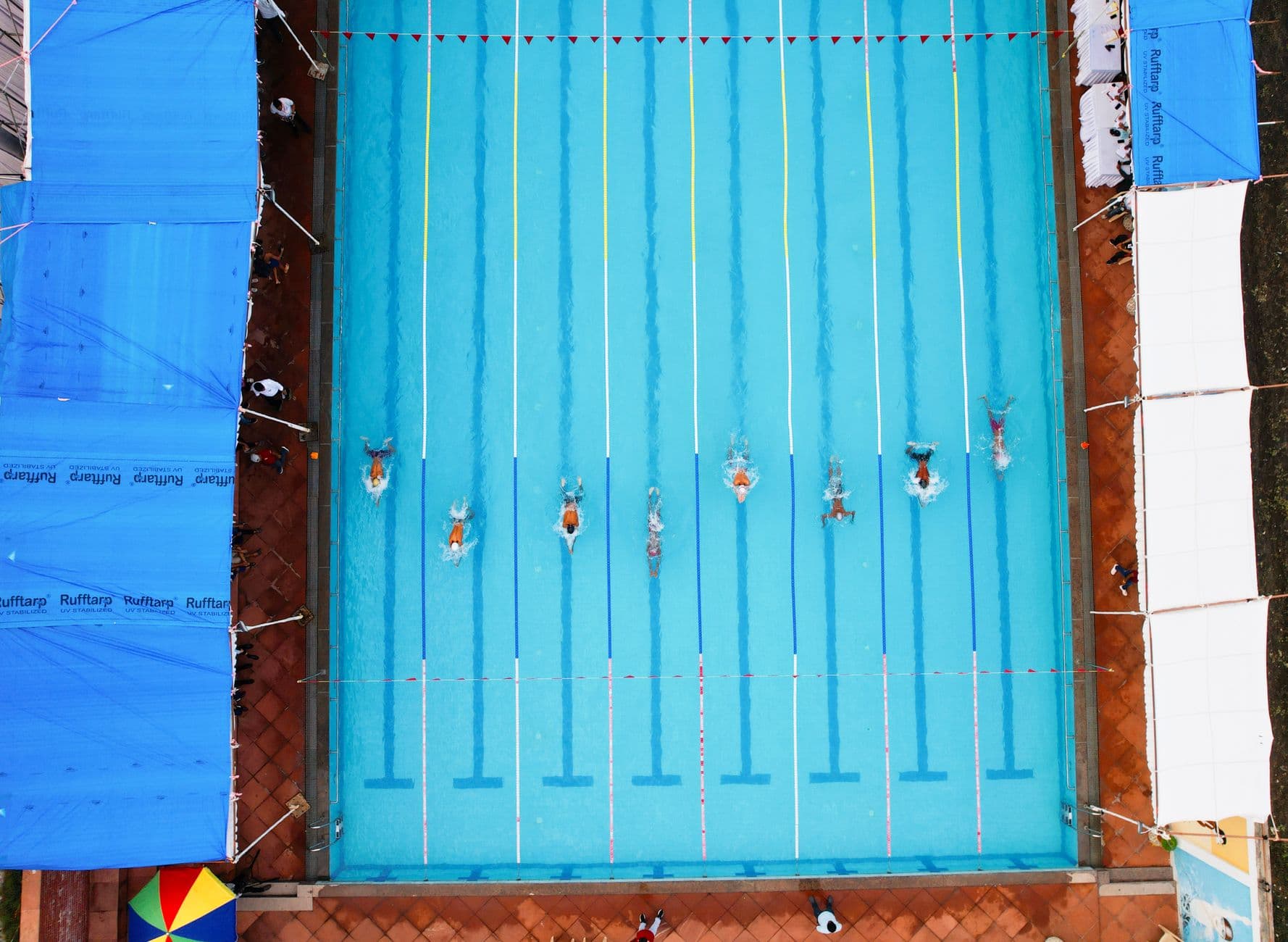
In a 25-yard pool, a mile is 70.4 lengths. In a 25-metre pool it is 64.4. In a 50-metre pool it is 32.2. Those fractions are not sloppy rounding — they are the whole reason this question keeps getting asked, because no pool divides neatly into a mile.
Then there is the second problem. The race that swimmers call "the mile" is not a mile. It is 1,650 yards in a yards pool and 1,500 metres in a metre pool, and both land about six per cent short of the real distance. So "how many laps is a mile" has two different correct answers depending on whether you want the distance or the race — plus a third question underneath both, which is whether the people around you count a lap as one length or two. This page separates the three and gives you a number you can actually use on the wall.
The answer by pool length, for a true mile
A mile is 1,760 yards, or 1,609.344 metres. Divide that by the pool you are standing in and you get 70.4 lengths of a 25-yard pool, 64.4 lengths of a 25-metre pool, and 32.2 lengths of a 50-metre pool. Those conversions are exact, not approximate, because the international yard is defined as precisely 0.9144 metres.
Pool lengths are not approximate either, which is what makes the arithmetic trustworthy. USA Swimming defines a racing course as 50.00 metres long course, and 25.00 yards or 25.00 metres short course. World Aquatics requires 50.000 metres or 25.000 metres between the touch panels, with a tolerance of plus 10 millimetres and minus nothing. So when you divide, you are dividing by a real number.
The trap is mixing units. A 25-yard length is 22.86 metres — nearly two and a half metres shorter than a 25-metre length. Over sixty-odd lengths that gap compounds into more than a hundred metres, which is why you cannot borrow a lap count from a yards pool and use it in a metre pool. If you need to move a time or a distance between courses, the time converter does it properly, and short course versus long course explains why the two are treated as separate sports for record purposes.
Lap or length? Settle this before you count anything
Half the confusion in every answer you will read online is terminology, and it doubles or halves the number. A length is unambiguous: one pool, wall to wall. A lap is not, and even the governing bodies use it differently.
World Aquatics uses lap to mean one length. Article 2.8.6 of its Competition Regulations instructs each inspector of turns, in the 400, 800 and 1,500 freestyle, to "record the number of laps completed" by the swimmer, with the remaining count shown on lap cards that display odd numbers at the turning end. The numbers can only be odd at the far end if one lap is one length — after one, three or five lengths you are at the opposite wall. Article 2.8.7 reinforces it: the warning signal comes when the swimmer has "two laps plus five metres" left, which in a 50-metre pool is 105 metres, not 210.
U.S. Masters Swimming, in its own article on this exact question, goes the other way and describes the 1,650 as "66 lengths, or 33 laps" — one lap being a round trip, as it is on a running track.
The practical rule. On an American pool deck, and in every lap-counting watch, a lap means one length. That is the convention this page uses throughout. If you adopt the round-trip meaning instead, halve every figure here — and if you take a round-trip count and swim it as lengths, you will swim two miles instead of one.
Why the race called "the mile" is not a mile
There is no mile in competitive pool swimming. The long freestyle event is 1,650 yards in a yards pool and 1,500 metres in a metre pool, and USA Swimming's event list pairs them as alternatives for the same slot: rule 102.1.1 lists "1500m/1650y freestyle" for senior championships, alongside "400m/500y" and "800m/1000y". Nothing in that list is a mile.
World Aquatics is even blunter about it. Its recognised freestyle events are 50, 100, 200, 400, 800 and 1,500 metres, in both 25-metre and 50-metre pools, and the word "mile" does not appear anywhere in the Competition Regulations. The only miles in USA Swimming's rulebook are in the long-distance records section, rule 703.2, which keeps records at five-mile increments — 5, 10, 15 miles and up, in a 25-yard pool. One mile is not a recognised distance in either book.
In lengths, the races are clean where the mile is not. The 1,650 is exactly 66 lengths of a 25-yard pool. The 1,500 is exactly 60 lengths of a 25-metre pool or 30 lengths of a 50-metre pool. That tidiness is the real reason these distances exist — they fit the pool, and a mile does not. For what those races should take, good mile swim times has the bands by age and standard.
The part that surprises people: the yard "mile" is the longer race
Because 1,650 yards is spoken of as the short-course equivalent of the 1,500, most swimmers assume the two are the same swim in different units. They are not. 1,650 yards is 1,508.76 metres — 8.76 metres longer than a 1,500. The yards version is the longer race, by about a third of a length.
The same thing happens all the way down the distance list, and always in the same direction:
- 500 yards is 457.2 metres, against a 400 metres. The yards race is 57.2 m longer.
- 1,000 yards is 914.4 metres, against an 800 metres. The yards race is 114.4 m longer.
- 1,650 yards is 1,508.76 metres, against a 1,500 metres. The yards race is 8.76 m longer.
USA Swimming pairs these as substitutes for one event slot, not as equal distances, and that distinction matters when you compare your own times. A yards time and a metres time at the "same" event are times for different amounts of water, which is exactly why seeding uses conversion factors rather than straight arithmetic.
The 1,600-metre shortcut, and what rounding really costs
Since no pool divides into a mile, you have to round, and the choice is better than it looks. Round down to the nearest even number of lengths and all three standard pools land in almost the same place:
- 70 lengths of a 25-yard pool = 1,750 yd = 1,600.2 m. Nine metres short of a mile.
- 64 lengths of a 25-metre pool = 1,600 m. Nine metres short.
- 32 lengths of a 50-metre pool = 1,600 m. Nine metres short.
So 1,600 metres is the practical mile in any pool: it is within 0.6 per cent of the real distance, and because all three counts are even, you finish at the end you started from — next to your water bottle, which is the actual reason anyone rounds. Rounding up costs much more: 72 lengths of a 25-yard pool overshoots by 37 metres, 66 lengths of a 25-metre pool by 41, and 34 lengths of a 50-metre pool by 91. If you want to be certain you have covered a full mile, 72, 66 or 34 will do it. If you want the mile without the extra, take the even number below.
Where a mile really is a mile: open water
Competitive open water is metric like the pool — USA Swimming's recommended open water events are 1, 3, 5, 10 and 25 kilometres. But community and masters open-water racing in the United States is still sold in miles, and there the one-mile swim is a genuine 1,609 metres. U.S. Masters Swimming runs a one-mile cable swim at its open water nationals, and most local lake events offer a half-mile and a one-mile option.
One honest caveat: in open water the distance on the entry form is the shortest line through the buoys, and almost nobody swims it. Every correction, every drift, every lifted head adds metres, so a "one-mile" open water swim is usually a bit more than a mile of actual swimming. That is a navigation problem rather than a counting problem, and sighting in open water covers how to shrink it. If this would be your first swim outside a pool, your first open water swim is the place to start.
Why your watch and the pool deck disagree
A swim watch does not measure distance. It counts turns and multiplies by the pool length you told it about, which means one wrong setting throws everything off by a fixed percentage. Set a watch to 25 metres in a 25-yard pool and every length is credited as 25 m instead of 22.86 m — a 9.4 per cent overcount. The watch will announce your mile at 65 lengths, when you have actually swum 1,485.9 metres. You would be 123 metres short, roughly five more lengths.
Two more ways the count drifts, both worth knowing before you blame the watch:
- Missed turns. Turn detection relies on a recognisable deceleration and push. A long glide, a stop at the wall for breath, or a lazy open turn can read as no turn at all, and the length vanishes from the total.
- Drills and kick. Single-arm drills and vertical kicking confuse stroke detection, which on many watches also degrades the length count. Keep drills in a separate interval if you are counting a distance swim.
The low-tech fix beats all of it: count in blocks off the pace clock rather than tracking a single running total. Ten sets of 100, or six sets of 200, and you know where you are without holding sixty-six in your head. If you want to compare what the watch reports across courses, run it through the time converter instead of trusting the raw number.
What a mile should take, and how to pace it
Published "average" mile times are mostly invented, so here is the honest version: the spread among adult lap swimmers is very wide, and the useful reference points are the ends of it rather than a middle. The fastest 1,500 metres ever swum is 14:26.79, by Johannes Liebmann at the 2026 European Championships — 1.73 metres per second held for a quarter of an hour, which over a genuine mile would come out near 15:30. A comfortable adult lap swimmer is usually somewhere between 1.0 and 1.3 metres per second, which puts a mile between roughly 21 and 27 minutes of continuous swimming.
That range is too broad to plan from, which is the point: you need your own number, not a population average. Swim a 200 or a 400 at an effort you could hold for a long time, put it into the pace calculator, and you have a per-100 target for the whole distance. The CSS calculator goes further and gives you the pace you can actually sustain, derived from two timed swims rather than from a guess. For the bands by age and standard, good mile swim times has them with their sources.
One pacing habit matters more than the target itself over this distance: start slower than feels right. Nearly everyone goes out too hard on a first long swim and spends the back half in damage control. Finishing the second half faster than the first — a negative split — is both the fastest way to swim it and the way it feels best.
Building up to it, if a mile is not yet in reach
A continuous mile is a real step up from a typical lap swim, and the ladder to it is well worn. Get comfortable with 500 continuous first — swimming 500 yards without stopping is the version of this problem most people meet first. From there, 1,000 continuous, then the full distance. Broken sets do most of the work: 6 × 200 with twenty seconds rest is the same volume as a 1,200 and far more useful early on, because you can hold technique through it.
What usually fails on a first long swim is not fitness but efficiency — the stroke falls apart around length thirty and the rest becomes survival. Building swimming endurance covers the progression, and how many laps makes a good swim workout puts the mile in context of a sensible week. Tracking SWOLF across the swim will tell you exactly where the stroke starts to go.
The count is not the whole difference: walls
Two swims of the same nominal distance can be very different swims, because the number of walls changes with the pool. Work it out and the gap is stark:
- 1,650 yards in a 25-yard pool: 66 lengths, 65 turns.
- 1,500 metres in a 25-metre pool: 60 lengths, 59 turns.
- 1,500 metres in a 50-metre pool: 30 lengths, 29 turns.
Sixty-five pushes off a wall against twenty-nine is the single biggest reason a short-course time looks faster than a long-course one, and it is pure arithmetic rather than a model. It also means the yards mile rewards a different skill: at 65 turns, a wall you lose half a second on costs you half a minute. If that is where your distance swimming leaks time, the flip turn is worth more to you than fitness. And it is why comparing a 1,650 to a 1,500 needs a conversion rather than a subtraction — see short course versus long course.
Before your first one: the safety line
A continuous mile keeps you in the water for twenty to thirty-five minutes, which changes a few things.
Do not make a first long swim a solo one. Swim where a lifeguard is on duty, and say what you are attempting — not because a mile is dangerous in itself, but because fatigue arrives gradually and the person who notices you struggling should not have to be you. Never practise breath-holding or hypoxic sets to "save strokes" over the distance: holding your breath repeatedly in the water can cause a blackout without warning, and it is the mechanism behind drownings in strong swimmers. If you get chest pain, real dizziness, or breathlessness out of proportion to the effort, stop and get it looked at by a medical professional rather than swimming through it.
There is lane logistics, too. You will be in one lane for a long block, which makes you a fixture other swimmers have to plan around. Pick a lane that matches your speed, circle-swim if there are three or more of you, and let faster swimmers past at the wall rather than mid-length — lane etiquette has the rest. If you are at all unsure about being tired a long way from the wall, practise treading water first, so that stopping mid-pool is a rest and not an emergency.
Where these numbers come from
The mile and yard values are the exact conversion factors in NIST Special Publication 811, Appendix B.9: one mile is 1,609.344 metres and one yard is 0.9144 metres, both exact by definition. The event distances and their pairings are quoted from the 2026 USA Swimming Rules and Regulations (rule 102.1.1 for senior events, 102.1.4 for open water and long distance, 103.3 for course dimensions, 703.2 for long-distance records) and from the World Aquatics Competition Regulations (article 2.3.1 for recognised events, 2.8.6 and 2.8.7 for lap counting, 15.1 for pool length). Every length count, turn count and shortfall on this page is arithmetic from those two inputs, not a figure copied from elsewhere. The round-trip meaning of "lap" is quoted from U.S. Masters Swimming's own article on the question, which is cited to show that the usage genuinely differs rather than to correct it. The 1,500-metre world record is credited to European Aquatics' report of the race. Pacing ranges are given as wide bands on purpose: there is no reliable published average mile time for adult lap swimmers, and inventing one would be worse than admitting the spread.
Frequently asked questions
How many laps is a mile in a 25-yard pool?
A mile is 70.4 lengths of a 25-yard pool, because a mile is 1,760 yards and each length is 25. Since you cannot swim four-tenths of a length, most swimmers take 70 lengths, which is 1,600.2 metres and nine metres short of a mile, or 72 to be certain they have covered it.
How many laps is a mile in an Olympic pool?
An Olympic pool is 50 metres long, so a mile — 1,609.344 metres — is 32.2 lengths. Thirty-two lengths gets you to 1,600 metres, nine metres short; 34 lengths overshoots by 91 metres. Thirty-two is the usual choice, and it leaves you at the end you started from.
Is the 1,650 freestyle really a mile?
No. The 1,650-yard freestyle is 1,508.76 metres, which is 110 yards or 6.25 per cent short of a mile. It is called the mile because it is the longest pool event and it fits a 25-yard pool exactly, at 66 lengths. The 1,500 metres is 109.3 metres short for the same reason.
Is a lap one length or two?
It depends who is speaking. World Aquatics uses lap to mean one length in its rules for the 400, 800 and 1,500 freestyle, and so do swim watches and American pool decks. U.S. Masters Swimming uses it to mean a round trip, as on a running track. Confirm which one your coach means before counting.
Which is longer, 1,650 yards or 1,500 metres?
The 1,650 yards, by 8.76 metres. It converts to 1,508.76 metres. This surprises people because the two are treated as the same event in different courses, but USA Swimming pairs them as substitutes rather than equals — the same is true of 500 yards against 400 metres, and 1,000 against 800.
Sources
- Special Publication 811, Appendix B.9 — conversion factors (mile = 1,609.344 m, yard = 0.9144 m, both exact) — NIST
- 2026 Rules and Regulations (PDF) — rules 102.1.1, 102.1.4, 103.3 and 703.2 — USA Swimming
- Competition Regulations — articles 2.3.1, 2.8.6, 2.8.7 and 15.1 — World Aquatics
- Facilities Rules — pool length and dimensional tolerances — World Aquatics
- How Many Laps Make a Mile in Swimming? — U.S. Masters Swimming
- Open Water National Championships — one-mile cable swim — U.S. Masters Swimming
- Paris 2026: Liebmann crushes the men 1500m world record on day six — European Aquatics
- Times and course definitions (SCY, SCM, LCM) — USA Swimming
Read next
What temperature should a pool be? The numbers, by who is in it
Competition pools have a rule: 25 to 28 °C. Everything else is a recommendation. The published numbers for babies, lap swimming, therapy and hot tubs, each with its source.
How a swim meet works: heats, lanes, seeding and scoring
Heats, lane assignments, circle seeding, scratches, DQs and team points, explained straight from the rulebook that meet officials actually work from.
How deep is an Olympic pool? The rule book, not the guesses
An Olympic pool must be at least 2.5 m deep. The two metres you keep reading is a different championship. Every figure here is quoted from the World Aquatics rule book.
SwimFast is an independent publication. We are not a swim school, a coaching service or a governing body, and nothing here is medical advice. Training paces and test protocols are cited from the published research or federation documents linked on each page. Never swim alone, never attempt breath-hold work without supervision, and check with a doctor before starting a new training programme.