Does swimming build muscle, or is it just cardio?
Swimming loads your muscles, but the load drops the moment you slow down. What the trials actually measured, where swimming does add muscle, and what to add.
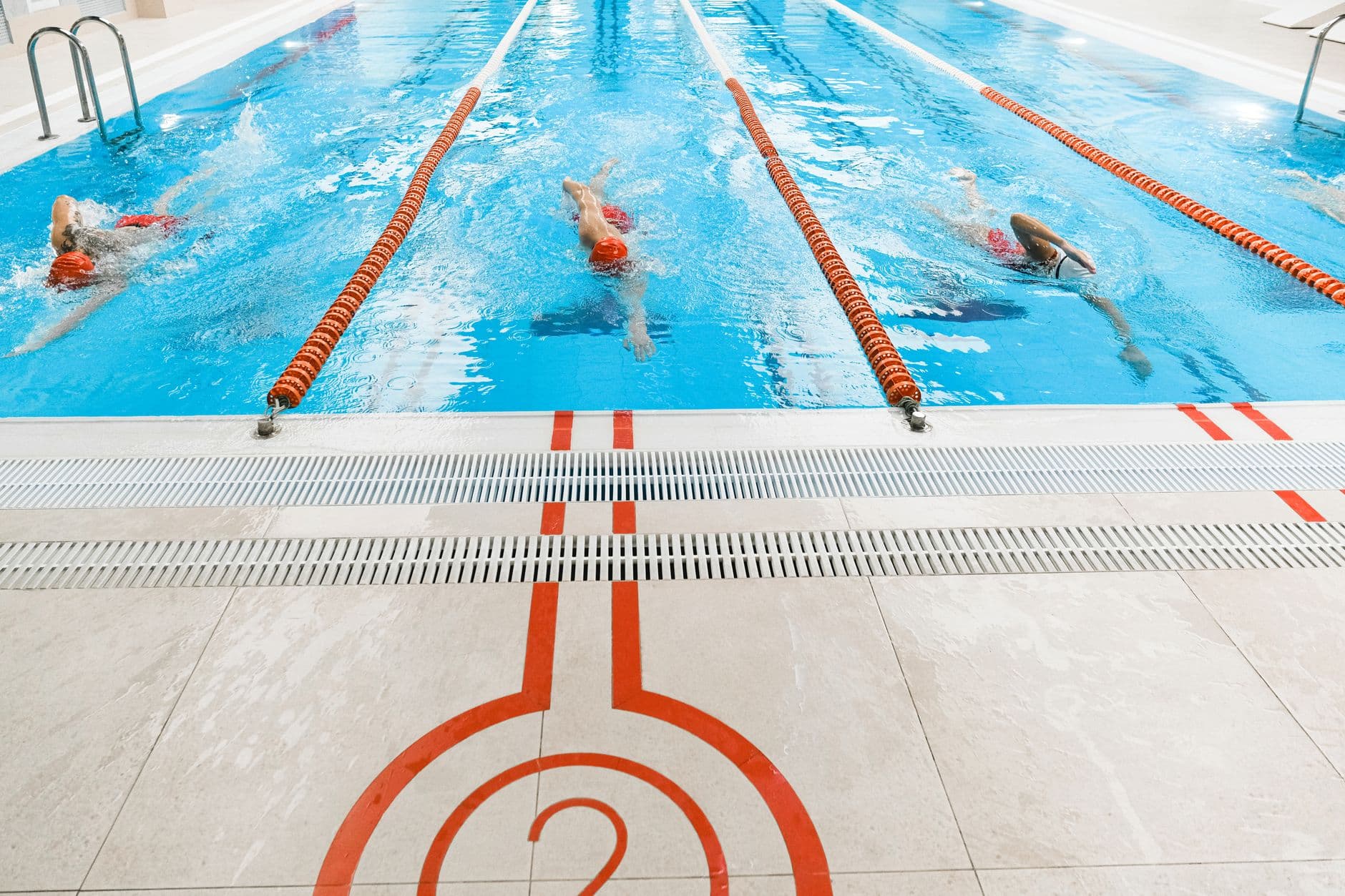
Swimming moves your whole body against something that pushes back, so the honest answer is not a flat no. It is yes, for a while, and then much less. Water loads your muscles, but the load is tied to how fast you are moving through it — and the moment you tire and slow down, the load falls away with you.
That self-cancelling quality is the whole story, and it is the part almost every page ranking for this question leaves out. What follows is the mechanism, what the trials actually measured, the one place in the body where swimming genuinely does add muscle, and what to do if muscle is what you are after.
The short answer, in one paragraph
Swimming builds muscle in someone who is not currently training, and it builds and holds muscle in the pulling muscles of the upper body — lats, shoulders, upper back — in people who swim a lot. It then stops doing much of either, fairly quickly, because the stimulus does not grow. If you want a bigger, stronger body than swimming has already given you, swimming is not the tool. That is not a knock on the sport. It is the same reason nobody expects cycling to build a bench press.
Everything else on this page is the detail behind those three sentences, starting with why water behaves this way.
The catch: water resistance follows you down
Resistance training works by progressive overload — the load has to keep climbing, or the body stops adapting. Water does something close to the opposite.
The force resisting a swimmer rises steeply with speed. How steeply depends on whose measurements you take: the method used to quantify swimming parachutes treats resistance as proportional to the square of velocity, while a review of front-crawl hydrodynamics reports recent work putting active drag closer to the cube of swimming velocity (Takagi et al., 2023). Either figure makes the same point from the other direction. Swim 10 % slower and the resisting force drops by about 19 % on the square, about 27 % on the cube.
Now picture the last 100 of a hard set. You are tired, so you slow down — and because you slowed down, the water stops pushing as hard. The set gets easier exactly when a weight room set would be getting harder. There is no way to hold the load constant while fatigue builds, which is the one condition hypertrophy training is built around.
This is also why a tired swim does not feel like a tired lift. If you want the other half of that story, see why you are so tired after swimming.
What the trials measured, and did not find
The cleanest test of the idea is a meta-analysis of randomised trials of aquatic exercise that included a resistance component, in adults with musculoskeletal conditions — people with room to improve. Fifteen trials out of 1,214 screened met the criteria, nine of them high quality. Compared with no exercise at all, the pooled effect on strength was not significant at any site: hip abductors SMD 0.28 (95 % CI −0.04 to 0.59), knee extensors 0.18 (−0.03 to 0.40), knee flexors 0.13 (−0.20 to 0.45) (Heywood et al., 2017). Every confidence interval crosses zero. The evidence was graded low or very low.
The authors' own explanation is the argument of this page: they concluded that the inadequate application of resistance in water was likely a significant contributor to that lack of effect, and that the trials had given almost no thought to prescribing or measuring how much resistance there was.
A later randomised trial separated the two things directly. Eighty adults aged 60 to 70 trained twice a week for 16 weeks as free swimming, aquatic resistance training, both, or a control group (Chen et al., 2024). The two strength tests were won by the groups that deliberately added resistance. The endurance test was won by swimming.
Read together: water will train your aerobic system without being asked. It will train your strength only if you make it.
Where swimming does build muscle: the pull
The exception is real and it is worth being precise about. Twenty-two male masters swimmers aged 52 to 82 were split by training distance and compared with eleven age- and BMI-matched men who did not swim. Anyone who did resistance training was excluded from the study, which is what makes it useful. Arm skeletal muscle mass was greater in both swimming groups than in the controls, and the higher-volume group — over 3,000 m per session, about four times a week — had a greater total muscle index than both the moderate group and the controls (Abe, Kojima and Stager, 2014).
So the pulling pattern does respond, it responds in proportion to volume, and it keeps responding into a swimmer's seventies. That is a genuinely good result and no gym can claim the joints get off as lightly.
Two honest caveats. This is a cross-sectional comparison, so it cannot separate what swimming did from who chooses to swim 3,000 m four times a week at 70. And the volume involved is large — this is not what three easy 30-minute swims a week produce. The legs tell the same story in reverse: knee extension strength was higher in the high-volume swimmers, knee flexion strength was not.
So why do swimmers look like that?
Because of selection and volume, not because of the strokes. Competitive swimmers are tall, long-armed and broad-shouldered before they are fast — those proportions are an advantage in water, so the sport keeps the people who have them. On top of that, a club swimmer may cover 30,000 to 60,000 m in a week. That is an enormous amount of work for the lats and shoulders, and it is accompanied by years of land-based strength training that nobody photographs.
The shape, in other words, is what you get from being built for the sport, swimming a very large volume, and lifting. Copying one third of that produces one third of the result, and not the third most people are hoping for.
It is also worth separating muscle from leanness. Swimming is a reasonable way to spend energy — see how many calories swimming actually burns — and a leaner version of the same muscle reads as "more muscular" in a mirror without a gram of tissue having been added.
Size and strength are two different goals
The current position stand of the American College of Sports Medicine, which synthesised 137 systematic reviews covering more than 30,000 participants, separates them clearly. Voluntary strength was enhanced by lifting heavy loads — at or above 80 % of a one-repetition maximum — through a full range of motion, for two to three sets, early in the session, at least twice a week. Muscle size was enhanced by something different: higher weekly volume, from about ten sets per muscle a week, and eccentric overload (Currier et al., 2026).
Look at that list of requirements and then look at swimming. There is no 80 % load, because the load is whatever your current speed makes it. Weekly volume for any one muscle is hard to even define. And eccentric overload — being loaded while the muscle lengthens — barely exists in water, because water does not push your arm back through the recovery. It just gets out of the way.
One more piece fits here. A set of meta-regressions found that strength gains were similar across a wide range of how close sets were taken to failure, but muscle size improved as sets were ended closer to failure (Robinson et al., 2024) — with the caveat that the models fit only modestly and the proximity to failure was estimated, not measured. Swimming, by its nature, lets you drift away from failure rather than toward it.
If you have not trained in years, the answer changes
All of the above is about someone already swimming regularly. For an adult coming back after a decade off, almost any resistance is above the current threshold, and swimming clears that bar comfortably. Expect real gains in the first couple of months — mostly in the lats, shoulders, upper back and grip — and expect them to flatten out, because the water is not going to get heavier.
That plateau arrives sooner than people expect, and it is usually misread as a technique problem. It can be both. If you are new to the water, learning to swim as an adult is the higher-value project, because a more efficient stroke lets you hold a faster speed, and a faster speed is the only way the water loads you harder.
The same logic sets the ceiling on frequency. Swimming more often will not restart the muscle response once it has levelled off; it will mostly add fatigue. We looked at where that line sits in should you swim every day.
Paddles and parachutes: how much load can you add?
This is the fair objection — swimmers do have resistance equipment. The question is how much it adds, and the numbers are published.
At maximal effort in tethered swimming, hand paddles do raise force. Compared with free swimming, extra-large paddles of 552 cm² increased peak force by 21.7 % and impulse by 30.9 %, with stroke rate dropping 9.5 % (Barbosa et al., 2013). A real increase — and about a fifth more force than your arm already produces, which is a long way from the load progression a barbell offers.
Parachutes can be quantified exactly. Measured drag coefficients were 15.4, 19.7, 37.2 and 73.9 N·s²·m⁻² for canopies of 400, 529, 900 and 1,600 cm², and resistance rose about 15 % when the chute was pulled by a propelling swimmer rather than towed (Coloretti et al., 2025). Take the 900 cm² chute at a brisk 1.2 m/s: 37.2 × 1.2², about 54 N, or roughly 5.5 kg of force. That is a useful overspeed and pacing tool. It is not a training load.
And there is a cost. Shoulder pain in swimmers tracks training volume across the whole lifespan of the athlete (Feijen et al., 2020). Adding paddle volume to chase muscle is the trade most likely to end in a layoff. If a shoulder is already complaining, read swimmer's shoulder first and see a physiotherapist or doctor before adding any resistance.
Our full breakdown of what the equipment does and does not do is in swim paddles and fins.
What to do instead, if muscle is the goal
Keep swimming, and stop asking it to do a second job. The combination that works is unglamorous: swim for the aerobic work, technique and joints, and lift twice a week for muscle. Public health guidance already asks for both — 150 to 300 minutes of aerobic activity plus muscle-strengthening work on two or more days a week (ODPHP, Physical Activity Guidelines for Americans). Swimming is a complete answer to the first half and a poor one to the second.
You do not need much. Two sessions a week of a handful of compound movements, taken through a full range of motion, with the load creeping up over months, satisfies the strength prescription above. A network meta-analysis of 36 randomised trials in swimmers found resistance work on land improves swimming performance as well, so this is not a tax on your swimming (Wang et al., 2025; see also Crowley et al., 2017).
What to actually do in those two sessions, and how to fit them around a swim week without wrecking either, is laid out in dryland training for swimmers. If your swimming itself is the thing that has stalled, building swimming endurance is the better place to spend the month.
How to tell whether any of this is working
Muscle is a slow and noisy thing to measure at home, and a mirror after a swim is the least reliable instrument there is. Two things are worth tracking instead, and both are free.
In the gym, track load and repetitions. If the weight on the bar is higher this month than last at the same repetitions, the stimulus is still progressing. If it has not moved in six weeks, nothing is being overloaded and that is the problem to fix.
In the water, track efficiency rather than effort, because effort lies. Count your strokes per length and time the length, and let the SWOLF calculator combine them — a falling score means you are getting more distance from each pull. Then set your pace honestly with a test rather than a guess: the critical swim speed calculator turns a 400 and a 200 into a threshold pace, and what CSS pace is explains what to do with it. Those two numbers will tell you more in a month than any amount of looking.
And if your stroke count and your pace are both improving, you are producing more force at the same cost. That is the closest thing to a strength readout swimming gives you — see stroke rate or stroke length.
Where the evidence runs out, and the safety line
Be clear about what is solid here and what is not. Solid: resistance training builds muscle and strength, and the prescription variables that matter are known. Solid: aquatic exercise trials with an unquantified resistance component have not shown strength gains over doing nothing. Reasonably solid: high-volume swimming is associated with greater arm muscle mass in older swimmers.
Much weaker: any number for how much muscle a given swim programme adds to a given person. There is no trial that measured hypertrophy in untrained adults put on a plain swimming programme, which means anyone quoting you a percentage is guessing. We would rather say that than invent one. The mechanism above is the reliable part; the magnitude is not known.
Two safety points, because they get ignored in pursuit of this goal. Do not use breath-holding or hypoxic sets to make swimming feel harder — the pool is the one gym where pushing to the point of blacking out can drown you, and no muscle gain justifies that risk. And never train alone or outside a lifeguarded area; fatigue is the whole point of a hard set, and fatigue in water is a different kind of problem than fatigue on land. New or returning pain in a shoulder, neck or lower back is a reason to see a doctor or physiotherapist, not something to train through.
Where next: the workouts section covers the training side, and technique covers the stroke work that lets you hold a faster speed in the first place.
Frequently asked questions
Does swimming build muscle or just burn fat?
It does some of both, and neither especially fast. Swimming adds muscle in untrained people and in the pulling muscles of high-volume swimmers, then levels off because the load cannot keep rising. It also spends a lot of energy, so bodies often look more muscular after a few months of swimming without having added much tissue at all.
Can you build muscle by swimming every day?
Not much beyond the first couple of months. Swimming daily adds volume, but volume alone does not restart the muscle response once water stops being a progressive load, and it raises the risk of shoulder trouble. Two gym sessions a week will add more muscle than two extra swims, and they also tend to improve your swimming.
Does swimming build muscle in your arms and legs?
Arms and upper back, yes — masters swimmers who train over 3,000 m a session have more arm muscle mass than non-swimming men of the same age and build. Legs, much less. In the same study, knee extension strength was higher in high-volume swimmers but knee flexion strength was not, and the kick loads the legs only lightly.
Is swimming cardio or strength training?
Cardio, with a mild and self-limiting strength component. A randomised trial in older adults found free swimming improved the six-minute walk test by 19.4 % over a control group, while the two groups that deliberately added resistance in the water were the ones that improved the strength tests. Water trains your aerobic system whether you ask it to or not.
Do swim paddles build muscle?
They raise force, but not by enough to count as resistance training. At maximal effort, extra-large paddles increased peak force by about 22 % over free swimming. That is a real increase and a useful technique tool, nowhere near the progression a barbell gives you, and paddle volume is one of the clearest ways to provoke shoulder pain.
Sources
- Heywood S. et al. (2017) — Effectiveness of aquatic exercise in improving lower limb strength in musculoskeletal conditions: systematic review and meta-analysis (15 randomised trials) — Archives of Physical Medicine and Rehabilitation
- Chen Y. et al. (2024) — High-intensity interval swimming improves cardiovascular endurance, while aquatic resistance training enhances muscular strength in older adults (RCT, 80 adults, 16 weeks) — Scientific Reports
- Abe T., Kojima K. & Stager J.M. (2014) — Skeletal muscle mass and muscular function in master swimmers is related to training distance — Rejuvenation Research
- Currier B.S. et al. (2026) — ACSM Position Stand: Resistance Training Prescription for Muscle Function, Hypertrophy, and Physical Performance in Healthy Adults (overview of 137 systematic reviews) — Medicine & Science in Sports & Exercise / American College of Sports Medicine
- Takagi H. et al. (2023) — How do swimmers control their front crawl swimming velocity? Current knowledge and gaps from hydrodynamic perspectives — Sports Biomechanics
- Coloretti V. et al. (2025) — Quantifying added drag in swimming with parachutes: implications for resisted swimming training — Journal of Strength and Conditioning Research
- Barbosa A.C. et al. (2013) — Acute responses of biomechanical parameters to different sizes of hand paddles in front-crawl stroke — Journal of Sports Sciences
- Robinson Z.P. et al. (2024) — Exploring the dose-response relationship between estimated resistance training proximity to failure, strength gain, and muscle hypertrophy: a series of meta-regressions — Sports Medicine
- Feijen S. et al. (2020) — Swim-training volume and shoulder pain across the life span of the competitive swimmer: a systematic review — Journal of Athletic Training
- Wang Z. et al. (2025) — Comparative effectiveness of physical training modalities on swimming performance: a two-tier network meta-analysis (36 randomised trials) — Frontiers in Physiology
- Crowley E., Harrison A.J. & Lyons M. (2017) — The impact of resistance training on swimming performance: a systematic review — Sports Medicine
- Physical Activity Guidelines for Americans, second edition — Top 10 Things to Know (150 to 300 minutes of aerobic activity plus muscle-strengthening on 2 or more days a week) — U.S. Department of Health and Human Services (ODPHP)
Read next
Can you swim with a cold? The neck check, and when to stay out
A head cold without fever is usually fine to swim through. A fever is not. The rule sports medicine uses, how thin the evidence is, and what changes in a pool.
Swimming on your period: what actually works in the water
Yes, you can swim. Which products hold in water and which fail, the FDA's 8-hour tampon rule, what the pool rules really say, and the shark question answered.
Swimming with asthma: what the evidence actually supports
Swimming provokes four to six times less bronchospasm than running, and elite swimmers have more asthma than other athletes. Both are true. What to do about it.
SwimFast is an independent publication. We are not a swim school, a coaching service or a governing body, and nothing here is medical advice. Training paces and test protocols are cited from the published research or federation documents linked on each page. Never swim alone, never attempt breath-hold work without supervision, and check with a doctor before starting a new training programme.