Can you swim with a cold? The neck check, and when to stay out
A head cold without fever is usually fine to swim through. A fever is not. The rule sports medicine uses, how thin the evidence is, and what changes in a pool.
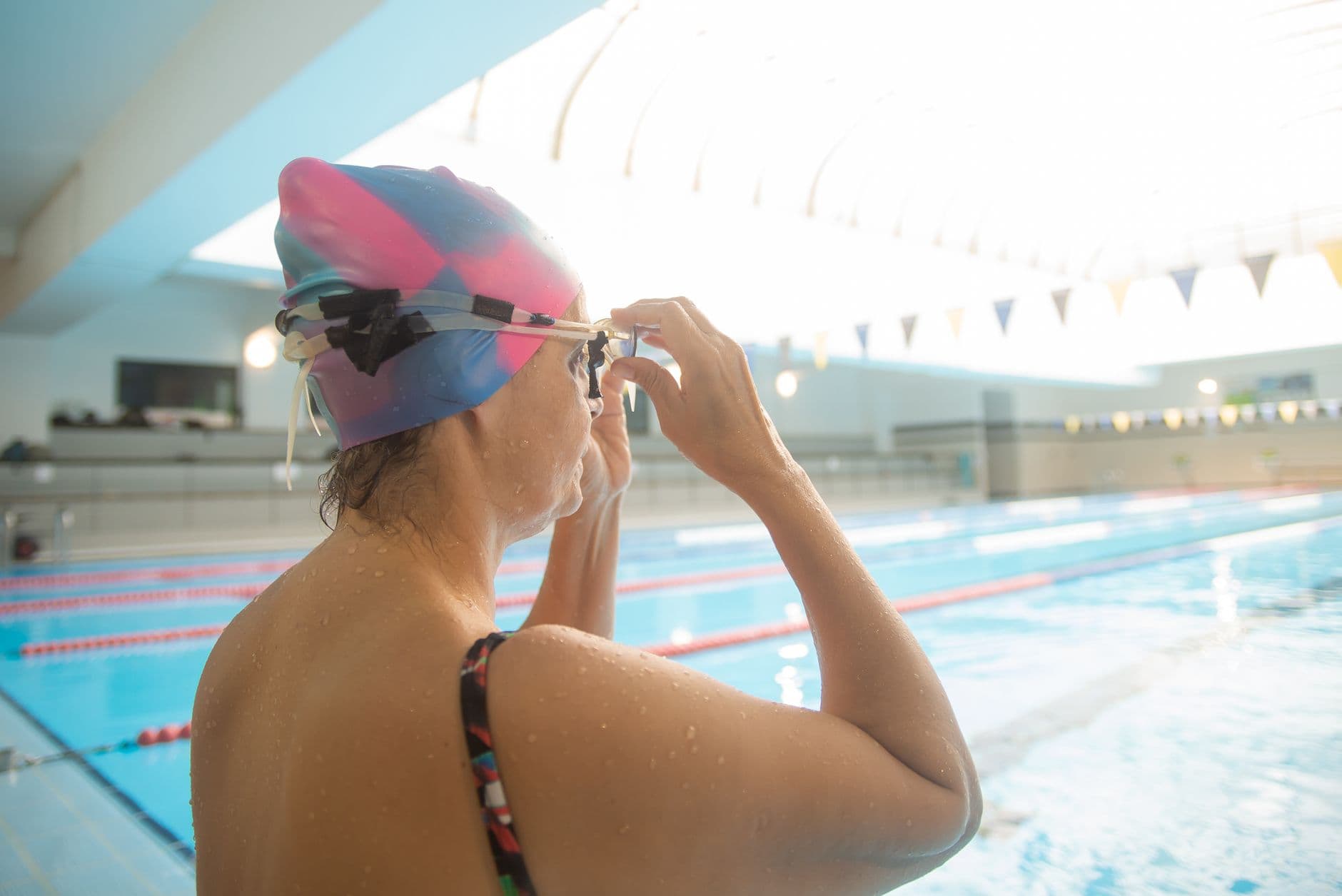
A blocked nose and a sore throat, no fever, and a session you are willing to cut in half: most sports medicine sources treat that as acceptable. A fever, a cough from your chest, aching all over: stay out. What almost nobody adds is how thin the evidence under that rule is, and that none of the studies behind it involved swimming. Here is the rule, its sources, the limits of both, and the parts that only apply in a pool. This is general information about a common illness, not advice about your own body — anything that worries you belongs with a clinician who can examine you.
The 30-second version. Above the neck and no fever: swim, but short and easy, and get out of the water to blow your nose. Fever, chest cough, body aches, swollen glands: no swimming, and no breath-holding sets ever as a way around a blocked nose. You stay infectious until the symptoms have gone, so the lane you share is part of the decision.
The short answer, and the honest version of it
U.S. Masters Swimming answers it directly: yes, if you are not debilitated, you can swim with a cold, and the real question is whether you should. Its rule of thumb is the one used across sports medicine — symptoms above the neck, moderate exercise is reasonable; below the neck, stay out.
To its credit, USMS says in the same paragraph where that rule comes from: it is largely based on one study. Every other page leaves that out. It is a sensible default built on a small evidence base, not a measured threshold.
The NHS, which does not discuss sport at all, gives the same test in plainer words. Its common cold page separates the two illnesses like this: a cold makes you feel unwell but you are OK to carry on as normal, while flu makes you feel exhausted and too unwell to carry on as normal. If you cannot carry on as normal, a swim is not normal activity.
The neck check, and who actually said it
The phrase comes from clinical practice, not from a trial. It appears in the literature as a decision aid: in a 2003 review in Current Sports Medicine Reports titled "Upper respiratory tract infections: who plays, who sits?", Metz writes that the decision to let an athlete play can be guided by the neck check rules, alongside non-medical factors. It sorts symptoms by where you feel them:
- Above the neck — blocked or runny nose, sneezing, sore throat, hoarse voice, mild headache. Moderate exercise is generally considered acceptable.
- Below the neck — fever, aching muscles, a productive or chesty cough, swollen glands, chest tightness, extreme fatigue, anything settling in the lungs. Do not train.
That review adds one detail worth keeping: glandular fever (infectious mononucleosis) is its own case with strict return-to-play guidance, because of the risk of splenic rupture. It is often mistaken for a cold when fatigue drags on for weeks, and it calls for a doctor rather than a rule of thumb.
What the studies behind the rule really tested
Four studies do most of the work, three from the same group at Ball State University, and their design is where the rule's limits live.
- Weidner et al., 1997. Forty-five people aged 18 to 29 were screened for existing rhinovirus 16 antibodies and deliberately inoculated, plus ten uninfected controls. At the peak of illness, lung function and a graded exercise test to exhaustion were unchanged.
- Weidner et al., 1998. Same inoculation model: 34 people exercised 40 minutes every other day at 70% of heart rate reserve for ten days, 16 did not. Symptoms were scored every twelve hours and used tissues were weighed. No difference in either.
- Weidner and Schurr, 2003, British Journal of Sports Medicine. Natural colds, sedentary volunteers: eleven exercised 30 minutes at 70% of target heart rate range on five days of seven, eleven did not. No difference in symptom scores or in time to becoming symptom-free. Their wording is careful — moderate exercise probably does not alter severity and duration.
- Weidner's 1994 review, International Journal of Sports Medicine, is the counterweight from the same author: athletes should monitor symptoms and training schedules and should rest during an upper respiratory illness.
So moderate exercise did not make a mild cold worse. It does not follow that it helps, and the researcher who ran the experiments still recommended rest.
Counts as reported in the three primary studies. All used dry-land exercise in volunteers aged 18 to 29 who were fever-free and medically screened; the 2003 study excluded anyone febrile. No swimming protocol appears in any of them.
So: small samples, young screened volunteers, nobody with a fever, and dry-land exercise throughout. Nobody has tested a face-down, horizontal, chlorinated version. Where the evidence runs out, the rest is clinician and coach consensus — a reason to label it and stay conservative, not to ignore it.
Fever is the one part that is not a judgment call
A 2014 clinical review in Sports Health, "Febrile illness in the athlete", gathers what is known: fever raises insensible fluid loss and dehydration, raises metabolic demand and disrupts temperature regulation, while human and animal studies show reduced strength and endurance from muscle catabolism. Two conclusions matter here. Strenuous exercise during a febrile illness can worsen the illness, and in animal models has shown increased lethality. And — note that this is an absence rather than a finding — no consensus recommendations support return to activity before the fever has resolved.
For a swimmer there is a layer on top. A fever already impairs temperature regulation, and water pulls heat out of you far faster than air at the same temperature, which is why pools are held in a narrow band at all: see what temperature a pool should be. Dehydration is also easy to miss in a pool, where you never notice sweating — on which, why am I tired after swimming.
Myocarditis, and why the fever rule stays firm
The serious reason behind that rule is myocarditis: inflammation of the heart muscle, often triggered by a viral infection. A 2021 clinical perspective in the European Journal of Preventive Cardiology, published on behalf of the European Society of Cardiology, calls it an important cause of arrhythmias and sudden cardiac death in athletes and active people alike. Its list of why athletes may be at higher risk names an impaired immune response from continuing training during infections and resuming training early afterwards, alongside strenuous competition and exercising in extreme conditions. The behaviour this page is about appears by name in a cardiology paper's risk list.
The presentation is unhelpfully vague, which is why a rule beats self-assessment: that paper describes athletes typically reporting fatigue, muscle soreness, a raised resting heart rate and reduced capacity — all of which also describe a hard training week. An unexplained jump in your morning heart rate during or after an illness is a reason to see a doctor, not to add a recovery swim; swimming heart rate zones covers how those numbers normally behave. For scale: in uncomplicated confirmed cases, with normal left ventricular function and no late gadolinium enhancement on cardiac MRI, that paper puts eligibility for sport at three months after clinical recovery.
A chest cold is a different animal in water
"Chest cold" is not a clinical category, but people searching for it mean something specific: the cough has moved down, it brings something up, and breathing feels like work. That is below the neck, and the answer is to stay out.
There is a swimming-specific reason on top of the general one. In the water your breathing is not voluntary the way it is on land — it is locked to the stroke. Freestyle gives you a window of a few tenths of a second per cycle, through one corner of your mouth, against a bow wave; how to breathe while swimming freestyle shows how little slack there is. A cough on a treadmill lets you slow down and keep breathing. In the water it costs you the breath, and the next one arrives on the stroke's schedule rather than yours. Lying horizontal does not help either: congestion tends to feel worse flat, which is everyday observation rather than a measured effect in swimmers, but it is what swimmers describe. And if breathlessness or coughing starts during a swim rather than before it, that is a different problem — see the warning signs in is dry drowning real.
What indoor pool air does to an airway that is already sore
This part is specific to swimming, and it is measured. A 2009 review in Sports Medicine, "The respiratory health of swimmers", sets out that chemicals formed when chlorine reacts with organic matter can irritate the respiratory tract and induce both upper and lower respiratory symptoms. It reports more rhinitis, asthma and airway hyper-responsiveness in elite swimmers than in the general population, linked to airway epithelial damage and increased nasal and lung permeability from chlorination by-products indoors.
Two qualifications. The groups where this shows up clearly are children, lifeguards and high-level swimmers — large cumulative exposure, not 1,500 metres twice a week — and the review concerns conditions developing over years, not a cold this week. No study has asked whether pool air prolongs a cold. What it justifies is a preference: a well-ventilated or outdoor pool, and skipping the session where the air at the surface smells strongest. The chemistry is in what chlorine does to your skin and hair. If you have asthma, start with swimming with asthma and take the question of training through a respiratory infection to your own clinician.
The head-cold session, if you decide to go
Assume above the neck, no fever, and you feel up to it. The shape of the session matters more than the distance.
- Decide the cut-off before you get in. "Twenty minutes, easy, and I stop if it feels wrong" is a plan. "I will see how I go" becomes the main set.
- Make it continuous and easy. No intervals, no time trial, no kick set to failure. The research that found no harm used steady moderate exercise at around 70% of heart rate reserve.
- Lengthen the warm-up, shorten everything else. A congested airway needs longer to settle; give it 400 easy metres before judging the session. The reasoning is in the swim warm-up.
- Breathe every two or three, not every four. A cold is not the week to practise breath control — see bilateral breathing.
- Get out of the water to blow your nose. USMS puts this as a courtesy to your lanemates, and it is the most useful line in its article.
- Warm up properly afterwards, and count it as a recovery day. The session replaces nothing: see should you swim every day.
Never let a blocked nose turn into breath-holding
This one has no exceptions. A blocked nose makes breathing feel inefficient, and the instinctive response — fewer, bigger breaths, one length without breathing, a hypoxic set — is the most dangerous thing a swimmer can do.
No breath-holding sets, ever, and least of all while ill. Repeated deliberate hyperventilation and breath-holding in water can make you lose consciousness without warning, underwater, with nothing that looks like distress beforehand. A head cold is not a reason to train breath control, and there is no version of a hypoxic set that is safe because you only did a few. The physiology, and what the lifeguarding bodies say about it, is in swimming and lung capacity.
If you cannot get enough air through your nose to swim comfortably, the answer is a shorter swim or no swim — never a longer breath. And do not swim alone when you are unwell, in a lake or in an empty lap pool with nobody watching.
You stay contagious longer than you feel ill
The neck check does not address this at all, and in a shared lane it may be decisive. The NHS is specific: you are infectious until all your symptoms have gone, which usually takes one to two weeks and longer in young children, and a person with a cold can start spreading it a few days before symptoms begin. Colds spread by germs from coughs and sneezes, which can live on hands and surfaces for 24 hours — and a pool deck is a surface, as are the lane rope, the kickboard rack, the pace clock button and the changing-room benches. The NHS rule is plain: if you have a high temperature, or do not feel well enough to do your normal activities, stay at home and avoid contact with other people until you feel better. It has no exception for the session you had planned.
The chlorine helps, partly, and not fast enough to settle it. USMS puts it accurately: a correctly chlorinated pool should kill most germs associated with the common cold, but chlorine does not work instantaneously, and as the CDC notes, it does not kill every germ. The water between you and the swimmer behind you is not sterile the moment you cough into it — and most of what passes a cold around a pool session is not the water at all. It is hands, benches, door handles, kickboards and the thirty seconds of conversation at the wall.
So if you go: take your own kit and neither borrow nor lend a towel, bottle or goggles, since not sharing towels and household items is on the NHS list. Wash your hands properly before and after. Swim at a quiet hour, in a lane you are not sharing with four other people — lane etiquette covers how to pick one. Open water has no chlorine and its own water-quality questions; your first open water swim covers what to check. And if you coach, teach or lifeguard, the calculation is not yours alone: you are in close contact with people who did not choose the exposure.
Cold sores are a different question
If you came here searching whether you can swim with a cold sore, that is a separate condition with separate guidance, and mixing the two would mislead you. A cold sore is caused by the herpes simplex virus, not a cold virus, and the advice is about contact rather than water.
What the NHS states: a cold sore usually begins with tingling, itching or burning, blisters appear over the next 48 hours, and it should start to heal within ten days. It is contagious from the first tingle until it has completely healed. The prevention advice is to wash your hands with soap and water whenever you touch it, not to kiss anyone while you have one, and to avoid oral sex until it has healed — and it warns that kissing a baby while you have a cold sore can lead to neonatal herpes, which is very dangerous for newborns.
Note what is absent from that list: swimming. The NHS does not tell you to stay out of the water, and says nothing about pools either way. That silence is worth leaving as it is — no source measures whether pool water transmits herpes simplex, and claims that chlorine inactivates it are not worth accepting without a study behind them. Since the route the guidance describes is hands and direct contact, the practical reading is: swim if you want to, keep your hands off it, wash them when you do touch it, and share no towels. Two swimming-relevant details are in the same guidance. Illness and sunshine are both listed as triggers, and the NHS recommends sunblock lip balm of SPF 15 or above in the sun — which matters for outdoor pools and open water, where lip balm washes off and your face is permanently exposed. And antiviral creams work best applied at the first tingle, not once blisters have appeared.
Children with a cold: the call a parent has to make
This is the most searched version of the question after the adult one. The same rule applies, with the threshold lower and the decision made on the child's behalf rather than by negotiation. Children are a distinct case for four reasons:
- Colds last longer in them. The NHS says symptoms can run longer in young children, who may also be irritable, feed and sleep poorly, breathe through the mouth and be sick after coughing. Mouth-breathing and a swimming lesson do not combine well.
- They stay infectious for longer — one to two weeks is typical, and longer in babies and toddlers.
- Children are one of the groups where pool air irritation shows up most in the respiratory literature.
- A child cannot judge their own capacity in water, and a lesson is a shared space: a small group in close contact for half an hour, often with a toddler group in the water before or after.
So: a mild runny nose, no fever, a cheerful child who wants to go — reasonable. Fever, a chesty cough, broken sleep, off their food, or simply miserable — keep them out, and tell the swim school rather than deciding at the poolside. The NHS also lists being worried about a child's cold symptoms as a reason to see a GP. Missing a week does not undo learning to swim: how to teach a child to swim and what age to start swim lessons cover how progress accumulates. If the recurring problem is earache, read swimmer's ear.
Coming back without losing the next two weeks
People lose a fortnight not by resting too long, but by resting four days, feeling 80% better, swimming their normal main set, and relapsing. Two sources point the same way: the 2014 febrile illness review says training should be resumed gradually once fever and dehydration have resolved, and the International Olympic Committee's 2016 consensus statement on load and illness, in the British Journal of Sports Medicine, concludes that inappropriate load management — including rapid changes in training load — is a significant risk factor for acute illness and overtraining. Returning straight into your previous volume is a rapid change in load by definition.
- First session back: half your usual distance, all easy, no intervals. If it feels harder than easy should feel, that is information — get out.
- Second: normal distance, still easy, technique work. Drills are a good use of this day; see freestyle drills.
- Third: add some pace, nothing maximal. Only then a quality set or a time trial.
Do not use a session in the week after an illness to reset your training paces: a slow test gives you slow paces for the next two months. Keep your old ones and retest when you are well, with the pace calculator or the CSS calculator. If any symptom was below the neck, be more conservative — USMS cites the American Council on Exercise's figure of two weeks before returning to intensive exercise, which is a second-hand number rather than one that traces back to a trial, so treat it as a cautious default and take anything involving fever back to a doctor.
When to stop guessing and ask a doctor
A cold normally needs no medical attention: the NHS says symptoms come on gradually over two to three days and you should begin to feel better in about one to two weeks. Knowing that timeline is how you recognise something stepping outside it.
Ask for a same-day GP appointment, or get help from NHS 111 — in the US, contact your own clinician or a walk-in clinic — if you feel short of breath or have chest pain. Neither belongs to a cold, and neither should wait while you decide whether to swim.
The NHS lists these as reasons to see a GP: a high temperature for more than three days; symptoms getting worse rather than better; a very high temperature, or feeling hot, cold or shivery; shortness of breath or chest pain; symptoms that have not improved after ten days; a cough lasting more than three weeks; a cold alongside a long-term condition such as diabetes or a heart, lung or kidney condition; a cold while your immune system is weakened, for example during chemotherapy; and worry about a child's symptoms.
Two more from the sports side. An unexplained rise in resting heart rate, or capacity that stays well down after symptoms have gone, are among the non-specific signs the cardiology literature associates with myocarditis — a reason to be checked rather than to self-diagnose. And fatigue dragging on for several weeks after a "cold" is worth a conversation about glandular fever. One last thing the NHS says plainly: antibiotics are not recommended for colds, because colds are caused by viruses and antibiotics will neither relieve symptoms nor speed up recovery. There is also little evidence that vitamin C, echinacea or garlic prevent colds or shorten them.
This page is general information about a common illness and the practice around training through it. It is not a diagnosis and not advice about your own body. Any decision to train while ill — especially one involving fever, chest symptoms or an existing heart or lung condition — belongs with a clinician who can examine you. Written by the SwimFast editorial team on 23 November 2026, against the sources listed below.
Frequently asked questions
Does swimming with a cold make it worse?
In the studies that tested it, no. Moderate exercise during a mild cold did not change symptom severity or how long the cold lasted, in three small trials of young, fever-free adults. But none of those studies used swimming, none included anyone with a fever, and the largest had 55 people. Treat it as reassurance about a short easy swim, not as proof.
Can you swim with a head cold?
Usually yes, if you have no fever and feel well enough for normal activity. A blocked nose, sneezing and a sore throat are all above the neck, which is the side of the rule where moderate exercise is considered acceptable. Keep it short and easy, breathe every two or three strokes rather than practising breath control, and get out of the water to blow your nose.
Can you swim with a chest cold or a cough?
No. A cough that comes from your chest, brings something up, or makes breathing feel like work is a below-the-neck symptom, and the rule says stay out. Swimming makes it worse than dry-land exercise would, because your breathing is locked to your stroke and a cough costs you the only breath window you get. Wait until your chest is clear.
How long should I wait after a fever before swimming again?
Until the fever has fully gone, and then build back gradually rather than returning to your usual set. No consensus guidance supports training before a fever resolves, and both dehydration and the small risk of heart muscle inflammation are reasons the rule is firm here. If you had a fever with chest symptoms, ask a doctor before restarting rather than following a rule of thumb.
Can you swim with a cold sore?
A cold sore is a different condition from a cold, and NHS guidance does not tell you to avoid swimming. It does say a cold sore is contagious from the first tingle until it has completely healed, and that the precautions are about contact: wash your hands whenever you touch it, do not kiss anyone, and share no towels. No source measures pool-water transmission either way.
Should my child swim with a cold?
Apply the same rule with a lower threshold. A mild runny nose with no fever in a child who wants to go is reasonable. Fever, a chesty cough, broken sleep or general misery means keeping them out, and telling the swim school instead of deciding at the poolside. Colds last longer in young children, and they stay infectious for one to two weeks.
Sources
- Common cold — NHS
- Cold sores — NHS
- Can I Swim While I'm Sick? — U.S. Masters Swimming
- Upper respiratory tract infections: who plays, who sits? (Metz, 2003) — Current Sports Medicine Reports
- Effect of exercise on upper respiratory tract infection in sedentary subjects (Weidner and Schurr, 2003) — British Journal of Sports Medicine
- The effect of exercise training on the severity and duration of a viral upper respiratory illness (Weidner et al., 1998) — Medicine and Science in Sports and Exercise
- Effect of a rhinovirus-caused upper respiratory illness on pulmonary function test and exercise responses (Weidner et al., 1997) — Medicine and Science in Sports and Exercise
- Literature review: upper respiratory illness and sport and exercise (Weidner, 1994) — International Journal of Sports Medicine
- Febrile illness in the athlete (Dick and Diehl, 2014) — Sports Health
- Myocarditis in athletes: a clinical perspective (Halle et al., 2021) — European Journal of Preventive Cardiology / European Society of Cardiology
- How much is too much? (Part 2) IOC consensus statement on load in sport and risk of illness (Schwellnus et al., 2016) — British Journal of Sports Medicine
- The respiratory health of swimmers (Bougault et al., 2009) — Sports Medicine
Read next
Swimming on your period: what actually works in the water
Yes, you can swim. Which products hold in water and which fail, the FDA's 8-hour tampon rule, what the pool rules really say, and the shark question answered.
Does swimming build muscle, or is it just cardio?
Swimming loads your muscles, but the load drops the moment you slow down. What the trials actually measured, where swimming does add muscle, and what to add.
Swimming with asthma: what the evidence actually supports
Swimming provokes four to six times less bronchospasm than running, and elite swimmers have more asthma than other athletes. Both are true. What to do about it.
SwimFast is an independent publication. We are not a swim school, a coaching service or a governing body, and nothing here is medical advice. Training paces and test protocols are cited from the published research or federation documents linked on each page. Never swim alone, never attempt breath-hold work without supervision, and check with a doctor before starting a new training programme.