Is kickboard work worth it? What the kick set is really training
The legs contribute roughly 30% of front crawl propulsion but a much larger share of the oxygen cost. That is the honest case for and against kick sets.
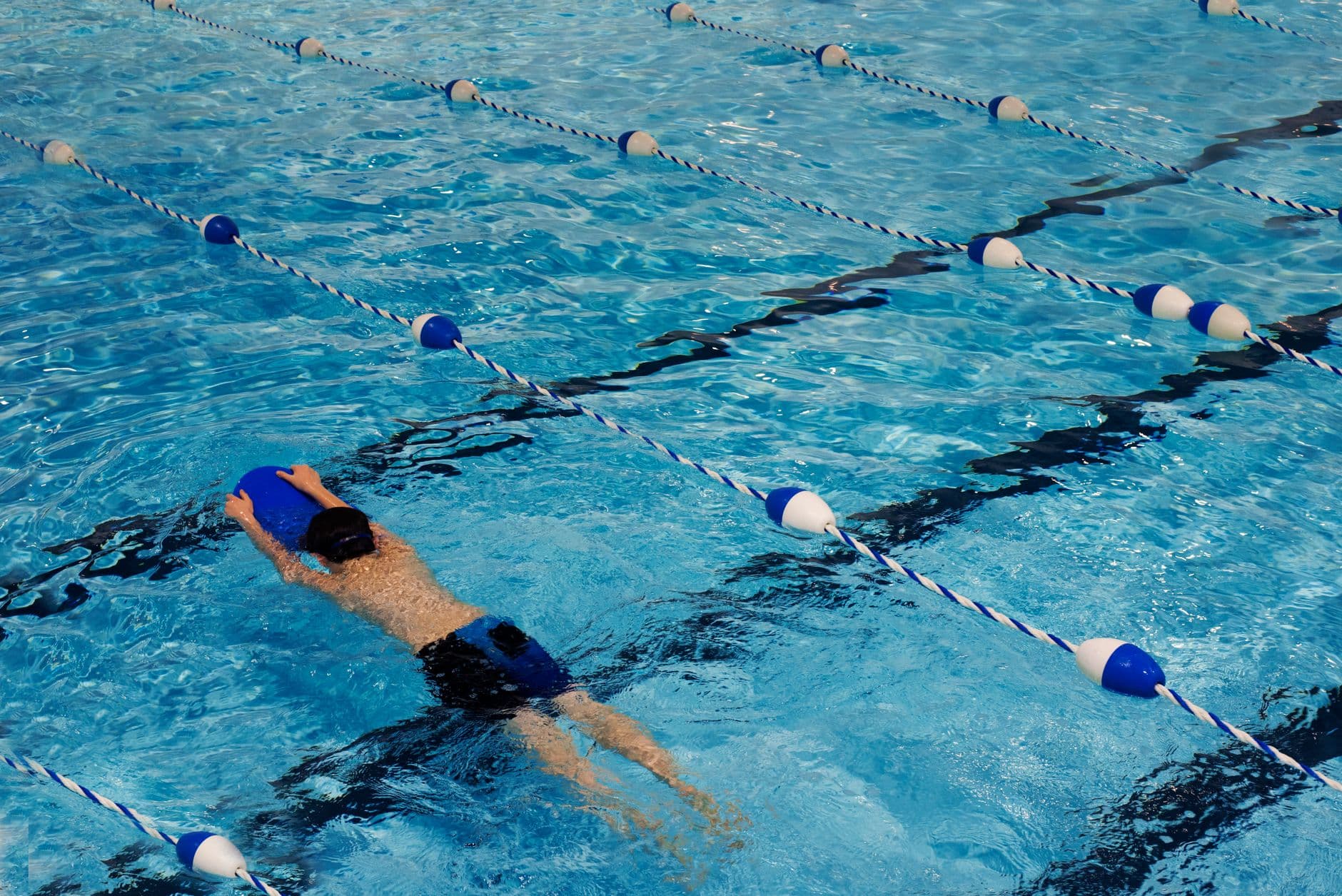
Walk into any pool at lunchtime and a quarter of the lane swimmers will be behind a board, kicking. It is the most-performed set in adult swimming and one of the least examined. Here is what it is actually doing.
The number that starts the argument
A study published in BioMed Research International had 23 national-level swimmers — 12 men and 11 women — perform three 30-second fully tethered front crawl efforts: whole body, arms only, and legs only, with the force measured continuously by a load cell.
The estimated relative contributions came out at roughly 70.3% arms to 29.7% legs for the men, and 66.6% to 33.4% for the women.
Two honest caveats before anyone builds a training plan on that. Tethered swimming is not free swimming — you are producing force against a fixed line rather than moving through water, and the two are related but not identical. And 30 seconds is a sprint, not a distance swim.
Still, the direction is not in dispute and matches what coaches see: in front crawl, the arms do most of the pushing.
Which raises the obvious question about all those lengths behind a board.
Why you still kick
Because propulsion is the wrong reason.
The largest force you fight in the water is drag, and drag depends on your shape. A swimmer whose legs hang low is presenting a much bigger cross-section to the oncoming water than one whose legs trail in line with the torso — and the difference in energy cost is not marginal.
The kick's primary job in freestyle is to hold the legs up and in line. It is a body-position tool that happens to also produce a little thrust. Judged as an engine it is inefficient; judged as a stabiliser it is essential.
This reframes the whole question. "Does kicking make me faster?" has a weak answer. "Does my kick let me hold a good body position for the whole swim?" has a very strong one, and it is the question your legs are actually answering at minute twenty of a hard set.
If your legs sink no matter how hard you kick, the cause is usually not the legs at all, and that is dealt with in why your legs sink when you swim.
The problem with the board
A kickboard does one thing well: it isolates the legs so you can work them without the arms taking over. That is genuinely useful for building the specific endurance of the leg muscles.
What it also does is put you in a body position you never swim in. Arms extended onto a floating object, shoulders and chest lifted, hips lower than they would otherwise be, head up, neck extended. The alignment you are training is not the alignment you use.
And in freestyle it removes rotation entirely. A real freestyle kick works through a body that is rolling from side to side; a board pins you flat.
None of that makes the board useless. It makes it a fitness tool rather than a technique tool, and the mistake is using it as though it were both.
There is also a practical complaint worth naming: kicking with the head up for long sets is unkind to necks and lower backs, and it is one of the more common ways adult swimmers accumulate a nagging ache from an activity that is supposed to be gentle.
Better versions of the same set
If the goal is a kick that helps you swim, three alternatives get closer.
Streamline kick on the front, arms extended overhead, hands stacked, face down, breathing every few kicks. This is the actual swimming position. It is far harder than a board, which is the point.
Side kicking, one arm extended, the other at your side, body rolled onto its edge, breathing to the top. This trains the kick in the rotated position freestyle actually uses.
Vertical kicking in deep water, arms crossed on the chest. Nowhere to hide: a kick that does not propel means you sink. Short repeats, generous rest.
All three are harder than a board, and all three will make your kick sets shorter. That is a feature.
When the board is the right tool
Having spent most of this article arguing against it, here is the fair case for a board.
It is the only piece of equipment that lets you keep your head up and talk, which makes it the natural place in a session for a swimmer who is genuinely out of breath and needs to keep moving without stopping. Recovery work is real work.
It also isolates the legs completely, which matters if you are coming back from a shoulder problem and cannot pull. In that situation a board is not a compromise: it is the only way to train at all, and it beats not swimming.
And it is the easiest way to add volume for a swimmer whose arms fatigue long before their legs do — common in adults who came to swimming from running or cycling.
What it is not is a technique tool for freestyle. Use it for what it does, and do the alignment work somewhere else.
The one place kicking really pays
There is a part of the pool where the kick is not a stabiliser but the entire means of propulsion: off the wall.
Competition rules allow you to travel up to 15 m underwater after the start and after each turn before your head must break the surface. In that zone, a streamlined body with a dolphin kick is typically faster than surface swimming — which is why every extra wall is free speed and why short course times are quicker than long course times, as we cover in short course vs long course.
Fifteen metres, in a 25 m pool, is more than half the length. A swimmer with a strong underwater kick is not doing a drill; they are swimming a meaningful fraction of the race with their legs.
If you are going to spend time on kicking, this is where it returns the most, and it is worth doing as part of your turn work rather than as a separate set. The mechanics are in how to do a flip turn.
The other cost nobody mentions
There is a reason kick sets feel disproportionately hard, and it is not that your legs are weak.
Leg muscle is large, and large muscle consumes a lot of oxygen. A kick set therefore buys a modest amount of propulsion at a high metabolic price, which is exactly the wrong trade in a long swim. That is the physiological version of the same point the tethered study makes mechanically.
It also explains a pattern that puzzles a lot of adult swimmers: kicking a 400 leaves them more wrecked than swimming one, despite going slower. Nothing is wrong. You spent a large share of your available oxygen driving the least efficient part of the system.
The practical consequence is about placement rather than quantity. A hard kick set at the start of a session compromises everything after it, and the stroke work you were going to do is the part that actually makes you faster. If you are going to kick hard, kick late.
How much kicking, in practice
A defensible default for an adult swimmer training three or four times a week:
Freestyle-focused: keep kick work to a modest share of the session and make most of it streamline or side kicking rather than board kicking. Add underwater work off every wall in your warm-up, where it costs nothing.
Breaststroke-focused: considerably more, and without apology. In breaststroke the legs are the main engine, and a kick that does not propel is not a small inefficiency — it is the whole problem, as we explain in why your breaststroke kick goes nowhere.
Triathlon or open water: less than a pool swimmer, and for a specific reason. There are no walls, wetsuits raise the legs for you, and legs are needed for the bike and run that follow. That trade-off is covered in swim training for triathlon.
The remaining sets are in workouts, and the stroke work in technique.
This is general information rather than a plan for your body. If you have a knee or lower-back history, kick sets are a place to be conservative and take advice from someone who can see you. Spotted an error? Tell us and we will correct it and date the change.
Frequently asked questions
How much of my speed comes from my legs?
In a tethered-swimming study of 23 national-level swimmers performing 30-second maximal efforts, the estimated relative contributions were about 70% arms to 30% legs for men and 67% to 33% for women. Tethered swimming is not the same as swimming freely, so treat those as indicative rather than exact, but the direction is clear: in front crawl the arms dominate.
So should I stop kicking?
No, because propulsion is not the main reason to kick in freestyle. A kick that holds your legs in line reduces drag, and drag is the largest force you are fighting. A swimmer whose legs hang low is dragging a hull through the water regardless of how good their catch is.
Is the board actually a problem?
It changes what you are training. Holding a board pushes your shoulders and chest up and your hips down, which is close to the opposite of the body position you want when swimming. It is a fine way to isolate the legs for fitness, but it does not train the alignment that makes the kick useful.
What about kicking without a board?
Kicking on your side or in a streamline with the arms extended keeps you in something much closer to swimming position, and adds the rotation that a real freestyle kick has to work through. It is harder, which is usually a sign that it is doing more.
Does any of this apply to breaststroke?
The arithmetic reverses. Breaststroke is the one stroke where the legs are the main engine rather than a stabiliser, so kick work is not optional there. What we say about boards still applies, but the case for spending time on the kick itself is much stronger.
Sources
Read next
Lane etiquette: how to share a crowded lane without being the problem
Which way to circle in the US, Britain and Australia, picking a lane by seconds per length, the 5-second gap, passing and resting — and where the published rules disagree.
Swim paddles and fins: what they train and when they cost you
Paddles lower your training load at steady speed and a four-week block changed nothing; fins raise energy cost. What the measurements say and how to use both.
Wetsuit for open water swimming: when you actually need one
The water temperatures at which World Aquatics, U.S. Masters Swimming and USA Triathlon require or ban wetsuits, what a suit does to your body, and how to measure it.
SwimFast is an independent publication. We are not a swim school, a coaching service or a governing body, and nothing here is medical advice. Training paces and test protocols are cited from the published research or federation documents linked on each page. Never swim alone, never attempt breath-hold work without supervision, and check with a doctor before starting a new training programme.