Swimming with asthma: what the evidence actually supports
Swimming provokes four to six times less bronchospasm than running, and elite swimmers have more asthma than other athletes. Both are true. What to do about it.
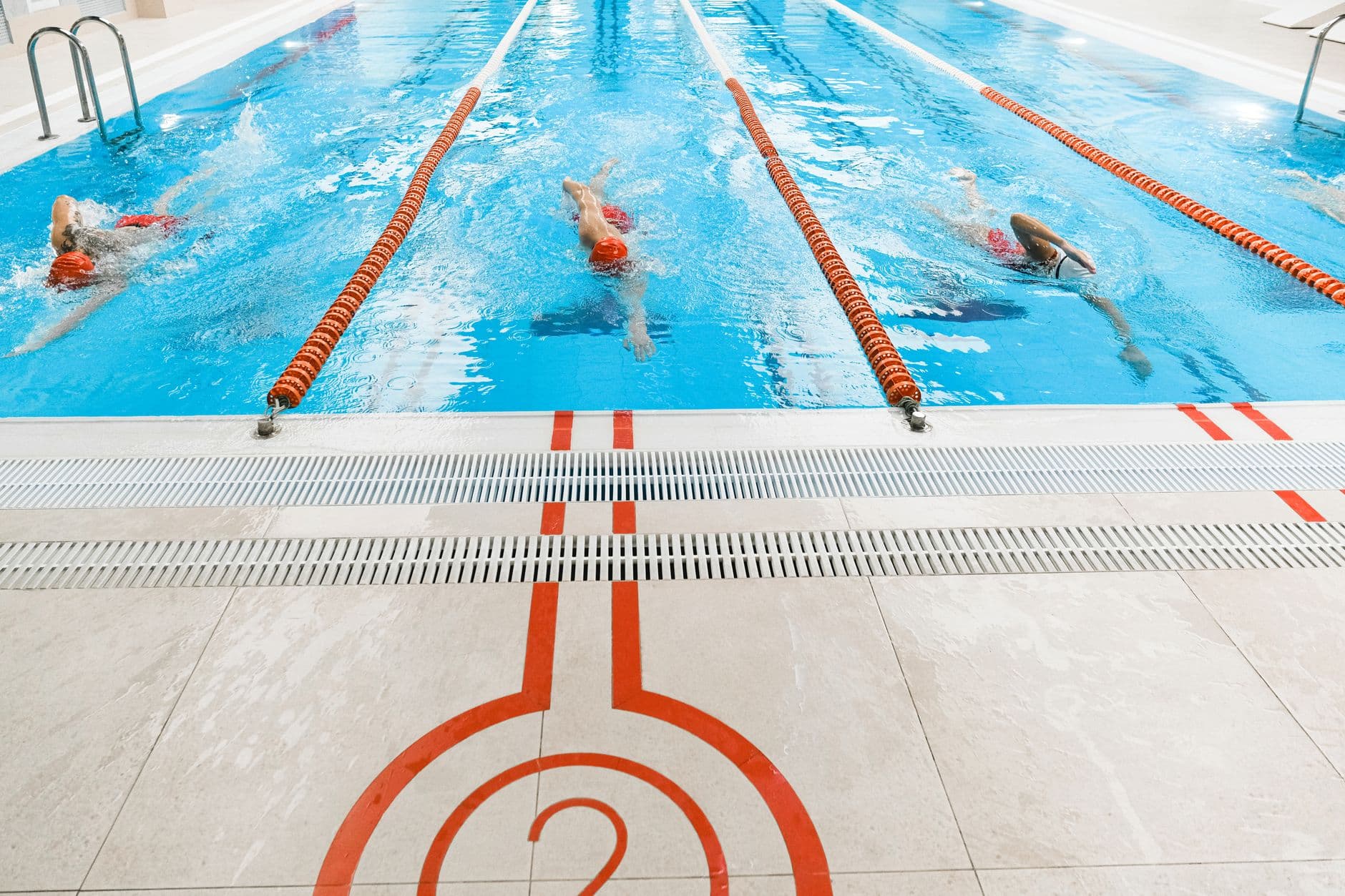
Two things are true about swimming and asthma at the same time, and most pages tell you only one of them. Swimming provokes fewer symptoms than almost any other hard aerobic exercise: in the meta-analysis of the studies that compared them head to head, running and cycling were associated with a four- to six-fold increase in exercise-induced bronchospasm compared with swimming. And the air above an indoor pool contains chloramines, which are a recognised respiratory irritant, and asthma is measurably more common in elite swimmers than in other elite athletes.
Both of those statements come from the published literature. A page that gives you only the first is selling you swimming; a page that gives you only the second is scaring you out of the water. This guide puts them side by side and then gets practical — how to warm up, what to do about breathing, which signs mean you get out, what to ask about the pool's ventilation, and how to tell whether any of it is working. It is information about what the evidence says, not a treatment plan. Your inhalers, your doses and your asthma action plan come from your doctor or nurse, and nothing here replaces them.
Swimming provokes fewer symptoms than running. Here is the number
Exercise-induced bronchoconstriction is airway narrowing brought on by exercise. It happens in a large share of people with asthma and also in some people without it. The usual explanation is the air: hard exercise means breathing large volumes through the mouth, and air that arrives cold and dry pulls water out of the airway lining. Asthma + Lung UK puts the mechanism plainly — during exercise we breathe through the mouth more than the nose, so the air is not warmed or moistened, and for some people colder, drier air makes the airways tighten.
That is exactly the variable swimming changes. The air immediately above a pool is warm and close to saturated, so the same effort costs the airway far less water. The 2008 meta-analysis by Goodman and Hays grouped the studies four ways, and the group that compared the immediate respiratory effects of different exercise found running and cycling associated with a statistically significant four- to six-fold increase in exercise-induced bronchospasm relative to swimming. That is the single strongest reason swimming keeps getting recommended, and it is a real finding rather than folklore.
Be precise about what that does not say. It compares what happens to the airways during and after a session. It is not a claim that swimming treats asthma, and it is not a promise about any one person — if cold water or chlorine is your trigger, your experience will not match the average.
The other half of the story: pool air, and asthma in elite swimmers
The same meta-analysis found something that sits awkwardly next to the paragraph above. Comparing elite swimmers with other high-level athletes, the pooled odds ratios for asthma ranged from 2.3 to 2.6, with every confidence interval excluding 1.0. Swimmers at the top of the sport have more asthma than other elite athletes, not less.
The pattern repeats wherever it is measured. A Swedish study of 101 elite-aspiring adolescent swimmers against 1,628 age-matched controls found more than double the rate of physician-diagnosed asthma — and, in the same questionnaire, the swimmers reported the best physical performance and the best mental and physical well-being of any group.
The suspected mechanism is the air, not the water. Chlorine reacts with ammonia from sweat and urine to form chloramines, and it is that combined chlorine — not the free chlorine doing the disinfecting — that produces the smell and the eye irritation at a badly run pool. Reviews of swimmers' respiratory health attribute the raised rates of rhinitis, atopy and airway hyper-responsiveness in elite swimmers to epithelial damage and increased airway permeability from that exposure, in a group training twenty or more hours a week indoors.
Why those two findings do not actually contradict each other
Three things reconcile them, and all three are in the papers themselves.
- Dose. The elite findings describe people who spend thousands of hours in indoor pool air. Two or three sessions a week is not the same exposure, and the meta-analysis found that the association with asthma was not confirmed among non-competitive swimmers — the childhood pool-use odds ratios came out below 1.0 and were not statistically significant.
- Selection. People with asthma choose swimming because it suits their airways. A cross-sectional count of asthma among swimmers cannot separate "swimming caused this" from "this is why they swim". The authors say so explicitly, and call causal conclusions premature.
- Design. Almost all of the prevalence work is cross-sectional, which establishes association and not cause. A 2026 cross-sectional study of 169 young competitive swimmers in Istanbul measured cumulative pool hours against objective markers — exhaled nitric oxide, epithelial permeability proteins, bronchial reactivity — and found no association between cumulative chlorinated-pool exposure and allergic disease or airway inflammation.
So the honest summary is this: the pool environment is a plausible occupational-scale risk for people training at an elite volume, the evidence that it harms recreational swimmers is weak, and swimming remains the exercise that provokes the fewest acute symptoms. All three sentences belong on the same page.
Does swimming treat asthma? What the trials in children found
This is where the sales pitch usually goes furthest beyond the evidence. The Cochrane review of swimming training for asthma in people aged 18 and under pooled eight randomised trials and 262 participants with stable asthma, ranging from mild to severe. Most programmes ran 30 to 90 minutes, two or three times a week, for six to twelve weeks.
What it found, and what it did not:
- Fitness improved, clearly. Maximal oxygen uptake rose by a mean of 9.67 mL/kg/min against usual care (95% CI 5.84 to 13.51) — rated high-strength evidence.
- Resting lung function improved modestly. FEV1 as a share of predicted rose by 8.07 percentage points (95% CI 3.59 to 12.54), rated moderate strength.
- Asthma itself did not measurably change. There was no statistically significant effect on quality of life, asthma control, exacerbations, or corticosteroid use.
- It was well tolerated. On the data available, no adverse effects on asthma control or exacerbations — in children with asthma of any severity, provided it was stable.
- It was not shown to beat other exercise. The reviewers say plainly that whether swimming is better than other forms of physical activity cannot be determined from the trials.
Read as a whole, that is a good result rather than a disappointing one. It says swimming is safe in stable asthma and makes you fitter, which is the reason to do it. It does not say swimming is a treatment, and a page that tells you it is has gone past the evidence. Broader reviews of exercise and asthma land in the same place: routine exercise is safe in children and adults with asthma and tends to improve symptoms and quality of life, with less consistent effects on lung function and airway reactivity.
Warm up the way the research says, not the way you were told
The standard advice is to start gently and build up. For exercise-induced bronchoconstriction, the systematic review of pre-exercise warm-ups does not support that version. Across seven randomised studies, the warm-ups that consistently blunted the post-exercise fall in FEV1 were high-intensity interval warm-ups (mean difference −10.6%, 95% CI −14.7 to −6.5) and variable-intensity warm-ups that mixed easy work with short very hard efforts (−10.9%, 95% CI −14.37 to −7.5).
Continuous warm-ups at a single pace — whether easy or hard throughout — had point estimates of similar size but confidence intervals so wide that they crossed zero, so the review could not conclude they worked. The consistent protection came from variation, not from gentleness.
In a pool that translates into something simple: after easy swimming, add a handful of short, genuinely fast efforts with full recovery before the main set. Our swim warm-up guide has the structure; the change for asthma is to make sure some of those efforts are short and hard instead of a flat 400 at one pace. If they bring on symptoms rather than preventing them, that is information for your next asthma review, not something to push through.
Breathing, and the one thing you must not do
Two breathing points matter and they pull in opposite directions.
The first is nose breathing, which only applies out of the water. The reason exercise dries the airway is mouth breathing, so breathing through the nose on the walk in, on the pool deck and during rest intervals warms and moistens the air for free. In the water, with your face down and a stroke to time, you will breathe through your mouth and there is nothing to be done about it — which is the other reason the humid air above the pool matters so much.
The second is the thing nobody should write and plenty of pool culture still does: do not do breath-holding sets, hypoxic sets or any drill built on taking fewer breaths. Deliberate hyperventilation followed by underwater breath-holding can cause blackout without warning in anyone, which is why lifeguarding bodies have moved against it, and with asthma you are adding that to airways that may narrow unpredictably. If you want to work on breathing, work on the pattern — bilateral breathing, exhaling fully into the water, getting the head position right. Our guide to breathing in freestyle covers the mechanics, and what swimming does and does not do to lung capacity covers what to expect from it.
Never swim alone, and swim where there is a lifeguard. That holds for everyone, and it holds harder when a predictable trigger is in play.
Your inhaler and your session: the line this page does not cross
The American Thoracic Society's clinical practice guideline on exercise-induced bronchoconstriction makes a strong recommendation for using a short-acting bronchodilator before exercise in all patients with EIB, and for people who still have symptoms despite that, strong recommendations for adding a daily inhaled corticosteroid, a daily leukotriene receptor antagonist, or a mast cell stabiliser before exercise. That is what the guideline says. Which medicine, which dose and how long before you get in are prescribing decisions, and they belong to the clinician who knows your history. We are not going to put a timing in minutes on this page, because the right answer differs by drug and by person.
What is yours to act on:
- Take your reliever inhaler to the pool and keep it where you can reach it — on the deck with your towel or in your bag at the end of the lane, not in a locker at the other end of the building.
- Tell the lifeguard, and tell whoever you swim with. One sentence at the desk is enough.
- Treat exercise symptoms as a reason to book a review. Asthma + Lung UK is blunt about this: for most people, exercise triggering asthma is a sign the asthma is not as well controlled as it could be. Needing extra reliever doses to get through a session is a reason to see your GP or nurse, not a normal cost of swimming.
- Use your preventer every day if you are prescribed one. It is what makes airways less reactive to the triggers you meet when you exercise.
Warning signs that mean you get out of the water
Get out — not "swim easy to the end of the set" — if any of these appear:
- Wheeze, a tight chest or a cough that starts in the water and does not settle when you stop.
- Breathlessness that is out of proportion to the effort, or that keeps building after you stop swimming.
- Any need for your reliever inhaler mid-session.
- Difficulty speaking a full sentence.
- Lips or fingertips turning blue, or feeling faint or confused.
An asthma attack needs emergency treatment. Follow your own asthma action plan, and if symptoms do not improve as that plan expects, if you start to feel worse at any point, or if you do not have your inhaler with you, call the emergency number for your country — 999 in the UK, 911 in the US, 000 in Australia. The NHS asthma page sets out exactly what to do during an attack, including the specific situations that mean calling an ambulance. Do not drive yourself to hospital.
Separately, note that a cough that only shows up after swimming, every time, is a specific complaint worth describing to your clinician in those words. It may be your asthma under-treated, it may be a reaction to the pool air, and the two have different answers.
A respiratory infection changes this calculation, and not only for people with asthma: swimming with a cold sets out the above-the-neck rule, the limits of the evidence behind it, and what indoor pool air does to an airway that is already irritated.
What to ask about the pool before you pay for a membership
You cannot control the water chemistry, but you can choose where you swim, and the choice is not arbitrary. Chloramines are produced when chlorine meets ammonia from sweat and urine, so the air quality above a pool depends on bather hygiene, water chemistry and — above all — ventilation. In the United States the CDC's Model Aquatic Health Code requires indoor aquatic facility air handling systems to comply with ASHRAE Standard 62.1-2019 on ventilation for acceptable indoor air quality. It is a model code, which means it carries weight only where a state or county has adopted it, but it is the benchmark a well-run facility will recognise.
Practical, in rough order of usefulness:
- Trust your nose, and read it correctly. A strong "chlorine" smell is a sign of chloramines, not of good disinfection. A well-run pool smells of very little.
- Ask about the air handling, not the chlorine level. "What standard is the ventilation designed to, and when was it last serviced?" is a question a competent operator can answer.
- Ask when the pool is quietest. Fewer swimmers means less ammonia and less chloramine.
- Try an outdoor or a 50 m pool if you have the choice. Outdoors the chloramine question largely disappears, and a big-volume long-course pool is better ventilated by its own geometry. The difference between short and long course affects your times too.
- Shower before you get in. It is the cheapest contribution anyone makes to the air everyone else breathes.
Our guide to what chlorinated water does to skin and hair covers the same chemistry from the other direction.
Children with asthma in the water
The trial evidence summarised above is almost entirely about children and adolescents aged 5 to 18, which makes this the best-evidenced group on the page: in stable asthma, supervised swimming training was well tolerated, improved fitness substantially and did not worsen asthma control.
What changes in practice is the logistics rather than the principle. The inhaler goes with the child to the poolside and the coach or teacher knows where it is and that it exists — not in the changing-room locker. The child needs to know it is allowed to stop, which is a surprisingly large barrier in a group lesson where everyone else is still swimming. Lesson sets should have real rest between efforts rather than continuous swimming, which happens to be good coaching anyway. And an indoor pool with poor air is worse for a child than for an adult, because children breathe more air per kilogram of body weight.
Asthma is not a reason to delay learning to swim, and swimming competence is a water-safety matter with its own urgency. See what age to start swim lessons and how to teach a child to swim for the sequencing, and tell the swim school about the asthma at sign-up rather than on the first day.
Open water, the sea and cold water
Open water removes the chloramine problem and introduces two others. Cold air over cold water is the classic trigger — the exact combination the humid air of an indoor pool protects you from — and cold-water immersion produces a gasp reflex and uncontrolled hyperventilation in the first minute for everyone, trained or not. Those two interact badly, and the evidence base for cold-water swimming specifically in asthma is thin enough that anyone claiming a confident answer is overreaching.
If you are going anyway, make it graduated: a supervised venue with safety cover, a long slow entry rather than a jump, a wetsuit and neoprene cap to blunt the cold shock, short first swims parallel to the shore, and a companion who knows what your plan says. Our first open water swim guide has the full progression. The sea is sometimes said to help asthma because of the salt air; that is a hypothesis, not an established result, so treat it as a preference rather than a therapy.
How to tell whether it is working
"I feel better" is worth something, but it is also the thing that drifts. Two measurements are enough, and both already exist on this site.
The first is pace at a fixed effort. Swim a critical swim speed test — a timed 400 and a timed 200 — once a month and watch the number. If your CSS pace is improving, your aerobic fitness is improving, which is exactly the outcome the trials measured as VO2 max. The second is how a known set feels: the same main set at the same target pace should cost less over a few weeks. Our guide to heart rate zones in swimming explains why heart rate alone is a poor judge in the water.
Two cautions on interpreting it. Do not chase fatigue: in asthma a hard session that ends in symptoms has cost more than it bought, and whether to swim every day is the wrong question compared with whether each session finishes well. And if your own sense is that progress has stopped while your reliever use has crept up, that is a clinical signal rather than a training one — the fix is an asthma review, not a harder set.
Where the evidence runs out
Being straight about the limits is part of the answer here. The acute comparison — swimming provoking less bronchoconstriction than running — is solid. The fitness benefit in children with stable asthma is solid. The raised asthma prevalence among elite swimmers is a consistent finding but almost entirely cross-sectional, so cause remains unsettled and at least one recent study with objective airway markers found no association with cumulative pool exposure. The warm-up finding comes from seven small trials. And for recreational adults specifically, there is far less data than the confidence of the internet suggests.
None of that changes what to do on Tuesday evening. Swim, in a pool that smells of nothing, with your inhaler on the deck, after a warm-up with some short fast efforts in it, with a lifeguard present, and stop when your body says stop. Then take anything that does not fit to the person who prescribes your medicines.
Frequently asked questions
Does swimming make asthma worse?
For recreational swimmers, the evidence does not show that. Swimming provokes less exercise-induced bronchoconstriction than running or cycling, and randomised trials in children with stable asthma found no worsening of asthma control. The raised asthma rates measured in elite swimmers involve thousands of hours in indoor pool air, and that association has not been confirmed in non-competitive swimmers.
Is swimming good for exercise-induced asthma?
It is usually the best-tolerated hard aerobic exercise, because the warm, humid air above a pool costs the airways far less water than cold, dry air does. In the pooled comparisons, running and cycling produced four to six times more exercise-induced bronchospasm than swimming. That is about provoking fewer symptoms, not about treating the asthma itself.
Is swimming good for children with asthma?
The randomised evidence is mostly in children aged 5 to 18, and it is reassuring: swimming training was well tolerated in stable asthma, raised maximal oxygen uptake substantially and improved resting lung function, with no measured harm to asthma control. It did not improve asthma control either. Tell the swim school, and keep the inhaler at the poolside.
Why do I cough after swimming?
A cough that appears reliably after swimming has two common explanations with different answers: asthma that is not fully controlled, and irritation from chloramines in indoor pool air. Describe it to your clinician in exactly those terms, including whether it happens at every pool or only one. Needing your reliever during sessions is a reason to book a review.
Can I do breath-holding or hypoxic sets if I have asthma?
No. Deliberate hyperventilation followed by underwater breath-holding can cause blackout without warning in anyone, which is why lifeguarding bodies advise against it, and asthma adds airways that may narrow unpredictably. Work on breathing pattern instead: bilateral breathing, a full exhale into the water and head position. Never swim alone, and swim where there is a lifeguard.
Sources
- An official American Thoracic Society clinical practice guideline: exercise-induced bronchoconstriction (Parsons et al., 2013) — American Journal of Respiratory and Critical Care Medicine
- Swimming training for asthma in children and adolescents aged 18 years and under (Beggs et al., 2013) — Cochrane Database of Systematic Reviews
- Asthma and swimming: a meta-analysis (Goodman and Hays, 2008) — Journal of Asthma
- Effect of warm-up exercise on exercise-induced bronchoconstriction (Stickland et al., 2012) — Medicine and Science in Sports and Exercise
- Asthma is more prevalent in elite swimming adolescents despite better mental and physical health (Romberg et al., 2012) — Scandinavian Journal of Medicine and Science in Sports
- Prevalence and characteristics of asthma in the aquatic disciplines (Mountjoy et al., 2015) — Journal of Allergy and Clinical Immunology
- The respiratory health of swimmers (Bougault et al., 2009) — Sports Medicine
- Allergic diseases and atopy in elite swimmers: a cross-sectional study (Unal et al., 2026) — European Journal of Pediatrics
- The impact of exercise on asthma (Lang, 2019) — Current Opinion in Allergy and Clinical Immunology
- Exercise, physical activity and asthma — Asthma + Lung UK
- Asthma — NHS
- Model Aquatic Health Code, section 4.6.2 (indoor aquatic facility ventilation) — Centers for Disease Control and Prevention
- Guidelines for Safe Recreational Water Environments, Volume 2: Swimming Pools and Similar Environments (2006) — World Health Organization
Read next
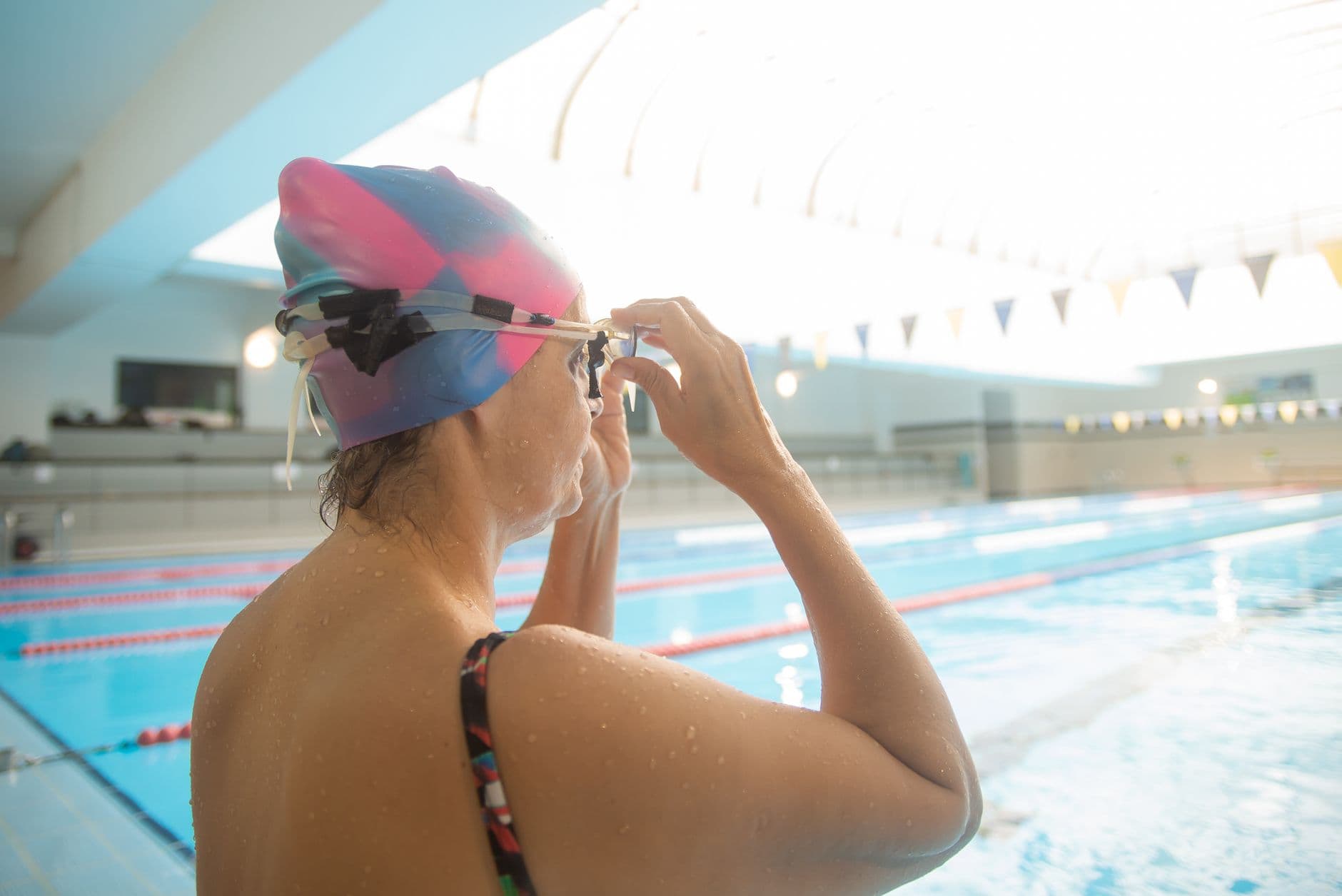
Can you swim with a cold? The neck check, and when to stay out
A head cold without fever is usually fine to swim through. A fever is not. The rule sports medicine uses, how thin the evidence is, and what changes in a pool.
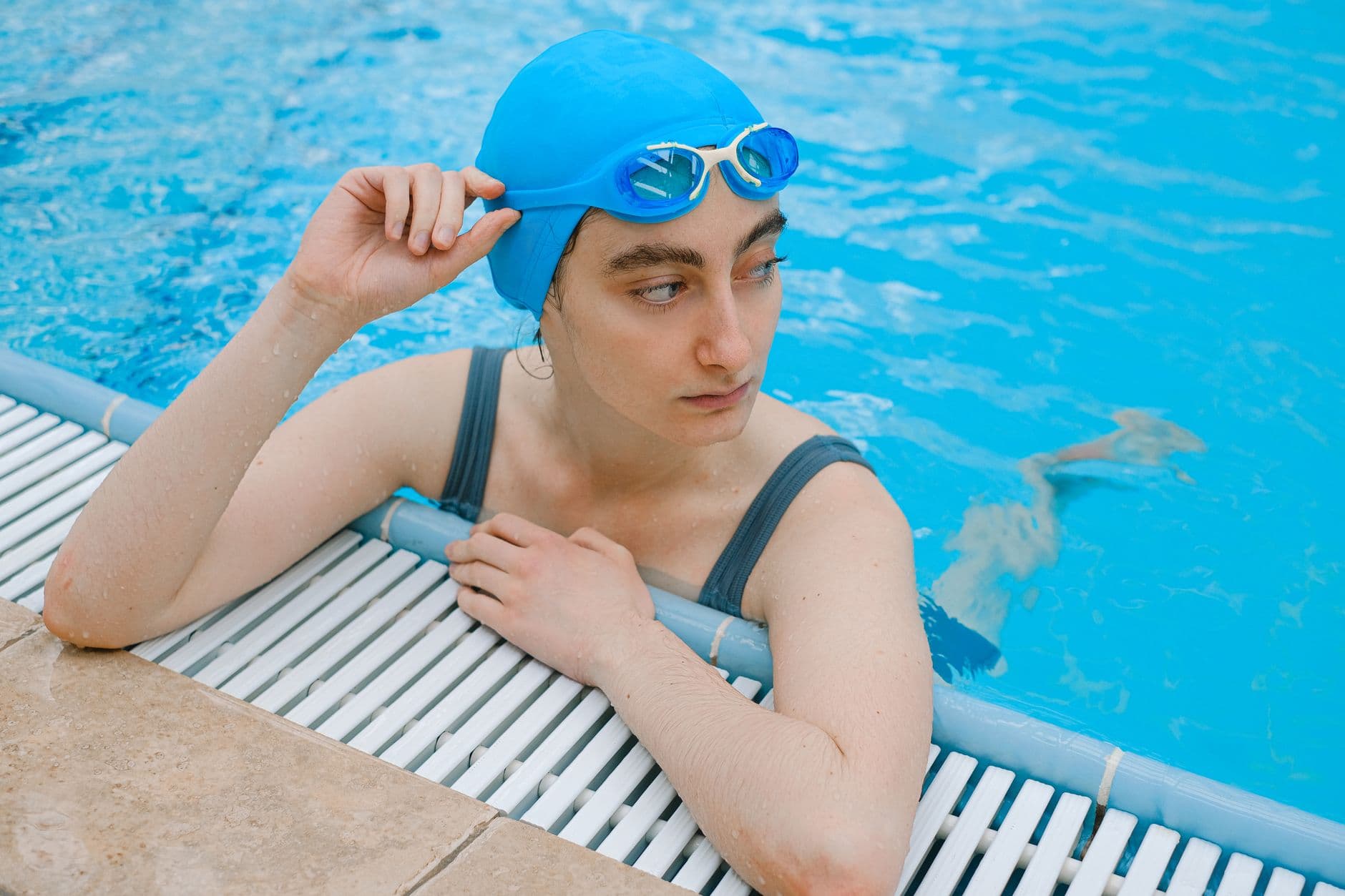
Swimming on your period: what actually works in the water
Yes, you can swim. Which products hold in water and which fail, the FDA's 8-hour tampon rule, what the pool rules really say, and the shark question answered.
Does swimming build muscle, or is it just cardio?
Swimming loads your muscles, but the load drops the moment you slow down. What the trials actually measured, where swimming does add muscle, and what to add.
SwimFast is an independent publication. We are not a swim school, a coaching service or a governing body, and nothing here is medical advice. Training paces and test protocols are cited from the published research or federation documents linked on each page. Never swim alone, never attempt breath-hold work without supervision, and check with a doctor before starting a new training programme.