Sighting: how to swim straight without wrecking your stroke
Without a line on the floor most swimmers curve and add distance. Lifting the head fixes the steering and sinks the legs, so the trick is doing it briefly and often.
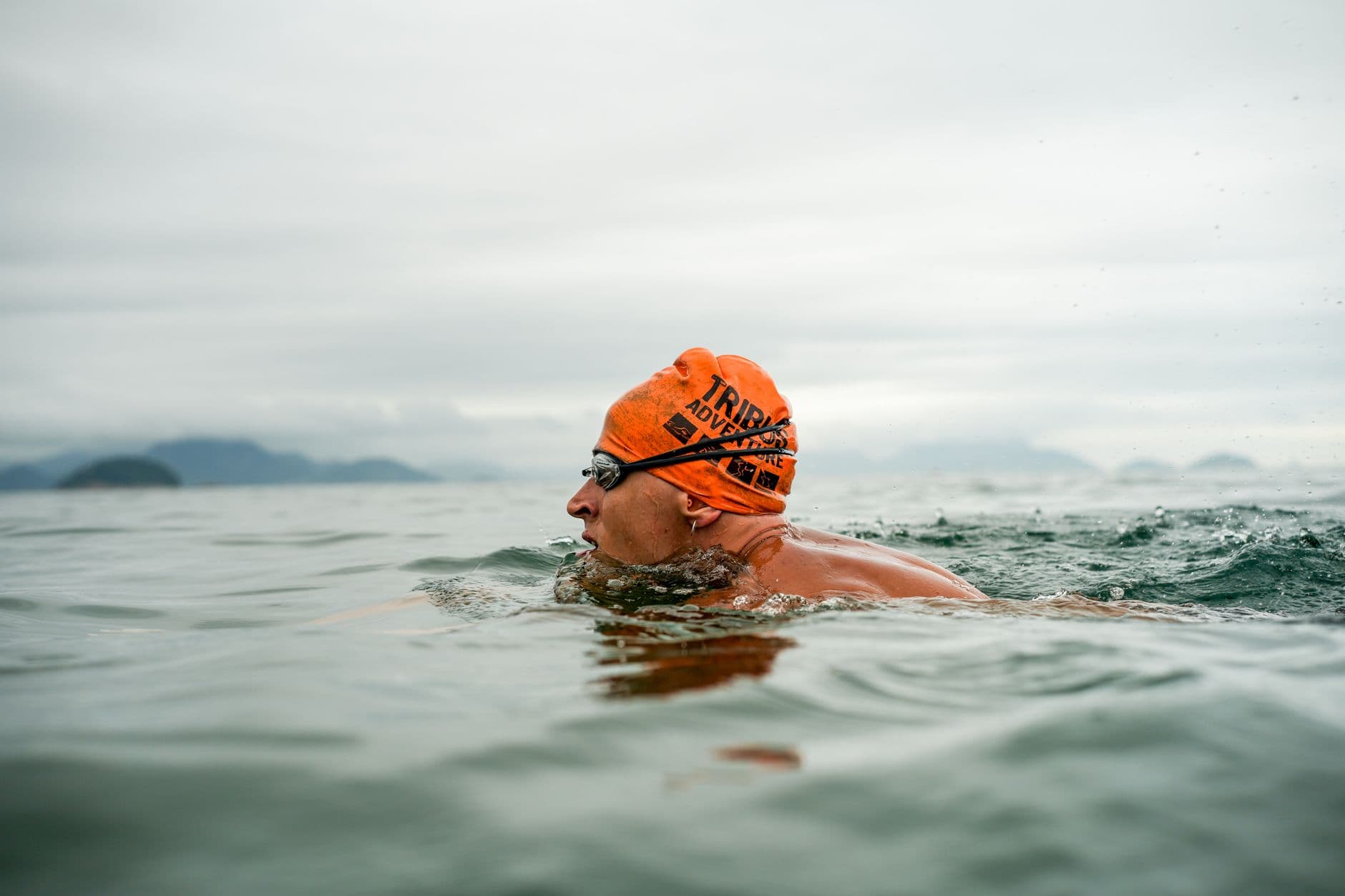
Take a competent pool swimmer, put them in a lake, and something strange happens: they swim a long, elegant curve and arrive somewhere they did not intend. The stroke is fine. The steering was never installed.
Why you curve
In a pool you steer constantly and never notice. The black line is directly under your face, the lane ropes are in your peripheral vision, and you make dozens of tiny corrections per length without any of them reaching your attention.
Take the line away and whatever asymmetry your stroke has — one arm entering wider, one pulling deeper, a body roll that is bigger to one side — is no longer being corrected. Over four hundred strokes, a bias of a fraction of a degree per stroke becomes a wide arc.
The extra distance is not trivial. A swimmer who curves enough to add ten per cent to a 1,500 m swim has swum an extra 150 m, which is a bigger performance loss than almost any technique fault you could name. No improvement to your catch is going to recover 150 m, and no amount of fitness makes swimming further than everyone else a good idea.
So sighting is not a safety extra. In terms of finishing time, it is often the highest-value skill an open water swimmer has.
What sighting costs
Every time you lift your head, the front of your body rises and — because a body in water pivots around its centre — your hips and legs drop.
That is exactly the drag problem described in why your legs sink when you swim, deliberately induced. A low-legged body position presents a much larger cross-section to the water, and you pay for it in the strokes that follow, not just during the lift.
Which produces the central trade-off of this article: you have to sight to swim straight, and sighting slows you down. Everything below is about making each look as cheap as possible.
The other half of the bill is the distance a bad line adds. The triathlon swim calculator prices that up for a race distance: over a 1,500 m swim, wandering 5 % further than the course is an extra 75 m, which is a minute and a half most swimmers never realise they spent.
A wetsuit changes the first half of that bill, not the second. Most of its lift arrives at the hips and legs, so it follows from the mechanics that the drop after each look should cost less in a suit — a reasonable inference, not something we have found measured. It does nothing for the line you swim. When you actually need a wetsuit covers the temperature rules, and why a suit that squeezes your chest is a risk rather than a speed trick.
The technique, in one sequence
The efficient version is a small addition to a stroke you already have, not a separate movement.
1. Press down at the front. As your leading hand begins its catch, press slightly downward. That pressure lifts the head for you, which means your neck is not doing the lifting.
2. Lift the eyes only to the waterline. Goggles just clearing the surface, like a crocodile. You do not need to see the shape of the buoy; you need to see roughly where it is. This is the single biggest difference between cheap sighting and expensive sighting.
3. Look, do not study. A fraction of a second. If you did not see it, take another look in three strokes rather than holding this one for longer.
4. Face back in, then breathe to the side. Two separate phases. Trying to combine the forward look and the breath into one movement forces the head much higher and holds it there twice as long.
The whole thing should feel like a small interruption to the front of one stroke, not a change of position.
How often
The instinct is to sight rarely, because each one costs something. That is the wrong optimisation, because the cost of being off line compounds while the cost of a look does not.
A reasonable default is every six to ten strokes in open water with a clear landmark. Increase the frequency when the situation is less forgiving:
In chop, because you may not see anything on a given look and you need more attempts.
Near a turn buoy, where a small error becomes a large one and everyone else is converging on the same point.
In a crowd, where you can be pushed off line without noticing.
When you are tired, because stroke asymmetry increases with fatigue and so does drift.
Two quick, low looks are almost always cheaper than one high, long one. That is the practical rule.
One refinement worth adding once the basic movement is comfortable: sight on the same side of your breathing cycle every time, so it becomes part of a rhythm rather than a decision you make repeatedly. A stroke pattern you do not have to think about is one that survives fatigue.
The three ways people get it wrong
Almost every expensive sighting technique is one of these.
The full head lift. Chin clear of the water, eyes well above the surface, a proper look around. It gives you excellent information and it stops you dead, because the hips drop far enough that the next two strokes are spent recovering the body position rather than moving forward. If you finish a swim with a sore lower back or neck, this is usually why.
Sighting and breathing at once. Lifting the head forward and rotating for air in a single movement. It feels efficient because it is one action instead of two. It is not, because the head has to go higher to do both and stays up for longer.
Sighting only when worried. Ten minutes of head-down swimming, then a long anxious look around, then a correction. The corrections are large, the looks are expensive, and the line is worse than if you had glanced every eight strokes.
All three come from the same instinct: treating sighting as an interruption to swimming rather than as part of it. The fix is frequency, not effort.
Pick the right thing to aim at
Most people aim at the buoy, which is the smallest and hardest-to-see object available and sits at water level, exactly where the chop is.
Before the swim, from the shore, find something large, high and behind the buoy: a building, a hill, a distinctive tree, a headland. Aim at that, and use the buoy only for the final approach.
Two cautions. Check whether your landmark is likely to still be there and still be visible — a boat is a bad landmark. And be careful with the sun: swimming into it can make a landmark disappear entirely, which is one reason being able to breathe to either side matters, as covered in bilateral breathing.
Fixing the drift itself
Sighting corrects your line. It does not fix the reason you needed correcting, and if the underlying asymmetry is large you will spend the whole swim steering.
The usual causes are worth checking in the pool, where you can see them. A crossover, where one hand enters past the centre line of your body, pushes you sideways with every stroke. An uneven pull, where one arm goes deeper or wider, does the same. And uneven rotation, common in swimmers who breathe only to one side, produces a stroke that is genuinely different on each side.
That last one is the most fixable and the most often ignored, which is the argument for learning to breathe both ways set out in bilateral breathing. It is not about the breathing; it is about the symmetry that comes with it.
Reducing the drift means you can sight less often, which means the whole thing costs less. It is the higher-leverage fix, and it happens in the pool where you can actually see what you are doing.
Practising it where it is safe to be bad at it
The pool is the right place to learn this, for the obvious reason that you can measure it.
The cost test. Swim 4 × 50 m normally and record times and stroke counts. Then 4 × 50 m sighting every six strokes, same effort. The difference is what your sighting technique costs. Work on the technique until that gap shrinks.
Eyes-closed lengths. In a quiet, empty lane, swim a length with your eyes shut and see where you end up. It is the fastest way to discover which way you drift and how much. Do this only with a clear lane and someone aware of what you are doing.
Sighting into a fixed point. Pick something at the end of the pool above the water and sight to it, so you are practising finding a target rather than just lifting your head.
Expect the pool version to feel artificial. The line is still there, you know where the wall is, and there is no chop. What you are training is the movement pattern, so that in open water your attention is free for the things that actually need it.
Then take it outside, where the first priority is not speed. Open water has failure modes the pool does not, and they are covered in your first open water swim — including the finding that swimmers cannot reliably judge their own condition once acclimatised.
If the swim is part of a race, the specifics are in swim training for triathlon. The rest of the stroke work is in technique.
This is general technique information rather than open water safety training. Never treat better sighting as a substitute for swimming supervised, close to shore and with company. Spotted an error? Tell us and we will correct it and date the change.
Frequently asked questions
How often should I sight?
More often than feels necessary, and briefly each time. Every six to ten strokes is a reasonable default in open water with landmarks; more often in chop, near a turn buoy or in a crowd. Two short looks are cheaper than one long one because the cost is in how far the head rises and how long it stays there.
Why do I always drift to one side?
Most swimmers do, and it is usually a stroke asymmetry — one arm pulling wider or deeper than the other, often on the side you breathe to. In a pool the line on the floor hides it because you correct constantly without noticing. Without the line, the same small imbalance compounds over hundreds of strokes.
Should I look forward or breathe first?
Look first, then breathe. Lifting the eyes forward and then turning to the side for air spreads the movement across two phases and keeps the head lower overall. Trying to look forward and breathe in the same motion is what produces the high, upright head position that stops you dead.
What if I cannot see the buoy?
Use something bigger. A building, a hill, a tree line or the sun's position is often easier to find than a small buoy in chop, and you can check the buoy less frequently. Working this out before the swim, from the shore, is worth five minutes.
Can I practise this in a pool?
Yes, and you should. Swim lengths with a sight every six strokes and compare your time and stroke count with a normal length. That difference is what sighting costs you, and it is the number that tells you whether your technique is efficient or expensive.
Sources
Read next
Chlorine, hair and skin: what it does and what actually helps
What chlorinated pool water really does to hair and skin, why the green tint is copper rather than chlorine, and which protective steps have evidence behind them.
Swimmer's ear: what prevents it and what is folklore
What causes swimmer's ear, which prevention advice has clinical backing, which has never been tested, and the point at which it stops being an article's problem.
Swim goggles that fog: what works and what is folklore
Fog is condensation on a lens colder than the air inside it. Which remedies have a mechanism, which are harmless folklore, and which one ends the goggles.
SwimFast is an independent publication. We are not a swim school, a coaching service or a governing body, and nothing here is medical advice. Training paces and test protocols are cited from the published research or federation documents linked on each page. Never swim alone, never attempt breath-hold work without supervision, and check with a doctor before starting a new training programme.